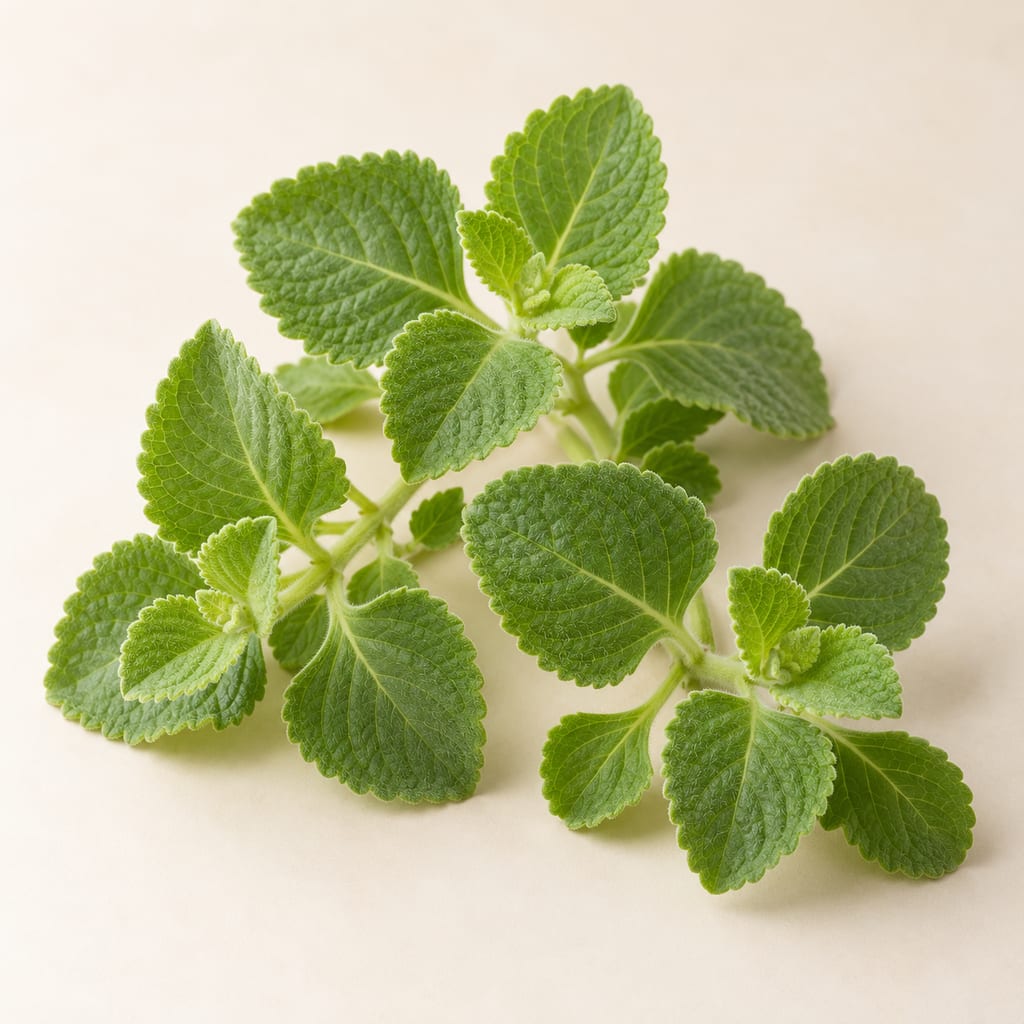
French oregano
French oregano, Coleus amboinicus, is a fleshy, strongly aromatic mint-family herb used as a seasoning in Cuba, where it is called orégano francés, and across the tropics.
 FermenteaWhere food goes to change
Spices and aromatics
A woody climbing vine in the buckthorn family, Gouania polygama is gathered for fresh stems used in Cuban pru, where it helps give the fermented botanical drink its characteristic effervescence and taste.
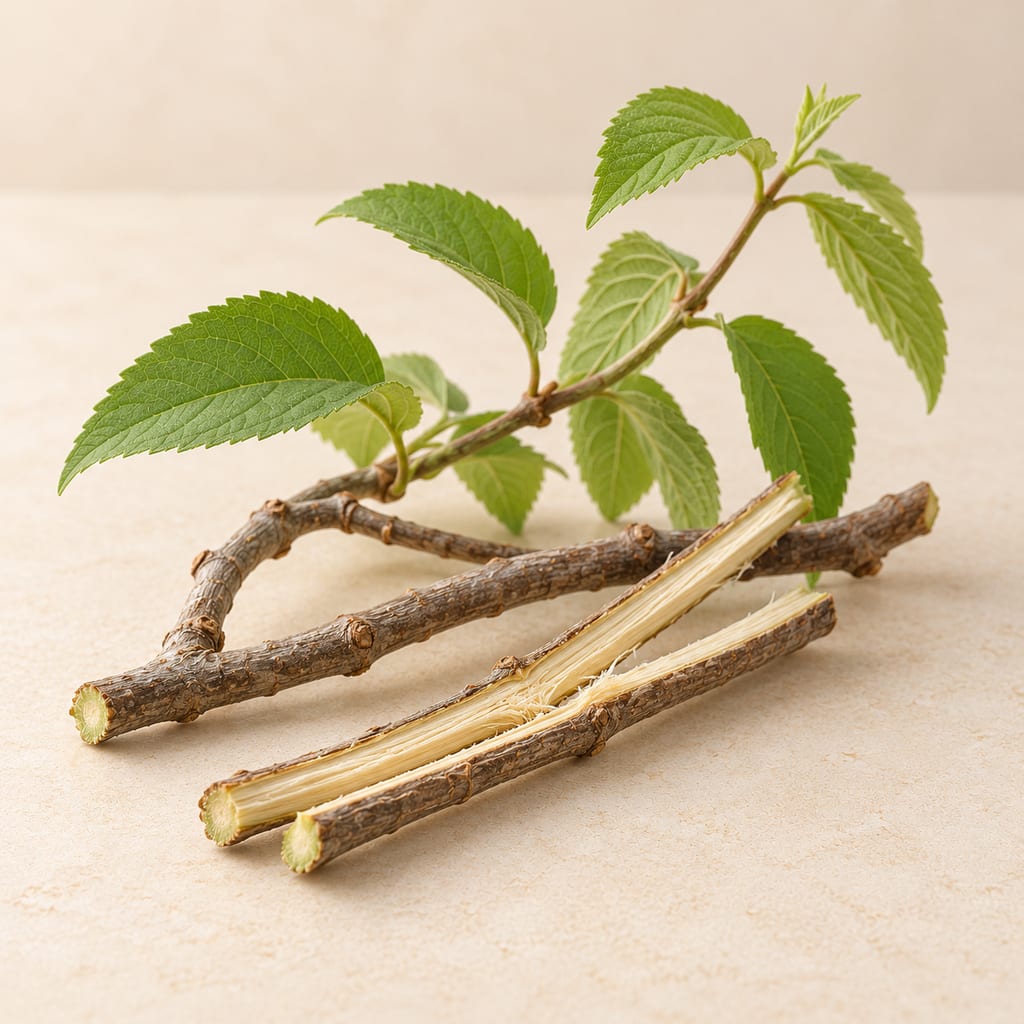
Gouania polygama (Jacq.) Urb. is an accepted species of Rhamnaceae, the buckthorn family, native to tropical and subtropical America. Cuban floristic records describe it as a woody climber; its stems weave through surrounding vegetation rather than forming a freestanding crop. The plant has alternate, broadly ovate to elliptic leaves with toothed edges. The underside is densely hairy, while the upper surface is darker; small greenish or pale flowers sit along elongated racemes, and the dry fruit separates into three winged units. These details describe the living plant, not a prepared spice.
The leaf surface helps distinguish G. polygama from its close relative Gouania lupuloides: the Costa Rican flora describes G. polygama as having a thicker leaf blade, more prominent veins and a densely pubescent underside. That is useful in botanical identification, but it does not settle every Cuban name in the market. Ethnobotanical writers report that the two congeners share several vernacular names and that G. lupuloides may be substituted for G. polygama in pru. A common name alone is therefore not a reliable species determination.
The 2004 study gives jaboncillo and bejuco de indio as the best-known Cuban names for G. polygama, alongside regional names including bejuco leñatero, bejuco de Cuba, bejuco de dientes, flor de madera, soplillo and amarrapalo. The exact taxonomic name is kept as the page title because several of these vernacular names are also applied to G. lupuloides in Cuba and elsewhere in the Caribbean. The accepted botanical name is G. polygama (Jacq.) Urb.; Rhamnus polygama is a synonym.
The authors describe pru as a family tradition in eastern Cuba and suggest a possible connection with French-Haitian migration to the island from the late eighteenth century. They present that origin as a hypothesis, not a demonstrated date for the use of this plant. They also discuss a possible Indigenous Caribbean origin for the use of Gouania in fermented drinks, but say they found no evidence to corroborate it. Their interviews document the drink's wider spread during Cuba's economic crisis in the early 1990s, when commercial soft drinks became scarce and pru making also offered income.
The documented food use is unusually specific: fresh stems of G. polygama are one of the principal botanicals in pru, a fermented Cuban refreshment. Volpato and Godínez's 2004 field study interviewed twenty pru producers and three medicinal-plant sellers, with fieldwork centred on eastern Cuba and visits to six other cities. Every producer named jaboncillo, identified in the study as G. polygama, as the main plant. One producer explained that pru could be made without the other plants but not without jaboncillo. The researchers describe its contribution as part of the drink's characteristic effervescence and taste.
Pru is a multi-plant preparation, not a drink made from this vine alone. In the study's core formulation, G. polygama is combined with a Smilax rhizome and allspice leaves; other plants appear in regional or household variations. The name pru refers to the finished sweetened, fermented decoction. This ingredient page records the vine as a raw material and does not turn the beverage's preparation into a second recipe for the plant.
The field study describes the stems as fresh material. Producers split them lengthwise into two or four pieces to expose the inner wood; some peel away the bark, while others keep it. The stems are used for a single decoction rather than boiled repeatedly. In the reported household process, the plant parts are steeped in water as it heats toward a boil, then removed and the liquid strained. Producers differ over whether to let the water boil for a further short period. Those are observations of pru practice, not a standardized preparation instruction for an unidentified vine.
The source records no dependable amount of Gouania per batch, no market grade, and no storage life for cut stems. It does not describe cultivated supply: the producers reported gathering or buying gathered plants, and some collected Gouania themselves. Freshness matters in the documented method, but the article supplies no validated holding temperature or number of days. Drying, freezing or keeping the stems for later decoctions would be unsupported additions.
Pru makers describe the ingredient through what it does in the drink: it contributes to effervescence and flavour. Their accounts are also practical and sensory. Some prefer the bark with the stem; others remove it because they say it produces excessive foam and bitterness. An excess of G. polygama is reported to make the drink gelatinous. These are differences in the finished beverage that the field researchers recorded, not measured dose limits or evidence that a particular quantity is safe.
The chemistry behind this role remains uncertain. Saponins are known from the stems of G. lupuloides and from other Rhamnaceae used in foaming drinks, and they can form foam in water; that is a plausible comparison, not a chemical finding about G. polygama. Volpato and Godínez found no published phytochemical or pharmacological study of G. polygama stems or bark in their literature review. Their observations do not establish which compounds cause pru's texture, flavour or bubbles.
Kew records G. polygama as native across tropical and subtropical America, including Cuba. A Costa Rican flora account gives a broad distribution from Mexico and the Antilles through parts of South America, while Cuba's 2024 plant catalogue lists the species as a native woody climber in several Cuban vegetation types. These range records describe the plant, not the origin of pru, and do not show that it is cultivated commercially.
Volpato and Godínez describe the species as common in Cuban thickets and woodlands, often on limestone, and report that stems or branches are cut for pru. They raised concern that wider demand could pressure wild populations, but also state that no study had then measured the effect of the expanding market on the plants. Their evidence supports careful distinction between a plausible harvesting concern and a demonstrated population decline. The same study notes that the plant is valued by Cuban beekeepers as a nectar source; this ecological role is another reason not to treat a wild climbing vine as an unlimited commodity.
Traditional use in pru documents a food tradition; it does not establish a safe general-purpose serving, medicinal benefit or safe way to identify a plant in the field. The available sources give no standardized dose, food-safety validation, allergen assessment or post-harvest storage guidance for G. polygama stems. The name jaboncillo is shared with other plants, and G. lupuloides is sometimes used in its place, so the species should not be inferred from a common name alone.
A 2024 review reports that toxicity research across the genus is sparse and lists G. polygama among species needing further study. Toxicity findings from other Gouania species or from a laboratory extract cannot be transferred to this plant or to a fermented beverage. The safety profile of its stems and bark is therefore not established.
A documented food-use association, not a claim that the plant originated here.
French oregano, Coleus amboinicus, is a fleshy, strongly aromatic mint-family herb used as a seasoning in Cuba, where it is called orégano francés, and across the tropics.
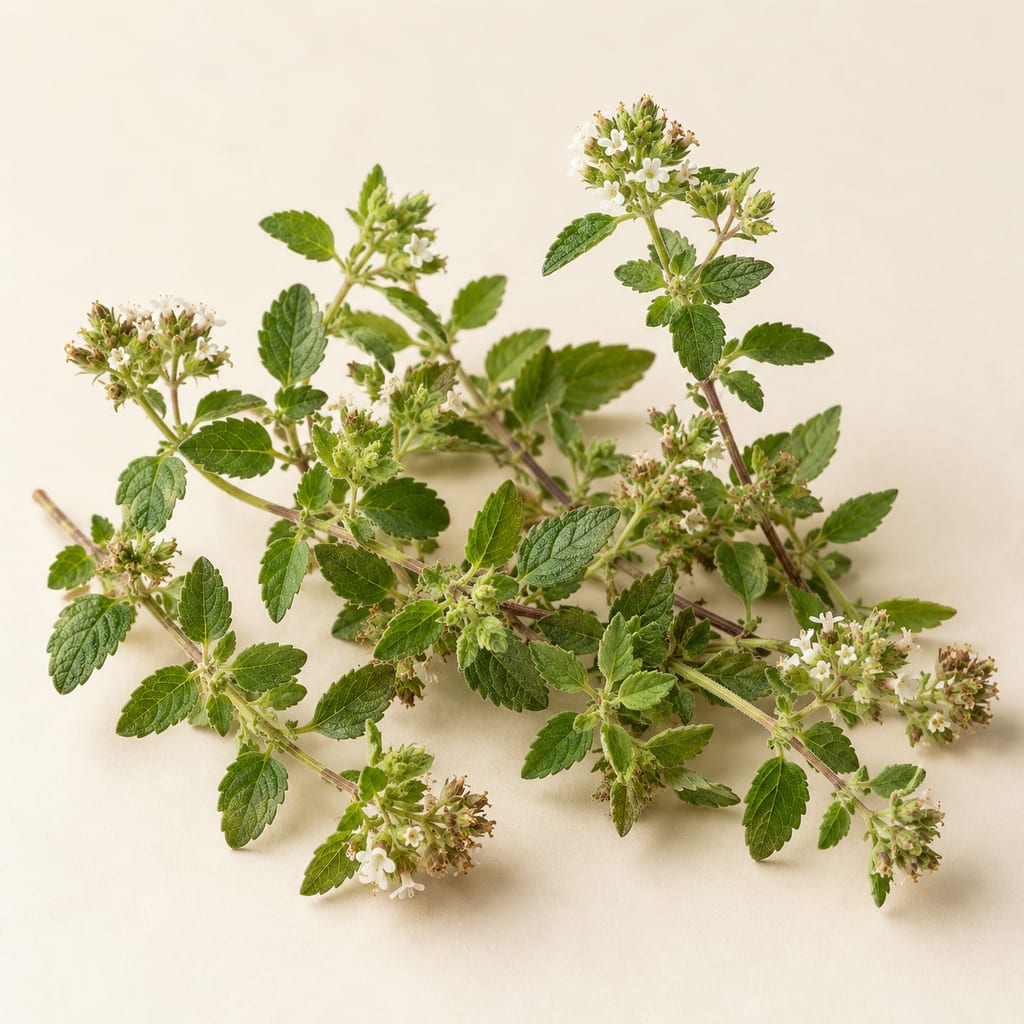
Oreganito, Lippia micromera, is a small aromatic shrub whose leaves the Flora de Cuba records as seasoning in place of oregano; no recipe, amount or method is documented.
No community contributions have been published for this entry yet.
Sign in to contribute. Published comments and photos are free to read.
Royal Botanic Gardens, Kew — Plants of the World OnlineIdentity · Geography
Gouania polygama (Jacq.) Urb.Accepted taxon, family Rhamnaceae, native range, and synonym Rhamnus polygama.
Cited in: A climbing member of the buckthorn family; Names, overlap and history; Wild sourcing and ecological context
Economic Botany 58(3), New York Botanical Garden PressIdentity · History · Culinary use · Preparation · Flavour · Ecology · Safety
Ethnobotany of pru, a traditional Cuban refreshmentField interviews and botanical identification for Cuban pru; names and shared use with Gouania lupuloides; fresh stem splitting, bark variation, one-decoction use, sensory effects; harvest and ecological concerns; absence of phytochemistry/pharmacology data for G. polygama stems and bark as reported by the authors.
Cited in: A climbing member of the buckthorn family; Names, overlap and history; Jaboncillo in Cuban pru; Fresh stems and preparation; What the vine contributes; Wild sourcing and ecological context; Safety and evidence limits
Wageningen University & ResearchHistory · Culinary use
Ethnobotany of pru, a traditional Cuban refreshmentBibliographic record and abstract confirming the authors, journal publication and broad account of pru as a Cuban decocted and fermented refreshment.
Cited in: Jaboncillo in Cuban pru
Organization for Tropical Studies, Flora Digital de la Península de Osa / Flora of Costa RicaIdentity
Páginas de Especies: Gouania polygamaLeaf morphology and diagnostic distinction from Gouania lupuloides; broad distribution reported by the flora.
Cited in: A climbing member of the buckthorn family; Wild sourcing and ecological context
Catálogo de las Plantas de Cuba / Planta! – Plantlife Conservation SocietyIdentity · Geography
RhamnaceaeAccepted Cuban taxon Gouania polygama (Jacq.) Urb., woody climbing habit, native status and Cuban vegetation contexts.
Cited in: A climbing member of the buckthorn family; Wild sourcing and ecological context
Heliyon 10(24), 2024Safety
Ethnopharmacology, phytochemistry, pharmacology and toxicity of the genus GouaniaThe review describes limited genus-wide toxicity evidence and calls for further investigation of Gouania polygama; the findings reported for other species do not establish this species' safety.
Cited in: What the vine contributes; Safety and evidence limits
iNaturalistIdentity
Gouania polygama, Viñales, CubaResearch-grade field observation and CC BY image documenting the species in Viñales, Cuba.