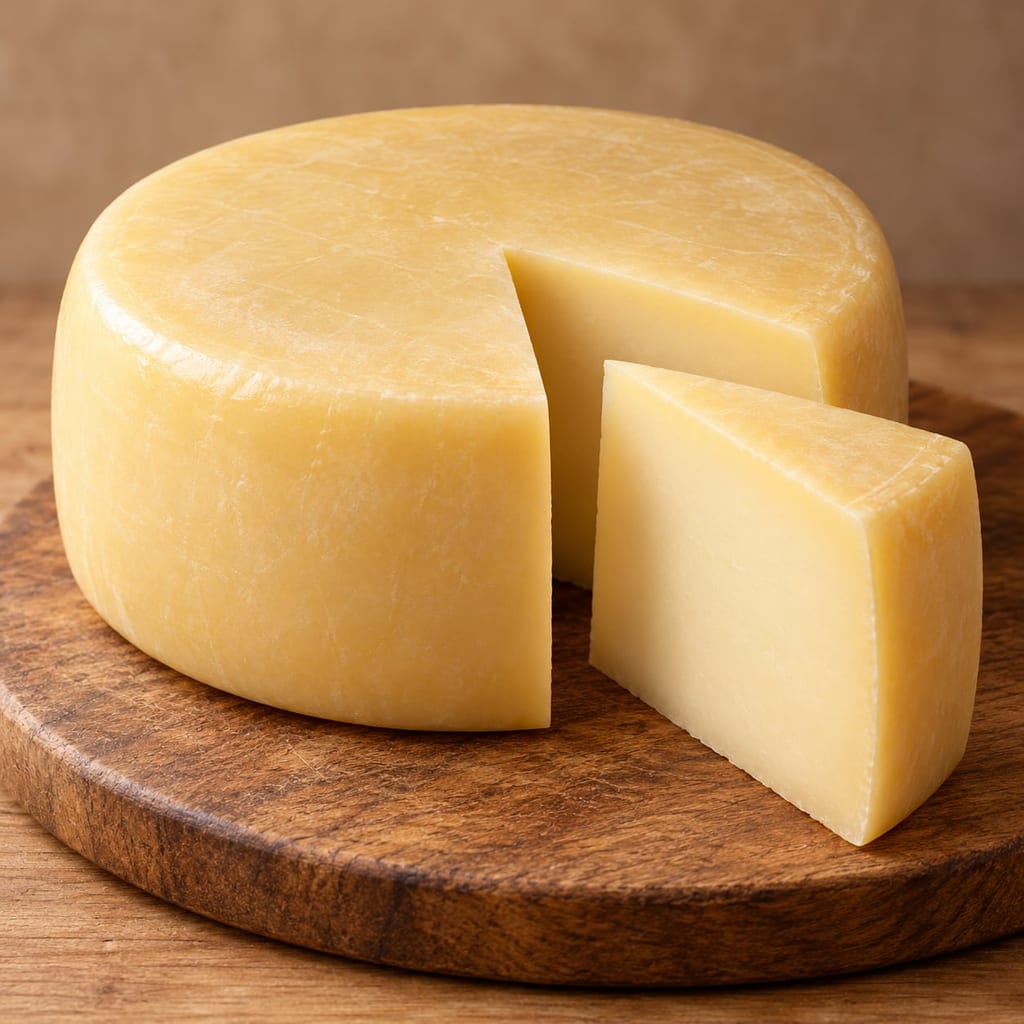
Kashkaval, traditional sheep-milk method
Kashkaval is a firm sheep-milk cheese whose acidified curd is worked in hot brine. This large-batch method finishes with repeated dry salting, wax coating and cool ripening.
 FermenteaWhere food goes to change
Cultures
An unspecified dairy starter for moderate-temperature acidification, documented in a sheep-milk Kashkaval method. The name identifies a functional temperature class, not a fixed species blend or supplied form.
Mesophilic dairy cultures contain lactic acid bacteria used for fermentations at comparatively moderate temperatures. Mesophilic describes a growth preference; it does not identify a species, a brand or a complete recipe. Cultures in this class can differ in acidification rate, aroma production and response to the conditions of cheesemaking.
The term often appears beside thermophilic, used for organisms suited to warmer fermentation conditions. These are useful practical categories, but living cultures do not share one exact boundary between working and failing. A particular preparation needs its own instructions. The category alone supplies neither an incubation setting nor a temperature that guarantees all its cells have been inactivated.
The culture here is the unnamed mesophilic addition in FAO's sheep-milk Kashkaval method. No species, strain, brand or packaging form is specified. Lactococcus lactis and other organisms discussed in dairy literature illustrate the wider category; they are not a confirmed ingredient list for this culture.
Before a culture could be ordered by a commercial name, dairy workers could carry a fermentation from one preparation into the next. Russell and Hastings's 1914 manual describes the care taken in selecting and maintaining homemade starters for ripening cream. The culture was an actively maintained part of production, with opportunities for its population to change between transfers.
Their account attributes a more selective approach to Storch's Danish work in1890. Organisms were isolated and assessed for their contribution to flavor, then favorable cultures were propagated. Liquid and dry commercial starters offered ways to supply those selections beyond the dairy that first maintained them.
This transition helps explain a modern culture's two meanings: the organisms themselves and the preparation in which they are supplied. Buying a selected culture changes how cells enter a dairy process. It does not remove the need to match their behavior to the milk, desired cheese and working conditions.
Lactic acid bacteria use milk's lactose and produce lactic acid. The resulting change in acidity alters the distribution of calcium phosphate associated with casein, the principal protein structure of rennet cheese. As the milk becomes curd, its acidification history affects the network that retains fat and moisture and subsequently releases whey.
The culture and rennet act through different mechanisms. Starter bacteria change the milk through metabolism; rennet enzymes act on casein to initiate gel formation. The two operations interact in many cheeses, but adding more of one is not a general substitute for correct management of the other.
Early acid development also helps determine which organisms persist during ripening and the conditions in which enzymes act later. The starter's contribution cannot therefore be reduced to a final sour taste. Its timing matters to the material that will be cut, drained, heated, salted and matured, even where a later stage strongly reduces living starter populations.
The documented Kashkaval process develops its curd before treating it in hot brine. FAO names mesophilic culture at the milk stage, then describes curd maturation before slicing, heating and kneading. Those are successive operations, so the culture need not remain equally active through every stage to contribute to the cheese.
Its place is the earlier fermentation that changes the curd before stretching. The later heat and mechanical work give pasta-filata cheese its stretched structure. A hot stage at the end does not by itself make the source's earlier mesophilic addition a transcription error or justify replacing it with a different modern culture.
This is one documented sheep-milk method, not a universal Kashkaval formula. FAO associates the cheese with Bulgaria and several Mediterranean production areas; that does not locate the starter's manufacture or the collection of its organisms. The culture's origin and commercial identity remain unknown, independently of the cheese's geographic associations.
Some commercial cultures are defined as a selected set of known strains. Others are maintained as more complex mixtures whose entire strain composition is not specified. Mesophilic describes neither of these approaches on its own. A temperature category and a community's degree of definition answer different questions.
White and colleagues investigated two industrial undefined mesophilic starters using genetic analysis alongside laboratory cultivation. The two cultures had different distributions of lactococcal genotypes. Results from methods based on growing organisms could also differ from genetic estimates, illustrating how the way a population is examined influences what is counted.
The same study exposed one culture to bacteriophages from dairy whey and to selected individual phages. Acidification slowed and population composition shifted. A mixed culture can therefore change function when susceptible members are affected. These were particular experimental cultures, not the FAO inoculum, but they show why two products carrying the same general category name need not be biological equivalents.
Milk contains substrates other than lactose that particular dairy organisms can metabolize. Citrate-using bacteria can direct carbon through pathways that contribute to aroma and gas formation. These capabilities are one reason a culture intended mainly for acidification can differ from a blend selected partly for its aroma contribution.
Starrenburg and Hugenholtz's experiments on Lactococcus and Leuconostoc showed that both the organism and its environment mattered. Their tested lactococci formed different products under different substrate, growth and aeration conditions. Acetoin-related metabolism was favored in some conditions; the tested leuconostocs behaved differently.
These pathways explain a practical distinction without promising one flavor from every mesophilic culture. The ability to ferment citrate is a biological trait to verify in a specified organism or commercial preparation. The word mesophilic does not itself mean buttery, aromatic or gas-producing, and it cannot establish those properties for the unnamed starter used in this Kashkaval method.
Milk protein is abundant, but bacteria cannot necessarily take up an intact casein molecule as a nutrient. Enzymes that cut protein into smaller fragments, followed by transport and further metabolism, help determine the nutrients available to a particular culture. Those systems vary between organisms and strains.
In experiments with Lactococcus lactis, Helinck and colleagues increased proteinase activity and observed a temporary increase in growth. The later response depended on which proteinase was involved. Enzyme breakdown, regulation and competition for peptide uptake contributed differently in their tested systems.
The result connects a culture's growth to more than the amount of lactose in its milk. It also distinguishes an enzyme's immediate action from the community's continuing response. It does not establish a proteinase specification for the generic culture here or support adding an enzyme to remedy slow acidification. The experiment explains one dependency of dairy bacterial growth, under its own tested conditions.
The chemistry associated with lactic acid bacteria extends beyond sugar fermentation. Bintsis's review distinguishes glycolysis, the use of sugars, from proteolysis, the breakdown of proteins, and lipolysis, the breakdown of fat. These pathways provide different starting points for flavor compounds and changes in the food's structure.
Calling all of them acid production would hide useful distinctions. Acidification changes the environment of the curd, while protein and fat transformations can supply smaller molecules for subsequent reactions. The organisms present, their enzymes and the conditions during ripening influence which transformations occur and how far they proceed.
The category lactic acid bacteria includes organisms with different metabolic capabilities. A starter chosen for one technological role does not automatically provide every possible activity attributed to the wider group. For this unspecified mesophilic culture, its documented role is a starter addition; individual flavor or enzyme claims require a more precise preparation and evidence for that preparation.
A dairy culture can arrive as a liquid, a frozen preparation or a freeze-dried powder. The supply format affects handling and how a maker introduces it, but none of these appearances identifies its microbial community. Nor does the weight of two different preparations establish that they supply equivalent amounts of active culture.
Freeze-drying aims to preserve viable cells through removal of water. Experiments by Bozoglu and colleagues found that survival varied with the organism, biomass concentration and storage atmosphere. Their tested cultures did not react identically to processing and subsequent storage.
The practical lesson is to keep the culture's specification with its physical form. A packet's current storage and dosing directions concern that preparation, while an older bulk-starter formula may describe a different concentration and route of inoculation. The FAO name does not establish a dry form, an activation schedule or a shelf life, so no such directions can be assigned from the category alone.
A bacterial culture is not necessarily supplied as cells alone. An ingredient list can include a carrier or other material alongside the organisms, and this changes what must be considered when selecting it. The active bacteria and the complete purchased preparation are related but different descriptions.
For example, New England Cheesemaking Supply Company's buttermilk starter lists several named bacteria and lactose, and its allergen table marks milk as present. That is a concrete declaration for that product. It does not identify the ingredients of every mesophilic culture and is not evidence that the FAO culture is the same blend.
For an unnamed preparation, neither a milk-free nor a vegan claim follows from the word culture. Check the exact product's current ingredient and allergen information, including any supplier clarification needed for a dietary requirement. A supplier's microorganism list alone cannot answer what else is present in the packet or how that material was handled.
Kashkaval research shows why starter activity and food safety must be considered separately. Samelis and colleagues compared craft pasta-filata curds made with different milk treatment and heating conditions. Their raw-milk curds had abundant indigenous mesophilic lactic acid bacteria, yet the study still found substantial staphylococcal contamination before stretching.
Milk pasteurization and subsequent curd heating changed the microbial picture in the studied process. The presence of lactic bacteria did not by itself describe the pathogens present, and the later stretching step could not be interpreted without its actual conditions and the earlier milk history.
The findings belong to those experimental and craft-production conditions. They do not validate the separate FAO method or establish a home heating schedule. They do explain why adding a mesophilic culture, or observing that a curd acidifies and stretches, cannot stand alone as evidence that a raw-milk cheese is safe.
Choose a preparation whose supplier identifies its cheesemaking application and explains its use in a supported method. Keep it protected from contamination and follow its current instructions for storage, inoculation and handling. The amount used in an old source should not be converted into a generic spoon measure for a modern concentrate.
New Mexico State University's cheesemaking guidance treats milk quality, hygiene and culture handling as separate parts of making cheese. CDC recommends pasteurized dairy and warns that good farm practice cannot guarantee raw-milk safety. A selected starter does not remove those responsibilities or sterilize the milk into which it is added.
No universal safe fermentation time, temperature, acidity endpoint or storage life follows from the label mesophilic culture. Sourness, aroma and a home pH measurement cannot prove safety. The existing Kashkaval recipe supplies the documented use; a fully identified culture and an appropriate supported process are still needed for practical application.
No geographic origin or manufacturing location is established for this unspecified ingredient. Recipe geography does not identify its supply.
Kashkaval is a firm sheep-milk cheese whose acidified curd is worked in hot brine. This large-batch method finishes with repeated dry salting, wax coating and cool ripening.
No community contributions have been published for this entry yet.
Sign in to contribute. Published comments and photos are free to read.
FAOIdentity · History · Fermentation function · Handling
The technology of traditional milk products in developing countries — FAO, 1990, §4.13 KashkavalOriginal sheep-milk Kashkaval method explicitly names mesophilic culture before curd maturation and hot-brine stretching; no species or form identified.
Cited in: Why a mesophilic culture can precede hot stretching
FAOIdentity · History · Fermentation function · Handling
Small-Scale Dairy Farming Manual, Volume 1, Technology Unit 10.1: Starter CulturesPages183–187: controlled souring; temperature classes, liquid/frozen/freeze-dried forms and pure/mixed cultures. No generic operating limits transferred.
Cited in: A temperature class, not one fixed blend; Manufactured form and activity are different properties
H. L. Russell; Project Gutenberg digitizationIdentity · History · Fermentation function · Handling
Outlines of dairy bacteriology, tenth edition — H. L. Russell and E. G. Hastings, 1914The 1914 tenth edition, pages 143–145, describes homemade starters and selected-culture work attributed to Storch in 1890; historical practice, not current handling advice.
Cited in: Dairies learned to carry a fermentation forward
Microbiology SpectrumIdentity · History · Fermentation function · Handling
Mesophilic and Thermophilic Cultures Used in Traditional Cheesemaking — Mark E. Johnson, 2013Origins of artisanal cultures and specialist starter production; class-level functions, not identity of FAO starter.
Cited in: A temperature class, not one fixed blend
Microbiology SpectrumIdentity · History · Fermentation function · Handling
The Basics of Cheesemaking — Paul S. Kindstedt, 2013Acidification alters casein mineral state and curd; distinction between acid and enzyme coagulation.
Cited in: Acidification prepares the chemistry of curd
Applied and Environmental MicrobiologyIdentity · History · Fermentation function · Handling
Citrate Fermentation by Lactococcus and Leuconostoc spp — Marjo J. C. Starrenburg and Jeroen Hugenholtz, 1991Original abstract: metabolites vary with organism, oxygen, growth conditions and substrates; not a test of assigned starter.
Cited in: Citrate gives some cultures another route to flavor
Applied and Environmental MicrobiologyIdentity · History · Fermentation function · Handling
The effects of adding lactococcal proteinase on the growth rate of Lactococcus lactis in milk depend on the type of enzyme — S. Helinck, J. Richard and V. Juillard, 1997Original abstract: casein degradation limited growth in tested strains; adding proteinase stimulated growth transiently.
Cited in: Protein breakdown helps support growth
Enzyme and Microbial Technology; OpenMETU author repositoryIdentity · History · Fermentation function · Handling
Survival kinetics of lactic-acid starter cultures during and after freeze-drying — F. Bozoglu, M. Ozilgen and U. Bakir, 1987Original abstract: organism, biomass and storage atmosphere affected survival; no assigned-ingredient shelf life.
Cited in: Manufactured form and activity are different properties
Applied and Environmental MicrobiologyIdentity · History · Fermentation function · Handling
A multifaceted investigation of lactococcal strain diversity in undefined mesophilic starter cultures — Kelsey White et al., 2024Two industrial cultures differed; specific phage challenges slowed acidification and changed community composition.
Cited in: A mixed culture is a population of different cells
New England Cheesemaking Supply CompanyIdentity · History · Fermentation function · Handling
Buttermilk Starter Culture — ingredients and allergen tableProduct-specific example lists lactose and milk allergenYes; not the formulation of FAO generic starter.
Cited in: Allergen information belongs to the actual preparation
New Mexico State University ExtensionIdentity · History · Fermentation function · Handling
Making Homemade Cheese — Guide E-216, revised by Nancy C. FloresProtect cultures from contamination; food-contact hygiene, milk treatment and cheese handling address separate hazards.
Cited in: Choosing a culture for a supported method
CDCIdentity · History · Fermentation function · Handling
Raw Milk — January 31, 2025Raw milk may carry pathogens; farm hygiene cannot guarantee safety; choose pasteurized dairy.
Cited in: Choosing a culture for a supported method
AIMS MicrobiologyIdentity · History · Fermentation function · Handling
Lactic acid bacteria as starter cultures: An update in their metabolism and genetics — Thomas Bintsis, 2018Review separates glycolysis, proteolysis and lipolysis and describes strain-dependent metabolic traits.
Cited in: Ripening includes several kinds of transformation
International Journal of Dairy TechnologyIdentity · History · Fermentation function · Handling
Effects of curd heating with or without previous milk pasteurisation on the microbiological quality and safety of craft-made Pasta Filata Kashkaval cheese curds — John Samelis et al., 2019Original abstract: raw-milk indigenous mesophilic LAB did not prevent high staphylococci counts; different milk treatments and heating changed microbiology. Not FAO process validation.
Cited in: A functioning starter does not settle raw-milk hazards