A community, not one organism or one mat
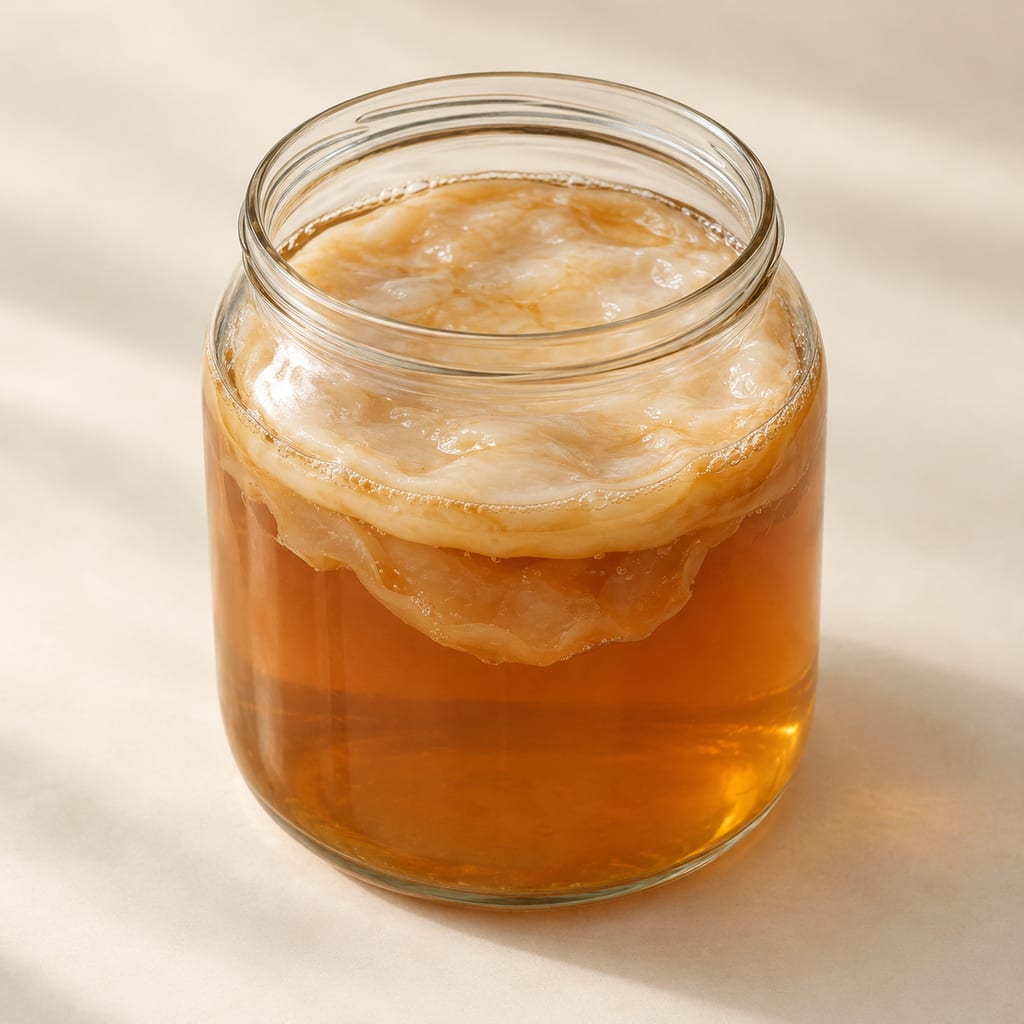
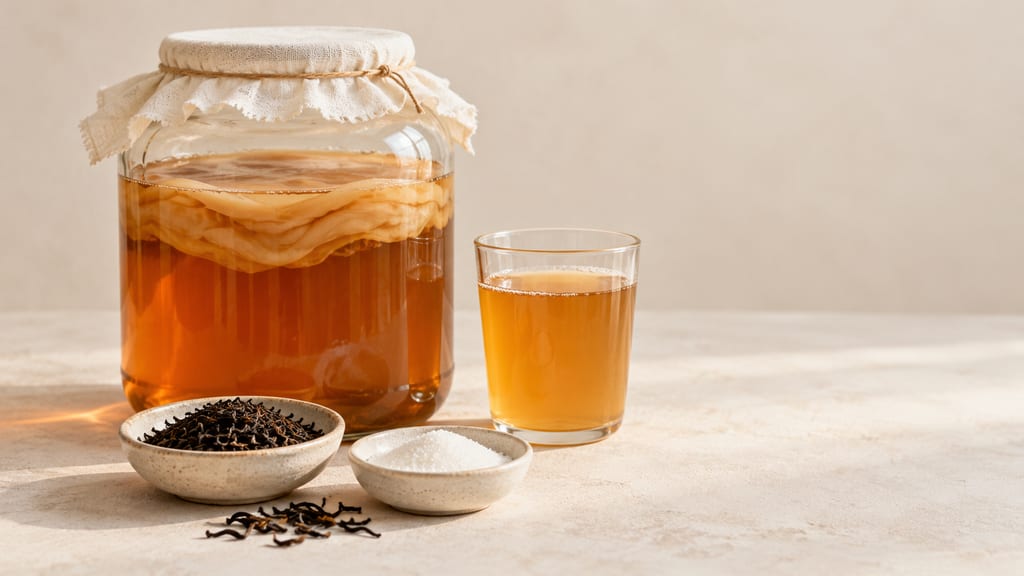
Kombucha is sweetened tea fermented by a mixed culture of yeasts and acetic acid bacteria. The word SCOBY, short for symbiotic culture of bacteria and yeast, is used for that whole community, but it is also used for the rubbery cellulose mat that floats on the surface. The two are not the same thing. The pellicle is a biofilm that the bacteria build at the point where the liquid meets the air, and the acidic liquid under it, often called starter tea, is the other half of what a brewer carries from one batch to the next.
Public-health guidance describes inoculating a new batch with liquid from the previous one, with or without a piece of the pellicle. A visible mat does not tell a brewer which microbes are present, and a culture sold or shared under one name is not a known strain.
Sources for this section
What sampling shows
Landis and colleagues sampled 23 kombucha cultures from across the United States, described the yeasts and the acetic acid bacterium in each, and then tested chosen pairings of yeast and bacteria in the laboratory. The sampled communities varied, and the pairings differed in how well they built a biofilm. Those results belong to those samples and those pairings. They do not give a species list for every home or commercial culture.
The same paper notes that how the microbes divide between the liquid and the pellicle is not fully worked out for kombucha ferments in general. A species found in one study is therefore not a fixed ingredient in the next jar. A separate Frontiers study used two-photon fluorescence microscopy to look at how the biofilm forms and is built, which adds to the picture of the pellicle as a structure and not only a by-product.
Sources for this section
From culture to drink
In the primary stage the culture works in sweetened tea, and the sources treat access to oxygen as part of that stage. Yeasts and bacteria both contribute: the community changes the sugar and the acidity of the tea and the pellicle thickens at the surface. When the drink is bottled, the conditions change. Fermentation and gas production can carry on after packaging, which is why the primary stage and the sealed stage are described separately.
A BC Centre for Disease Control guideline sets out controls for its own processing and inspection setting, and the Colorado State and Utah State extension pages give their own household methods. Each of these belongs to its context. This page does not turn them into one instruction, and it gives no recipe, pressure limit, alcohol estimate or storage period.
Sources for this section
Origin stories
The BC Centre for Disease Control background repeats an origin associated with north-eastern China and Manchuria. A 2017 ethnographic thesis from Texas State University calls the origin contested and reviews the competing later stories. No source from the period that would support the commonly repeated early date was found among those read, so this page gives kombucha no verified birthplace or route of spread.
The same thesis records one home-brewing community in San Marcos, Texas, in the 2010s. That is evidence about that community and its practice, not about where kombucha began or who owns it.
Sources for this section
What the sources do not settle
None of the sources sets a universal household rule for starting a culture, for storing it, for the alcohol a batch reaches, for bottle pressure or for what to do after contamination. Appearance, smell and taste do not show that a batch is safe, and a pellicle that looks healthy is not a safety check.
Sources for this section
Places
Unknown
Relationship not established · Place not establishedThe origin is contested and no source read establishes a place; a north-eastern China and Manchuria origin is repeated but not supported by a period source.