
Kombucha intake
Kombucha: the drink, the culture and the decisions between them
Kombucha starts as sweet tea and becomes a changing mix of sugars, acids, alcohol and gas. This guide covers its history, the culture, substrates, vessels, measurements, bottling and what health research can support.
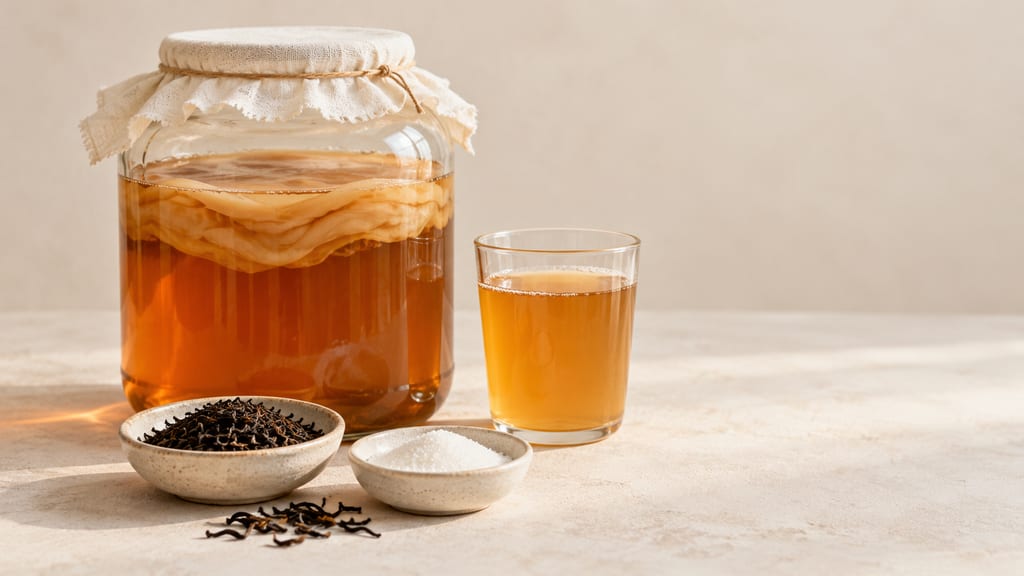
A kombucha culture floating on sweet tea in a wide glass jar, beside the tea leaves and sugar it feeds on.
Introduction
Kombucha begins as sweet tea and becomes a changing mixture of sugars, acids, alcohol, dissolved gas and microbial products. Its familiar floating disc makes the process visible, but much of the work happens in the liquid. Understanding that distinction changes how we keep a starter, compare batches and judge the claims made for a finished bottle.
The pleasure is in the drink: tea aroma against acidity, a little sweetness, sometimes carbonation. The difficulty is that several processes continue together. A batch can become more alcoholic without a corresponding change in pH. A bottle can appear clear while organisms remain active. A culture that worked well in one vessel or substrate may behave differently after repeated transfers. Good brewing therefore depends on a documented method and measurements that answer specific questions. No single appearance, flavour or number certifies the whole process.
A history with an uncertain beginning
Kombucha's precise birthplace and earliest date remain unresolved. Stories about an ancient Chinese imperial drink or a physician carrying a miraculous culture to Japan circulate widely; repetition is not evidence of an unbroken tradition. Japanese konbu-cha, made with kombu kelp, adds a naming trap. It is distinct from the sweet-tea culture commonly called kōcha kinoko, or black-tea mushroom.
The documentary trail becomes firmer in the early twentieth century. Historian Uwe Spiekermann traces Gustav Lindau's 1913 description to material sent from Courland, in present-day Latvia, through Paul Gisevius. Lindau's name Medusomyces gisevii belongs to that historical description of a peculiar community. It should not be used as the modern species name of every kombucha culture.
During a Central European fashion in 1926–1930, cultures passed between households, accompanied by therapeutic claims and commercial preparations. Names such as Teepilz, Teeschwamm and Teekwaß describe a mushroom-like surface, a sponge or a tea drink. Labels invoking India or Japan reveal how a product was presented, rather than proving its origin. Household exchange, advertising and commercial manufacture are part of kombucha's history even where its earlier route remains uncertain.
Relatives without a single family tree
Many fermented drinks combine yeasts and bacteria. Shared organisms or sourness do not make them regional versions of kombucha. Their raw materials, inherited starters and social uses differ.
Water kefir, also called tibicos, grows conspicuous grains in a sugary liquid. Its grain-associated bacteria and yeasts produce lactic acid and ethanol, among other metabolites. Those grains differ from kombucha's surface cellulose film. A recipe that exchanges one starter for the other has made an experimental substitution, not recovered an ancient synonym.
The historical ginger-beer plant is another distinct mixed culture, investigated by H. Marshall Ward in 1892. That persistent plant should not be conflated with every modern ginger bug, which may be assembled by repeatedly feeding ginger and sugar. A shared English beverage name does not establish identical starters.
Mexican tepache is commonly made from pineapple shells and brown cane sugar. Pulque instead begins with aguamiel, agave sap, and may be inoculated with mature pulque. Its bacterial and yeast community develops in that sap. Neither drink needs to be renamed “fruit kombucha” to be understood.
Fermented tea leaves create a further distinction. Northern Thai miang is a leaf fermentation with diverse lactic acid bacteria across its producing regions. Japanese Awa-bancha likewise belongs to a leaf-processing tradition. These products are not sweetened tea infusions inoculated with a kombucha starter. Their existence shows how many different foods can begin with Camellia sinensis.
Jun is closer in contemporary brewing practice, with green tea and honey as its characteristic ingredients. The formulation does not verify a claimed Tibetan antiquity or prove that all cultures sold as Jun share one microbiome. Names, ingredients, places and starter histories each help distinguish these drinks. Similarity can invite comparison without erasing a tradition.
What the culture contains
“SCOBY” expands to symbiotic culture of bacteria and yeast. In ordinary conversation it often means the rubbery disc. For brewing, it is more useful to distinguish the living community from the cellulose pellicle it builds and the liquid in which organisms also live.
Commercial starters vary in their microbial composition. Among 103 starter pellicles from brewers predominantly in North America, several community groupings appeared. Komagataeibacter and Brettanomyces were prominent, while other yeasts and the abundance of lactic acid bacteria varied. Sampling position mattered too. A small piece of film cannot necessarily represent the entire vessel.
Yeasts can split sucrose and ferment available sugars, producing ethanol and carbon dioxide. Acetic acid bacteria use oxygen in transformations that include ethanol oxidation to acetic acid; some also produce bacterial cellulose. Different organisms compete as well as cooperate. The familiar yeast-feeds-bacterium sketch explains part of the system, but does not specify every member or every reaction in an unknown starter.
Within the developing biofilm, microscopy has revealed yeast aggregates and differences between cellulose-rich and cell-rich layers. Experimental cultures also formed a new pellicle from liquid inoculum without an old disc. The film is therefore neither the whole starter nor a necessary physical parent for every new film. Its thickness is not an alcohol test, a purity test or a scale of health benefit.
Repeated transfer, often called backslopping, is another selection pressure. In an eight-cycle experiment, community changes increased sugar use and ethanol accumulation without speeding acidification. A familiar souring pattern therefore does not guarantee that the rest of the fermentation has remained unchanged.
Treat a starter as a lineage with a history. Record where it came from, its previous substrate, the transfer date and what was actually transferred. “A piece of SCOBY” leaves out liquid volume, liquid acidity, film mass and the condition of the previous batch. These omissions make it difficult to repeat a successful brew or explain a disappointing one.
Tea, sweeteners and changing the substrate
Black, green and oolong teas all come from Camellia sinensis, but their processing and extraction produce different starting liquids. Tea identity, leaf quantity, water volume, infusion time and temperature belong in the batch record. “Strong tea” is a sensory description, not a reproducible ingredient specification.
White sucrose offers a comparatively simple reference ingredient. Brown sugar, molasses, honey, palm sweeteners, fruit juice and syrups introduce different mixtures of sugars and other compounds. Kitul palm syrup from Caryota urens and palmyrah jaggery from Borassus flabellifer have both supported kombucha fermentation in a comparative sweetener experiment. That result establishes possibilities for those tested materials, without establishing identical residual sugar, alcohol or flavour. Its antioxidant and starch-hydrolase assays were laboratory measurements, not proof of a therapeutic effect. Bee honey is a further distinct ingredient: floral source, handling and composition vary. An equal spoonful of two sweeteners need not provide equal fermentable sugar.
These differences make substrate trials interesting, but they complicate interpretation. If a brewer changes tea, sweetener and starter amount together, a faster result cannot be assigned to any one change. A useful comparison retains a documented base batch, changes one variable and records the result without claiming that the whole category will behave similarly.
Herbal additions can change both composition and microbial growth. Green-tea mixtures containing spearmint, hibiscus or butterfly pea differed in chemical composition and microbial counts in a 2025 experiment. Those particular mixtures do not establish that every herb infusion sustains a culture indefinitely or that any aromatic plant is suitable for food.
Sweet whey and acid whey introduce a dairy matrix and a milk allergen. In a sequential-transfer experiment with both whey types, the lactose-fermenting yeast Brettanomyces anomalus, already present in the starter, displaced the initially dominant B. bruxellensis. Acetic acid and ethanol were major fermentation products. This was adaptation of a particular community to whey, not evidence that any tea culture will reliably ferment milk or replace a yoghurt starter. Fruit additions such as pineapple or orange introduce sugars as well as flavour. Inulin or grape-skin extract may be study ingredients, but their presence alone cannot establish a prebiotic or therapeutic effect. Keep the ordinary tea culture separate from experimental branches so that an unsuccessful trial does not erase the working reference.
Substitution ratios depend on ingredient composition and culture behaviour. Compare measured amounts of fermentable sugar and the resulting fermentation, rather than exchanging sweeteners spoon for spoon.
Coffee cascara: name the material first
Coffee cascara is material from the coffee fruit surrounding the seed. The term can refer to products obtained through different coffee-processing routes. Pulp separated from fresh fruit and then dried is not identical to husk removed after whole-fruit drying. The latter can contain a different mixture of skin, pulp residues and parchment. Coffee leaves, roasted beans, spent grounds and roasting silverskin are further distinct materials.
That identity matters before fermentation begins. A food-grade ingredient needs a known origin, processing history and storage condition. Describing cascara as a by-product explains where it comes from; it does not establish that an arbitrary sack of coffee-processing waste is suitable for a drink.
Dried Coffea arabica husk intended for an infusion needs defined composition and contaminant specifications. A safety assessment of one specified material cannot cover every coffee-processing by-product. Cascara also contains caffeine. Neither a fruity aroma nor the absence of roasted coffee establishes a caffeine-free drink, and fermentation cannot be assumed to remove it. Where caffeine content matters, obtain a relevant product specification or measurement rather than estimate from colour or taste.
The same common name also refers to cascara sagrada, medicinal bark from Rhamnus purshiana, also classified as Frangula purshiana. That herbal medicine is unrelated to coffee fruit and is not an alternative kombucha ingredient. A search result for “cascara” must be resolved to the actual species and plant part.
Coffee-fruit infusions have their own histories; the existence of an established infusion does not prove an established kombucha fermentation. Modern cascara kombucha is best described with its actual material and inoculum, rather than supplied with a borrowed ancient origin.
Vietnamese Arabica husk infusions have supported experimental fermentation with a kombucha starter, with sugar additions and fermentation times compared for chemical, sensory and laboratory biological results. One analytical detail needs care: a value labelled acetic acid was obtained by titration. It expresses acidity as acetic-acid equivalents; the method does not selectively identify all that acidity as acetic acid. The measured low pH and inhibition tests also do not validate every cascara recipe, alcohol level or storage period. A research fermentation is evidence to investigate, not a complete household process to reconstruct from a few numbers.
Make the first batch repeatable
For a first tea batch, use the complete National Center for Home Food Preservation method linked below, including its ingredient quantities, cleaning, starter handling and storage instructions. It specifies fermentation at 20–25 °C, approximately 20–25 °C, for 7–10 days. Those conditions belong to that method; they are not a readiness guarantee for a different vessel, culture or substrate. Its starter check, pH 4.0 or below, likewise refers to the starter liquid in that procedure. It must not be turned into a universal finished-product safety rule.
Before starting, write down the method and choose equipment that can actually support it. Use food-contact equipment appropriate for an acidic drink, a secure breathable cover where the method calls for one, and a place where temperature can be observed. Keep insects and handling contamination out. Do not use an ornamental container of unknown food-contact suitability simply because it holds liquid.
A useful batch sheet records five groups of information:
Ingredients: tea and sweetener identity, masses, water source and final volume; any later flavouring and its amount.
Starter: source, previous batch, liquid volume, measured condition and any transferred pellicle.
Vessel: material, internal diameter, liquid depth, cover and intended batch size.
Observations: date, time, temperature, measurements and changes, using the same sampling method each time.
Finish: when the drink was removed, what was added, how it was packaged and its subsequent storage history.
This is a record of decisions, not a bureaucratic substitute for brewing. It lets the next batch answer a useful question. If one jar acidifies differently, the record may reveal a colder room or a changed inoculum rather than an imaginary “weak SCOBY”.
Set aside the next starter before flavouring the drink, following the selected method. Keep it identified and protected; an accumulating collection of old films is not a validated preservation system. Drying, freezing, refrigeration and long storage each need their own evidence if they are expected to preserve a particular community reliably. The age and appearance of a “SCOBY hotel” do not establish how long its culture will remain suitable for reuse.
If mould or other spoilage is suspected, do not taste the batch to decide whether it is acceptable. Discard the affected culture and drink rather than skim the surface and continue. A photograph can help explain a visible problem, but cannot identify every organism or certify an apparently normal batch. Smell, bubbles and film growth are observations, never proof of safety.
Oxygen and the shape of the vessel
Oxygen reaches an open culture through its exposed surface, but the entire liquid does not necessarily remain well oxygenated. Experimental measurements found substantial depletion within the liquid and oxygen limitation after bottling. The surface and the bulk liquid are different microbial environments.
This makes scaling a geometric problem as well as an arithmetic one. For a straight-sided cylindrical vessel, exposed liquid area divided by liquid volume equals the reciprocal of liquid depth. Doubling depth halves that ratio. This is geometry, not a predicted fermentation rate: convection, the cover, biofilm and microbial demand also matter.
A litre and ten litres can therefore share ingredient ratios without sharing oxygen conditions. Simply multiplying the recipe cannot establish the larger batch's timing or alcohol behaviour. Record dimensions and verify a scaled process independently. Likewise, stirring or aeration is a process change, not a neutral way to speed every slow brew.
Three measurements, three questions
pH describes hydrogen-ion activity. It is useful for following acidification, but it does not report how many grams of acid are present. Two drinks can have similar pH and different buffering, acid composition and sourness. A pH result says nothing direct about alcohol concentration.
Use an instrument and procedure appropriate to the sample. Follow the meter manufacturer's calibration, electrode-care and temperature instructions; record calibration and sample conditions. A display with several decimal places can still give a poor result if the electrode is neglected or calibration is wrong. Coloured liquids can also make a strip's colour comparison difficult. Analytical buffers belong beside the instrument, never in the drink.
Titratable acidity measures how much base is needed to reach a specified endpoint. The endpoint and reporting convention matter. Hach's kombucha method, for example, specifies degassing, a pH 8.2 endpoint and reporting as lactic-acid equivalents. Another method may use a different endpoint or express its result as acetic acid. Those labels do not identify the individual acids present.
Consider an arithmetic illustration, not a brewing target: 10 mL of sample requiring 5 mL of 0.100 N sodium hydroxide corresponds to about 3.00 g/L as acetic-acid equivalents. Reporting the same neutralising capacity under another acid convention changes the stated mass. Comparing values without their methods can therefore create a false difference between batches. Sodium hydroxide is a caustic analytical reagent; titration requires suitable training and protective handling, and the tested portion is discarded.
Alcohol by volume describes ethanol concentration. A raw kombucha hydrometer or refractometer reading is not a selective ethanol assay. Residual sugars, acids and other dissolved material affect the reading, while microbes can both produce ethanol and consume it through further metabolism. A simple beer-style original-to-final gravity calculation can therefore mislead.
Reliable low-level alcohol work needs a method validated for the matrix and relevant concentration. Suitable methods include validated gas-chromatographic and enzymatic assays. Distillation followed by appropriate density measurement is different from floating a hydrometer directly in the tea. Analytical suitability and compliance with a jurisdiction's alcohol rules are separate questions.
For a meaningful laboratory result, specify the product, method, units, reporting limit and uncertainty, and identify when the sample was taken. A result at bottling describes that sample. It cannot establish the concentration after a week of further fermentation or temperature abuse. Neither a sour taste nor a low pH can fill that evidential gap.
Bottling changes the process
Closing the vessel changes gas exchange and allows carbon dioxide to accumulate. Adding juice, fruit, syrup or another flavouring also changes the available nutrients. “Secondary fermentation” is a convenient brewing label; it does not mean that the biological activity begins only when the bottle is closed.
Flavour additions can stimulate yeast activity, with consequences for ethanol and pressure even under refrigerated storage, as observed in a field investigation of flavoured kombuchas. Assimilable nitrogen was one possible explanation examined. The implication is broader than “sugar makes bubbles”: flavour ingredients can change several microbial resources at once.
Refrigeration slows many processes but does not demonstrate that fermentation has stopped. A storage instruction must apply to the actual formulation and package. Transfer a shelf-life claim from an unflavoured reference to a fruit-containing bottle only when the changed product has been assessed.
Use packaging designed for the intended pressure and handling. A decorative glass bottle or ordinary jar is not qualified by having a tight lid. Opening bottles intermittently to release gas does not measure pressure, predict its return or validate the drink's alcohol content. A bottle suspected of dangerous pressure needs cautious handling; shaking it or leaning over the closure adds avoidable risk. A warm-bottling period or carbonation sugar dose needs validation for the particular product and package.
For a home batch following a published method, observe that method's packaging and prompt refrigeration instructions. Commercial production requires validation of the complete package and cold chain, including foreseeable storage conditions. “Keep refrigerated” on a label does not itself supply that evidence.
What stopping fermentation actually means
Removing the pellicle removes a visible structure. Pouring through cloth removes some particles. Neither action establishes that the remaining drink is free of active bacteria or yeast. A transparent drink can continue to ferment.
Thermal processing aims to inactivate organisms through a defined treatment. A 2026 study examined heat-treated commercial kombuchas and monitored their subsequent stability. Its treatments applied to the products and experimental conditions studied. They do not justify a single home pasteurisation time for every drink, bottle or batch size. Heating rate, product temperature and recontamination after treatment matter; a nominal water-bath temperature alone does not describe the process received by the drink. Heating also does not automatically remove ethanol or create a sterile, indefinitely shelf-stable food.
Filtration is a separate approach. Ceramic cross-flow microfiltration has improved kombucha's clarity in experiments, while residual microorganisms and subsequent preservation remain to be assessed. A clearer filtrate is not proof of sterile filtration. A filtration process intended to stop microbial activity must demonstrate retention under its operating conditions and control contamination downstream.
High-pressure processing, or HPP, applies intense pressure in purpose-built equipment. Microbial inactivation depends on the pressure history, temperature, organism and food matrix; the package must also suit the process. General HPP evidence therefore supports an industrial option to investigate, not a ready-made kombucha treatment. Validation must test the actual beverage and resistant target organisms, including whether injured survivors recover during storage. A domestic pressure cooker cannot reproduce an industrial HPP process.
Ultraviolet treatment has a different limitation: the light must reach the organisms. A coloured or cloudy drink, particles and deposits on the equipment can change the delivered treatment. In engineered juice systems, flow, light output, exposure geometry, sensors and cleaning are part of process control. Those juice principles explain what a kombucha development programme would need to assess; they do not validate a lamp aimed at a jar or a drinking-water purifier repurposed for tea. Microbial reduction must be demonstrated for the beverage and equipment together.
Preservatives such as potassium sorbate and sodium benzoate can inhibit yeast growth, but inhibition is not universal killing. In model ready-to-drink beverages, the probability of yeast growth depended on both preservative concentrations and pH. A kombucha formulation still needs its own microbial and storage assessment, including its residual sugars and flavour additions. Preservatives cannot substitute for hygienic production or rescue a spoiled batch. Their legal use also depends on the food category, conditions of authorisation and destination market. In Great Britain, the authorisation register supplies those conditions; a substance's name appearing in the register does not permit every use or dose. A foreign processing guide cannot supply a locally authorised formulation.
These distinctions also affect language. A heat-treated or filtered drink can still be a fermented food because fermentation was part of its production. Whether it contains live organisms at consumption is a separate claim. The producer should say which claim has actually been measured.
In the kitchen and beyond the glass
Use a sound finished kombucha for its measured culinary qualities: sweetness, acidity, tea flavour and, where present, carbonation. A little can contribute acidity to a dressing or sauce, or become part of a drink assembled for immediate service. Taste can guide the balance of a dish once the ingredient is suitable to use; it cannot retrospectively validate an uncertain fermentation.
An over-acidified batch is often called kombucha vinegar. That name does not establish the acetic-acid strength required by a preservation recipe. Vinegar of unknown acidity is unsuitable for tested pickling methods. Do not substitute homemade kombucha into a shelf-stable pickle or canning method whose specified acid is part of its safety design. Culinary seasoning and preservation have different evidential requirements.
The pellicle offers another material to investigate. It contains bacterial cellulose, but a home film also contains organisms and retained fermentation liquid. An experiment with drying, colouring or shaping it is not evidence that the resulting material is suitable for food packaging, wound contact or water treatment. Keep such experiments outside food production and label their purpose.
Cellulose can also serve as a framework for engineered living materials. Gilbert and colleagues constructed defined bacterial–yeast co-cultures with programmed functions, incorporating enzymes or living cells into the material. These were deliberately designed research systems. They do not confer those functions on an ordinary household culture. Nor does one successful sheet demonstrate a durable replacement for leather or plastic across all uses.
What health research can support
Kombucha research spans chemical assays, microbial tests, animals and people. Each answers a different question. Antioxidant activity in a test tube measures a reaction under assay conditions. Inhibition of another organism on laboratory media measures that interaction. Neither establishes that drinking a batch prevents disease, detoxifies the body or treats an infection.
“Live” and “probiotic” also differ. A probiotic claim requires adequately characterised live microorganisms with demonstrated health benefit. A beverage can be fermented, interesting and enjoyable without meeting that standard. Counting organisms or detecting a familiar genus is insufficient to transfer a clinical effect from a tested strain to an unknown starter.
Human studies deserve close reading rather than a list of favourable headlines. Mendelson and colleagues' 2023 diabetes pilot included twelve participants in some analyses, but only seven had complete fasting-glucose data for both periods. Glucose fell during the kombucha period relative to its own baseline; the overall comparison with placebo at four weeks was not statistically significant. A favourable subgroup result involved five people. These are reasons to investigate further, not grounds to alter diabetes treatment.
A 2024 study by Ecklu-Mensah and colleagues analysed sixteen kombucha participants and eight controls after exclusions. It reported microbiome changes but no significant between-group improvement in the assessed metabolic and immune measures. One participant withdrew after severe bloating. Changes in microbial composition therefore should not be translated automatically into improved health or universal tolerance.
The newer trials do not remove that uncertainty. Bonifácio and colleagues' 2026 energy-restricted-diet trial reported no significant overall between-group difference in changes to the evaluated cardiometabolic markers, despite some favourable within-group and sex-specific findings. A separate 2026 trial in beginner runners tested green-tea kombucha with and without grape-skin extract. Its prespecified antioxidant-capacity outcome did not improve significantly; nominal secondary findings did not survive adjustment for multiple testing. Different preparations, populations and outcomes should remain visible when discussing this evidence.
For the reader choosing a drink, the actionable information remains its ingredients, caffeine, residual sugar, alcohol, processing and handling. Where a health condition, medicine, pregnancy or alcohol avoidance makes those details important, an unmeasured home batch cannot supply certainty. Treat kombucha as a food with a production history, not a standardised supplement. Its flavour is a sufficient reason to be interested; health promises require their own evidence.
Related
Discussed in this article

Jun
Jun is a fermented tea drink made with green tea and honey instead of the sweetened tea of kombucha. Its culture identity and origin are not established, and sealed bottles can build pressure and alcohol.
Kombucha culture
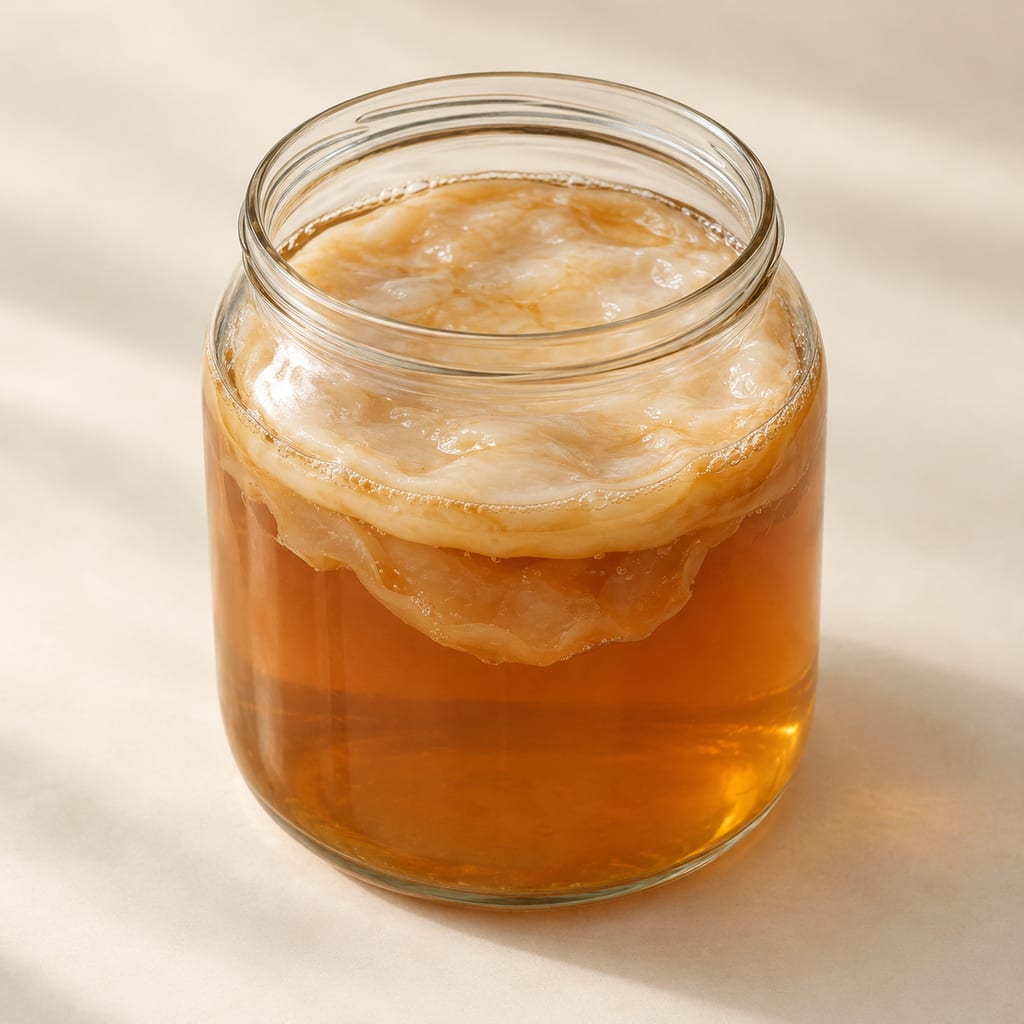
The kombucha culture is a mixed community of yeasts and bacteria carried in an acidic starter liquid and a floating cellulose pellicle, used to turn sweetened tea into kombucha.
Tea
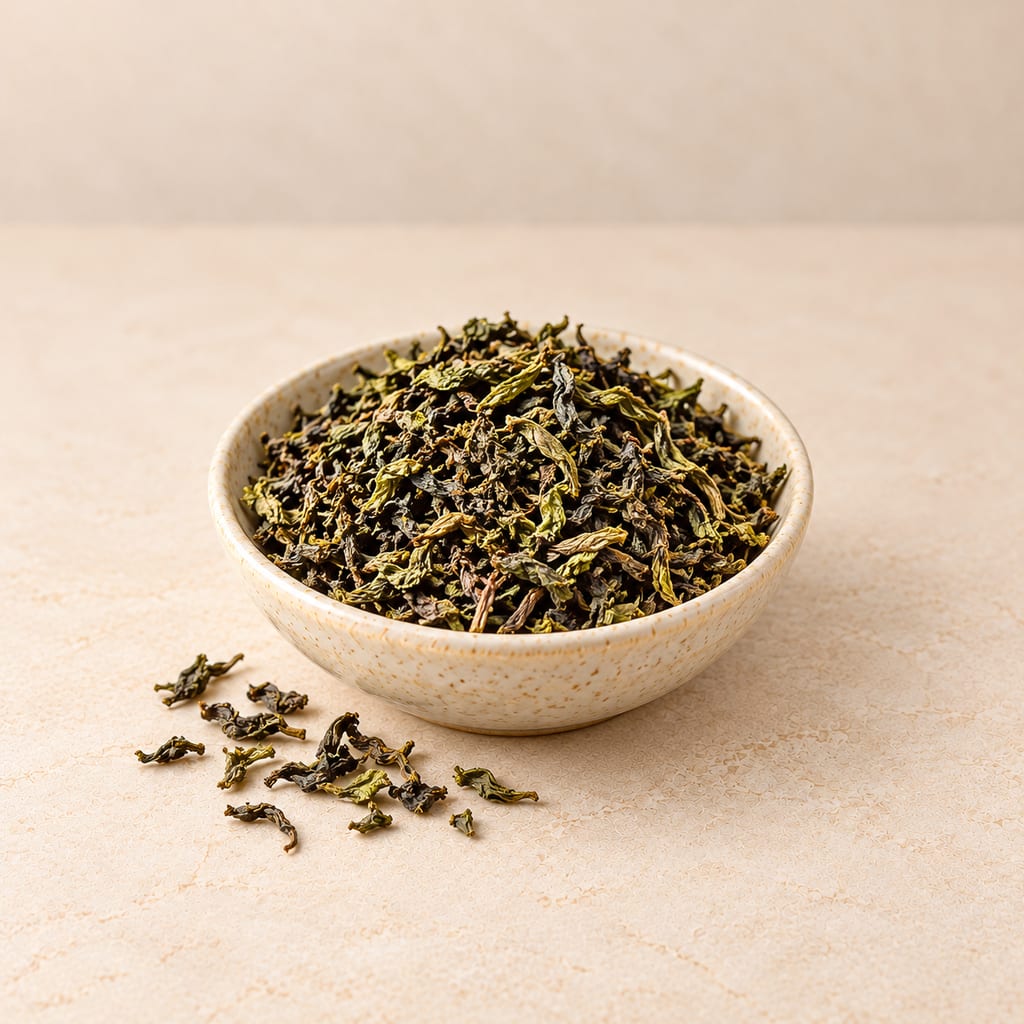
Tea is the processed leaf of Camellia sinensis, an evergreen shrub from the borderlands of south-western China. Steeped and sweetened, it is the base of kombucha and jun.
Community
No community contributions have been published for this entry yet.
Share what you made
Sign in to contribute. Published comments and photos are free to read.
Sources
Uwe Spiekermann
Eingehegter Wunderpilz: Die Kombucha-Mode in den späten 1920er JahrenCited in: Introduction; A history with an uncertain beginning
Applied and Environmental Microbiology
Microbial Species Diversity, Community Dynamics, and Metabolite Kinetics of Water Kefir FermentationCited in: Relatives without a single family tree
William Turner Thiselton-Dyer; Royal Society
Referee's report by William Turner Thiselton-Dyer, on a paper 'The ginger-beer plant, and the organisms composing it: a contribution to the study of fermentation-yeasts and bacteria' by Harry Marshall WardCited in: Relatives without a single family tree
Microbiological Research
Microbial community structure, physicochemical characteristics and predictive functionalities of the Mexican tepache fermented beverageCited in: Relatives without a single family tree
Scientific Reports
Genomic profiling of bacterial and fungal communities and their predictive functionality during pulque fermentation by whole-genome shotgun sequencingCited in: Relatives without a single family tree
Journal of Microbiology
Diversity of lactic acid bacteria from Miang, a traditional fermented tea leaf in northern Thailand and their tannin-tolerant ability in tea extractCited in: Relatives without a single family tree
Microbes and Environments / Japanese Society of Microbial Ecology and partner societies
Diversity of Lactic Acid Bacteria Involved in the Fermentation of Awa-banchaCited in: Relatives without a single family tree
Microorganisms
Microbial Composition of SCOBY Starter Cultures Used by Commercial Kombucha Brewers in North AmericaCited in: What the culture contains
Frontiers in Microbiology
Shedding Light on the Formation and Structure of Kombucha Biofilm Using Two-Photon Fluorescence MicroscopyCited in: What the culture contains; What stopping fermentation actually means; In the kitchen and beyond the glass
Foods
Identification of Key Parameters Inducing Microbial Modulation during Backslopped Kombucha FermentationCited in: What the culture contains; Make the first batch repeatable
Food Microbiology
Oxygen management during kombucha production: Roles of the matrix, microbial activity, and process parametersCited in: Oxygen and the shape of the vessel; Bottling changes the process
PubMed primary journal record
Influence of Herbal Additives on the Physicochemical, Microbiological, Polyphenolic, and Sensory Profile of Green Tea-Based KombuchaCited in: Tea, sweeteners and changing the substrate
Journal of Microbiology and Biotechnology
Coffee Husk By-Product as Novel Ingredients for Cascara Kombucha ProductionCited in: Tea, sweeteners and changing the substrate; Coffee cascara: name the material first; Three measurements, three questions; What health research can support
EFSA Journal
Safety of dried coffee husk (cascara) from Coffea arabica L. as a Novel food pursuant to Regulation (EU) 2015/2283Cited in: Coffee cascara: name the material first
Societé de Produits Nestle SA; hosted by European Commission
Summary of the notification: Coffee cherry pulpCited in: Coffee cascara: name the material first
European Medicines Agency
Final assessment report on Rhamnus purshiana DC., cortex - Revision 1Cited in: Coffee cascara: name the material first
National Center for Home Food Preservation, University of Georgia
Kombucha TeaCited in: Make the first batch repeatable; Bottling changes the process
BCCDC / Ministry of Health Saskatchewan
Section 3.11 Kombucha and junCited in: Relatives without a single family tree; Tea, sweeteners and changing the substrate; Make the first batch repeatable; Bottling changes the process; What health research can support
Lorraine McIntyre, Sung Sik Jang; BCCDC
A Study of Alcohol Levels in Kombucha Products in British ColumbiaCited in: Three measurements, three questions
BCCDC
Fact Sheet: Laboratory Options for Alcohol Testing for Kombucha ProcessorsCited in: Three measurements, three questions
US Alcohol and Tobacco Tax and Trade Bureau
Kombucha GeneralCited in: Three measurements, three questions
Food and Bioprocess Technology
Field Investigation of Flavored Kombucha's Shelf Life Unveils High Sensitivity of Microbial Dynamics Towards Assimilable NitrogenCited in: Bottling changes the process
Food Bioscience
Microbial and chemical stability of commercial kombucha after thermal processingCited in: What stopping fermentation actually means
Chemical Industry and Chemical Engineering Quarterly
Cross-flow microfiltration of traditional kombucha beverage using ceramic tubular membraneCited in: What stopping fermentation actually means
National Center for Home Food Preservation
General Information on PicklingCited in: In the kitchen and beyond the glass
Nature Materials
Living materials with programmable functionalities grown from engineered microbial co-culturesCited in: In the kitchen and beyond the glass
MIT News; Anne Trafton
Inspired by kombucha tea, engineers create “living materials”Cited in: In the kitchen and beyond the glass
Nature Reviews Gastroenterology & Hepatology
The International Scientific Association for Probiotics and Prebiotics (ISAPP) consensus statement on fermented foodsCited in: What stopping fermentation actually means; What health research can support
Frontiers in Nutrition
Kombucha tea as an anti-hyperglycemic agent in humans with diabetes – a randomized controlled pilot investigationCited in: What health research can support
Scientific Reports
Modulating the human gut microbiome and health markers through kombucha consumption: a controlled clinical studyCited in: What health research can support
Journal of Food Science
Effect of Green Tea Kombucha Within an Energy-Restricted Diet on Cardiometabolic Risk Markers in Individuals With Excess Body Weight: A Randomized Controlled TrialCited in: What health research can support
Journal of Food Science
Acute and Chronic Effects of Green Tea Kombucha With and Without Grape Skin Extract on Immune and Oxidative Stress Markers in Beginner Runners: A Randomized Controlled TrialCited in: Tea, sweeteners and changing the substrate; What health research can support
Journal of Food Processing and Preservation
Evaluation of the Effect of Different Sweetening Agents on the Polyphenol Contents and Antioxidant and Starch Hydrolase Inhibitory Properties of KombuchaCited in: Tea, sweeteners and changing the substrate
Journal of Dairy Science
Changes in microbial community structure during adaptation of kombucha symbiotic culture of bacteria and yeast to fermentation of sweet and acid wheyCited in: Tea, sweeteners and changing the substrate
EFSA Journal
The efficacy and safety of high-pressure processing of foodCited in: What stopping fermentation actually means
US Food and Drug Administration
Guidance for Industry: Juice Hazard Analysis Critical Control Point Hazards and Controls Guidance, First EditionCited in: What stopping fermentation actually means
Applied and Environmental Microbiology
Modeling Yeast Spoilage in Cold-Filled Ready-To-Drink Beverages with Saccharomyces cerevisiae, Zygosaccharomyces bailii, and Candida lipolyticaCited in: What stopping fermentation actually means
Food Standards Scotland
Food Additives Inspection GuidanceCited in: What stopping fermentation actually means
Gaps
- Precise kombucha origin and transmission routes are unresolved.
- No validated general cascara home-brewing method, ABV trajectory, caffeine-removal rate or shelf life established.
- No universal culture storage/revival method, heat schedule, filtration specification or safe bottle pressure established.
- No kombucha-specific high-pressure processing validation is established.
- No kombucha-specific UV treatment validation or home schedule is established.
- No kombucha-specific preservative dose, legal food category or authorisation condition is established.
- No quantitative sweetener-substitution advice is established; the sweetener and whey adaptation findings stand only for their reported results.
- No legal category or numerical additive condition for kombucha is established. UK and Scottish alcohol thresholds are not covered.
Updated 2026-10-27