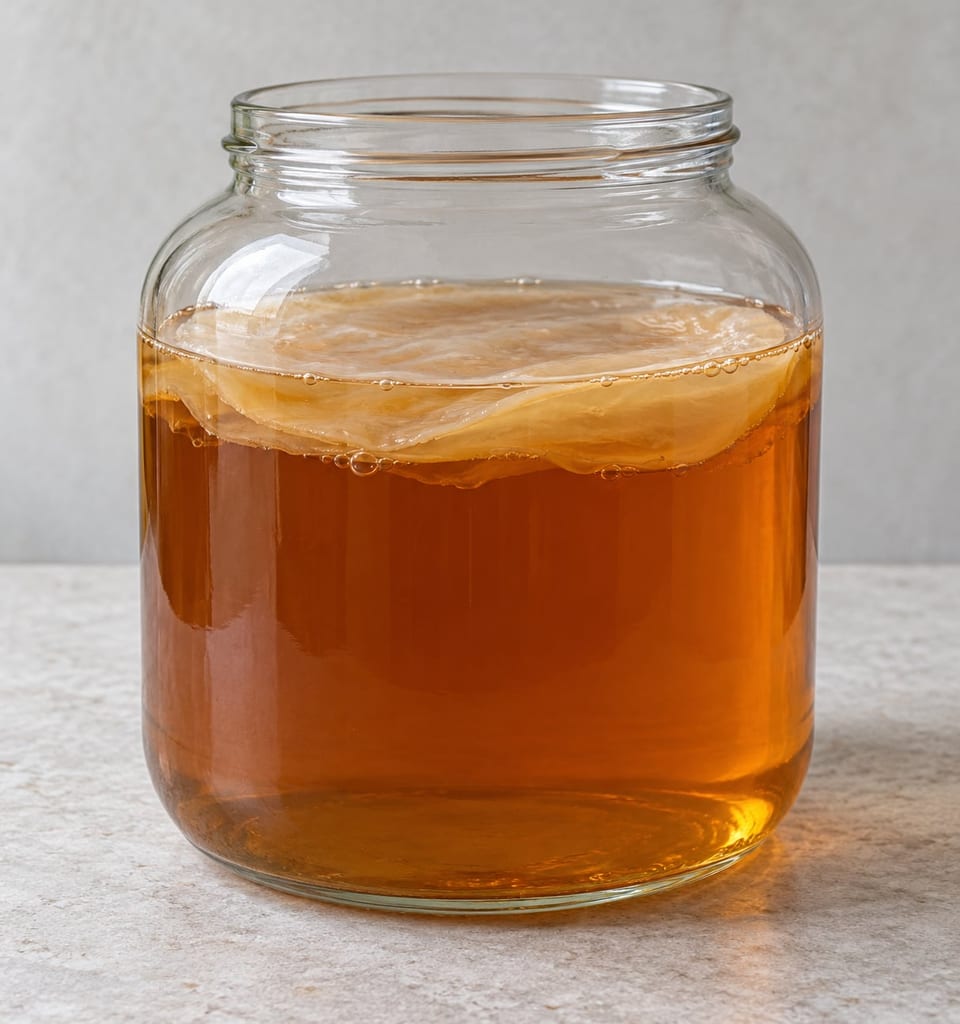
Kombucha culture and tea
Kombucha culture is the mixed starter, a retained liquid with a cellulose pellicle, that ferments sweetened tea into kombucha. Its organisms vary between samples, and a visible mat does not identify them.
 FermenteaWhere food goes to change
Substrates
Tea is the processed leaf of Camellia sinensis, an evergreen shrub from the borderlands of south-western China. Steeped and sweetened, it is the base of kombucha and jun.
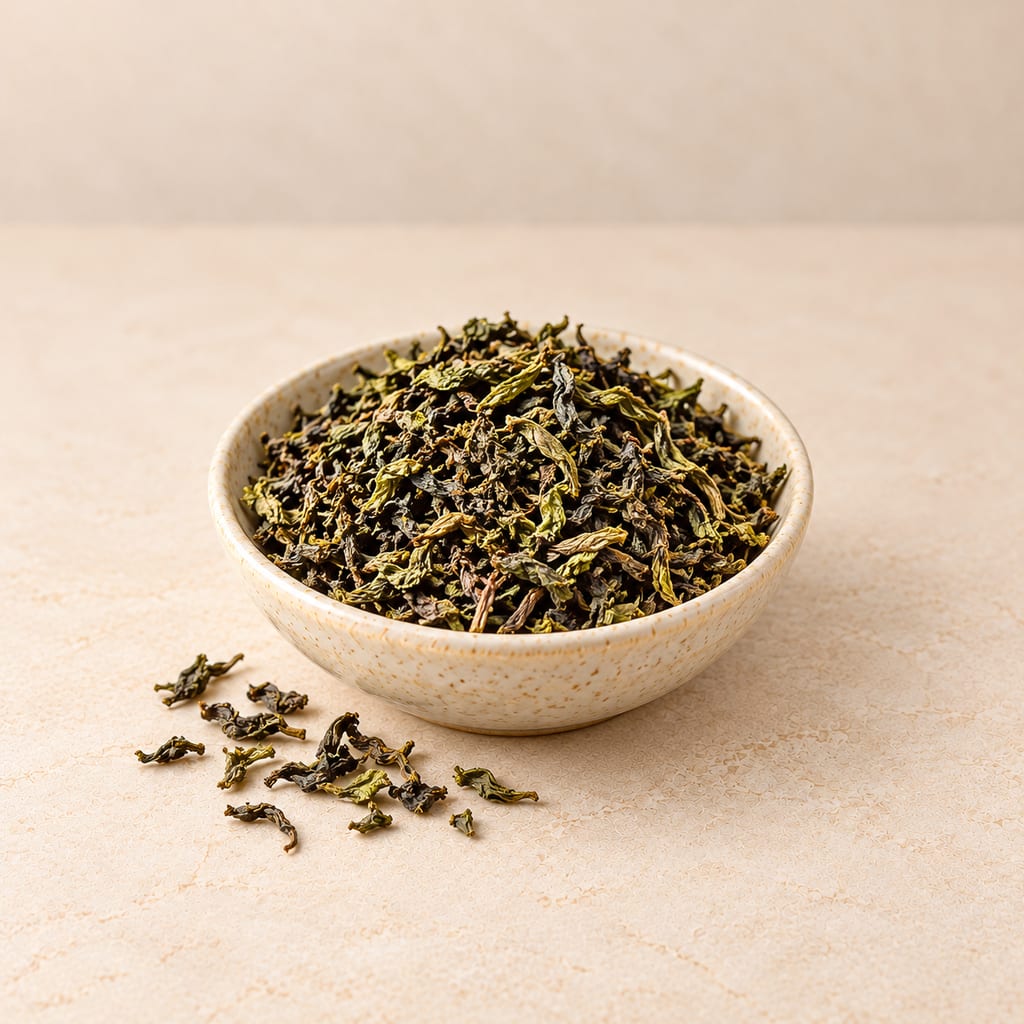
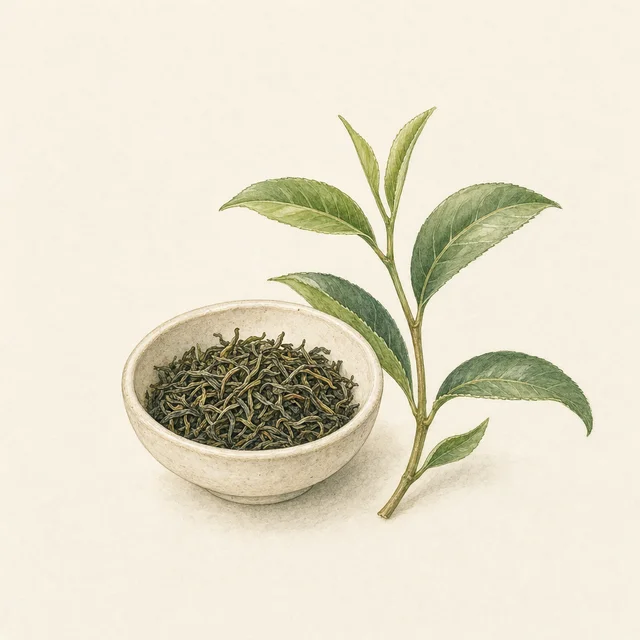
Tea is made from the leaves, buds and sometimes stems of Camellia sinensis, an evergreen shrub or small tree. In the wild it is usually 1 to 5 metres tall and can reach 20; on plantations it is pruned to about waist height with a flat top. The leaves are 4 to 22 centimetres long, leathery, shiny and dark green with finely toothed edges. The flowers are white, 2.5 to 3.5 centimetres across, with six to eight petals, and the fruit is a flattened capsule holding brown seeds. A good bush stays productive for decades, with peak yields at 30 to 50 years and some plants cropping for more than a century.
The botanical name has a history. Linnaeus placed the plant in its own genus, Thea, in 1753. Robert Sweet merged it into Camellia in 1818, a genus named for the Moravian-born Jesuit missionary Georg Kamel, and the species name sinensis means from China. White, yellow, green, oolong, dark and black teas all come from this one species. Herbal infusions are not tea in this sense. Kukicha is a tea made from twigs and stems alone, and the seeds yield tea oil, a cooking oil that is a different substance from tea tree oil.
In Chinese the plant is 茶树 and in Japanese チャノキ, chanoki. Two varieties are grown for tea: var. sinensis, the small-leaved Chinese plant, used for most Chinese, Formosan and Japanese teas, and var. assamica, the large-leaved Assam plant, used for Pu-erh and most Indian teas other than Darjeeling.
The native range of tea is uncertain. The usual account places its origin in the borderlands of far eastern India, northern Myanmar and south-western China, and others point to Yunnan. Chinese legend credits the farmer-god Shennong with tea in 2737 BC, which is myth. The first known reference to boiling tea is in Wang Bao’s text of 59 BC. Camellia material found in 2016 in the mausoleum of Emperor Jing of Han shows that the Han emperors drank it in the second century BC, and in the third century AD the physician Hua Tuo left an early credible record of tea drinking.
In the eighth century Lu Yu wrote The Classic of Tea. Under the Tang tea became widely consumed and spread to Korea, Japan and Vietnam. Loose-leaf tea became common under the Song, pan-firing and rolling kept unoxidised leaves green under the Yuan and Ming, and oolong developed in the fifteenth century.
Europe came to tea late. Portuguese priests and merchants introduced it in the sixteenth century, the Dutch East India Company shipped it from Macao to Java in 1607, and the first English record is a letter of 1615. Tea was sold in a London coffee house in 1657, and Catherine of Braganza brought the habit to the English court in 1662. Russia has drunk tea since 1638, brewed in a samovar. The Tea Act of 1773 provoked the Boston Tea Party, and in 1785 Britain removed the tax on tea.
Britain then moved production to its empire. Chinese small-leaf tea was introduced to India in 1836, the first Assam estate was established in 1837, Archibald Campbell began experiments in Darjeeling in 1841, Robert Fortune was sent to China in 1848 to bring back plants, the Alubari garden opened in 1856, and tea reached Ceylon in 1867.
Tea also has local forms. In Myanmar tea is drunk hot, sweet and green, and pickled tea leaves, lahpet, are a national delicacy, usually eaten with sesame seeds, fried beans, peanuts and garlic chips. In Mali gunpowder tea is served in three rounds, the first unsweetened and called strong like death, the second sweetened and called pleasant as life, and the third sweetest and called sweet as love. In the United States about 80 percent of tea is drunk iced, and sweet tea is native to the south-east.
Tea is drunk in very different ways. Turkey had the highest per-person consumption in 2010, at 2.7 kilograms a year. In the United Kingdom 63 percent of people drink tea daily, and milk may be added to black tea. Iran serves it in traditional glasses with a saucer and a teaspoon, and the tea is grown on the Caspian shore in the north of the country. The Gongfu ceremony of China uses small Yixing clay teapots and oolong. Russia brewed tea in a samovar, and Mali’s three rounds turn one pot into a sequence of flavours.
Genetics gives a deeper time scale. A 2017 sequencing of the Assam variety found about 3 billion base pairs, and on the assumption of a 12-year generation the Chinese small-leaf and Assam types are estimated to have split about 22,000 years ago, and the Chinese and Indian Assam plants about 2,800 years ago.
Tea is mainly grown in tropical and subtropical regions with at least 127 centimetres of rain a year, and it needs acidic soil. It is grown commercially from the equator to Scotland, and the northernmost plantation is at 59°N on Shapinsay in Orkney. High-quality teas are often grown up to 2,200 metres, where growth is slower and the flavour is said to be richer; the Nilgiri teas grow at 1,000 to 2,500 metres. A plant takes 4 to 12 years to bear seed and about three years to reach its first harvest.
Only the top 25 to 50 millimetres of the shoot is picked, and a new flush grows every 7 to 15 days. Darjeeling has three flushes, spring, summer and autumn, and the spring flush is light and aromatic. The Japanese cultivars include Yabukita, Okumidori, Saemidori and Benifuuki.
World production in 2022 was 29.76 million tonnes, of which China made 14.53 million, India 5.97, Kenya 2.33, Sri Lanka 1.40, Turkey 1.30 and Vietnam 1.12. The top four producers account for 81 percent. Most tea consumed outside East Asia comes from large plantations in India and Sri Lanka, while small gardens make the most prized teas. Tea is the world’s most consumed manufactured drink, India the biggest tea-drinking nation by total and Turkey the largest per person.
The kind of tea is set by how the leaf is handled after picking, and the deciding step is oxidation, an enzymatic browning that darkens the leaf as its chlorophyll breaks down and that heat stops at a chosen point. Green tea is unwilted and unoxidised. Yellow tea is unwilted and unoxidised but allowed to yellow. White tea is wilted and unoxidised. Oolong is wilted, bruised and partly oxidised. Black tea is wilted, sometimes crushed, and fully oxidised. Post-fermented or dark tea is green tea allowed to ferment or compost, of which Pu-erh from Yunnan is the best known.
That last kind is the only one that is itself fermented; black and green tea are oxidised or not. The distinction matters for a page on a fermentation ingredient, because the fermentations in this collection happen to a brewed infusion and not to the leaf.
Fresh leaves contain about 4 percent caffeine, a compound the plant makes in young leaves and uses as a natural pesticide, with small amounts of theobromine and theophylline. In dry tea caffeine is about 3 percent of the weight, which gives roughly 30 to 90 milligrams in a 250 millilitre cup: black tea has about 22 to 28 milligrams per gram and green tea about 11 to 20. Polyphenols make up 30 to 40 percent of the leaf and include flavonoids and catechins, among them epigallocatechin gallate; these account for tea’s astringency.
Black and green teas contain no essential nutrients in significant amounts, except manganese, about 0.5 milligrams a cup, or 26 percent of the reference daily intake. Evidence for health effects beyond the alertness that caffeine brings is not strong, and evidence that the polyphenols lower disease risk is insufficient. Some brick teas can contain enough fluoride to pose a risk if drunk in large amounts.
Teas have also been found to carry residues of banned pesticides, and some brewed teas have contained heavy metals and other toxic elements, in some cases at levels that rose with steeping time. Another study found the heavy metals in commercial teas tightly bound to the leaf, with only a little leaching into the brew. Tea is a common target of food fraud, with cheaper ingredients substituted, undeclared colours or flavours added, and origin, picking season or processing misrepresented.
Two fermented drinks are built on a sweetened tea infusion. Kombucha is a fermented, effervescent, sweetened black tea drink, and jun is a similar drink made with green tea and honey. Home recipes for kombucha name black or green tea. The tea is steeped in hot water, the leaves are removed, sugar is dissolved in the liquid, and the sweet tea is cooled before the culture goes in; jun’s tea is cooled to room temperature before the honey is dissolved in it.
The infusion brings flavour, colour, caffeine and polyphenols, and the finished kombucha still carries a small amount of caffeine along with polyphenols. What the yeasts and bacteria ferment is the added sugar or honey, which they turn into acids and a little alcohol, and not the leaf itself. The method, the culture and the safety checks belong to the recipes for black-tea kombucha and for green-tea and honey jun, which this page links to and does not repeat.
Kombucha’s own history is poorly documented. It possibly originated in the Bohai Sea region of China, spread to Russia and appeared in an 1852 work, became a health fad in Japan after Sumako Nakamitsu’s 1974 bestseller, was a national craze in China in the 1980s, and reached wide popularity in the United States around the turn of the twenty-first century. Its Chinese name is hóngchá jūn, 红茶菌, red tea fungus, and its Japanese name is kōcha kinoko, 紅茶キノコ, black tea mushroom.
Tea is kept at room temperature in an airtight container, away from heat, light, air and moisture. Black tea in a bag inside a sealed opaque canister may keep for about two years, while green tea usually deteriorates in less than a year. Refrigeration is advised for most teas but only sparingly for green tea. Tea is usually steeped as loose leaves in hot water for a set time, while compressed and fermented teas are often decocted, simmered in the water.
Both loose leaf and tea bags are sold, and compressed teas such as brick tea are often simmered instead of steeped. Labels carry some assurance. Certified sustainable tea, from schemes such as Rainforest Alliance, Fairtrade, UTZ Certified and Organic, grew at about 35 percent a year from 2008 to 2016, and by 2016 at least 1.15 million tonnes were certified, valued at 2 billion dollars. Labour is a concern behind the cup: the United States Department of Labor reports child labour in tea in Kenya, Malawi, Rwanda, Tanzania and Uganda. Climate change threatens yields and flavour, through changes in rainfall and temperature, pests and shifting growing seasons.
Probable origin in the south-western borderlands and earliest tea finds; largest producer in 2022 at 14.53 million tonnes. No locality is claimed.
Assam and Darjeeling estates from the 1830s and 1840s; second-largest producer in 2022 at 5.97 million tonnes.
Part of the probable native range; pickled tea leaves, lahpet, are a national delicacy.
Third-largest producer in 2022 at 2.33 million tonnes.
The British introduced tea to Ceylon in 1867; fourth-largest producer in 2022 at 1.40 million tonnes.
Kombucha possibly originated here; the history is poorly documented.
Kombucha culture is the mixed starter, a retained liquid with a cellulose pellicle, that ferments sweetened tea into kombucha. Its organisms vary between samples, and a visible mat does not identify them.
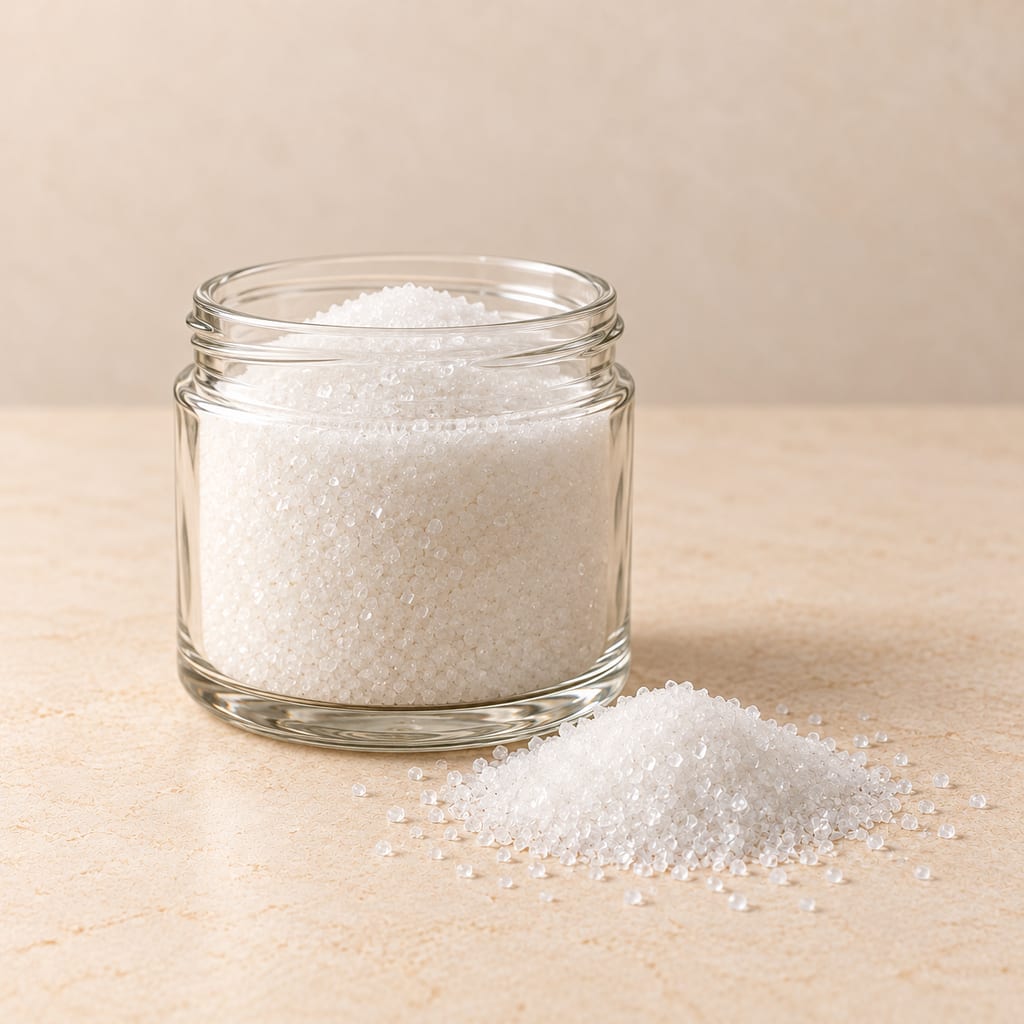
Sugar is a family of sweeteners with different forms and food roles; refined white sucrose may come from cane or beet, while less refined forms add other flavours and moisture.
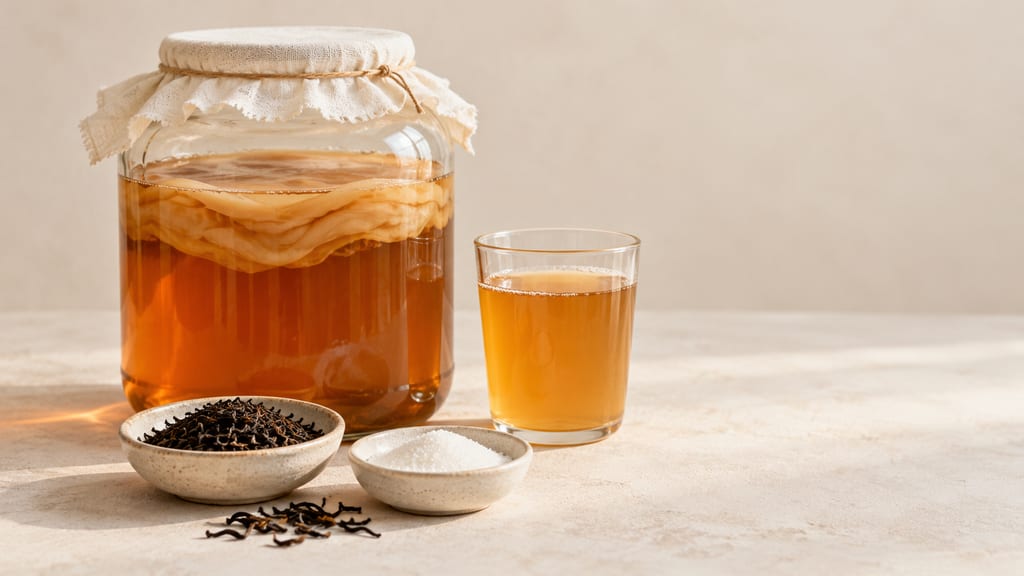
Kombucha starts as sweet tea and becomes a changing mix of sugars, acids, alcohol and gas. This guide covers its history, the culture, substrates, vessels, measurements, bottling and what health research can support.
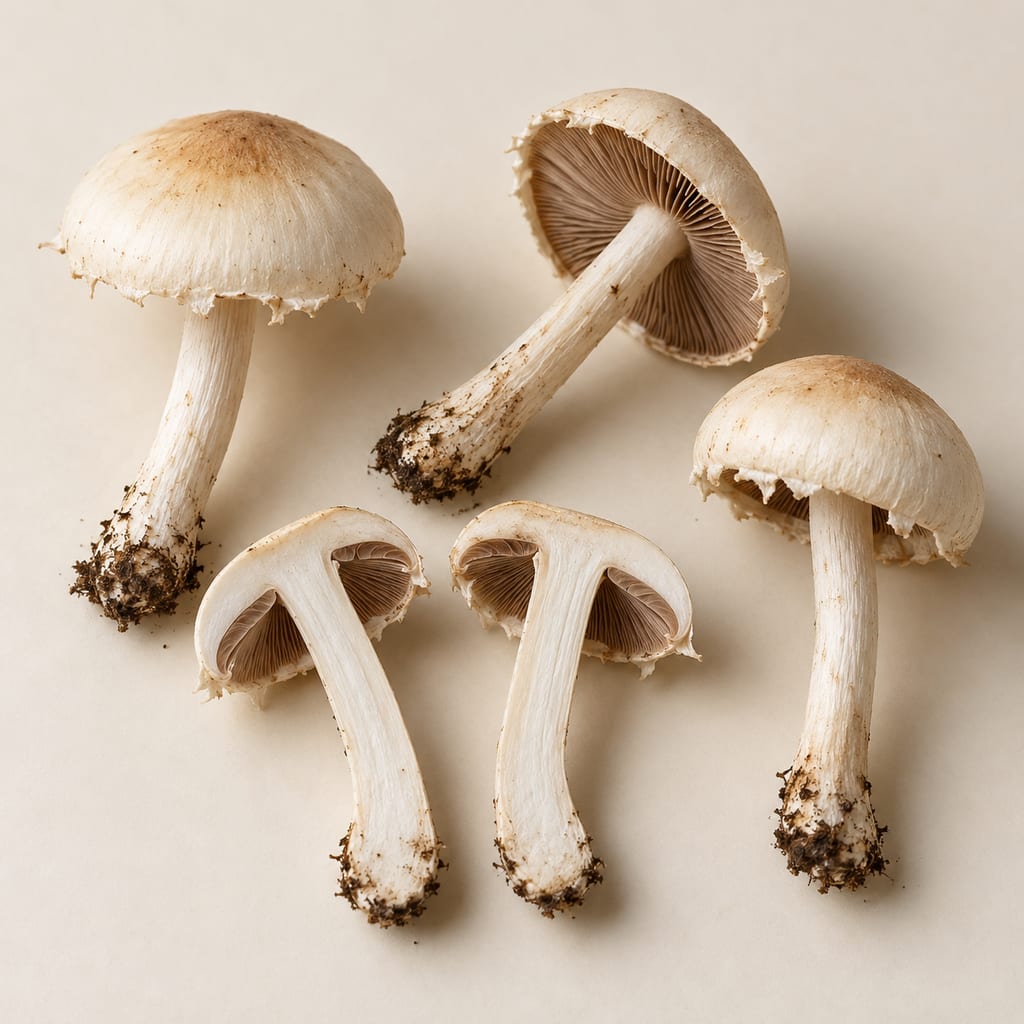
A grassland agaric listed as edible in historical and scientific catalogues for Hong Kong and China. Taxonomic concepts and practical food value vary; the listings do not establish safe identification or culinary practice.
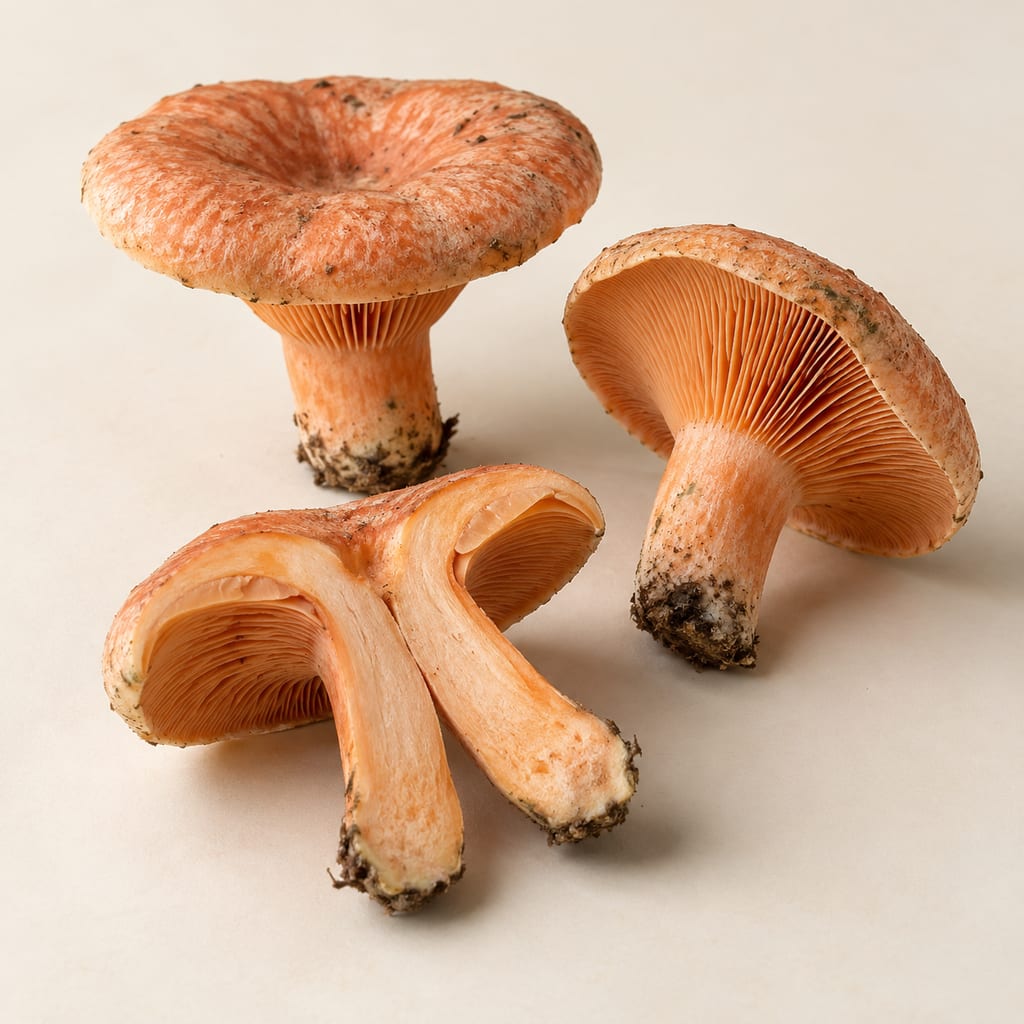
Akahatsu, Lactarius akahatsu, is a wild milkcap of East Asian pine and mixed forests that is sold in Yunnan markets, with its edibility and identity still needing species-level review.
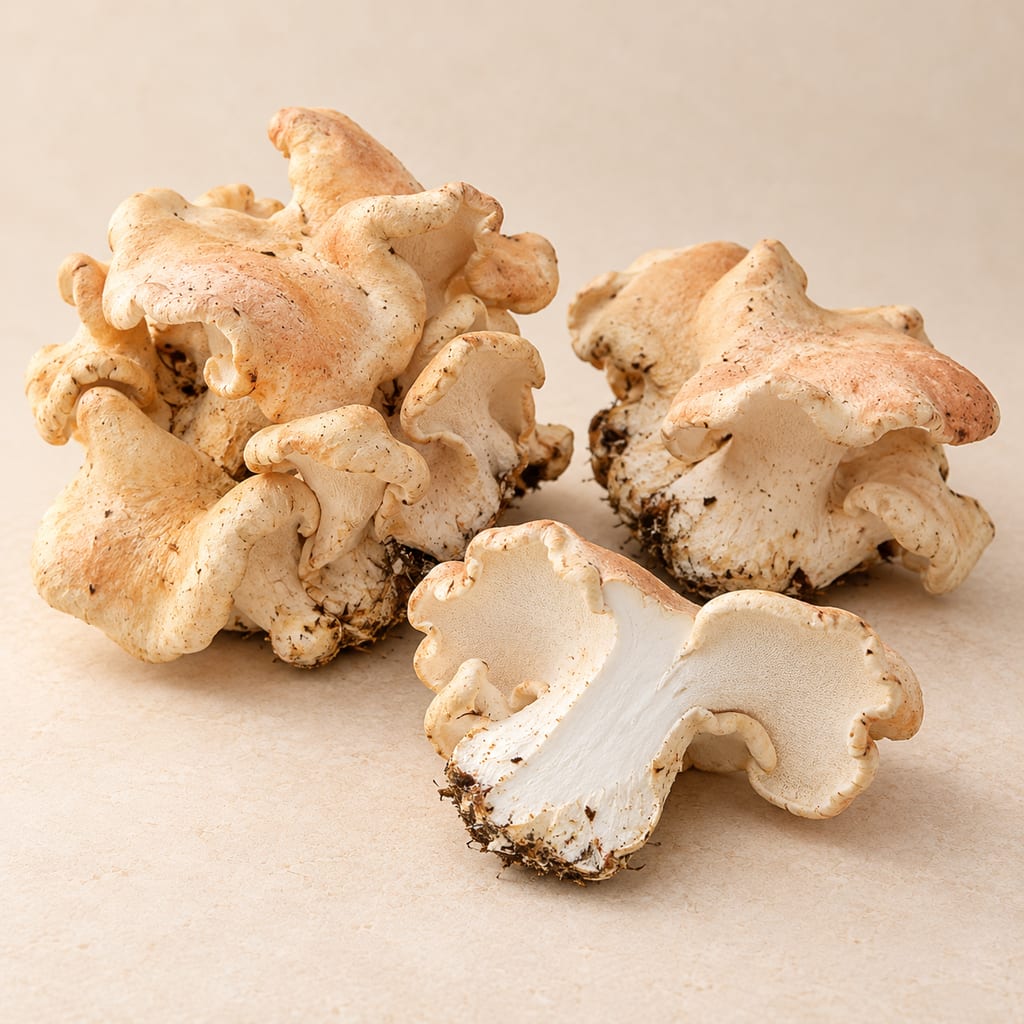
Albatrellus confluens is a ground-growing polypore with fused buff-orange caps. Sources document Chinese market use and regional edibility, but others reject it as too bitter; taxonomy also varies between Albatrellus and Albatrellopsis.
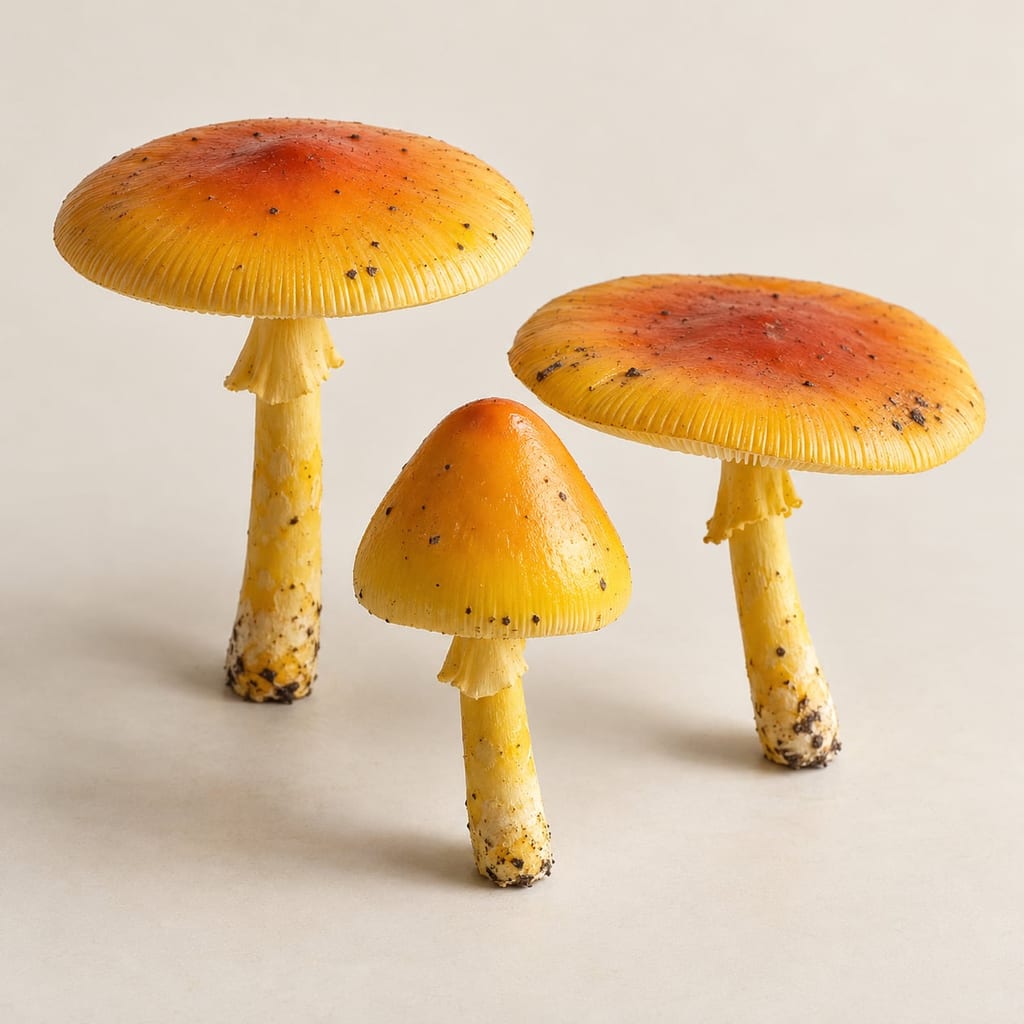
A wild Amanita recorded from China in a 2026 checklist of edible and medicinal fungi. The genus holds deadly species, so this page gives no identification or edibility verdict.
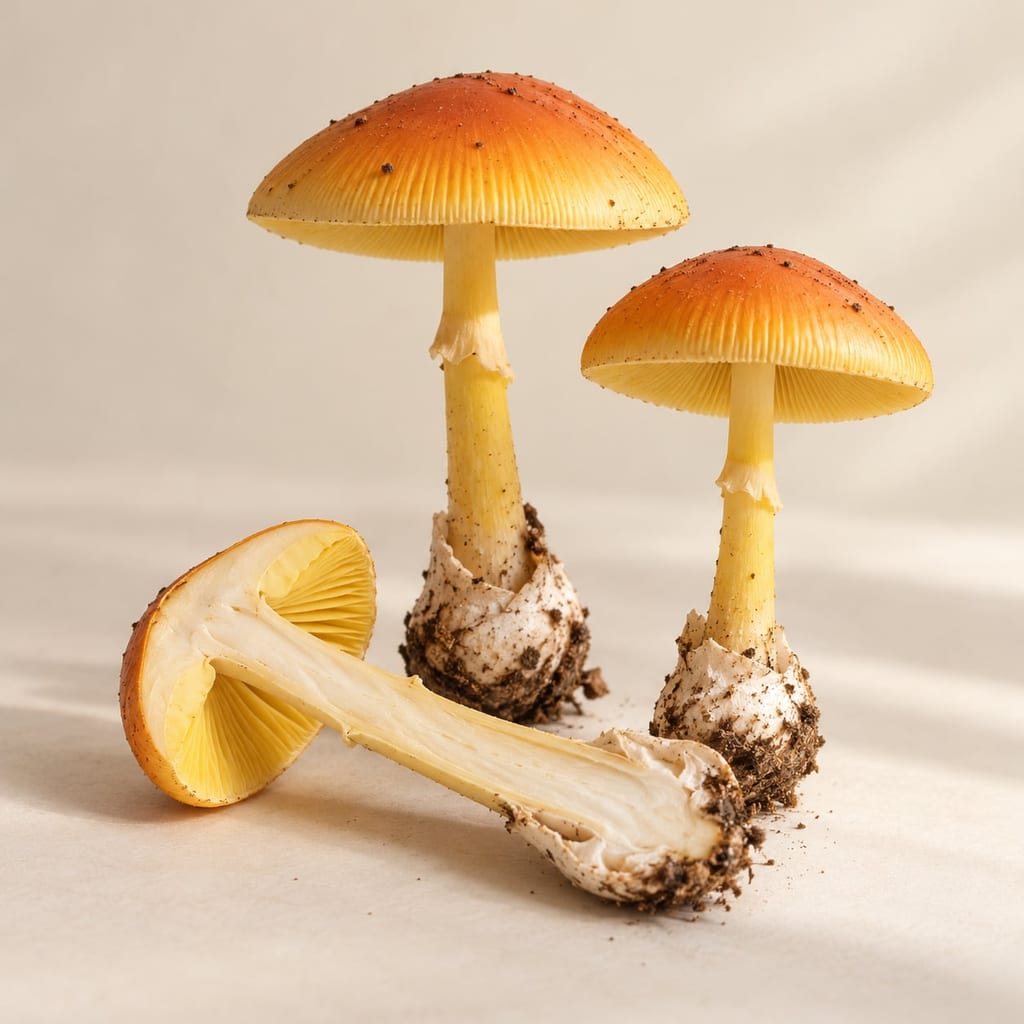
A wild Amanita of China, first reported there and listed as edible in a Yunnan ethnomycology study. The genus contains deadly species, so this page does not support identifying or eating it.
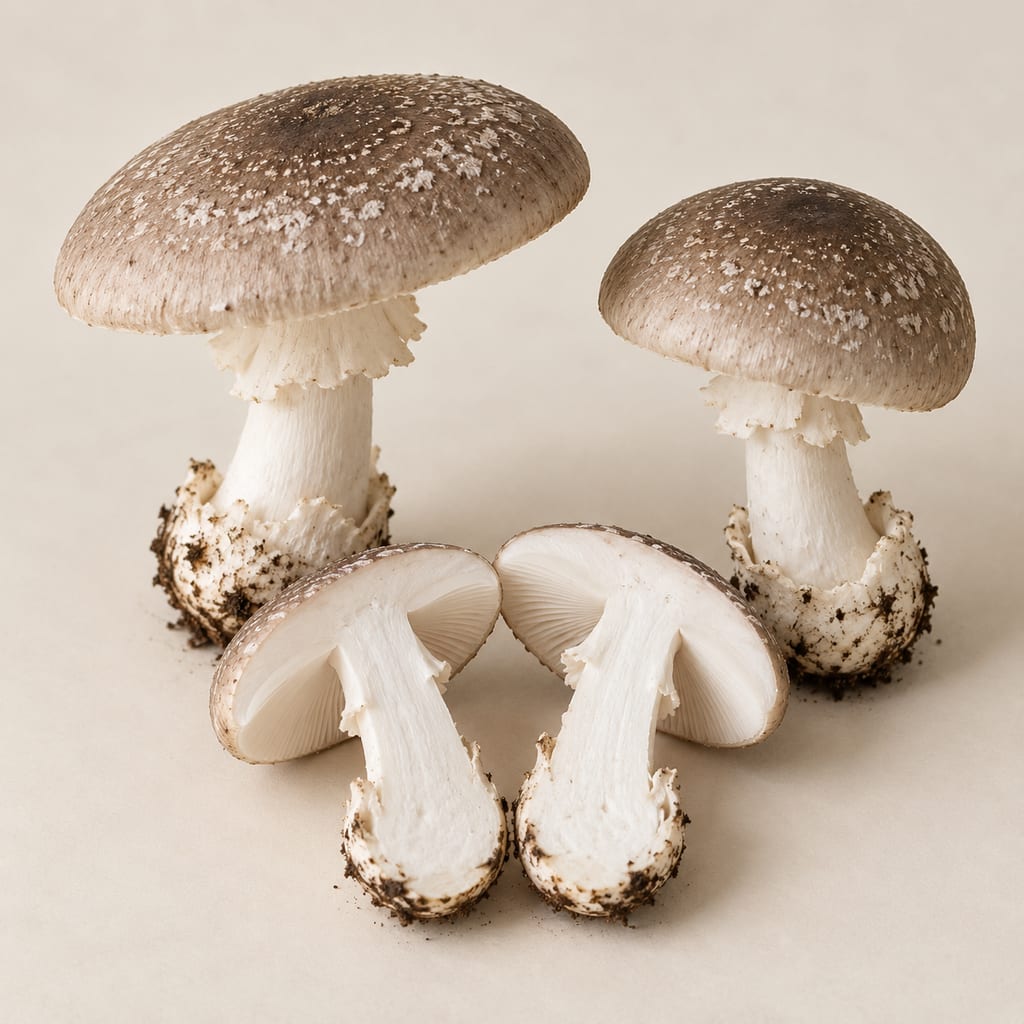
Amanita yuaniana is a Chinese Amanita that a 2023 Yanshan survey and a Yunnan ethnomycology survey list among edible species. No source tests it for safety, and the genus holds the most lethal mushrooms.
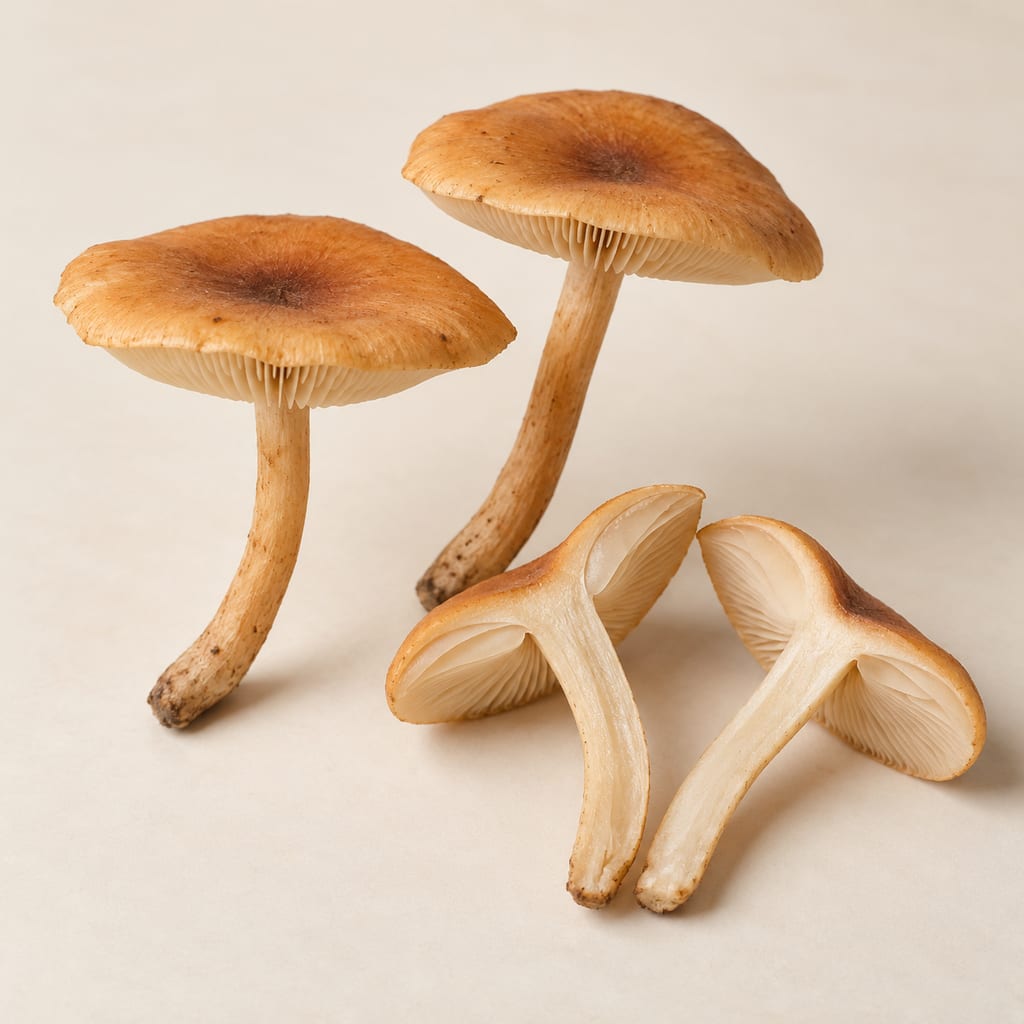
A wood-associated Armillaria recorded in Yunnan and Sichuan, China, and listed as edible in a 2026 Chinese catalogue.
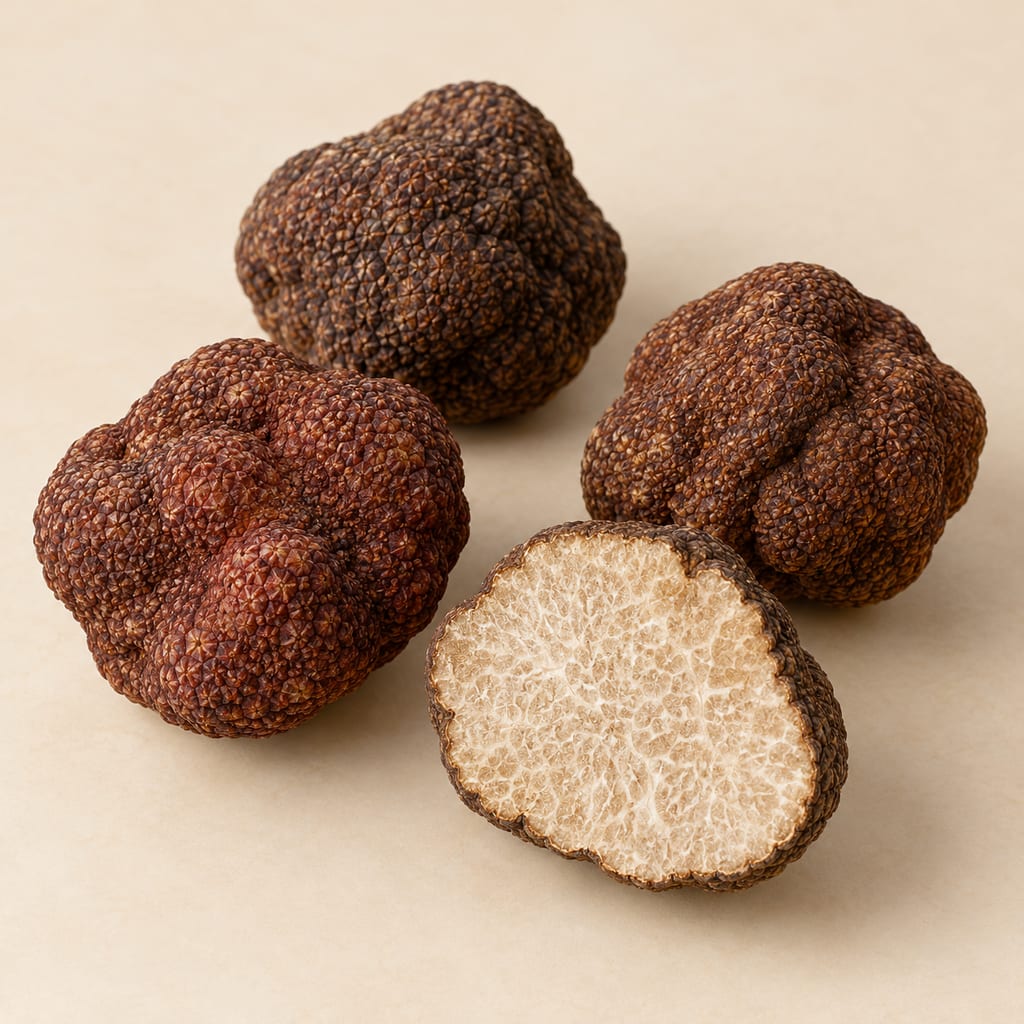
Tuber pseudohimalayense is a wild black truffle from Yunnan, China, listed as edible in a Chinese species catalogue. No independent assessment of its culinary use or safety is available.

At North Abydos in Egypt, a fixed early Dynastic brewery comprised parallel semi-subterranean installations with rows of ceramic mash vats; excavation reports revise their number, scale and estimated batch capacity.

Ají amarillo is the orange-yellow Peruvian chilli cultivar group of Capsicum baccatum, used to colour and season huancaína sauce and ají de gallina. Published heat estimates do not establish one range for the named cultivar.

Toasted almonds are whole sweet almond kernels dry-roasted until golden to brown. Heat replaces their marzipan note with a roasted, nutty one; they thicken and flavour romesco.

Kodiak salmon, halibut and cod cut as seg'aq and hung on an initaq rack to become tamuuq, with kac'amaasaq and kupcuunaq named as different results.

Aniseed is the dried ripe fruit of Pimpinella anisum, an aromatic Apiaceae spice commonly called a seed. It adds a sweet, warm aroma to breads such as Moroccan krachel and South African mosbolletjies, and is distinct from star anise.

A fixed Late Chalcolithic installation in Areni-1 cave combined a shallow clay pressing basin with a large jar set into the cave floor and storage vessels nearby.

Ripe avocado flesh is the soft, buttery, fat-rich pulp of Persea americana, eaten raw. It is low in acid, so it is a fresh ingredient that needs care in chilled dishes.

A portable dome and pan used over a hearth, with embers on the lid and heat from below. Regional peka and saç forms share this principle while differing in materials, pan shape and how the food is cooked.
No community contributions have been published for this entry yet.
Sign in to contribute. Published comments and photos are free to read.
WikipediaPlant · Processing · Composition · History · Production · Storage · Secondary
TeaTea types and processing; caffeine and polyphenols; manganese and fluoride; history dates; regional traditions; 2022 production and consumption; storage; safety, fraud, labour and climate.
Cited in: The leaf behind the cup; Where tea began and how it spread; Tea in daily life; How tea is grown and picked; The kinds of tea; What is in the leaf; Choosing and storing tea
WikipediaBotany · Cultivation · Secondary
Camellia sinensisBotany, range and origin, cultivation climate and altitude, varieties, caffeine in fresh leaves, taxonomy history, names.
Cited in: The leaf behind the cup; Where tea began and how it spread; How tea is grown and picked; The kinds of tea; What is in the leaf
WikipediaUse · History · Secondary
KombuchaKombucha as a sweetened black tea drink; tea steeped, leaves discarded, sweet tea cooled before the culture; small amount of caffeine and polyphenols; history and names.
Cited in: Tea as the base of kombucha and jun
WikipediaUse · Secondary
Jun (drink)Jun is a kombucha-like drink of green tea and honey; the tea is cooled to room temperature before the honey is dissolved.
Cited in: Tea as the base of kombucha and jun
Utah State University ExtensionUse
Homemade KombuchaThe extension recipe names black or green tea and steeps and removes the tea before adding sugar.
Cited in: Tea as the base of kombucha and jun