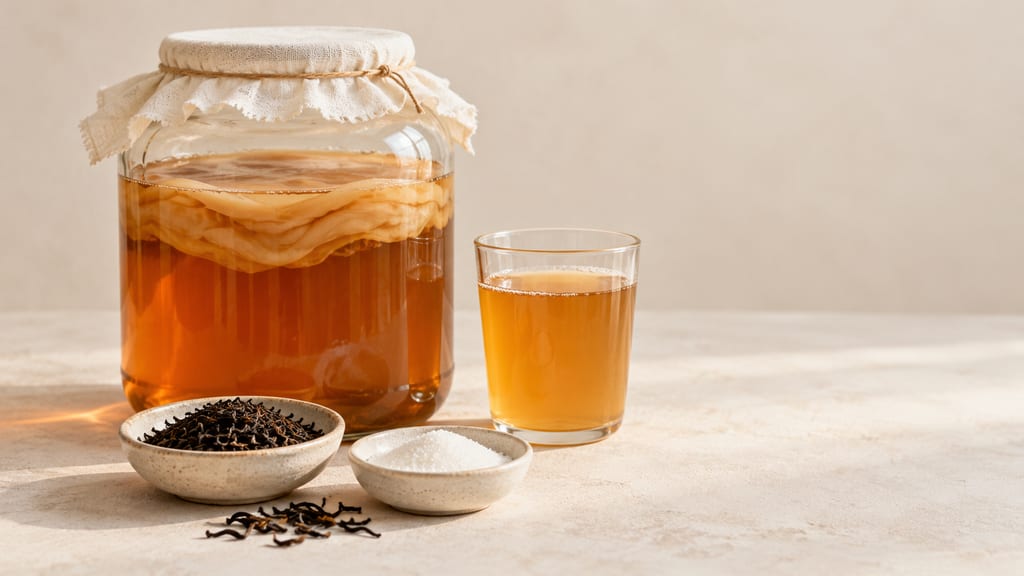
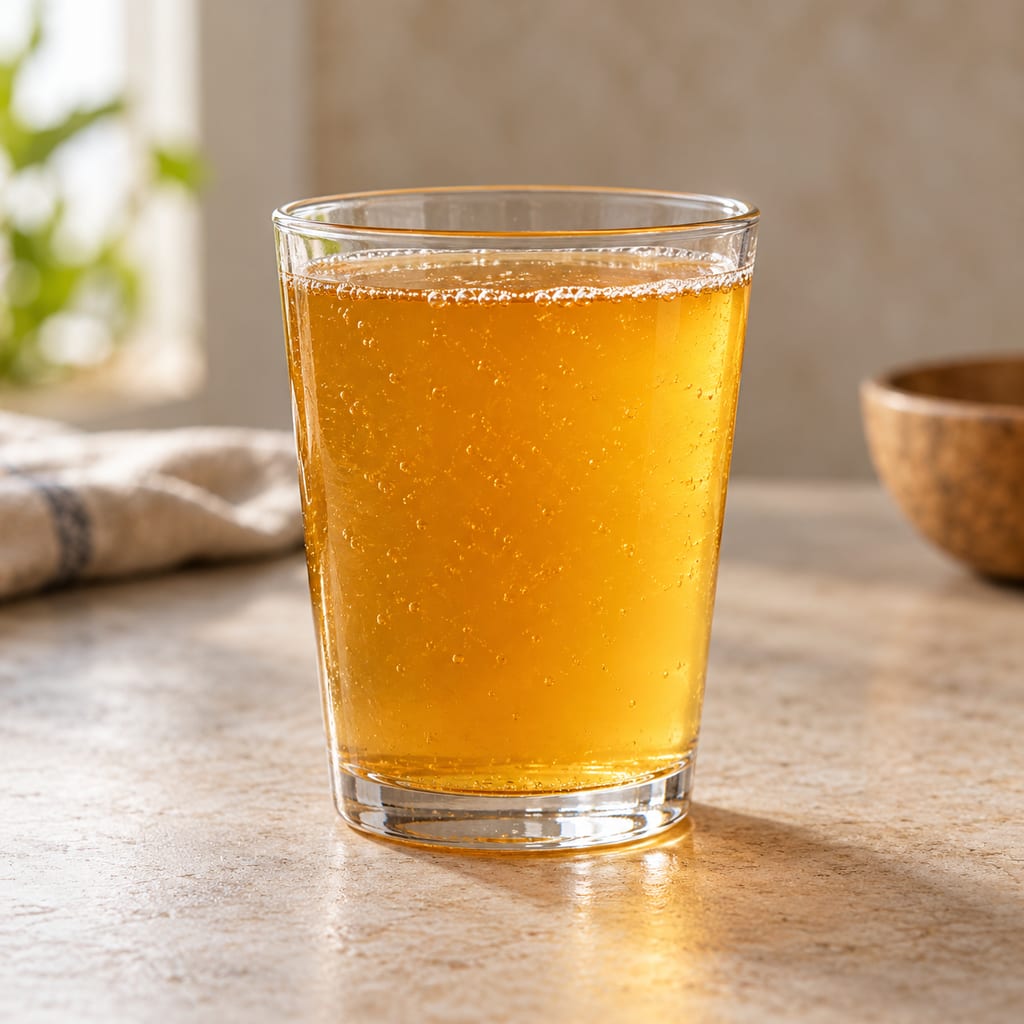
Jun is a fermented tea drink made with green tea and honey instead of the sweetened tea of kombucha. Its culture identity and origin are not established, and sealed bottles can build pressure and alcohol.
Jun is a fermented tea drink made with green tea and honey. Where kombucha is made with sweetened black or green tea, Jun takes its sweetness from honey, and BCCDC treats the two drinks as separate named beverages because their usual tea and sweetener differ. After the primary ferment the drink is still; the optional sealed stage makes it carbonated.
The mixed culture that ferments it is the central question. Jun is made by adding a culture, often sold as a Jun SCOBY, to honey-sweetened green tea, and the same culture is kept for the next batch with some of the liquid. The name describes the beverage. It does not identify one microbial lineage, and a seller's label for a culture does not establish which organisms it holds.
Jun is documented as a modern home practice. A widely repeated story places its origin in Tibet and the Himalayas, but a 2019 recipe article reports that the story lacks verifiable evidence. That article discusses Jun as a possible modern offshoot of kombucha, and it is a secondary account rather than a historical record.
A 2025 laboratory study from Can Tho University in Vietnam calls Jun a kombucha variant. It used a green-tea-and-honey formulation under controlled conditions. It documents a research setting, not a regional tradition, and it does not compare the Jun and kombucha communities, so whether they share a culture is not established.
Jun is fermented by a mixed culture in the same family as kombucha. Kombucha-family cultures contain yeasts and acetic- and lactic-acid bacteria, and BCCDC describes a primary fermentation with access to air. Yeasts produce alcohol and carbon dioxide from the honey and tea sugars, and bacteria convert those products toward acids. Those general processes support a mixed-culture description; they do not give a Jun-specific species list.
Honey is the sweetener in this recipe, and it is a different substrate from the sugar in kombucha. The sources do not say how honey changes the community that develops, and a honey substitution, a green tea or a new pellicle does not verify a culture identity.
The water is heated to 170°F (77°C) and poured over the sencha for a 3 to 5 minute steep. The source then cools the tea to 65 to 75°F (18 to 24°C) before the honey goes in. The source gives these temperatures and times but does not explain why each one was chosen, so the reasons are not stated here.
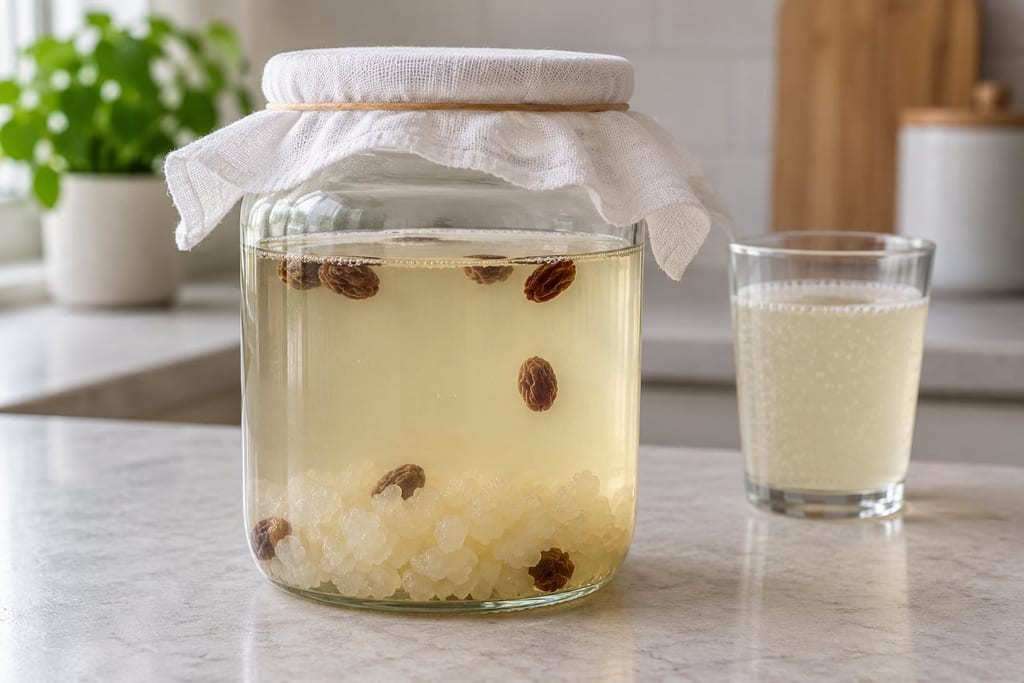
The culture and starter tea are added together. The starter liquid from a previous batch carries the community from one batch to the next, and the source treats it as a working part of the process. The jar is covered with cloth through a fermentation of 3 to 5 days at 65 to 70°F (18 to 21°C).
After the primary ferment, the source reserves half a cup of liquid with the culture for the next batch, then divides the drink into flip-top bottles for a sealed stage of 2 to 3 days at room temperature. The sealed stage is the one that builds carbon dioxide and can build alcohol; the source gives no pressure endpoint, so the bottles are the place where the reader needs the most caution.
A soursop-flavoured second-stage Jun was tested in the 2025 Vietnamese study, as a product experiment rather than a customary form. Households also flavour the finished drink, but the sources do not establish a regional serving tradition for Jun.
Kombucha is the nearest relative. Ginger beer plant, ginger bug and other sweetened starters are different cultures. A drink labelled Jun may be made by any of several routes, so the name alone does not say which culture was used.
The sealed stage is where the main hazards sit. A sealed bottle keeps the carbon dioxide the culture makes, and the extension handout warns that pressure can build and containers may burst. Alcohol can form, and the amount is not measured in this recipe. Use bottles made for carbonated beverages, refrigerate after the conditioning interval and open cautiously.
BCCDC lists excess alcohol, excessive acidity, contamination, surface mould and pressure in packages as concerns in kombucha-family production. Its numerical controls and limits were written for a British Columbia food-processing and inspection context and are not household instructions. The sources do not give a home alcohol limit, a pressure limit, an acidity target or a storage duration for a stock culture.
A sensory check for a finished batch is a preference, not a safety test. Smell, taste, bubbles and a visually normal pellicle do not establish that a batch is safe, and the recipe source's storage advice is its own, not validated for Jun in general.
The origin of Jun, its culture identity and any seasonal calendar remain unestablished. The recipe's own statements conflict on timing: the displayed total reads as three days while the prose gives three to five days for the primary stage. The sealed-stage pressure and storage limits need qualified process review before any executable control is published.
Jun is documented as a modern home-fermentation practice. A 2019 recipe article calls the often-repeated Tibetan and Himalayan origin story unsupported by verifiable evidence and discusses Jun as a possible modern offshoot of kombucha. A 2025 Vietnamese laboratory study calls Jun a kombucha variant. No inspected primary historical record establishes an origin, a date or a seasonal calendar.
Ingredients
Yield 8 servings (about 2 quarts before starter reservation) · Scaling: source batch only
Jun SCOBYa culture adapted to green tea and honey; it can need several batches to adapt
1 culture
Starter tea from a previous Jun batchmature liquid from an earlier batch, or supplied with the culture
118 mL½ cup as recorded
Method
Risks and precautions · Elevated risk
carbon dioxide pressure in sealed bottles
The sealed second stage captures carbon dioxide; the extension handout warns that containers can burst. The source gives no pressure endpoint.
Hazard source
residual alcohol
Kombucha-family cultures contain yeasts and bacteria; alcohol can form, and the amount is not measured in this recipe.
Hazard source
variable mixed-culture activity
The composition of a kombucha-family culture varies, and so do its fermentation outcomes.
Hazard source
Use bottles made for carbonated beverages, refrigerate after the stated conditioning interval, and open cautiously. The source gives no pressure endpoint.
Control source
Jun can produce alcohol and bottle pressure; neither is measured in this recipe.
Taste preference is not a safety endpoint, and smell, bubbles or a visually normal pellicle do not establish safety.
BCCDC process controls were written for a food-processing and inspection context and are not household limits.
Heat the water to 170°F (77°C), pour it over the sencha and steep for 3 to 5 minutes. Strain and cool the tea to 65 to 75°F (18 to 24°C).
Stir the honey into the cooled tea, then add the Jun culture and ½ cup starter tea. Cover a half-gallon jar with cloth and ferment for 3 to 5 days at 65 to 70°F (18 to 21°C).
Remove the culture, stir the liquid and reserve ½ cup with the culture for the next batch. Begin another batch promptly, or keep the culture and starter at room temperature for up to one week, as the recipe gives.
Divide the remaining drink among four pint-size flip-top bottles. Close them for 2 to 3 days at room temperature, then refrigerate. Fermentation may continue more slowly while chilled.
Conditions
Yield8 servings (about 2 quarts before starter reservation)
Active time10 min
Fermentation5–8 days
Temperature18–21°C
Temperature controlAmbient, monitored
Places
Unknown
Relationship not established · Place not established
No inspected source establishes a place of origin or a regional tradition for Jun; the 2025 study is a laboratory setting at Can Tho University.
Kombucha starts as sweet tea and becomes a changing mix of sugars, acids, alcohol and gas. This guide covers its history, the culture, substrates, vessels, measurements, bottling and what health research can support.
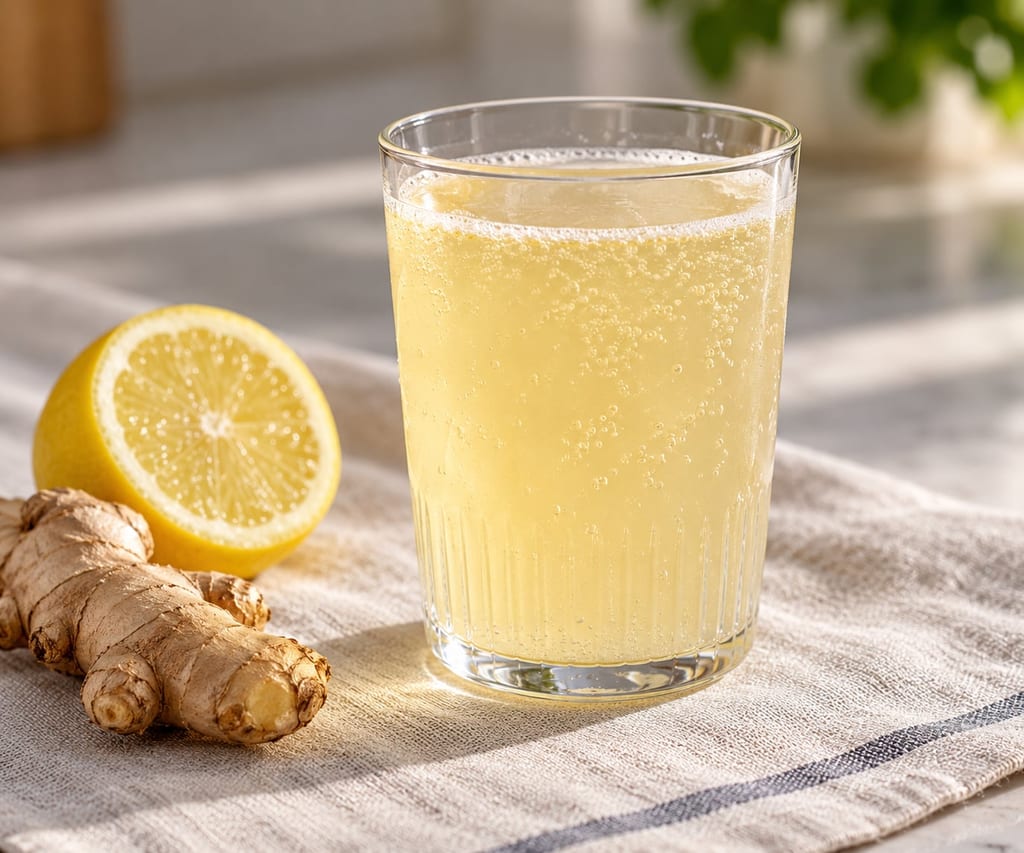
A one-liter teaching recipe ferments bruised ginger, lemon, sugar and cream of tartar with measured baker’s or ale yeast, then conditions the drink briefly in PET bottles before refrigeration.
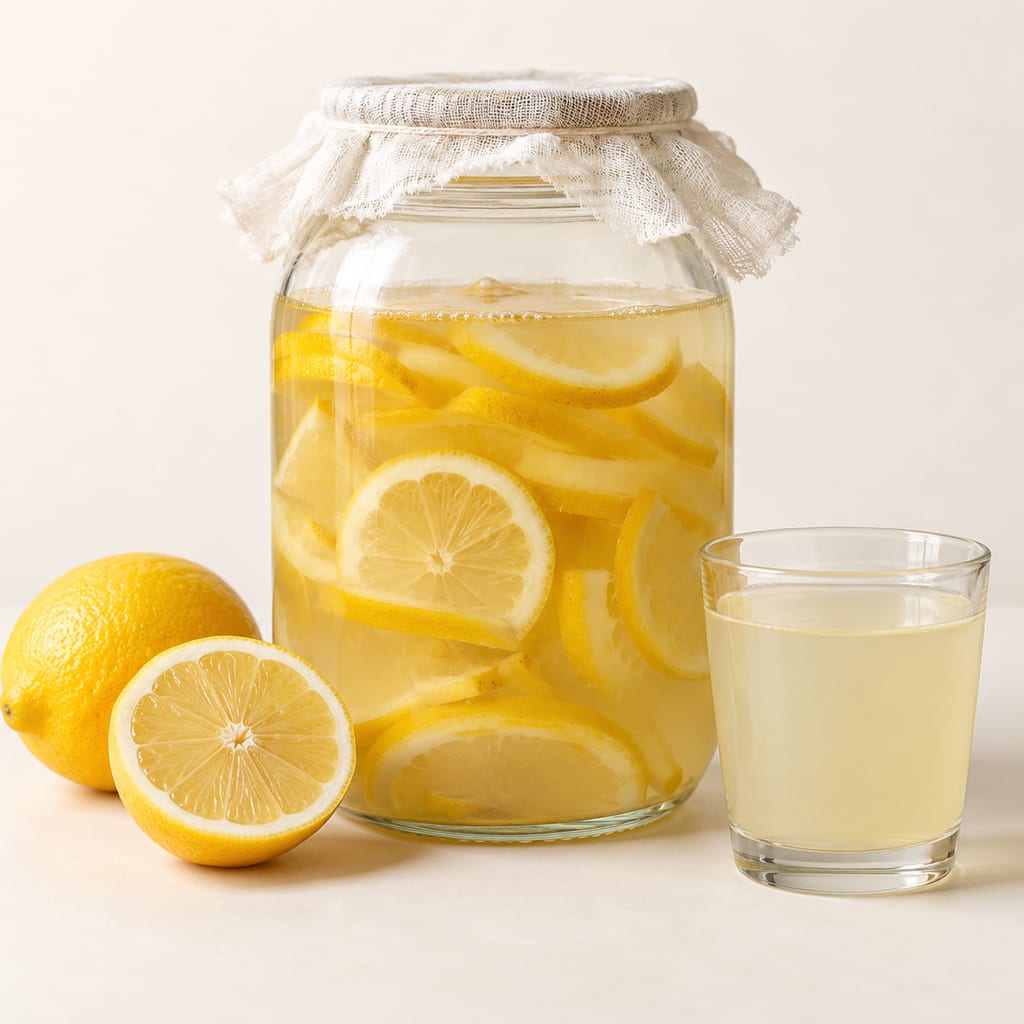
A lightly fizzy lemon drink made from peel-on lemons, water and sugar, held in a covered jar, bottled and kept going with small sugar and peel additions.
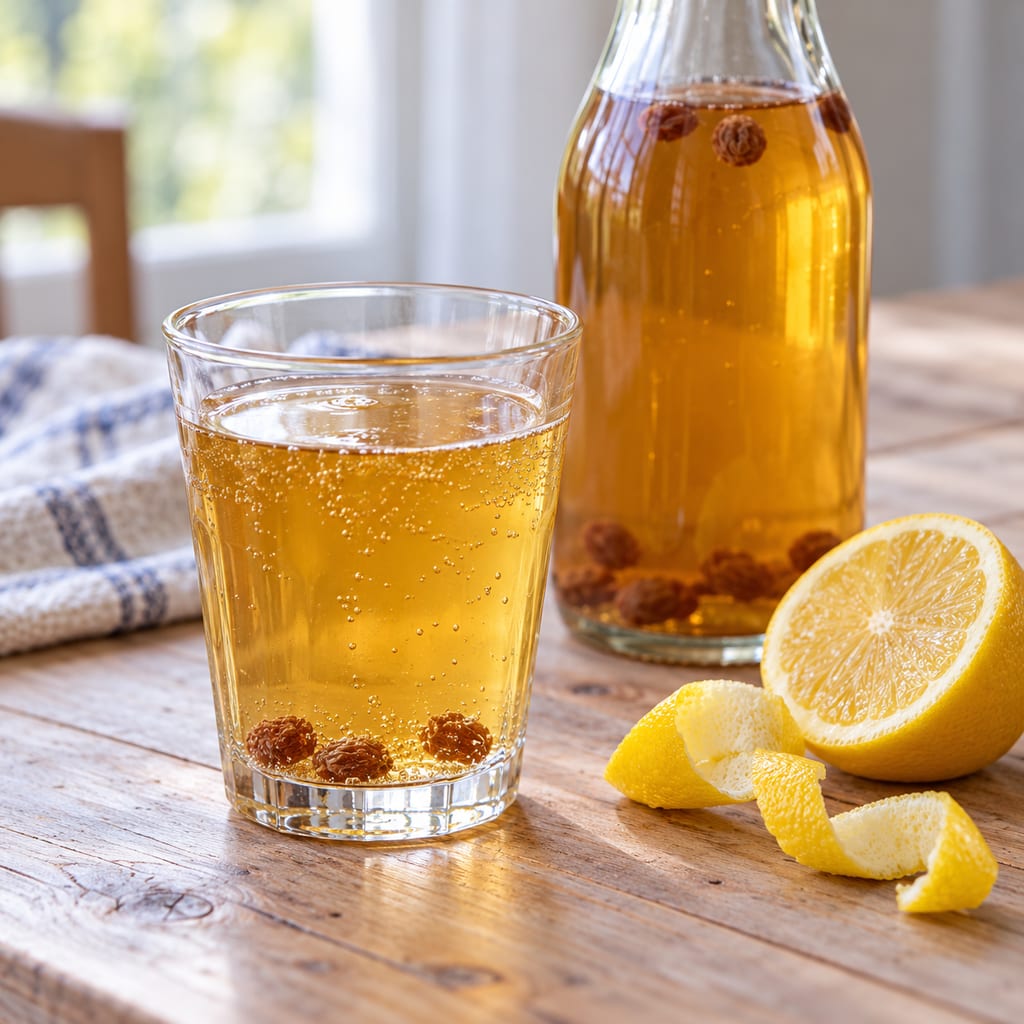
A lightly fermented Finnish May Day drink of lemon, white and brown sugar and a little yeast, bottled with raisins that rise as the carbonation builds.
A Victorian household wine of boiled sugar, lemon and bruised ginger, worked on raisins in a cask for a fortnight and finished with brandy, made nine gallons at a time.
Wright's 1909 compilation records a parsnip wine made from boiled roots, sugar and a little yeast. The liquor spends ten days in a tub, then twelve months in a cask topped up daily only while the wine works over.
An Oregon State food-science lab formula ferments pineapple skin and piloncillo with jalapeño and warm spices for three to five days, then strains and refrigerates it. The handout reports wide alcohol variability.
Water kefir grains culture lightly sweetened water into a tart, faintly fizzy drink, with raisins added as an optional dried-fruit nutrient. Alcohol, acidity and fermentation rate vary batch to batch.
Community
No community contributions have been published for this entry yet.
Share what you made
Sign in to contribute. Published comments and photos are free to read.