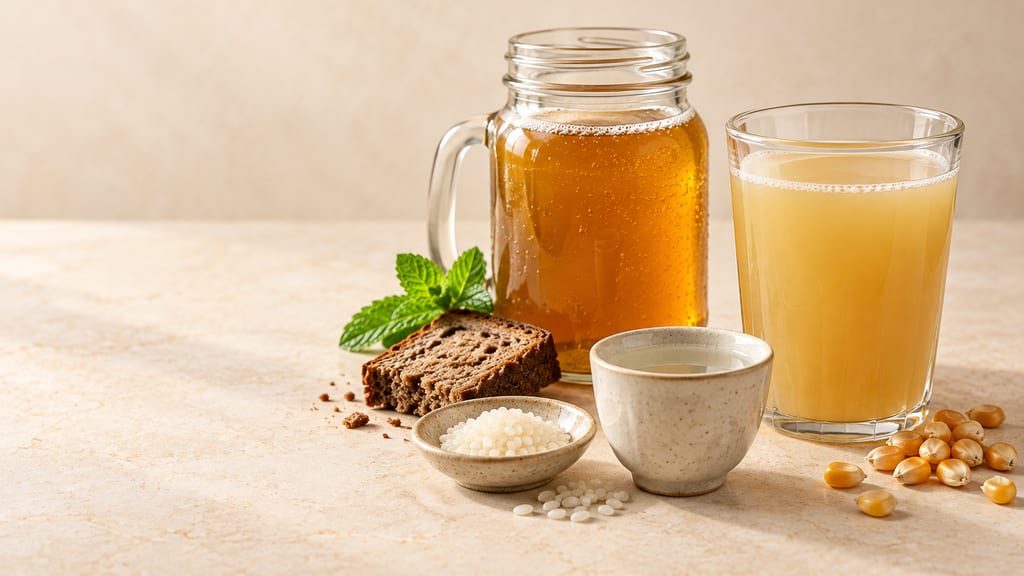
Yeast and the world's fermented drinks
People kept, traded and steered living ferments for thousands of years before anyone saw a yeast cell. This is that history, region by region, and a guide to what a yeast strain is today.
 FermenteaWhere food goes to change
Modern method
Water kefir · tibicos
Water kefir grains culture lightly sweetened water into a tart, faintly fizzy drink, with raisins added as an optional dried-fruit nutrient. Alcohol, acidity and fermentation rate vary batch to batch.
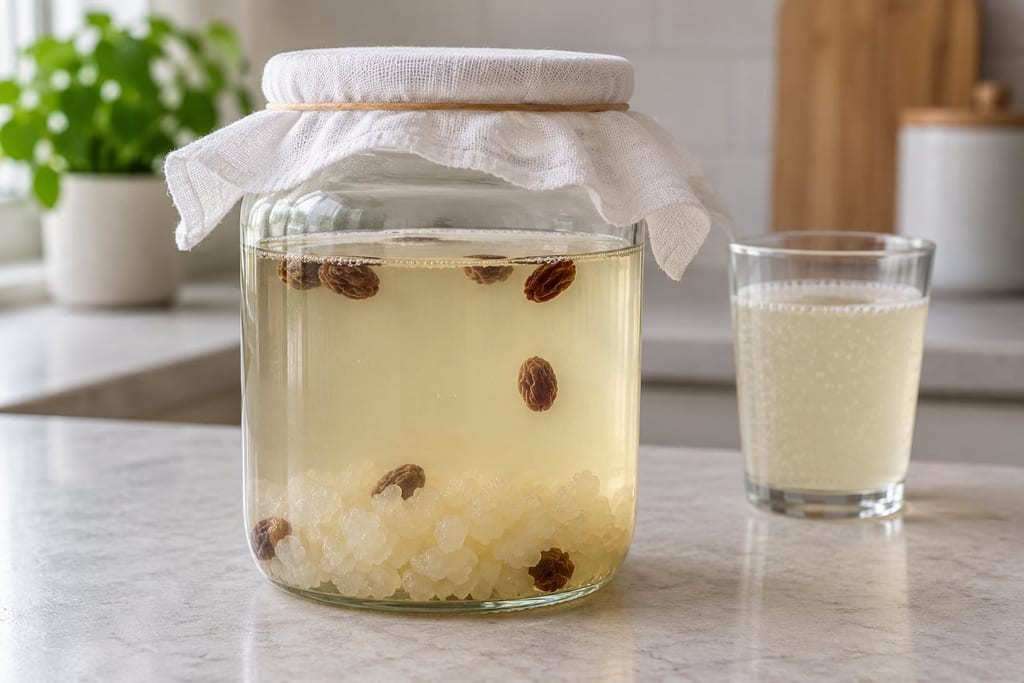
Water kefir is a fermented drink produced by placing living water-kefir grains into a sweetened aqueous solution. The grains are not cereal grains. They are translucent or pale, gelatinous microbial aggregates containing yeasts and bacteria within a polysaccharide matrix.
The organisms consume sugar and produce a mixture of organic acids, carbon dioxide, ethanol and aromatic metabolites. The result is usually a lightly acidic, sometimes sparkling beverage whose flavour depends on the sugar, grain culture, water composition and any added fruit.
The recipe preserved here is a simple sugar-water preparation with optional raisins. It uses one US quart of filtered water, a quarter cup of sugar and two tablespoons of hydrated water-kefir grains.
Raisins are an optional addition, not an essential definition of water kefir. They contribute extractable nutrients, sugars and fruit flavour and can influence microbial activity.
Water kefir is distinct from milk kefir. The latter ferments milk, producing a different beverage with different substrate requirements and a somewhat different microbial ecology.
The two systems are related in the broad sense that both use microbial consortia organised into grains, but their grains should not automatically be regarded as interchangeable.
Water kefir is also distinct from kombucha. Although both involve mixed cultures and produce acidity and carbon dioxide, the substrates and structural forms of their cultures differ.
The name tibicos is widely associated with water-kefir grains, particularly in accounts linking the ferment to Mexico.
Other names in circulation include kéfir de agua, sugar kefir, Japanese water crystals and ginger beer plant. Those names do not necessarily describe historically identical cultures.
Several competing origin stories exist. One associates tibicos with Mexico and microbial growths found on prickly-pear cactus. Another links related sugar-fermenting grains to European ginger beer plant traditions.
These accounts require care because microbial aggregates can look similar while containing different organisms.
Nineteenth-century scientific descriptions of gelatinous fermenting aggregates are important to the history of the subject, but they do not by themselves establish a single geographical birthplace for all present-day water-kefir cultures.
The relationship between water kefir and microbial growths associated with Opuntia cacti has been discussed in microbiological literature. The cactus association should be presented as a historical hypothesis or reported observation rather than proof that every modern culture descends from a particular Mexican source.
The currently available food-safety literature explicitly treats the origin of water kefir as unclear.
This record therefore retains a modern household method without assigning a traditional national origin that cannot be demonstrated.
Its ingredients are internationally available, and water kefir is now produced in numerous countries through household culture exchange and commercial sales of starter grains.
Water-kefir grains consist largely of a microbial community held within a matrix of extracellular polysaccharides.
A particularly important component is dextran, a polymer of glucose. Certain lactic acid bacteria produce dextran from sucrose using extracellular enzymes.
This helps explain the physical structure of the grains. They are not merely loose yeast sediment; they are an organised microbial habitat that can retain organisms and expand as the culture grows.
A bacterium historically called Lactobacillus hilgardii, now commonly classified as Lentilactobacillus hilgardii, has been associated with water-kefir dextran production.
Other lactic acid bacteria, yeasts and sometimes acetic acid bacteria participate in the community.
Reported yeast genera include Saccharomyces, Dekkera and others, but their presence and proportions vary among cultures.
There is no universal water-kefir species list that applies to every starter.
The organisms interact metabolically. Some break down sucrose, others consume the resulting simple sugars, and some use metabolites formed by their neighbours.
This cooperation helps support the complex fermentation that distinguishes the drink from sugar water inoculated with a single commercial yeast.
The grains themselves can change in size and appearance as polysaccharide production, growth and fragmentation occur.
Grain growth is not necessarily a direct measure of beverage quality. A culture can remain metabolically active without producing the same visible increase in grain mass under every set of conditions.
The major added carbohydrate in this recipe is sucrose.
Microorganisms can hydrolyse sucrose into glucose and fructose. These simpler sugars enter microbial metabolic pathways.
Yeasts produce ethanol and carbon dioxide through alcoholic fermentation. Carbon dioxide creates bubbles and can remain dissolved in the drink.
Lactic acid bacteria produce lactic acid, although their exact pathways vary. Some organisms are heterofermentative and also produce carbon dioxide, ethanol or acetic acid.
Acetic acid bacteria can oxidise ethanol to acetic acid where oxygen is available.
Other compounds, including glycerol, esters and aldehydes, may contribute to aroma and mouthfeel.
The overall process reduces sweetness and develops acidity, but the balance of these changes depends on the particular culture.
Water composition also matters. Minerals and buffering substances can affect microbial activity and changes in pH.
Raisins can supply nutrients and fermentable material beyond those found in plain refined sugar.
Unrefined sugars such as piloncillo or turbinado differ in mineral and flavour composition from refined white sugar. This can influence both taste and fermentation behaviour.
However, it does not follow that adding more minerals invariably improves a culture. The specific nutrient requirements and tolerances of a given mixed community are more complicated.
A significant distinction between water kefir and some other fermented foods is that initial acidity may already be low when fruit or acidic ingredients are present.
In such cases, final pH alone may not reveal how effectively fermentation occurred.
For that reason, the public-health guidance calls for verification of the fermentation process rather than treating acidity as a universally sufficient indicator.
Ingredient — Quantity — Function
Filtered water — 1 US quart — Main liquid medium
Sugar — ¼ cup — Fermentable carbohydrate
Hydrated water-kefir grains — 2 tablespoons — Living mixed starter
Raisins — 4, optional — Fruit-derived flavour and nutrients
The source offers piloncillo, cane sugar or turbinado as sugar options.
Only one of the optional nutrient additions is necessary if that option is used.
The original recipe also offers a rinsed and boiled eggshell or one tablespoon of aguamiel de maguey in place of the raisins.
Aguamiel is the sweet sap obtained from certain agaves. It is not the same as commercially bottled agave syrup.
An eggshell introduces an animal-derived material and requires particular attention to its preparation. The source specifically instructs rinsing and boiling it.
The primary raisin variation is the most relevant form for this record.
An optional secondary flavouring stage uses a quarter cup of chopped fruit or frozen berries. This addition must not be incorporated into the base ingredients unless that separate stage is chosen.
The finished yield is not measured. One US quart is the starting water quantity, not a guaranteed strained-beverage volume.
A half-gallon Mason jar is given as a suitable household vessel.
A separate container can be used for heat-treating and cooling the starting liquid before it contacts the grains.
A scale or measuring utensils are required to reproduce the quantities.
A clean strainer is needed to recover the grains. The equipment must be suitable for food contact and properly sanitised.
For repeatable, measured production, a calibrated thermometer and pH meter are useful.
Fermentation creates carbon dioxide, so a container must be able to release excess pressure.
A tightly sealed non-pressure-rated jar is not a suitable substitute for controlled venting.
The household recipe and the public-health guidance describe different fermentation windows. They are kept separate here rather than combined into an invented single schedule.
1\. Measure the base ingredients. Use one US quart filtered water, a quarter cup sugar and two tablespoons hydrated water-kefir grains. Set aside four raisins if using that variation.
2\. Dissolve the sugar. The household formula permits dissolving the sugar in one cup hot water before adding three cups cold water to reach the original quart quantity.
3\. Prepare the starting medium. Food-safety guidance recommends heat treatment of the sugar-water mixture and fruit additions before introducing the live culture. It provides a process example of 71.1°C for at least one minute. This is an example within guidance, not independent validation of every possible fruit-containing formulation.
4\. Cool before inoculation. Allow the treated starting mixture to cool to an appropriate inoculation temperature. The household recipe specifies that it must be no hotter than 98°F, approximately 37°C. Public-health guidance calls for cooling within two hours where possible and no longer than six hours.
5\. Add the living grains. Transfer the cooled liquid into a clean vessel and introduce the two tablespoons of hydrated grains. Heat treatment must not be applied to the live grains themselves.
6\. Provide the intended fruit addition. Include the four raisins only in the version using them, following the starting-medium treatment requirements rather than introducing contaminated fruit after sanitation.
7\. Allow primary fermentation. The original household recipe describes 24–48 hours at room temperature. The public-health review describes common traditional water-kefir fermentations of 48–96 hours at 21–25°C. These are descriptions from different sources, not a verified interchangeable range.
8\. Monitor the fermentation. Changes in sweetness, gas formation and acidity may become apparent. The source does not define a universally reliable sensory endpoint.
9\. Recover the grains. Strain the liquid using sanitised utensils and retain the living grains for subsequent use.
10\. Check the finished drink. Public-health guidance specifies that kefir should reach pH 4.6 or below but not below 2.5. It also warns that pH alone can be inadequate where the starting mixture is already acidic.
11\. Refrigerate promptly. Finished water kefir should be stored at 4°C or below. No validated shelf life is supplied for the household batch.
12\. Handle carbonation carefully. If additional fruit or sugar is used in a sealed secondary stage, further alcohol and carbon dioxide can develop. The original recipe offers this as an optional variation, not an essential step.
The household method does not define a final sugar concentration, total titratable acidity or alcohol content.
These omissions matter when deciding whether a batch can be safely distributed beyond immediate household consumption.
The original recipe allows a quarter cup of chopped fruit or frozen berries to be added for secondary fermentation.
This can change the drink substantially.
Fresh or frozen fruit introduces sugars, acids, flavour molecules and, depending on handling, additional microorganisms.
Fruit can contribute aroma, colour and residual sweetness. It can also create additional fermentation activity after the grains have been removed.
If the flavoured drink is bottled, pressure may accumulate rapidly.
The food-safety guidance addresses this by recommending pressure precautions and clear warnings for containers holding active fermented beverages.
The optional fruit stage has no independently established pH, pressure, alcohol or storage endpoint in the household source.
It is therefore best preserved as a documented variation rather than merged into a guaranteed-safe bottle-conditioning procedure.
Water kefir is sometimes made using dried figs, apricots, raisins, citrus peel or other fruits.
These ingredients are not identical from a chemical perspective. They contribute different mineral compositions, sugar concentrations and acids.
Different sweeteners can also produce different results.
Piloncillo gives a more pronounced cane-derived aroma than refined sugar. Turbinado introduces another level of molasses-like flavour.
Agave sap creates a different starting medium from sugar water, with its own nutrient and microbial considerations.
There are also commercial water-kefir drinks in which fermentation conditions and post-fermentation stabilisation are controlled more precisely than in household preparations.
Commercial shelf life must not be copied into a homemade recipe without evidence that the manufacturing processes are equivalent.
Water kefir is usually consumed chilled as a refreshing drink.
A basic sugar-water version can taste mildly sweet and acidic, with light yeasty or fruity notes.
The raisins may add faint dried-fruit flavour rather than a strongly identifiable grape character.
Carbonation can vary considerably between batches.
Plain water kefir can accompany ordinary meals, especially where a lighter alternative to strongly flavoured beverages is desired.
Fruit-flavoured versions are served as standalone refreshments or used in mixed drinks.
They are sometimes described as soda alternatives, but the comparison should not imply that the alcohol content is necessarily zero.
The drink contains living microorganisms unless subsequently processed to remove or inactivate them.
Claims that it treats particular diseases or reliably confers probiotic benefits are not established simply by the presence of a mixed culture.
Small bubbles and changes in sweetness or acidity are consistent with fermentation.
The grains may become larger, smaller or more fragmented depending on their condition and the medium.
Some haze or sediment can occur because yeast and bacterial cells remain in suspension.
A gradual shift from plain sugar-water flavour toward a pleasantly acidic drink indicates that microbial transformation is occurring.
However, appearance, sweetness and bubbling are not adequate food-safety measurements.
A sluggish batch might reflect damaged grains, insufficient nutrients, unsuitable water or temperature conditions.
A culture that has been improperly stored may not regain normal activity immediately.
A lack of grain multiplication does not necessarily mean the culture is dead, but it is a reason to consider its condition and performance.
Visible mould or abnormal putrid odours are reasons to discard the batch.
Unusual sliminess outside the normal grain structure, suspicious colour development or evidence of contamination also require caution.
The major concerns are contamination of starting ingredients, failure of the intended fermentation, alcohol production and carbon dioxide pressure.
The public-health review identifies E. coli O157:H7, Salmonella and Listeria among pathogens relevant to starting-medium contamination.
Heat treatment before inoculation reduces risks associated with raw starting materials, but a valid treatment for a specific product must account for its composition and equipment.
Fermentation performance needs to be verified. A pH endpoint alone may be insufficient, especially for initially acidic fruit-containing preparations.
Water kefir may produce measurable alcohol, and alcohol content can continue changing during storage.
The Canadian guidance discusses checking alcohol concentration against applicable requirements and recommends cautionary labelling for potentially alcoholic kefir beverages.
It also identifies excess carbonation as a storage hazard.
Refrigeration at or below 4°C is recommended after completion.
The review states that reliable water-kefir shelf-life information is unavailable. Therefore, a fixed shelf life should not be invented.
Editorial conclusion: Preserve the simple raisin-and-sugar household recipe, but treat the public-health guidance as a separate control framework. Do not present its pH and temperature recommendations as proof that the particular household process has already been validated.
The BCCDC and Manitoba Agriculture review states that the origin of water kefir is unclear. This entry records a contemporary home preparation, not a traditional origin.
Scaling: source batch only
The food-safety review says contaminated ingredients can introduce pathogens and recommends heat treatment of the starting mixture before inoculation.
Hazard sourceGovernment guidance reports water kefir can contain elevated alcohol and carbon dioxide can build up in containers.
Hazard sourceHeat-treat the sugar-water and fruit starting mixture before adding activated grains; use clean, sanitized equipment and sieve.
Control sourceMeasure final pH and alcohol and refrigerate at 4°C or below; the source notes that pH alone may not be meaningful if the starting mixture is already acidic.
Control sourceDo not rely on this recipe alone to verify safety: the government review says a water-kefir process needs validation and measured fermentation performance.
Alcohol and carbonation can build. Do not call the drink alcohol-free; use a vented fermenting container and refrigerate the finished beverage.
The public-health review says water-kefir origins are unclear; this recipe is a contemporary home adaptation.
People kept, traded and steered living ferments for thousands of years before anyone saw a yeast cell. This is that history, region by region, and a guide to what a yeast strain is today.
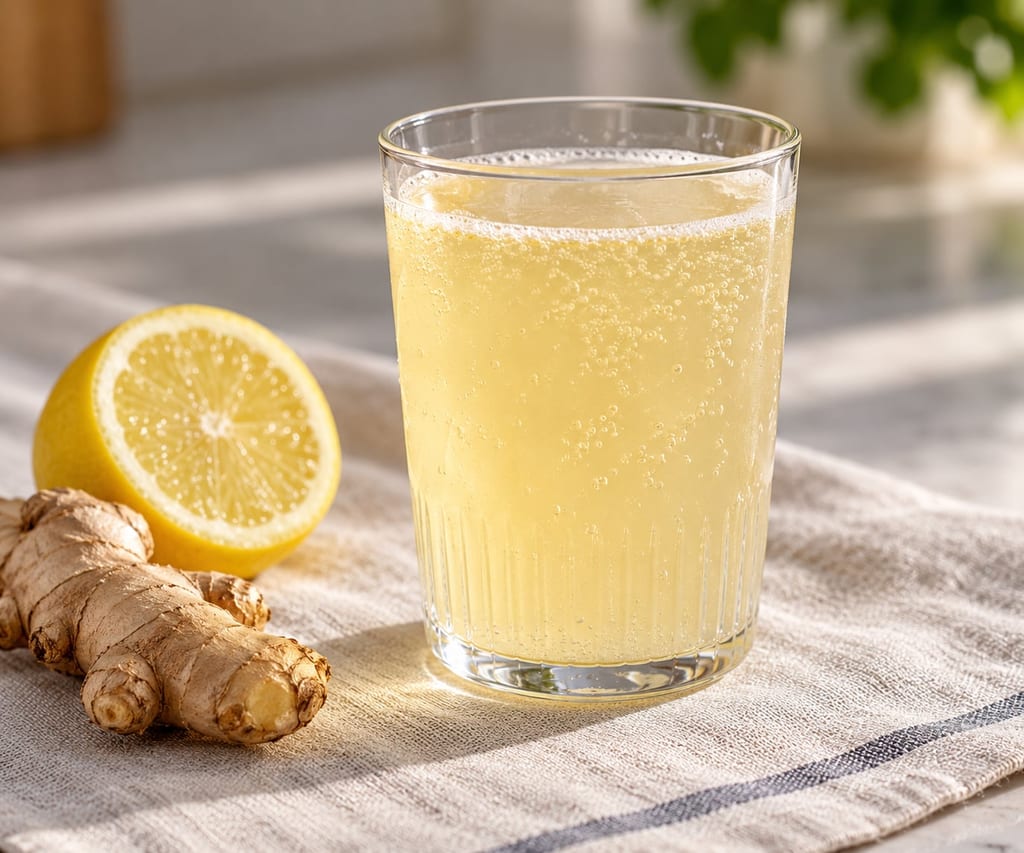
A one-liter teaching recipe ferments bruised ginger, lemon, sugar and cream of tartar with measured baker’s or ale yeast, then conditions the drink briefly in PET bottles before refrigeration.
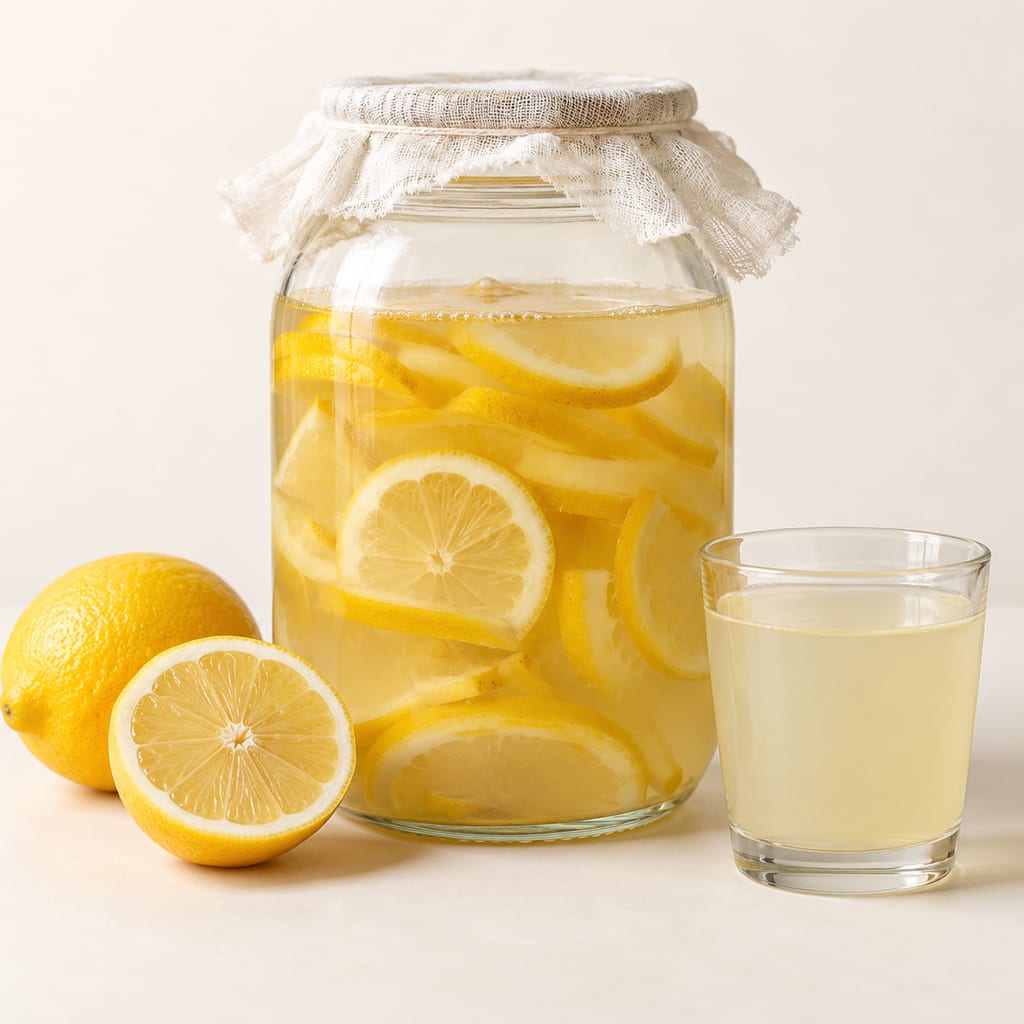
A lightly fizzy lemon drink made from peel-on lemons, water and sugar, held in a covered jar, bottled and kept going with small sugar and peel additions.
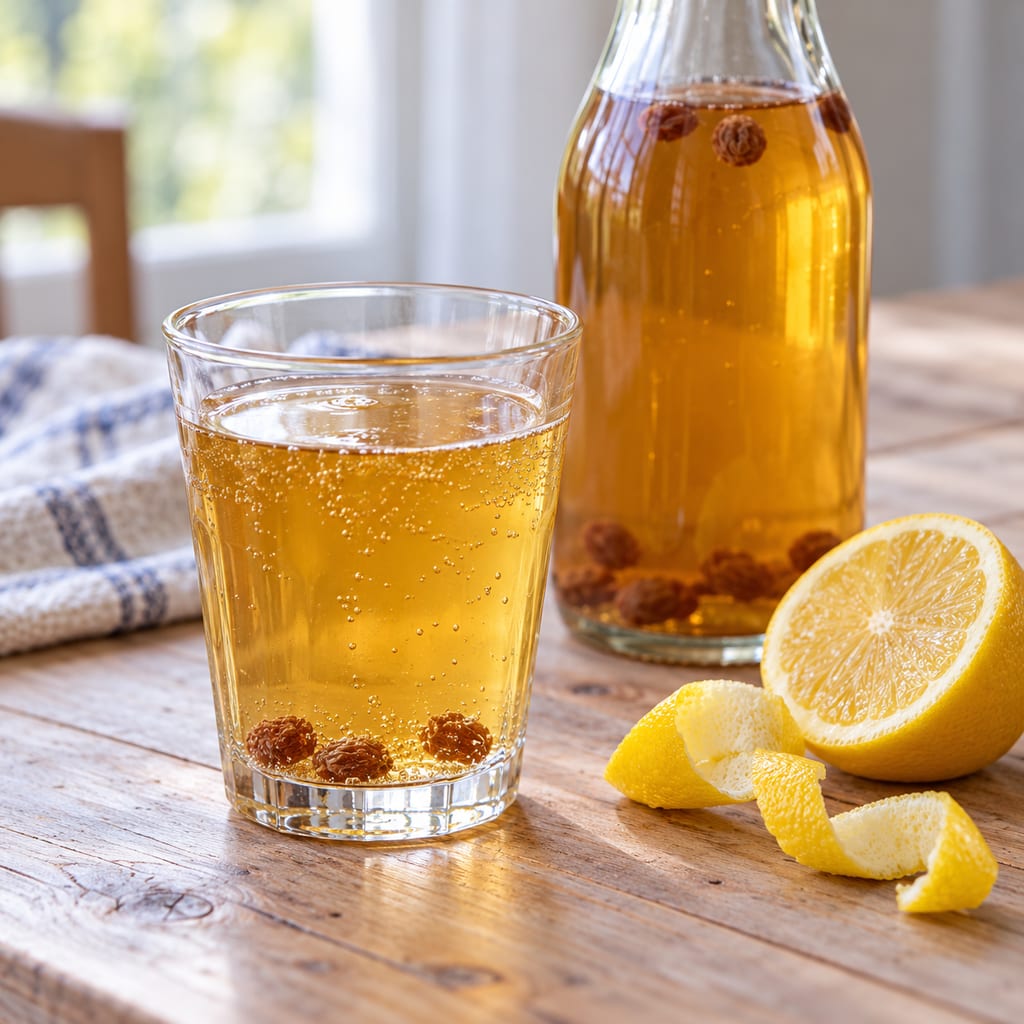
A lightly fermented Finnish May Day drink of lemon, white and brown sugar and a little yeast, bottled with raisins that rise as the carbonation builds.
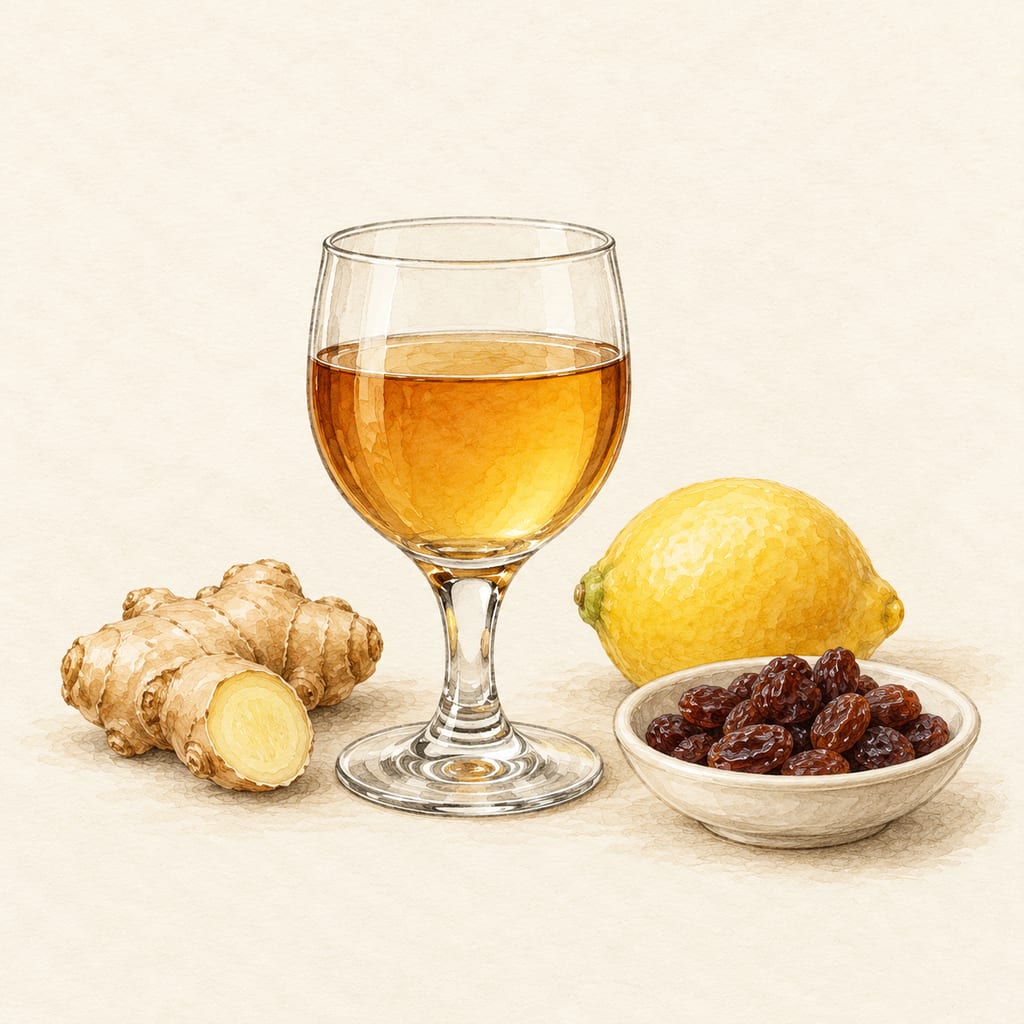
A Victorian household wine of boiled sugar, lemon and bruised ginger, worked on raisins in a cask for a fortnight and finished with brandy, made nine gallons at a time.

Jun is a fermented tea drink made with green tea and honey instead of the sweetened tea of kombucha. Its culture identity and origin are not established, and sealed bottles can build pressure and alcohol.
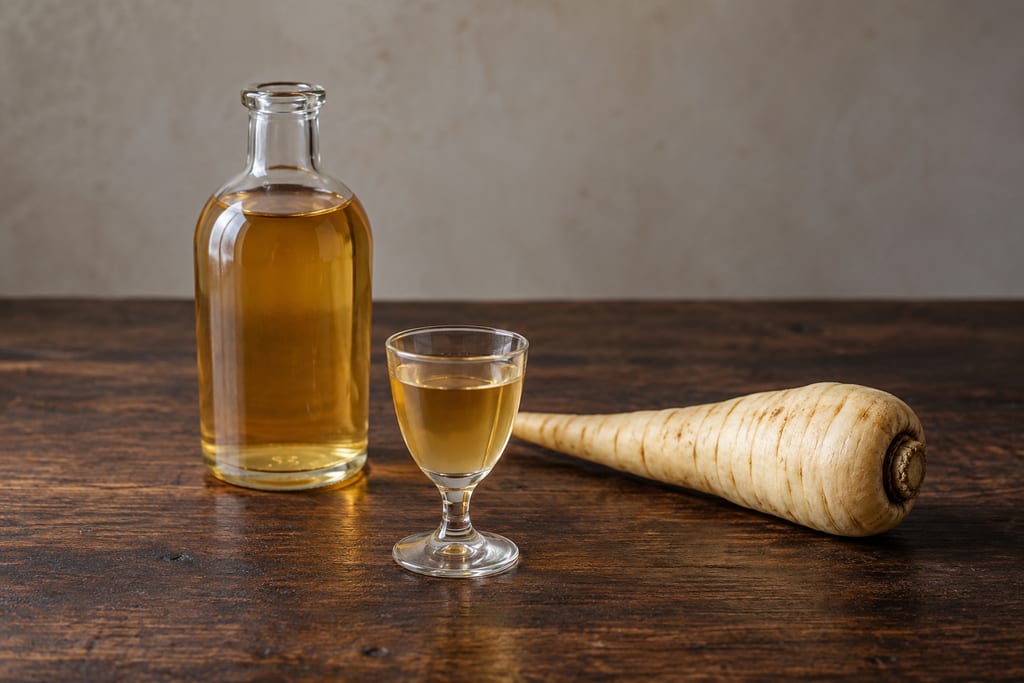
Wright's 1909 compilation records a parsnip wine made from boiled roots, sugar and a little yeast. The liquor spends ten days in a tub, then twelve months in a cask topped up daily only while the wine works over.
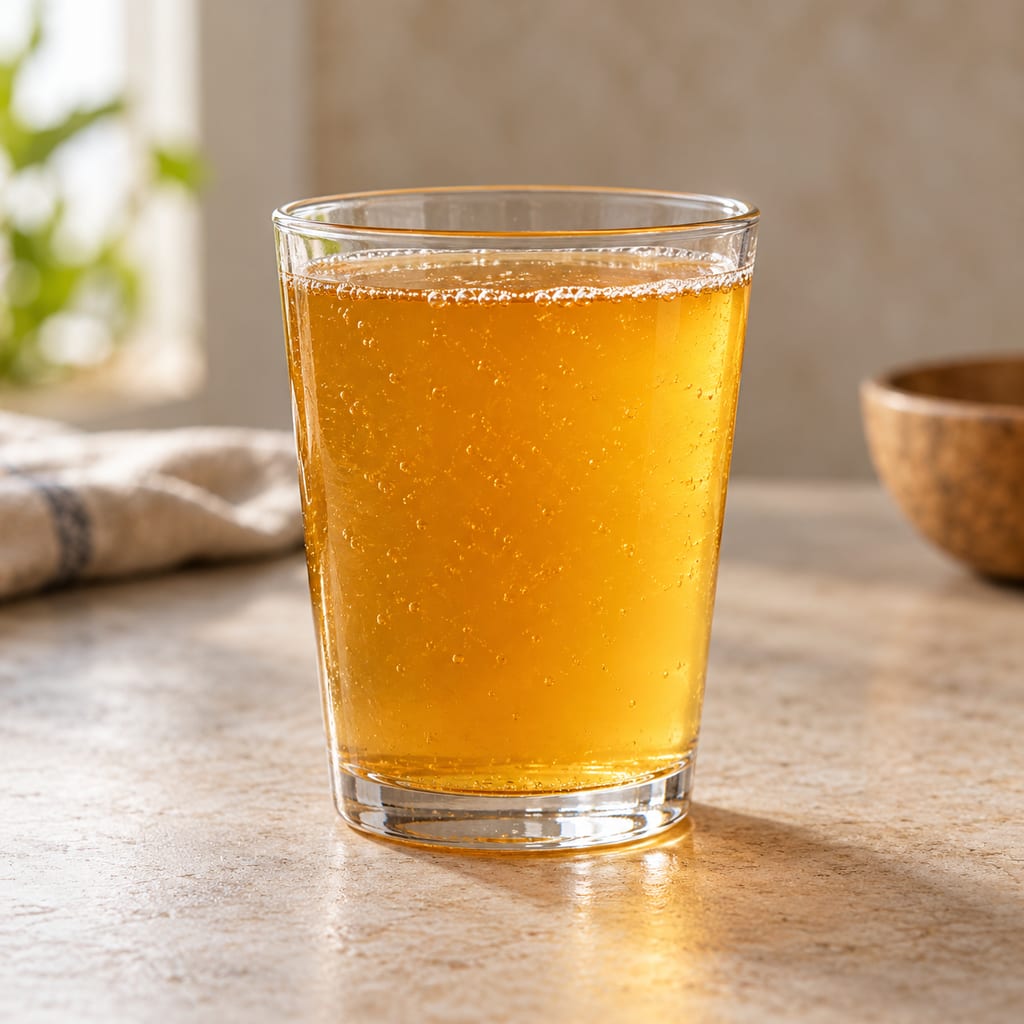
An Oregon State food-science lab formula ferments pineapple skin and piloncillo with jalapeño and warm spices for three to five days, then strains and refrigerates it. The handout reports wide alcohol variability.
No community contributions have been published for this entry yet.
Sign in to contribute. Published comments and photos are free to read.
Mother Earth NewsInspiration · Process
Water Kefir Recipe¼ cup sugar, 1 quart filtered water, 2 tablespoons hydrated water kefir grains and optional 4 raisins
Dissolve sugar, add hydrated grains, culture 24–48 hours, strain and refrigerate; secondary fruit stage is optional
Source warns bottle pressure can build; not used as a safety-validation source
Cited in: What it is; Ingredients and their roles; Equipment; Preparation stages; The optional fruit-flavoured stage; Other variations; How it is served; Recognising normal activity
Manitoba Agriculture; BC Centre for Disease Control and Public Health Ontario contributing authorsSafety · Process · Culture background · History
Safety of Fermented Foods: Section 3.12 KefirWater kefir grain culture contains mixed bacteria and yeasts; water-kefir origin is unclear
Review recommends heat treatment of starting ingredients, active grains, measured process performance, pH/alcohol checks, venting and refrigeration
Traditional fermentation commonly 48–96 h at 21–25°C; final kefir pH 2.5–4.6, but pH may not validate safety if the starting mixture is already low
Cited in: What it is; Equipment; Preparation stages; Recognising normal activity; Safety, alcohol and storage
Applied and Environmental MicrobiologyInspiration
Microbial Species Diversity, Community Dynamics, and Metabolite Kinetics of Water Kefir FermentationWater-kefir microbial ecology
Cited in: The microbial grain; Fermentation chemistry; Ingredients and their roles
Heliyon, 2024Inspiration
Challenges in Water Kefir Production and Limitations in Human ConsumptionCurrent scientific review
Cited in: Names and geographical history; Fermentation chemistry; How it is served; Safety, alcohol and storage
Inspiration
Water Kefir: A Review of Its Microbiological and Physicochemical CharacteristicsCulture and substrate variation
Cited in: Names and geographical history; The microbial grain; Other variations