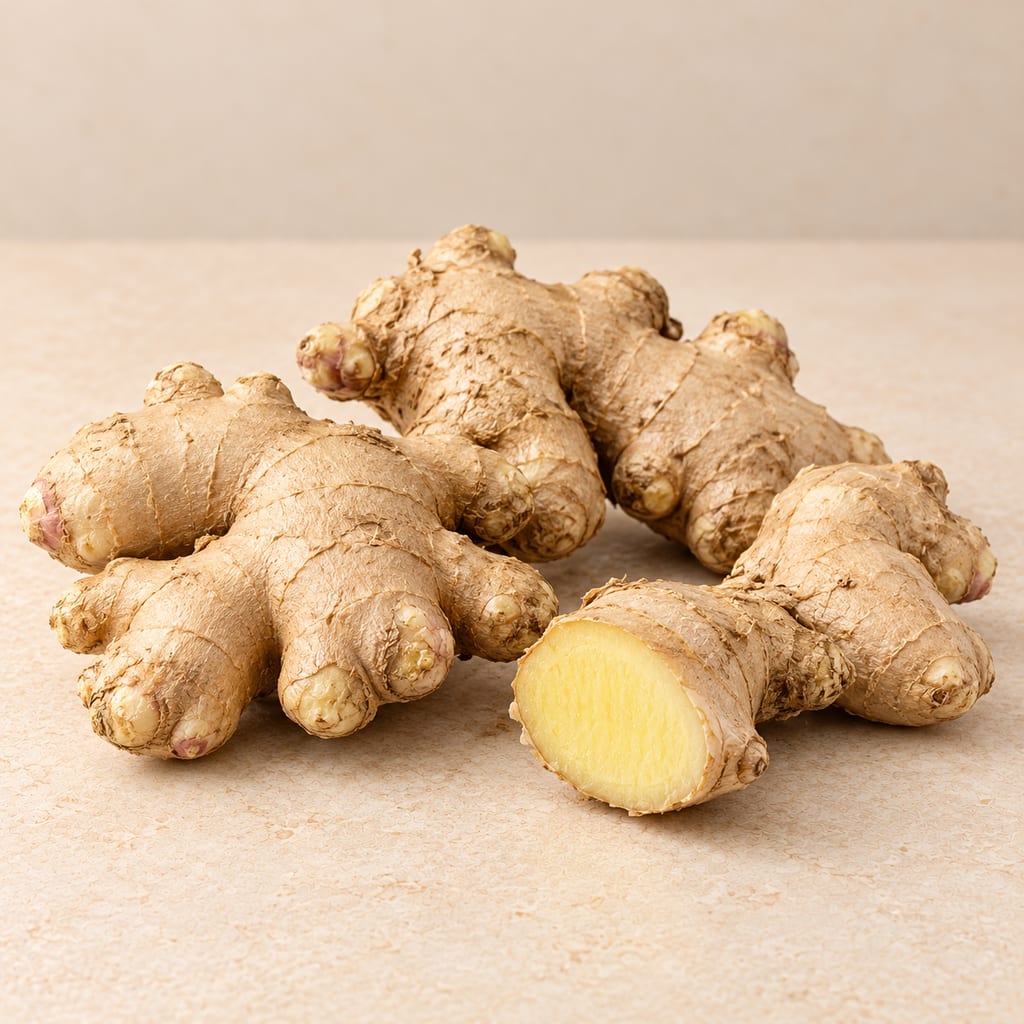
Ginger
Ginger is the aromatic rhizome of Zingiber officinale, used fresh, dried and preserved. Historical ginger wines sliced or bruised it to flavour a sugar-based ferment.
 FermenteaWhere food goes to change
Historical attestation
Ginger Wine
A Victorian household wine of boiled sugar, lemon and bruised ginger, worked on raisins in a cask for a fortnight and finished with brandy, made nine gallons at a time.
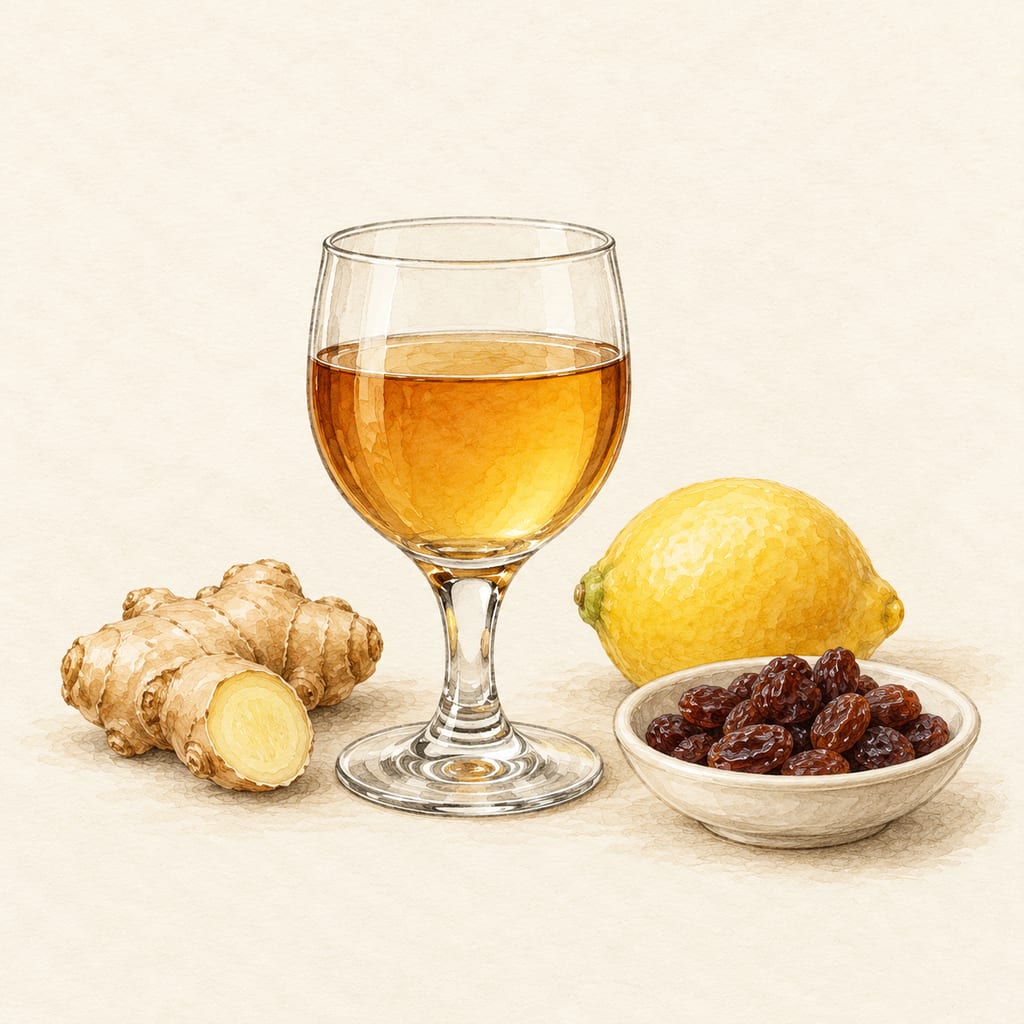
Ginger wine is a spiced household wine in which ginger is carried by a sweetened, yeasted liquor rather than by grape must. This particular version follows Isabella Beeton’s 1861 recipe 1819: water and loaf sugar are boiled with lemon rind and bruised ginger; fresh yeast is added after the liquor cools; strained lemon juice and chopped raisins go into a dry cask the next day; after a fortnight of daily stirring, the wine receives brandy and is closed gradually. Beeton’s batch is nine historical gallons. The book gives no modern metric equivalent, no measured alcohol content, and no test for the point at which fermentation has stopped.
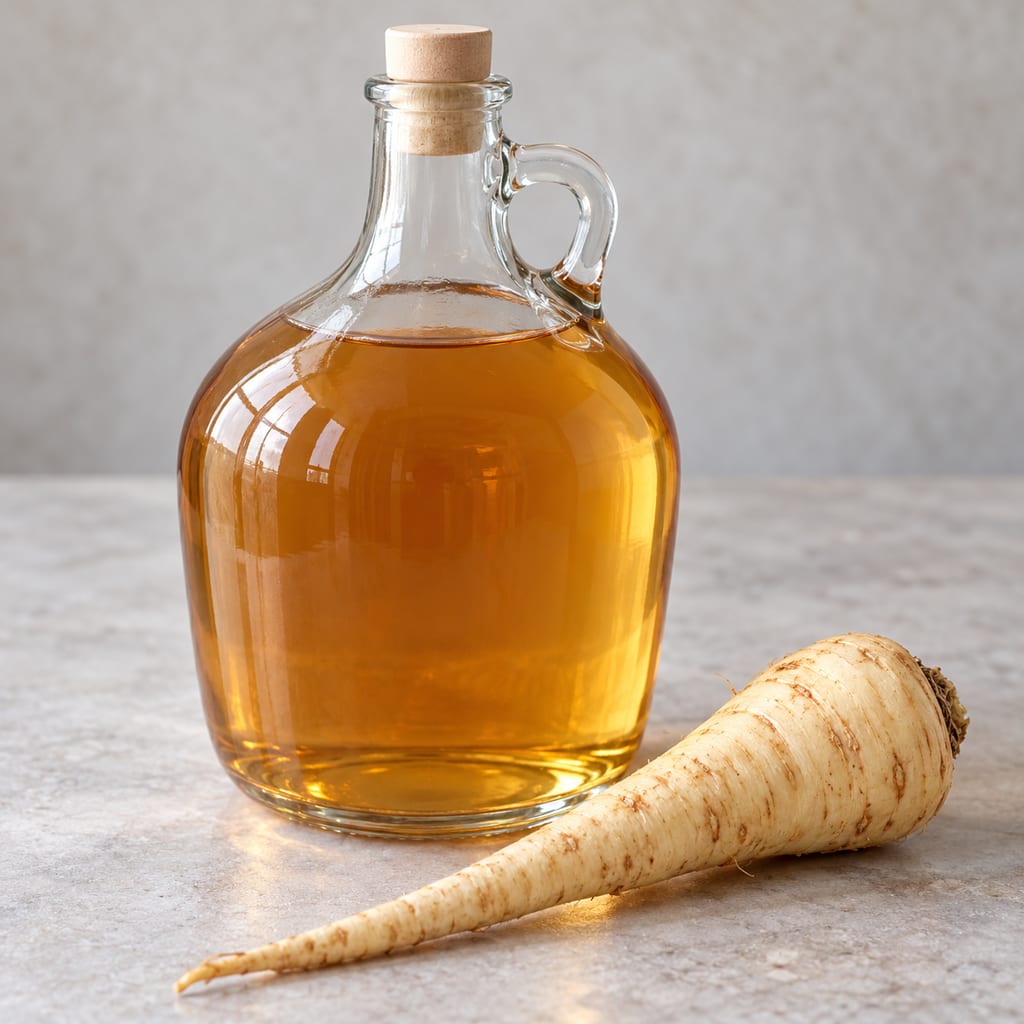
The title describes a family of drinks, not a single fixed formula. Some later commercial ginger wines are fortified fruit or currant wines; others are modern, bottled beverages with a producer’s own process. They are useful appearance references, but they do not establish the colour, strength or exact taste of Beeton’s cask. The published image likewise illustrates a finished amber ginger wine, not a documentary reconstruction of a Victorian batch. The record keeps the historical formula intact so the reader can see what the book actually prescribes without mistaking it for a validated contemporary winemaking protocol.
Beeton’s book locates this recipe in a particular publishing moment: recipe 1819 appears in the beverage chapter of a household manual printed in London in 1861. That is a dated attestation, not proof that the drink began in London or that Beeton invented it. Its ingredient list belongs to a broader household-wine repertoire in which sugar, fruit, spices, yeast and sometimes spirits made drinks outside the grape-wine tradition. The recipe’s cost notation, 2 shillings per gallon, and the recommendation to make it in March or September place it among practical household provisions, though they do not tell us how many readers followed the directions.
Elizabeth Moxon’s English Housewifry, in an edition dated 1764, gives an earlier printed ginger wine that differs substantially. It uses fourteen quarts of water, three pounds of loaf sugar, one ounce of sliced ginger and three lemons; brandy and a yeast-covered toast are added when the liquor is milk-warm, and the mixture works for a day before being transferred. Moxon’s shorter method is not a preliminary step in Beeton’s recipe. Comparing them shows the category changing across books: the later version scales to nine gallons, includes raisins, uses a cask and daily stirring, and waits weeks before bottling.
The Horniman Museum’s account of ginger describes its early English associations with courtly medicinal practice and the high cost of imported spices in the Tudor and Stuart periods. That context helps explain why ginger could mark a drink as flavoured and valuable, but it does not establish that Beeton’s nineteenth-century wine was prescribed as medicine. The documented source for this batch is domestic cookery; later medicinal associations should not be carried forward as health claims.
Yeast turns fermentable sugars into ethanol and carbon dioxide, while also producing smaller quantities of compounds that contribute aroma and flavour. In grape wine, glucose and fructose are major sugars and Saccharomyces commonly carries out much of the alcoholic fermentation. Those are general wine-science examples, not an identification of the yeast or the exact reaction in Beeton’s cask. Her source names only three tablespoonfuls of yeast, described as thick and very fresh; it does not identify a species, strain, cell count or whether the yeast was cultivated or gathered from another fermentation.
Here the fermentable sugar comes mainly from loaf sugar dissolved in water. The historical recipe also includes raisins, whose sugar, nutrient and other contribution is not documented. Ginger and lemon supply flavour rather than a documented measurable fermentation role. The process therefore differs from grape wine, where juice itself supplies the fermentable sugars and many other components. A modern scientific description can explain why a yeasted sugar liquor may become alcoholic, but it cannot predict how a nineteenth-century batch actually behaved.
Brandy is added after the two-week stirring period, but Beeton does not state its strength or say whether it is meant to stop fermentation, raise alcohol, change flavour or do more than finish the wine. It should not be treated as a calculated stabilization step. The recipe reports a sequence; it does not specify the chemistry or endpoint of that sequence.
Loaf sugar is the main measured source of fermentable material in this formula. At twenty-seven pounds for nine gallons, it makes a very sweet starting liquor by modern household proportions, although no final sweetness or alcohol can be inferred because the recipe supplies neither sugar measurements during fermentation nor a residual-sugar result. The recipe’s historic gallon is undefined in the source record, so converting the batch to litres would imply a precision the text does not support. It is best read as the original nine-gallon scale rather than casually divided into a modern bottle-sized batch.
Bruising the ginger breaks it into pieces and increases exposed surface; the one-hour boil lets the ginger and lemon rind steep in hot sweetened water. This is an extraction stage, not fermentation. Beeton specifically instructs the cook to skim the liquor and move it out of the copper into a tub or pan after boiling. The strained lemon juice is added later with the raisins, not boiled with the rind. Keeping rind and juice separate preserves the sequence of the printed recipe and avoids silently changing the extraction.
The thick, fresh yeast wording is a quality description, not a modern yeast specification. It gives no temperature, mass or commercial equivalent. Raisins are stoned and chopped before entering the cask; that prepares the fruit and exposes it to the liquid, but the source does not say whether raisins were expected to contribute more sugar, flavour or body. Brandy appears only after the daily-stirring period. A contemporary substitution should not be invented for any of these ingredients if the goal is to reproduce the historical method.
Beeton starts with a well-scoured copper because the liquor is boiled there, but explicitly says it should not remain in the copper after boiling. The directions transfer it to a large tub or pan and wait until it is nearly cold before yeast is introduced. This cooling interval separates heat extraction from fermentation: adding yeast to a still-hot liquid would expose living cells to damaging heat, though the historical source offers no thermometer reading or inoculation limit. “Nearly cold” is the source’s sensory instruction and should not be converted into an invented temperature.
The next-day transfer moves the liquor, strained lemon juice and chopped raisins into a dry cask. The adjective “dry” describes the vessel’s condition; the recipe does not prescribe sterilization, a specific wood, a bung design or headspace. Its daily-stirring instruction keeps the recipe’s solids and liquid in contact and is part of this particular method. It should not be silently replaced by a modern airlock method or by an open-vessel technique from a different wine recipe.
After two weeks, brandy is added and the cask is stopped gradually. The calendar estimate is “a few weeks” before bottling; the separate note says wine begun early in March may be fit in June. The book gives no gravity reading, fermentation lock observation or other completion test. These dates document the historical recipe’s expectation, not a reliable endpoint for a new batch made with different yeast, ingredients, vessel, temperature or volume.
Moxon’s 1764 version is the clearest contrast in the records used here. Its ginger is sliced rather than bruised; the liquor boils for half an hour rather than an hour; egg whites are used for fining; brandy and a yeast-bearing toast enter when the liquid is milk-warm; and Moxon says to work it for one day before tunning it. Johnson’s 1755 dictionary defines “to tun” as putting liquor into casks, so Moxon does include a cask transfer, although the receipt gives no duration or handling details for that stage. Beeton’s version instead uses raisins, cask transfer the next day, two weeks of daily stirring and a later brandy addition. Combining Moxon’s clarifying step or one-day fermentation with Beeton’s batch would create a recipe neither book gives.
Beeton’s own recipe 1827 offers another branch. In an orange-wine instruction, she says ginger wine may be made in the same manner without boiling, with two pounds of bruised whole ginger in a muslin bag and sugar placed in the cask; the book gives ten days to make and recommends bottling the following January. That is a distinct cask method, not a minor optional garnish to recipe 1819. It changes the extraction method, ginger format, handling of sugar and calendar, so it belongs as a separate preparation if catalogued.
These printed alternatives show why “ginger wine” cannot be reduced to one universal process. A recipe may be quick and toast-inoculated, boiled and cask-matured, or unboiled and steeped over months. Each has its own source and timeline. The version here follows recipe 1819 alone and names the alternative only to help readers understand the family.
The sources establish ginger wine as a beverage made for bottling and use, but they say little about how Beeton’s batch was served. A household wine of this kind could be poured as a drink or used in recipes that called for wine, yet the exact culinary uses of this formulation are not supplied in the cited pages. The historical method does not prescribe chilling, warming, dilution, food pairings or garnish. Later producers may recommend their own ginger wine with cheese, in winter drinks or as a cooking ingredient, but those directions belong to those modern products, not to Beeton’s recipe.
The formula suggests a beverage shaped by sugar, ginger and lemon, with raisins and brandy added later, but an evidence-based page should not invent a tasting note. Beeton supplies no description of colour, aroma, sweetness, heat or body. Nor does the recipe say whether the finished drink was clear, cloudy, still or sparkling. The approved image shows a plausible amber drink from the broader ginger-wine family; it cannot settle these historical details.
The early English history of spiced wine is wider than this formula. The Horniman Museum notes that ginger-spiced wine known as hippocras was associated with medicinal use at the English court. That is useful cultural context for ginger and wine together, but hippocras is a different drink and does not establish that this household ginger wine shared its recipe, purpose or social setting. This distinction keeps cultural history connected without collapsing different preparations.
The recipe’s timing is unusually specific for a historical household wine: boil for an hour, add yeast when nearly cold, transfer the following day, stir daily for a fortnight, add brandy, stop the cask down by degrees, and bottle after a few weeks. These instructions tell us what the book expected, but they do not measure fermentation. No starting density, final density, pH, alcohol percentage, residual sugar, pressure or microbial stability is reported. A month or a seasonal date cannot prove that a modern batch is finished.
That omission matters because fermenting liquid can keep producing carbon dioxide. If a sweet or actively fermenting wine is sealed in a bottle, pressure can accumulate. A later home-wine source warns of a working parsnip wine bursting paper over its cask; another historical housekeeper says to bung a cask only after fermentation has ceased. Those examples support caution about pressure, but neither provides a ginger-wine endpoint. They are not a modern validated protocol.
This is a historical recipe, not a tested shelf-stable beverage formula. Do not bottle by calendar alone or treat brandy, a quiet surface, taste, smell or a clear appearance as proof that fermentation has stopped or that the wine is safe. The source gives no instrument-based endpoint or modern packaging procedure. A reader seeking a reproducible beverage should use a current, tested home-winemaking method with measured ingredients and an appropriate fermentation-completion protocol rather than treating this nineteenth-century timetable as process validation.
The record ties the preparation to a London household book in 1861 and to a printed English recipe tradition that includes Moxon’s 1764 ginger wine. It does not claim a single origin, an uninterrupted regional lineage or a fixed style shared across Britain. The recipe’s location is its historical publication, not the birthplace of the drink. Ginger’s longer history as an imported spice and a flavour in courtly beverages is relevant background, but evidence about trade routes, cultivation regions and nineteenth-century household access would require dedicated sources beyond the recipe pages used here.
The record also preserves the limits of the primary text: the historical gallon is not converted, the yeast is generic, the fermentation is not instrumented and the final drink is not described. General science explains yeast fermentation but does not identify Beeton’s organisms or establish the sensory outcome. A source can establish what a recipe says without proving that every household followed it or that every batch behaved the same way.
Those boundaries make the method more useful. Readers can compare Moxon’s faster formula and Beeton’s own unboiled cask alternative, understand what each stage was intended to do, and see why a period instruction cannot be used as modern safety assurance. The recipe remains a documented historical preparation, with its quantities and sequence intact and its unknowns stated plainly.
Ginger wine belongs to the British tradition of household wines made from sugar, dried fruit and flavourings rather than grapes. An early printed recipe is Elizabeth Moxon's, in an edition of English Housewifry dated 1764: fourteen quarts of water, three pounds of loaf sugar and an ounce of sliced ginger boiled for half an hour and fined with egg whites, then three lemons, a quart of brandy and a toast spread with yeast added when the liquor was milk-warm, worked for a day, tunned, bottled within five days and ready to drink a week after bottling. Isabella Beeton's Book of Household Management (London, 1861) prints a stronger and slower wine, recipe 1819: nine gallons made with 27 lb of loaf sugar, 12 oz of ginger, nine lemons and 2 lb of raisins, stirred in the cask for a fortnight, finished with brandy and bottled after some weeks, at a stated cost of 2s. a gallon. Per gallon that is three pounds of sugar and about an ounce and a third of ginger, against Moxon's less than a pound of sugar and a third of an ounce, and with raisins and a longer, fortnight-long cask process in place of Moxon's one-day working period before tunning and five-day bottling instruction. The same book gives a second way, in its orange wine recipe 1827: ginger wine may be made the same way, without boiling, with two pounds of whole bruised ginger in a muslin bag put into the cask with the sugar, ten days to make and bottling the following January.
Yield 9 historical gallons, as stated in the recipe · Scaling: source batch only
A parsnip wine in a 1909 collection is likely to work up and burst the paper pasted over the cask; a wine closed in or bottled while it is still working builds pressure, and this recipe sets the time to bottling by the calendar, not by a test.
Hazard sourceStop the cask down by degrees, as the recipe says.
Control sourceBung the cask only when fermentation has ceased, as a parsnip wine in a book of 1851 does.
Control sourceBottling before fermentation has stopped can build pressure and burst bottles; close the cask by degrees and bottle only once the wine has stopped working.
Printed in London in Isabella Beeton's household book of 1861; no birthplace or regional method is claimed.
Ginger is the aromatic rhizome of Zingiber officinale, used fresh, dried and preserved. Historical ginger wines sliced or bruised it to flavour a sugar-based ferment.
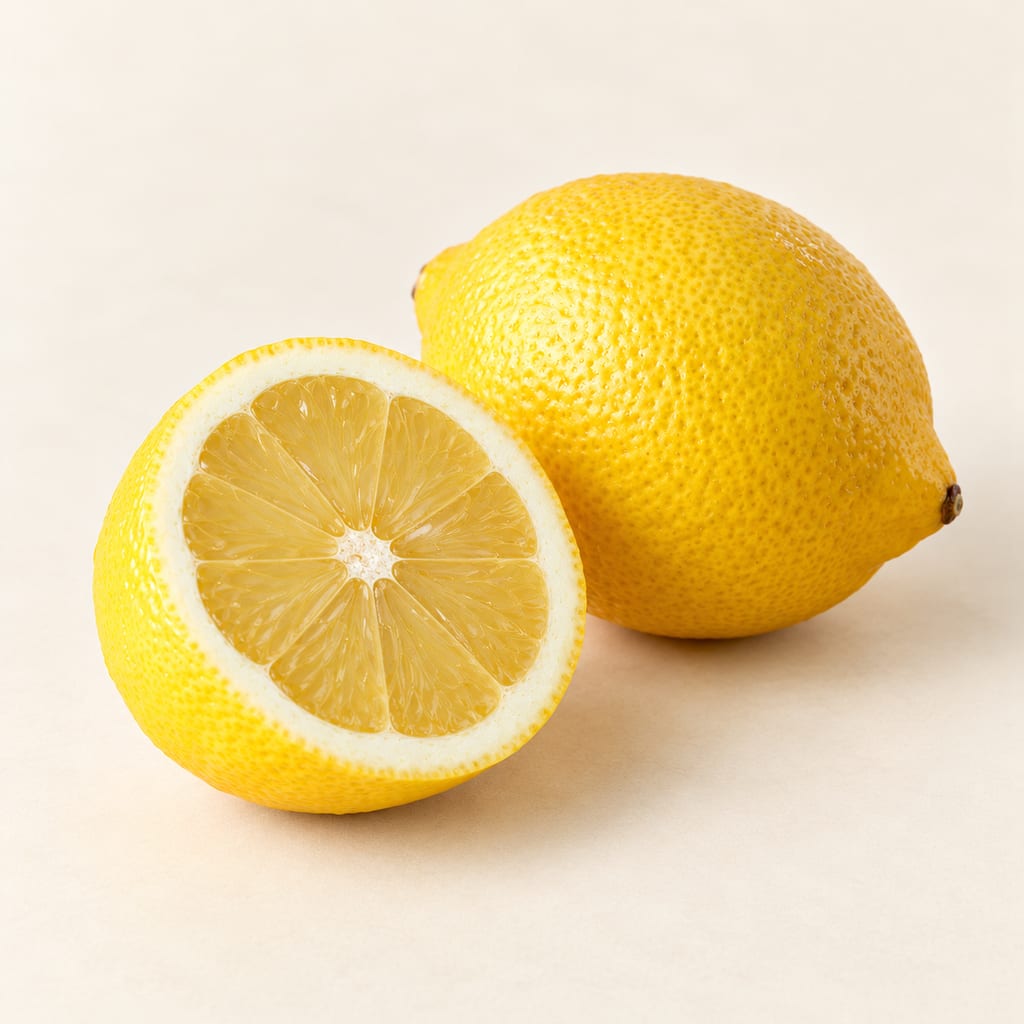
Lemons are aromatic, acidic citrus fruits whose peel, pith and juice serve different jobs in food and drink. The fruit is a hybrid with a complex history.
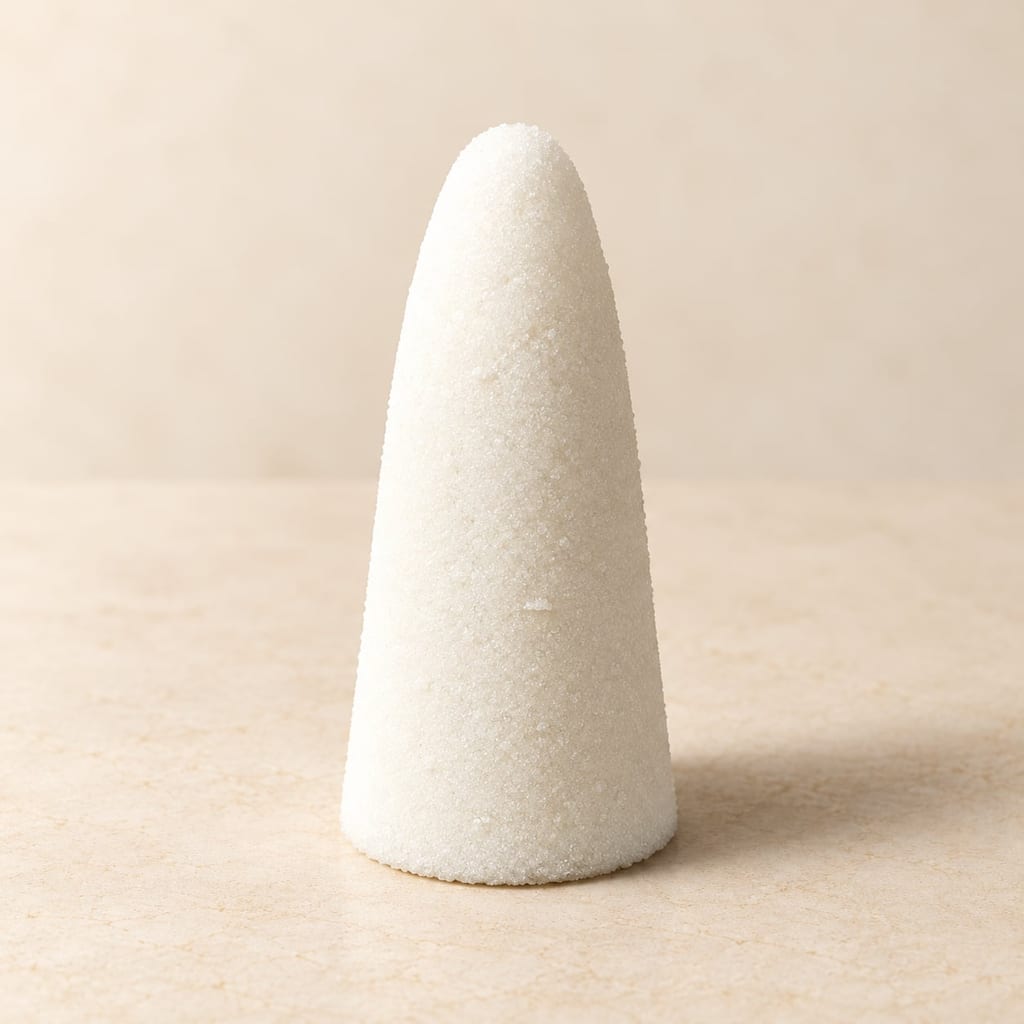
Refined sugar formed into a solid cone, historically cut or powdered for kitchen use and dissolved into wine liquor.
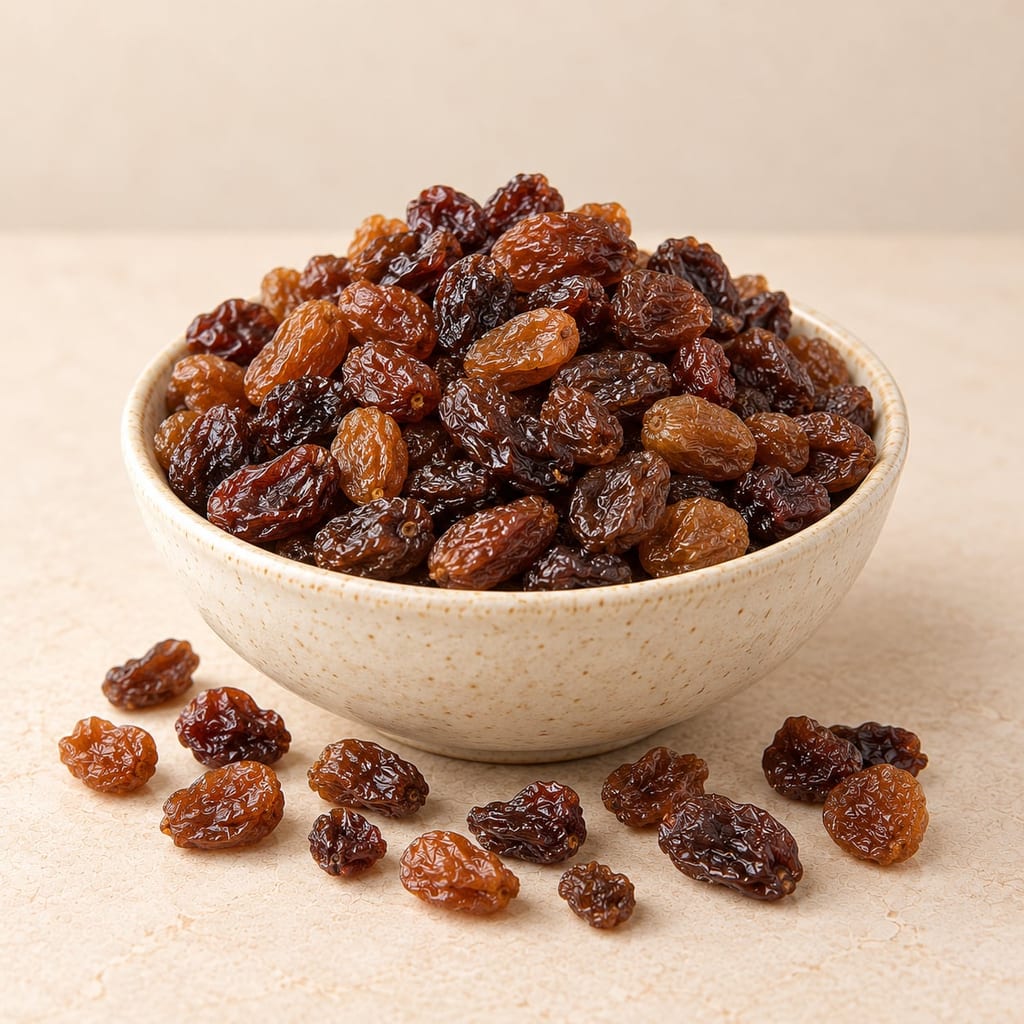
Raisins are dried grapes whose variety and drying method shape their size, colour and flavour. In a documented 1861 ginger wine they are stoned, chopped and added to the cask after yeast.
Yeast named by a recipe without an identified species, strain or commercial form, used to begin a fermentation.
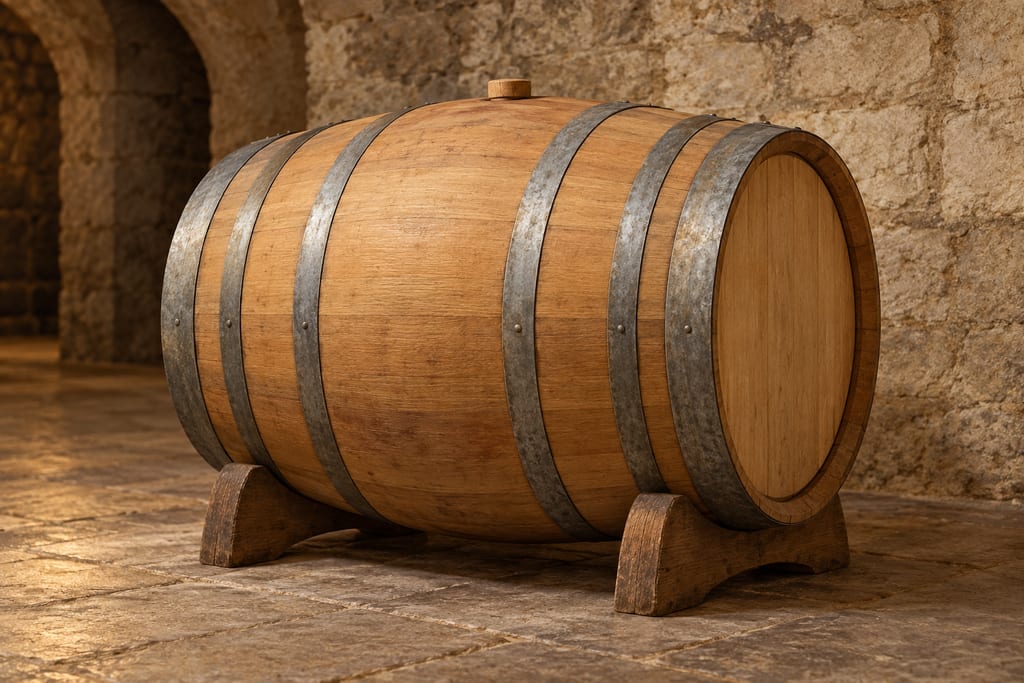
Coopered vessels use shaped staves and hoops, but portable barrels, large foeders and upright wooden vats serve different roles. Materials and uses vary by place and process.
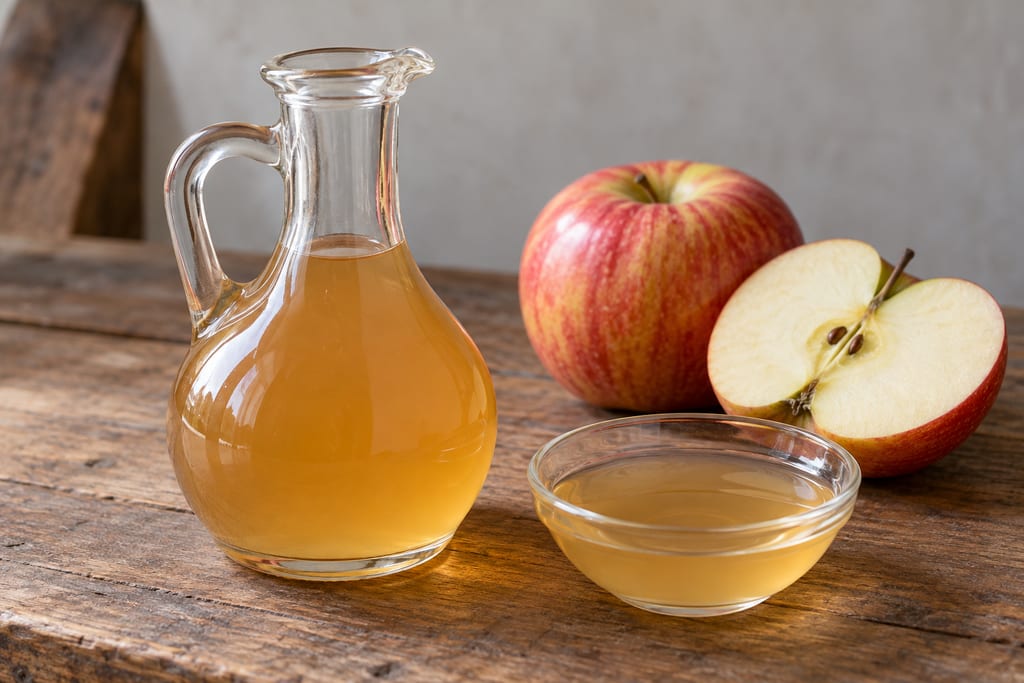
Cider vinegar is made when acetic-acid bacteria use oxygen to turn the alcohol in dry apple cider into acetic acid. This historical cask method begins with fermented cider and differs from apple-scrap vinegar made with sugar and water.
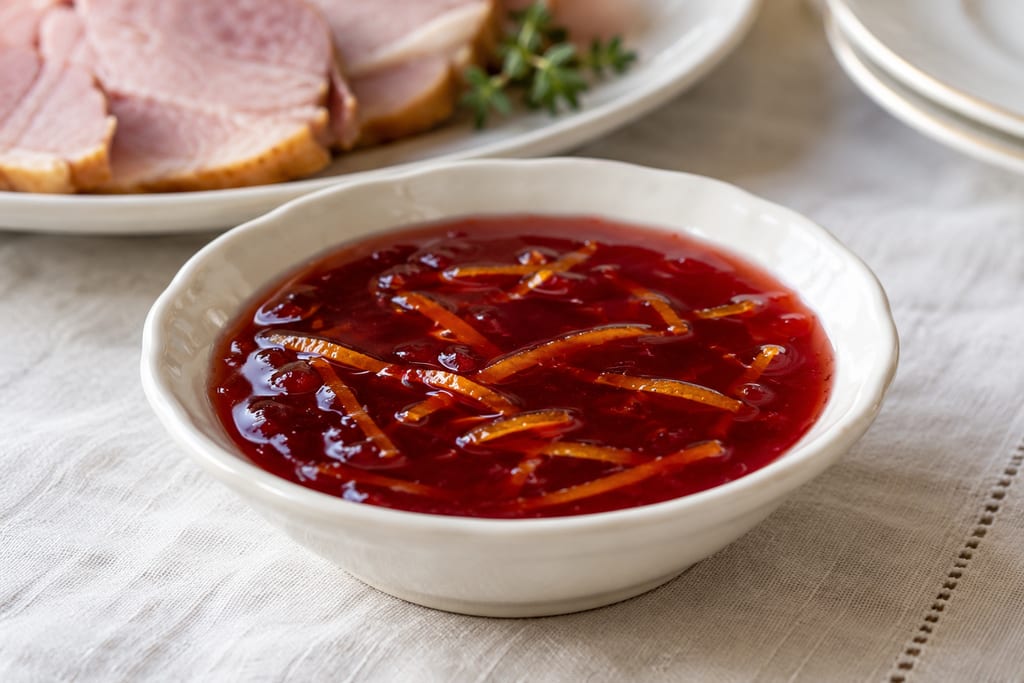
Cumberland sauce is a British condiment of redcurrant jelly, mustard, blanched orange peel and port, traditionally served cold with ham, game and cold meats.
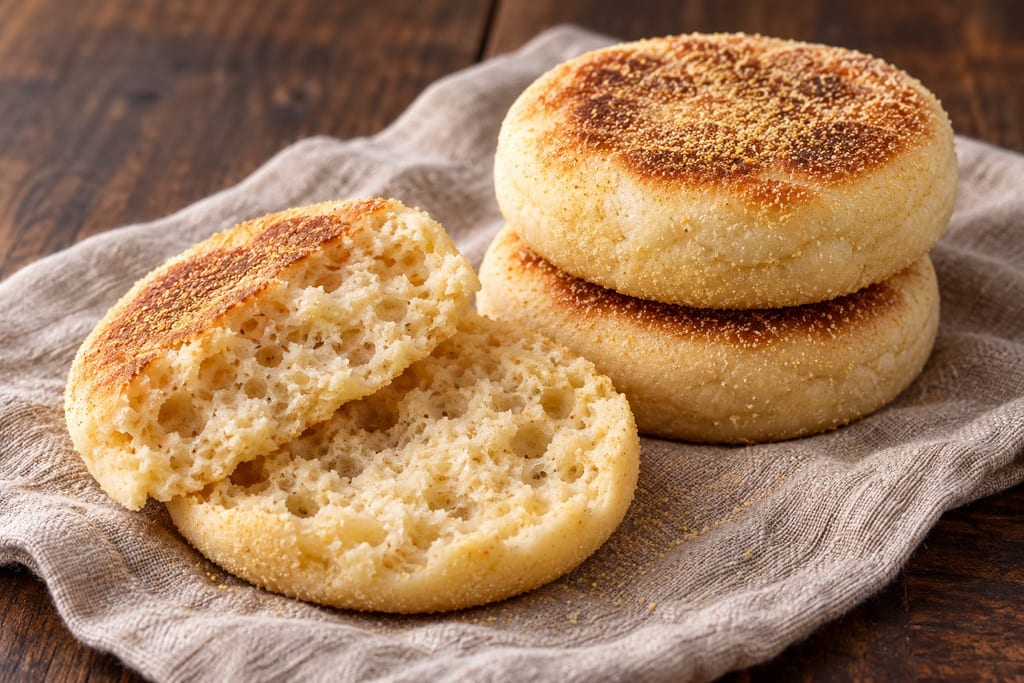
King Arthur’s six-piece English muffin batch uses a yeast preferment, two folds and a skillet or electric griddle; it is distinct from the sourdough-and-yeast version already catalogued.
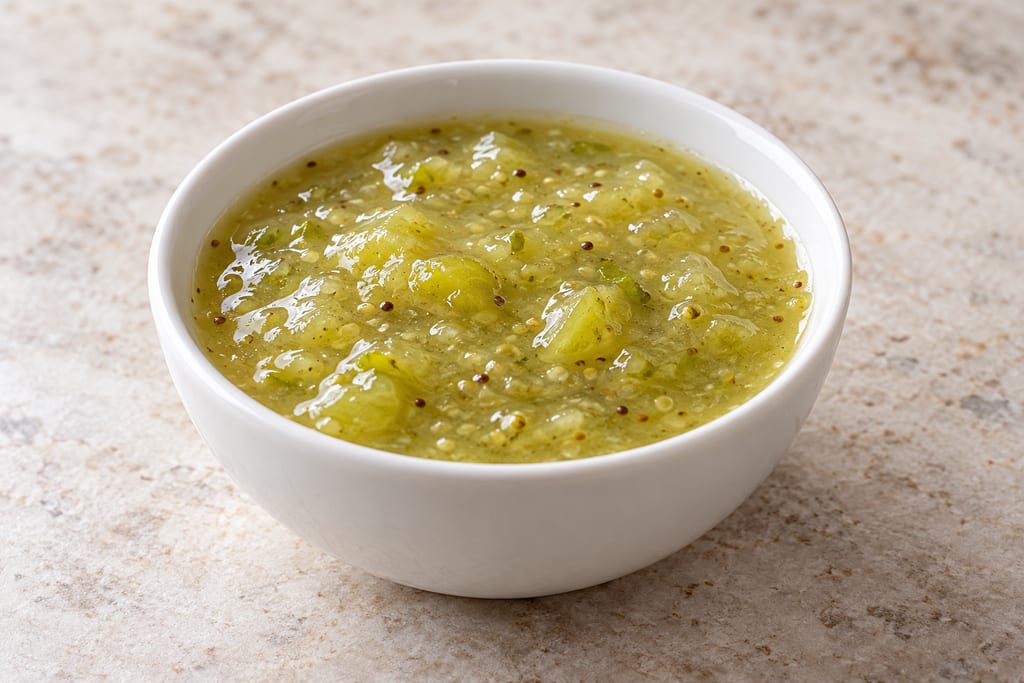
Gooseberry sauce is a soft, tart sauce of cooked green gooseberries, sharpened with wine or vinegar and lightly sweetened, traditionally served with mackerel.
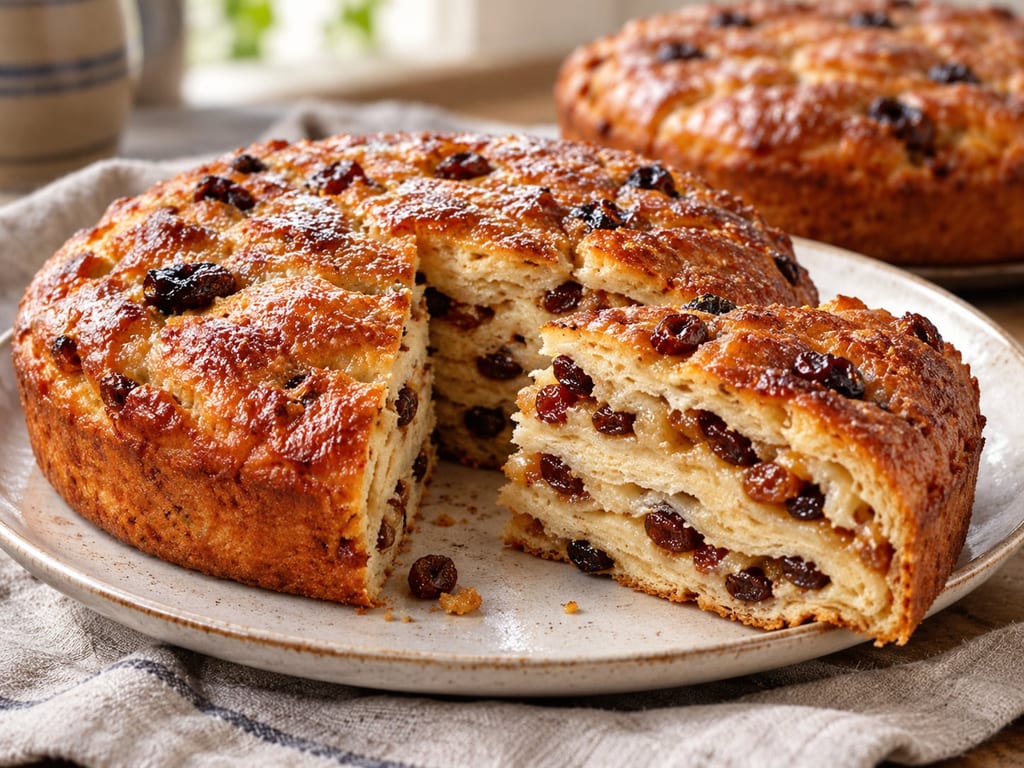
A yeast dough is folded around sweetened lard and dried fruit, then baked in tins until the bottom caramelizes.
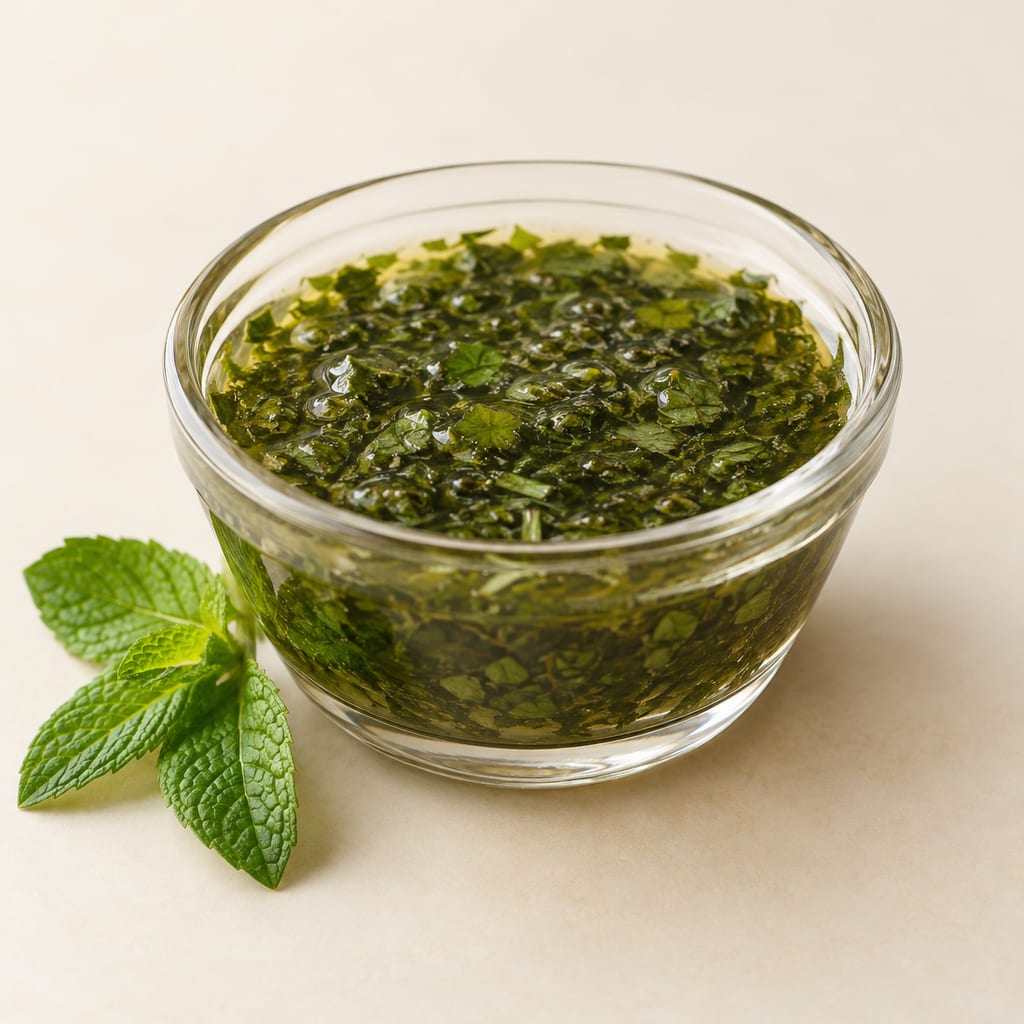
Finely chopped fresh mint steeped in a sweet and sharp liquid of white wine vinegar, sugar and water, the sauce traditionally served with roast lamb in Britain.
A root wine made from boiled parsnip liquor and lump sugar, fermented with yeast and finished with brandy before bottling.
Parsnip liquor ferments with loaf sugar, crude tartar and fresh yeast, then matures in a cask for twelve months before bottling.
A one-liter teaching recipe ferments bruised ginger, lemon, sugar and cream of tartar with measured baker’s or ale yeast, then conditions the drink briefly in PET bottles before refrigeration.
A lightly fizzy lemon drink made from peel-on lemons, water and sugar, held in a covered jar, bottled and kept going with small sugar and peel additions.
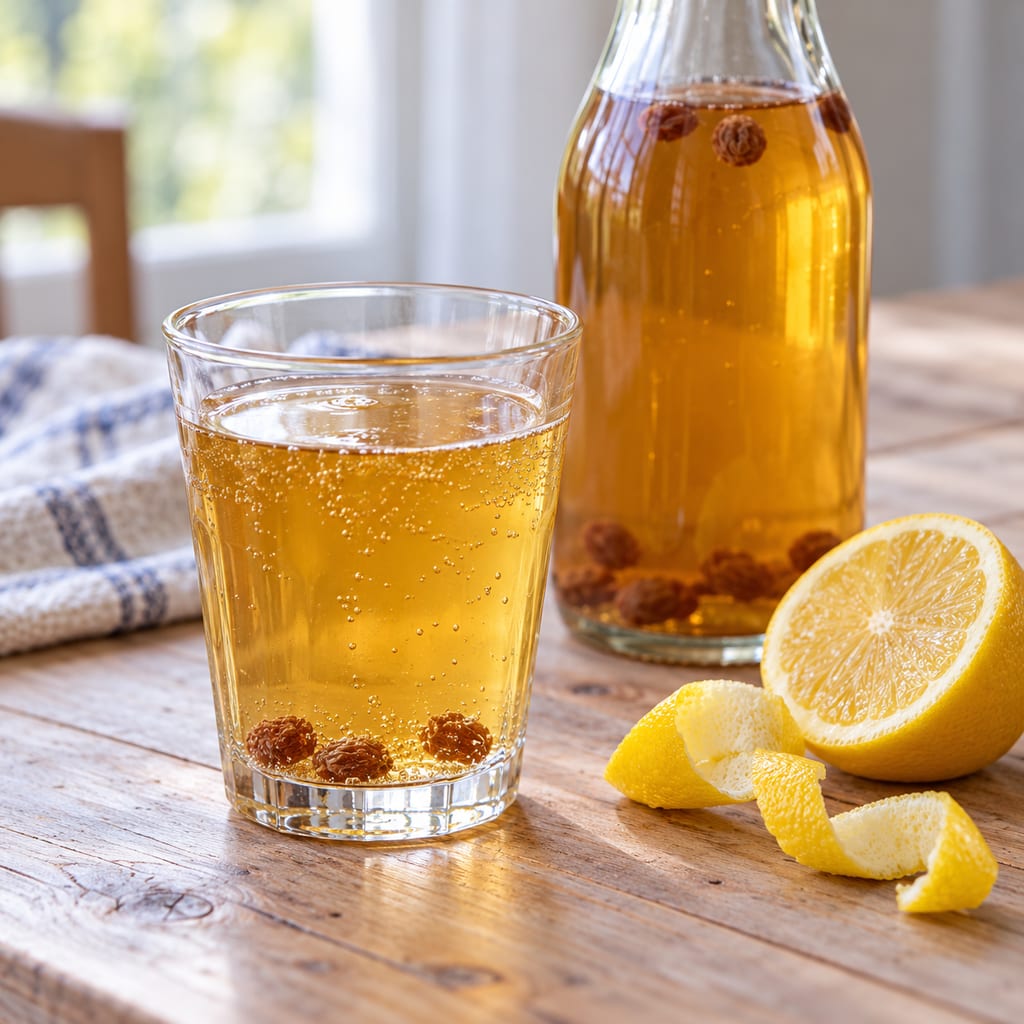
A lightly fermented Finnish May Day drink of lemon, white and brown sugar and a little yeast, bottled with raisins that rise as the carbonation builds.

Jun is a fermented tea drink made with green tea and honey instead of the sweetened tea of kombucha. Its culture identity and origin are not established, and sealed bottles can build pressure and alcohol.
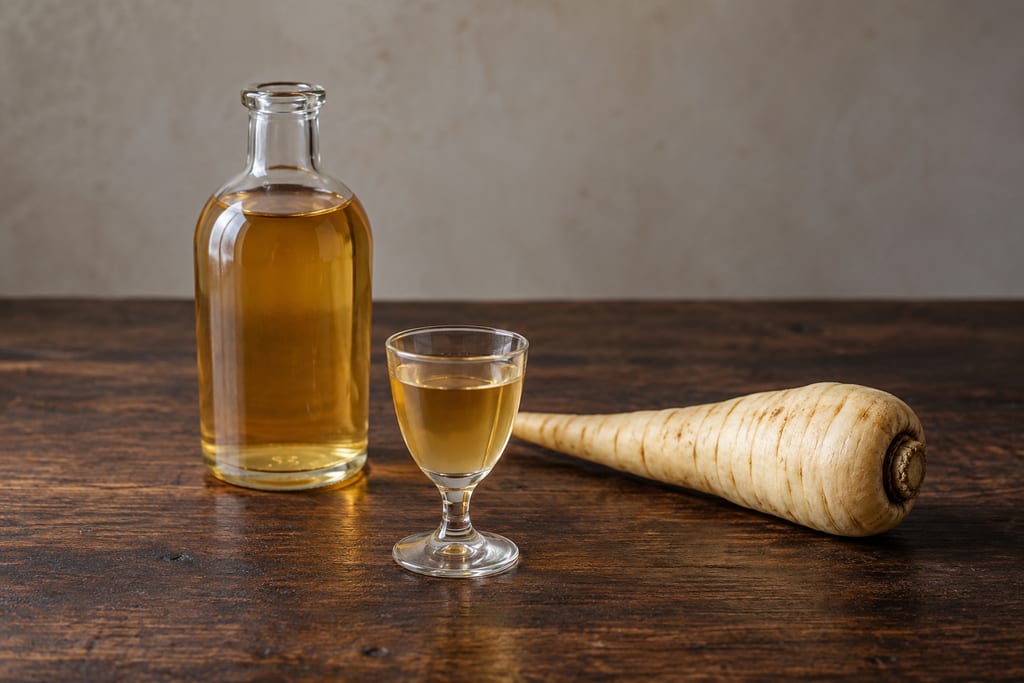
Wright's 1909 compilation records a parsnip wine made from boiled roots, sugar and a little yeast. The liquor spends ten days in a tub, then twelve months in a cask topped up daily only while the wine works over.
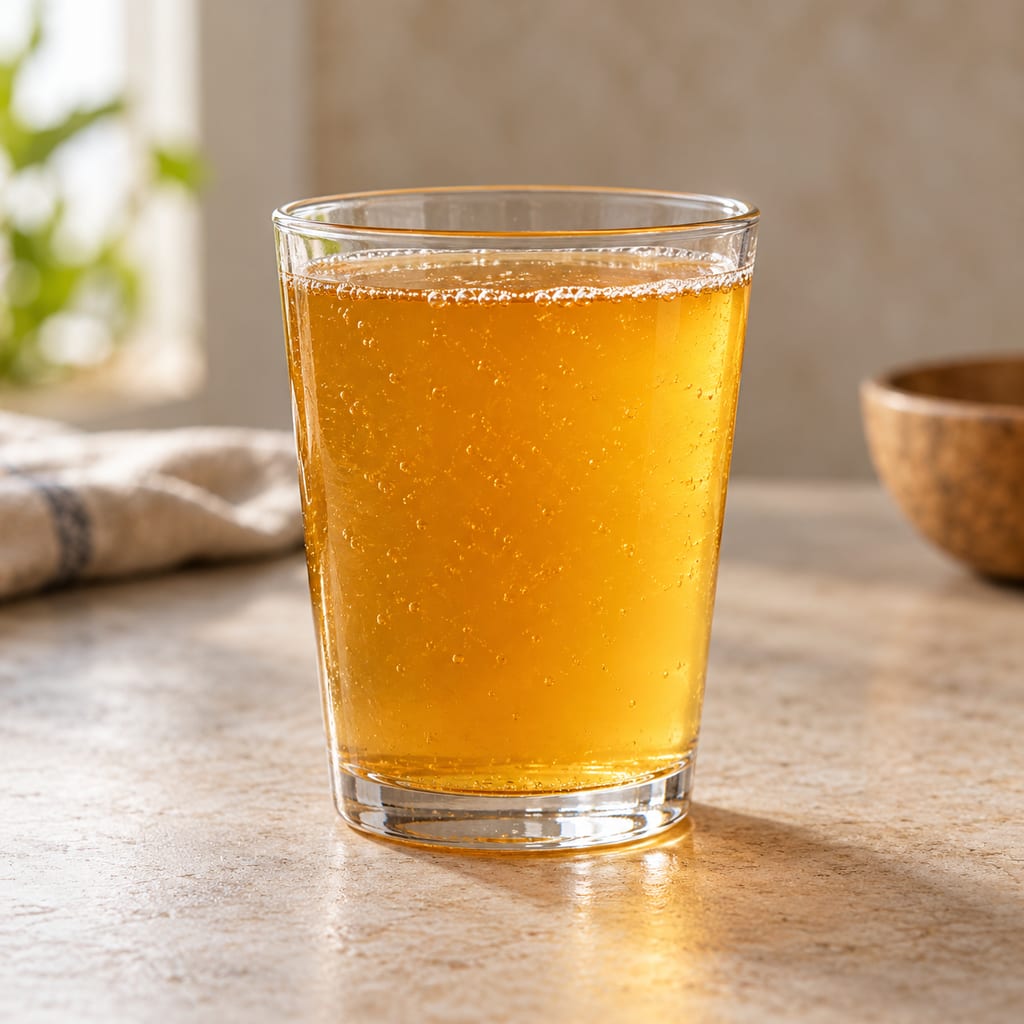
An Oregon State food-science lab formula ferments pineapple skin and piloncillo with jalapeño and warm spices for three to five days, then strains and refrigerates it. The handout reports wide alcohol variability.
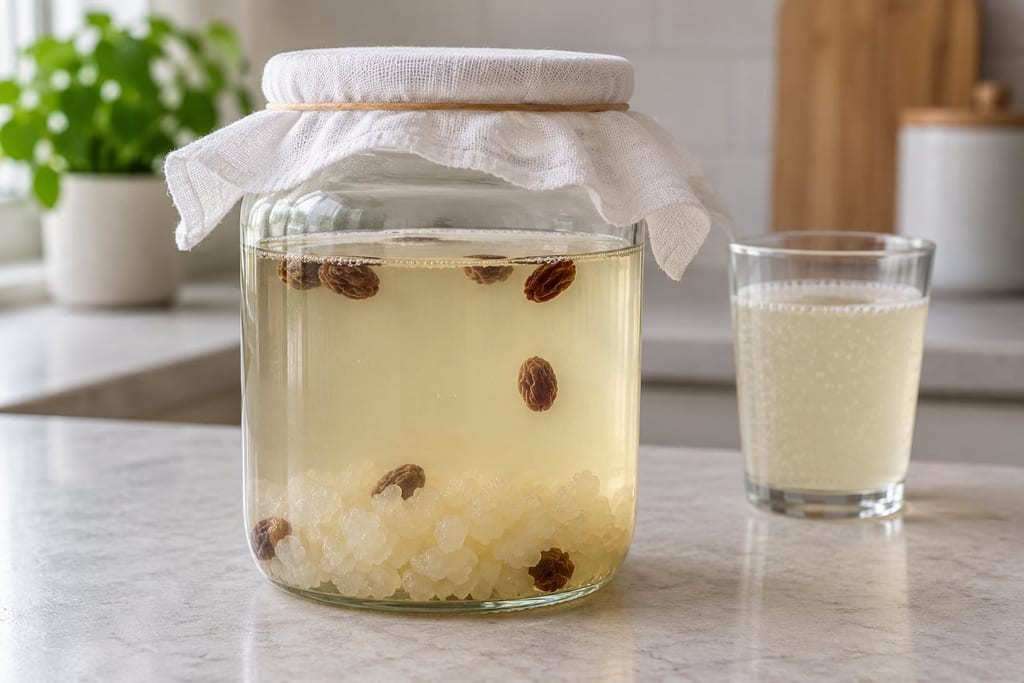
Water kefir grains culture lightly sweetened water into a tart, faintly fizzy drink, with raisins added as an optional dried-fruit nutrient. Alcohol, acidity and fermentation rate vary batch to batch.

A gelling polysaccharide extracted from red seaweeds, sold as kanten strips or powder; it sets firm at a low concentration and stays solid until about 85 °C.

A Dominican table and seasoning condiment of sour orange juice, mixed with lime and salt and bottled raw; garlic, oregano or a hot pepper may be added for meat or a spicier bottle.

Cicerbita alpina is an alpine perennial whose tender shoots and leaves have been eaten raw or cooked. Sámi milk preparations and modern Carnian dishes are distinct uses, with serious identification and preservation limits.

Japanese skipjack tuna cooked, then repeatedly smoked and dried over a wood fire by the hand-fired tebiyama method into a hard block for shaving into dashi: the first stage of katsuobushi.

A Swedish-style spirit vinegar made by fermenting neutral alcohol with live vinegar bacteria, with a separate guide to commercial ättika strengths.

A yeast-raised wheat ring shaped from a firm dough, briefly boiled and baked. This source-batch formula gives a gently malted crust and a chewy crumb.

A warm dip of garlic, anchovy and olive oil, often enriched with butter, that Piedmont serves over a flame with raw and cooked vegetables and bread.

Bechamel is a white sauce of milk thickened with a butter and flour roux, one of the French mother sauces, and the base from which Mornay and other cheese and cream sauces are made.
No community contributions have been published for this entry yet.
Sign in to contribute. Published comments and photos are free to read.
S. O. Beeton, LondonIngredients · Method · History
Isabella Beeton, The Book of Household Management (1861), recipe 1819, printed page 882Recipe 1819 on printed page 882: exact ingredient list, one-hour boil, next-day cask transfer, daily stirring for a fortnight and later brandy.
Early-March wine may be fit to bottle in June; the 1861 title and the selected recipe page were inspected, not the whole book.
Cited in: A household wine built around ginger; A printed history in London and earlier English cookery; What fermentation changes; Why the ingredients and preparations matter; The vessel, cooling and cask work; Two documented versions, not one blended recipe; Serving, culinary place and sensory limits; Reading the calendar and the safety limits; What this page can and cannot establish
Project Gutenberg eBook 10136Method · History · Safety
Isabella Beeton, The Book of Household Management, recipes 1819 and 1827 (transcription)Recipe 1819 as transcribed: copper well scoured, scum removed, liquor not left in the copper, yeast thick and very fresh, stir daily for a fortnight, stop the cask down by degrees, fit to bottle in a few weeks, 2s. a gallon, March or September.
Recipe 1827 (orange wine) adds that ginger wine may be made the same way with 2 lb of best whole bruised ginger in a muslin bag; ten days to make; bottle the following January.
Cited in: A household wine built around ginger; Why the ingredients and preparations matter; The vessel, cooling and cask work; Two documented versions, not one blended recipe; Reading the calendar and the safety limits; What this page can and cannot establish
Project Gutenberg eBook 10072History · Method
Elizabeth Moxon, English Housewifry Exemplified, receipt 57 Ginger Wine (title page dated 1764)Receipt 57: 14 quarts water, 3 lb loaf sugar, 1 oz ginger sliced thin boiled half an hour and fined with two egg whites; three lemons, a quart of brandy and a yeasted toast added when new-milk warm; worked one day, tunned, ready to bottle in five days, drinkable a week after bottling.
Cited in: A printed history in London and earlier English cookery; Why the ingredients and preparations matter; Two documented versions, not one blended recipe; What this page can and cannot establish
The Page Company, Boston, 1909; Project Gutenberg eBook 75708Safety
Helen S. Wright, Old-Time Recipes for Home Made Wines, Cordials and Liqueurs, Parsnip Wine No. 2, pp. 83-84A parsnip wine tunned with paper pasted over the cask is likely to work up and burst the paper, which must be renewed.
Cited in: Reading the calendar and the safety limits
Project Gutenberg eBook 55314Safety
Anne Cobbett, The English Housekeeper (1851), Parsnip Wine, second alternative, pp. 341-342The second parsnip wine is tunned and the cask bunged up only when fermentation has ceased.
Cited in: Reading the calendar and the safety limits
University of California, Davis, Viticulture and EnologyScience
Overview of Grape Juice FermentationExplains glucose and fructose as grape sugar substrates, the role of Saccharomyces in grape juice fermentation and ethanol and carbon-dioxide formation. Used as general fermentation explanation, not a claim about the historic ginger-wine microbiome.
Cited in: What fermentation changes
University of Georgia Cooperative ExtensionScience · Method · Safety
Winemaking at HomeExplains that yeast uses fruit sugar and produces ethanol and carbon dioxide; sugar is depleted as alcohol rises; aromas also arise from minor fermentation products.
Cited in: What fermentation changes; Reading the calendar and the safety limits
Horniman Museum and GardensHistory · Culture
Ginger and gingerbreadThe museum relates courtly medicinal uses of ginger and spiced wine to English documentary history and describes ginger's scarcity and luxury associations during increased early modern imports.
Cited in: A printed history in London and earlier English cookery; Serving, culinary place and sensory limits; What this page can and cannot establish
International Organisation of Vine and WineScience
Alcoholic fermentationDefines alcoholic fermentation in grape must as transformation of grape sugars into ethanol, carbon dioxide and secondary products; describes spontaneous and inoculated yeast fermentation. Used only for general wine-fermentation context, not to identify Beeton's yeast.
Cited in: What fermentation changes
Wellcome CollectionHistory · Method
A Dictionary of the English Language, Samuel Johnson (1755)Defines the verb 'to tun' as putting liquor into casks, clarifying Moxon's use of 'tun it'. It does not establish vessel duration or handling details.
Cited in: Two documented versions, not one blended recipe