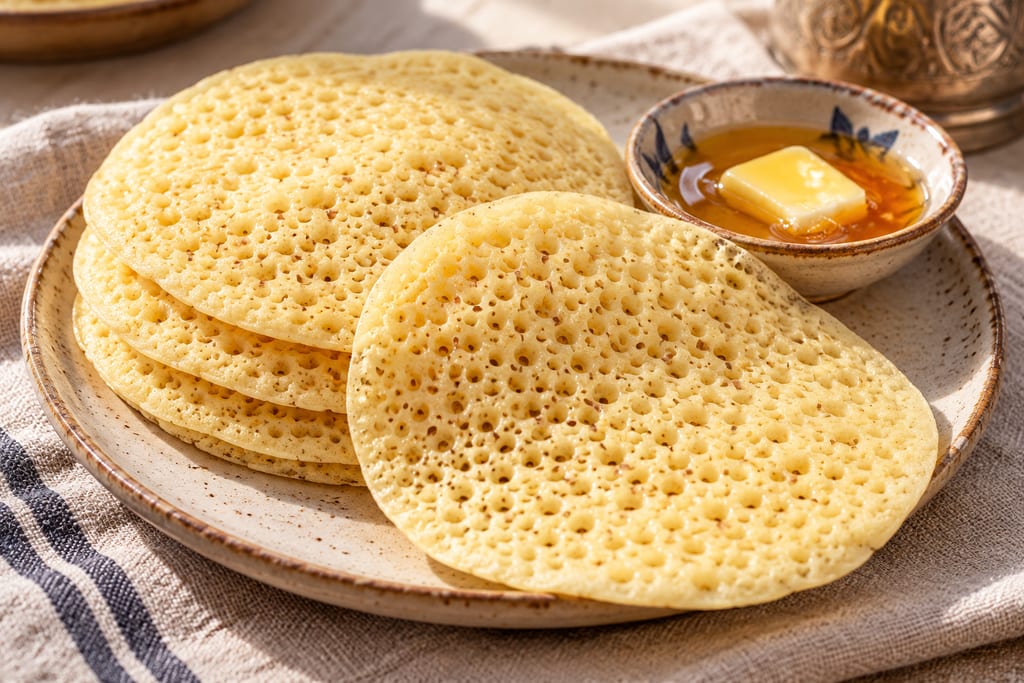
Baghrir
Moroccan semolina pancakes made from a thin yeast batter, rested until foamy and cooked on one side until the surface sets with a honeycomb of holes. This source-specific batch makes sixteen 5-inch pancakes.
 FermenteaWhere food goes to change
Sugar sources
Honey is a bee-made food from floral nectar or honeydew; breads use it in dough or as a syrup served with cooked griddle breads.
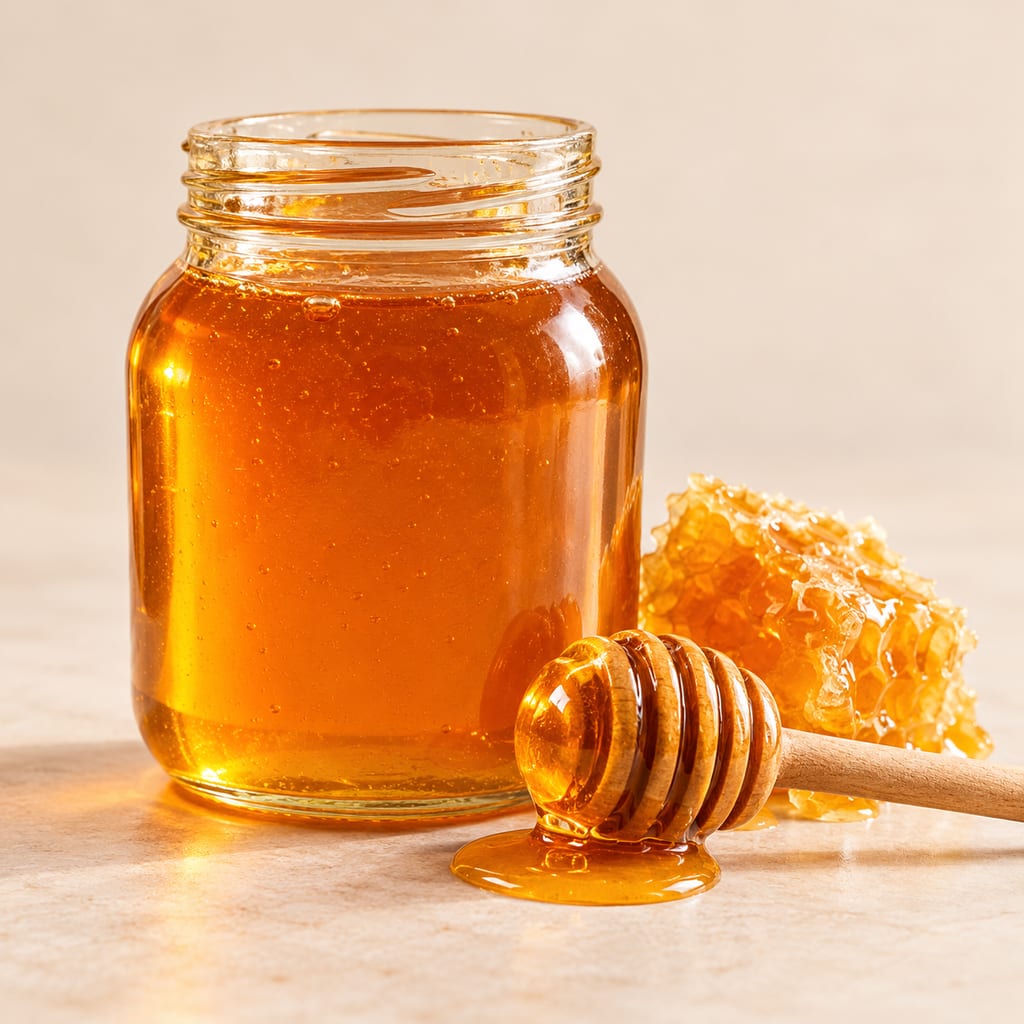
The oldest use of honey cannot be assigned to one place from this evidence. The Metropolitan Museum’s catalogue describes an Egyptian storage jar fragment whose hieratic label identifies honey; the object is dated to about 1386–1347 BCE. It shows honey stored as a named food in Egypt, not the beginning of honey use.
At Tel Rehov in the Jordan Valley, researchers identified bees’ remains inside clay cylinders as evidence of an apiary operating in the 10th to early 9th centuries BCE. The authors interpret the remains as evidence for an established beekeeping practice and discuss the possibility that bees were moved from Anatolia. That regional finding does not establish a single route or birthplace for beekeeping.
People also gathered honey from wild nests, but this record does not date the first gathering or settle where it began. The account therefore distinguishes the dated Egyptian honey label and Tel Rehov hives from any global origin story.
Bees collect sugary material from plants, either nectar from flowers or honeydew associated with sap-feeding insects. They process and concentrate it, then store it in comb as it ripens. Codex uses this process to define honey and recognises both floral and honeydew sources. Other bee species also store honey-like foods, but the standard's definition is specific to honey bees.
Honey varies a great deal. The standard describes colour that runs from nearly colourless to dark brown, a consistency that can be fluid, viscous or partly to entirely crystallised, and flavour and aroma that come from the plants the bees worked. Honey from nectar is called blossom or nectar honey; honey that comes mainly from the excretions of sap-sucking insects, order Hemiptera, is honeydew honey. The two behave differently in the jar and on the plate, and the differences are covered below.
In a fermenting kitchen, honey supplies sugar that yeast can use. Concentrated honey behaves differently from dough or other wet mixtures, so its keeping properties do not carry over automatically when it is diluted.
Honey takes different roles across bread formulas. In Marcus Samuelsson’s 2009 Epicurious recipe, titled “Honey Bread” and introduced as Ethiopian dabo, honey is kneaded into a yeast dough. That page documents one modern author’s formula; it is not a historical recipe or a definition of every dabo.
A Moroccan baghrir recipe published by Infos Tourisme Maroc serves the cooked semolina pancakes with a mixture of honey and butter. Here honey is a topping and dip, rather than a sweetener mixed into the batter. The atlas also records honey as an accompaniment to other griddle breads, but these two recipes are the uses directly documented in the sources listed here.
In bread, honey contributes dissolved sugars, moisture and its own flavour. In a yeast dough it can supply fermentable sugar, while in a syrup it remains a finishing ingredient. The source recipes do not establish a universal substitution ratio for replacing sugar or other sweeteners.
Nectar is 70 to 80 percent water, and honeydew is wetter still, about 89 percent. A forager carries nectar in a honey stomach that holds about 40 milligrams in the western honey bee, Apis mellifera. Enzymes from the bee’s salivary and hypopharyngeal glands start splitting sucrose, the sugar plants make, into glucose and fructose, the two simple sugars that make up most of honey.
In the hive the nectar is passed from bee to bee, regurgitated and swallowed again, and spread in thin films while the bees fan it with their wings. Water evaporates until the honey holds roughly 15.5 to 18 percent, and the bees then seal each cell with a wax cap. The air in the honey-storing part of the hive sits around 35 °C, which the colony holds with body heat and evaporative cooling. The cap protects the ripened honey from dampness and from contamination.
Another enzyme, glucose oxidase, turns some glucose into gluconic acid and hydrogen peroxide. The acid is the largest of honey’s many organic acids, and together the two products add to honey’s acidity and to the way it holds back bacteria. An average hive produces about 29 kilograms a year.
Honey is mostly two sugars. Fructose makes up about 51 percent of the sugar and glucose about 44 percent, while galactose, maltose and sucrose each contribute 3 percent or less. By weight, 100 grams of honey holds about 82 grams of carbohydrate and 17 grams of water, with almost no fat, 0.3 grams of protein and 300 kilocalories. Its sweetness is roughly that of sucrose, and its density is 1.38 to 1.45 kilograms per litre at 20 °C.
Honey is acidic. The average pH is 3.9, with a range from 3.4 to 6.1, and organic acids make up 0.17 to 1.17 percent of the weight. Gluconic acid dominates; formic, acetic, citric, lactic, malic and succinic acids are among the others.
The Codex standard sets sale requirements: moisture, sugar and insoluble-solids limits vary by honey type. It forbids additions and removal of honey’s pollen except to remove foreign matter; honey that has begun to ferment or effervesce does not meet the standard.
An optional Codex annex sets criteria for acidity, diastase activity, hydroxymethylfurfural and electrical conductivity. Diastase can fall with heat exposure, while hydroxymethylfurfural can rise. Conductivity distinguishes many blossom honeys from honeydew and chestnut types. These are quality and classification tests, not home-fermentation instructions or safety tests.
Honey resists microbial growth because little of its water is available. Water activity measures water available to microbes; dissolved sugars keep it low. The study on honey water activity reports a limiting range around 0.61–0.62 for osmotolerant yeasts. Honey is not sterile: yeasts can occur naturally, but growth depends on the conditions.
Fermentation risk rises when moisture, viable osmotolerant yeasts, crystallisation and storage temperature align. A beekeeping-laboratory paper summarizes USDA handbook observations about moisture and storage time. Those measurements describe the referenced study conditions and do not establish one moisture limit for every jar or a universal home-storage guarantee.
When glucose crystallises, water redistributes into the liquid between crystals. That phase can have more moisture than the original honey, changing its fermentation risk.
Yeasts can produce carbon dioxide and ethanol from honey sugars; in oxygen, ethanol may be converted to acetic acid. Gas can pressurise sealed containers and flavours change. Producers manage quality by checking moisture, keeping containers clean and controlling moisture before storage. Treatment instructions depend on the product and can affect heat-sensitive compounds.
Honey absorbs moisture from air, so keep it sealed. Processing for retail storage is product-specific.
Honey is a supersaturated sugar solution: it holds more glucose than water can dissolve at room temperature, and with time glucose precipitates as small crystals. Crystallised honey melts at about 40 to 50 °C. Crystals form fastest between 13 and 17 °C, and seed crystals form best at 5 to 8 °C, while below about 5 °C honey does not crystallise at all.
The proportion of glucose to fructose decides how quickly it happens. Honey with much glucose, such as honey from brassicas, granulates quickly; chestnut and tupelo honeys, which are low in glucose, largely do not. The Codex standard treats a fluid, viscous or crystallised consistency as ordinary. What crystallisation does change is the water content of the liquid that remains between the crystals, as the section on spoilage describes.
Mead is made by fermenting honey with water. Honey supplies most of its fermentable sugar, though fruit, grain, herbs or spices may be added. Styles vary in sweetness, strength and carbonation, and written names do not always imply one fixed recipe.
Traditional mead fermentations could rely on yeasts and bacteria carried by honey or fruit. Modern makers may use selected yeasts and nutrients, but honey composition and microbial cultures differ; fermentation time and outcome therefore vary. A documented process is evidence for that batch, not a universal schedule.
Mead relatives use different additions or treatments: metheglin includes herbs or spices; melomel includes fruit, with cyser for apple and pyment for grape; braggot includes malt; bochet uses heated honey. Tej is a honey drink flavoured with gesho. These names describe varied traditions and formulations.
Concentrated honey resists fermentation; dilution changes water activity and can let yeasts use its sugars. Fermented honey is distinct from honey that has spoiled in storage.
Honey also appears alongside other fermentable ingredients. Chemical analysis of Jiahu vessel residues led researchers to interpret a seventh-millennium BCE beverage made from rice, honey and hawthorn and/or grape; the analysis does not recover a recipe. Archaeological, biomolecular and plant evidence from Nordic sites supports a mixed drink in which honey, local fruit and cereal were fermented together, sometimes with imported grape wine; this is a reconstruction, not a standard formula. In southwestern Uganda, a primary study describes Enturire as a sorghum-and-honey beverage: its traditional sequence ferments a sorghum malt slurry before adding honey, while the study also tests a modified order and selected starter cultures. These examples show honey acting as one substrate among several, rather than defining every drink as mead.
Beekeepers and buyers sort honey by what the bees worked. Monofloral honey comes mainly from one kind of flower; clover, orange blossom and manuka are examples, and manuka is darker, earthy and slightly bitter. Polyfloral or wildflower honey comes from many plants, and its taste varies from year to year. Honeydew honey is stronger and less sweet than blossom honey. Pine honey makes up 60 to 65 percent of Greek honey production.
Under Codex rules, a floral name such as clover or lavender may be used only if the honey comes wholly or mainly from that plant and has the matching properties, and a place name only if the honey was produced entirely within that area; the country of production must be declared as well. Honey may also be labelled by how it left the comb: extracted by centrifuge from decapped broodless combs, pressed from broodless combs, or drained. Styles are liquid or crystalline honey, comb honey sold in sealed combs and chunk honey containing pieces of comb. Honey filtered so that pollen is significantly removed must be labelled filtered honey.
Grading is a separate matter. In the United States, voluntary grades depend on soluble solids, flavour and aroma, defects and clarity. Grades A and B need at least 81.4 percent soluble solids, which means no more than 18.6 percent water, and Grade C at least 80.0 percent. Colour is graded on the Pfund scale, from 0 for water white to more than 114 for dark amber.
In 2023 the world produced about 1.89 million tonnes of honey. China made 463,500 tonnes, about a quarter, followed by Turkey with 114,886, Ethiopia with 84,591, Iran with 80,389, Argentina with 73,395 and the United States with 62,855.
Honey is sometimes adulterated with other sugars and syrups, added to change flavour or viscosity, cut cost or prevent crystallisation. Corn syrup is now the most common adulterant and is hard to detect; isotope-ratio mass spectrometry can detect added cane sugar or corn syrup at about 7 percent. The Codex standard prohibits adulteration of anything sold as honey. For the cook, the practical points are to buy from a source that states its origin, to expect real honey to crystallise in time and to store it tightly closed away from damp.
Honey should not be given to infants. The United States Centers for Disease Control and Prevention state that honey can contain the bacteria that cause botulism, and advise not feeding honey to a child younger than one year and not giving honey or products made with it to infants, including honey pacifiers; several babies in Texas became ill with infant botulism after using honey pacifiers. The risk is small, and honey is considered safe after the first birthday.
On the glycaemic index, honey varies; the estimated range is 31 to 78, depending on the variety. The Jain tradition prohibits eating honey.
Dates assigned to the Araña honey-collecting painting vary, and the earliest mead evidence remains disputed. Honey fermentation also depends on yeast load, moisture and temperature; no single figure predicts how every jar will behave.
The Met dates a jar fragment from Malqata, Thebes, to this period and reads its hieratic label as honey; this documents honey in Egypt, not its origin.
The PNAS study identifies bee remains in clay cylinders at Tel Rehov as an apiary; no coordinate is asserted.
The source frames its honey bread as dabo/Ethiopian breakfast and includes honey in the dough. It documents this modern recipe, not a complete account of Ethiopian dabo.
The source pairs cooked baghrir with honey and butter. This is a documented service use, not an origin claim for honey or baghrir.
Moroccan semolina pancakes made from a thin yeast batter, rested until foamy and cooked on one side until the surface sets with a honeycomb of holes. This source-specific batch makes sixteen 5-inch pancakes.
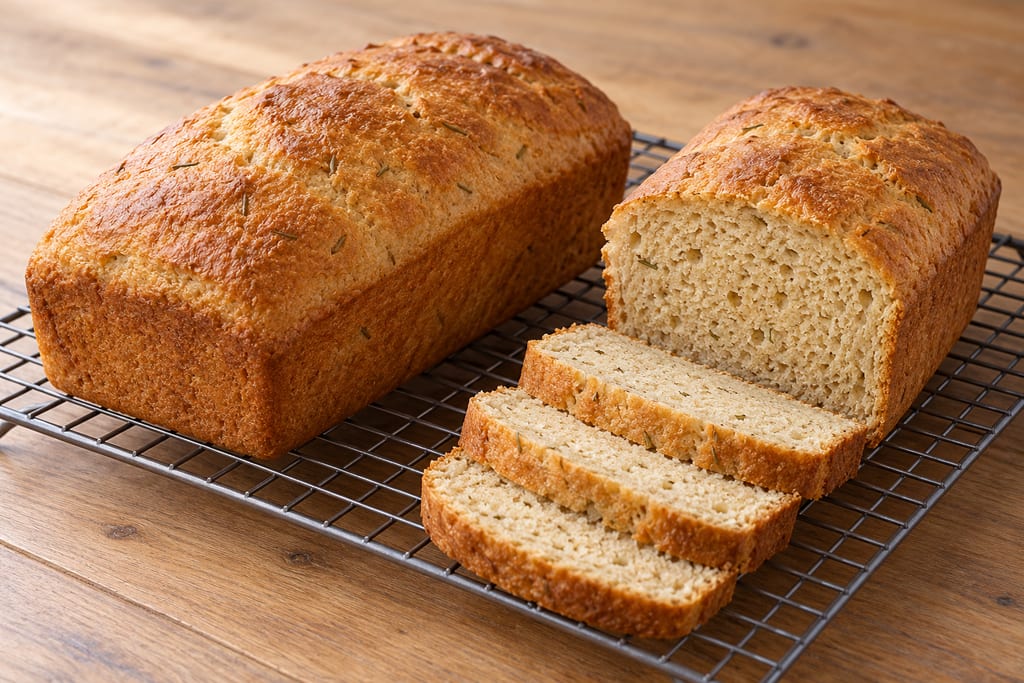
Ethiopian breakfast honey bread: two rosemary-scented yeast loaves shaped in pans and baked at 400°F.
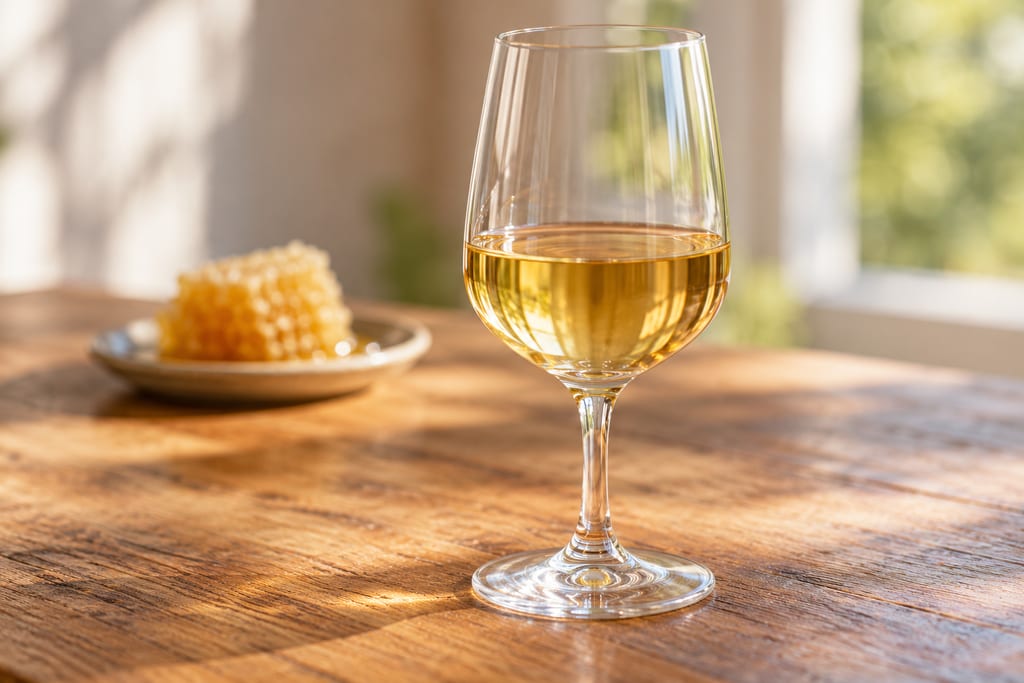
Mead is an alcoholic drink made by fermenting diluted honey with yeast, then racking and ageing it. The honey, not refined sugar, is what makes it mead.
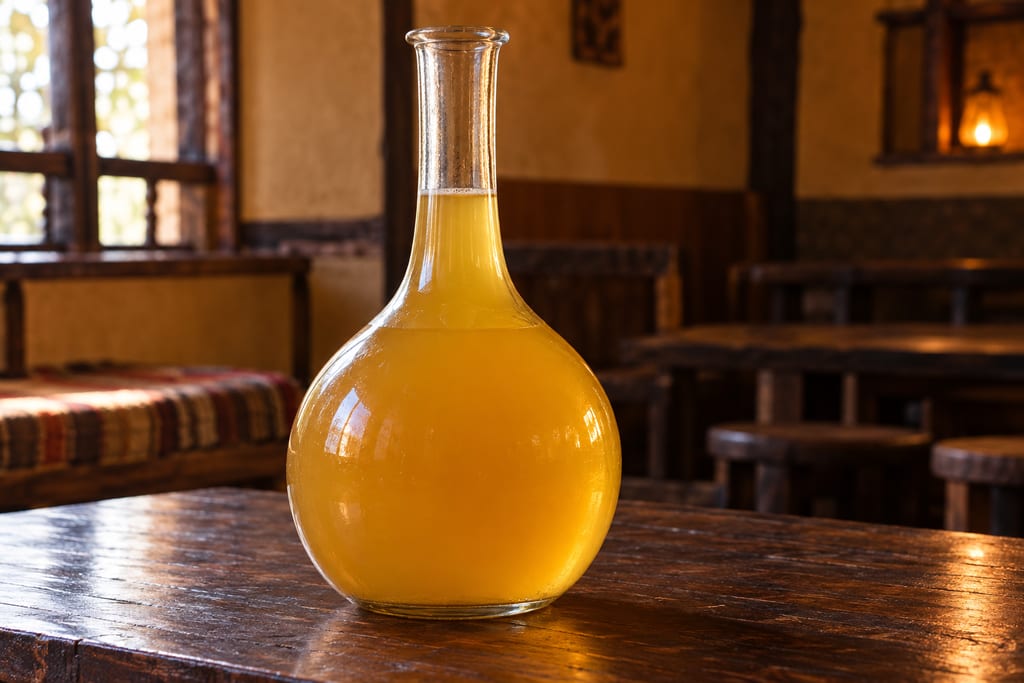
An Ethiopian honey wine made here as a controlled laboratory formulation with honey, water, a mixed bacterial-and-yeast starter, and gesho.
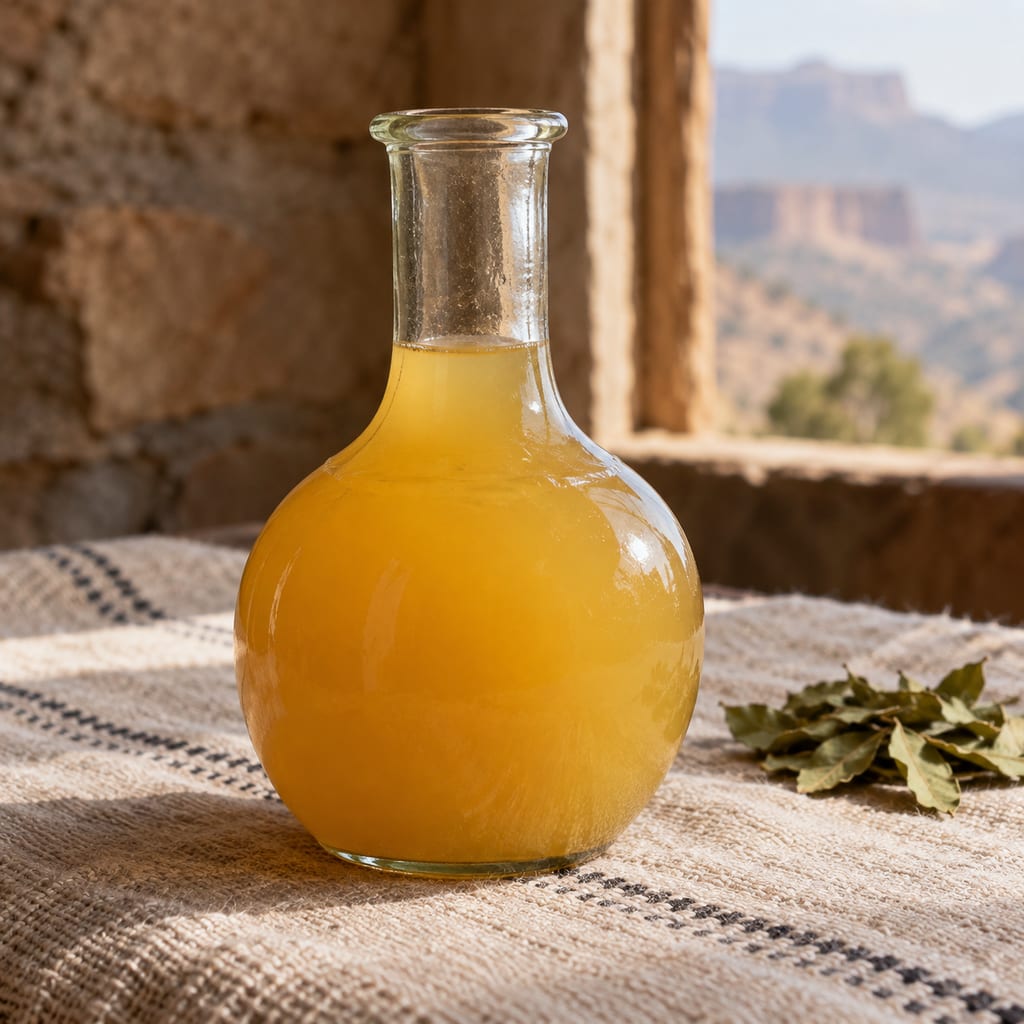
An Ethiopian honey wine of the Tigray highlands, fermented with the leaves and stems of gesho, which supply both bitterness and the microorganisms that carry the ferment.
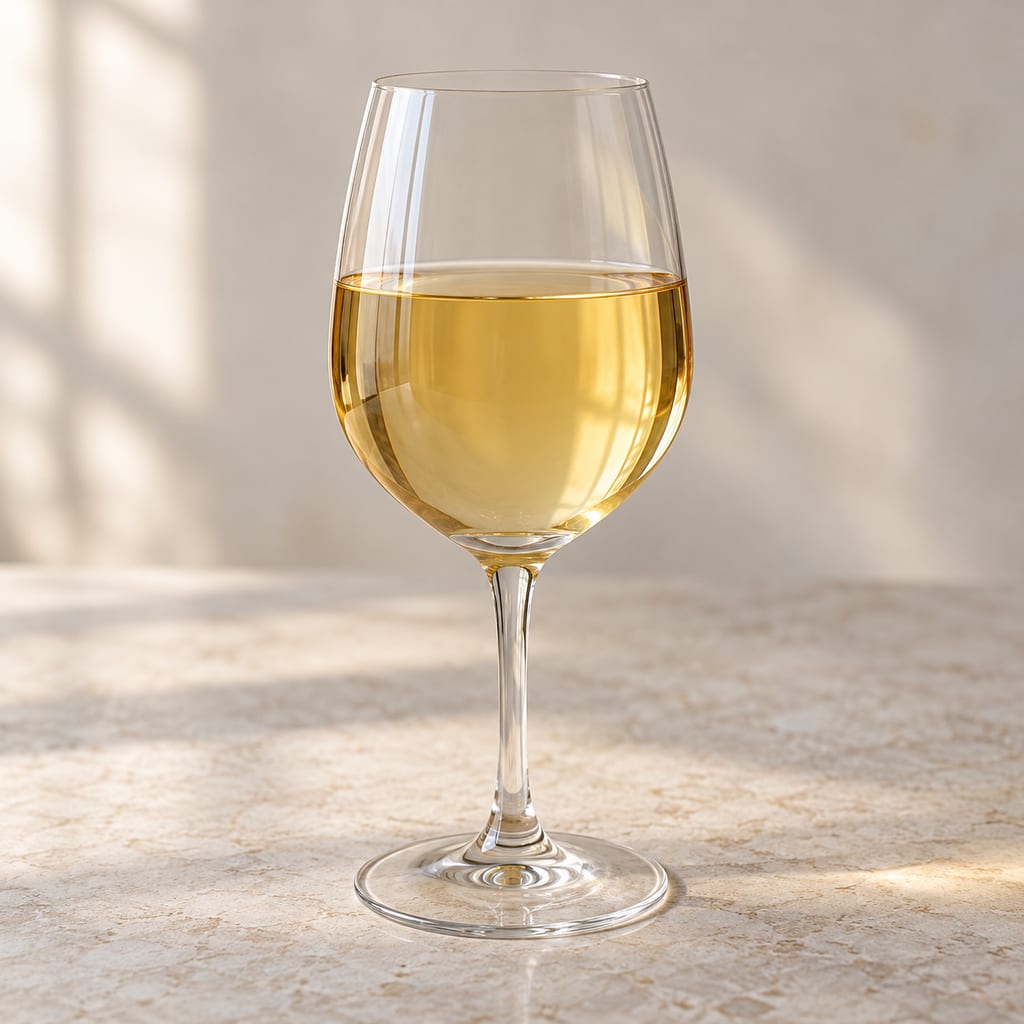
A still, dry honey wine fermented from varietal honey and water with a single wine yeast, carrying no residual sweetness and no added carbonation.
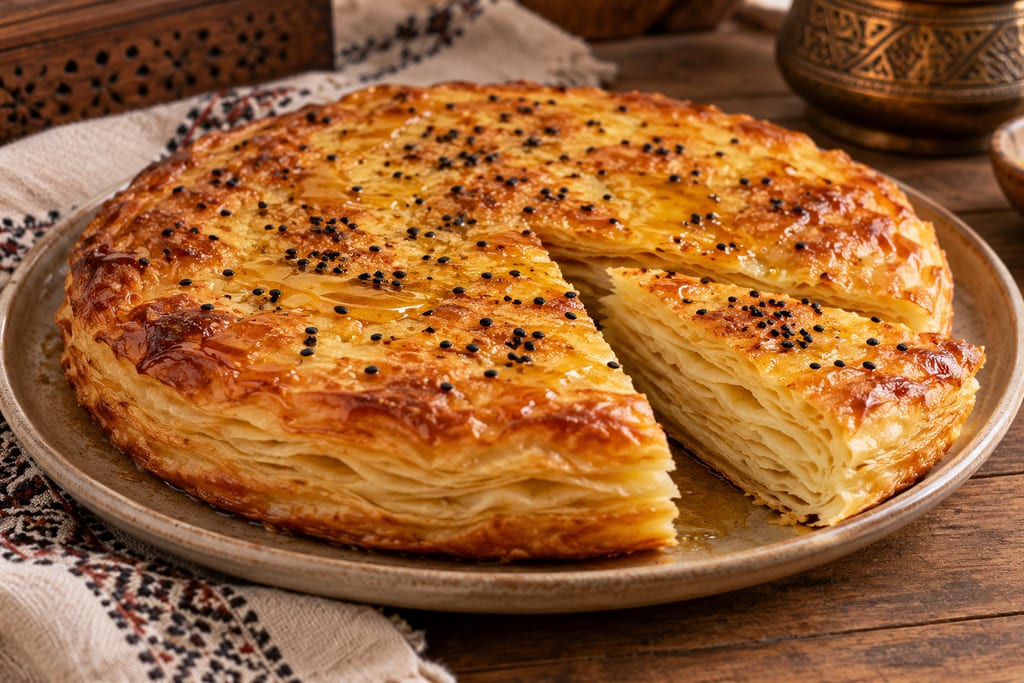
Bint al-sahn is a Yemeni celebration and home bread built from thin, egg-rich yeast dough layers brushed with ghee or butter. This source-specific version makes one round cake, baked until golden and served warm with honey.
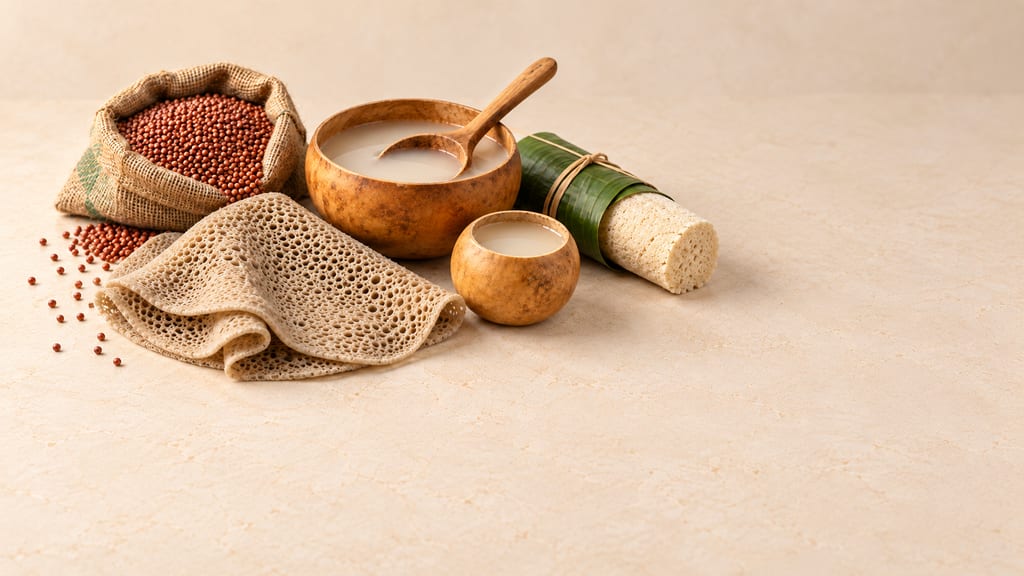
From sour breads and milk to savoury seeds, cassava staples and living beers, African fermentation follows the crop, the community and the work of transformation.
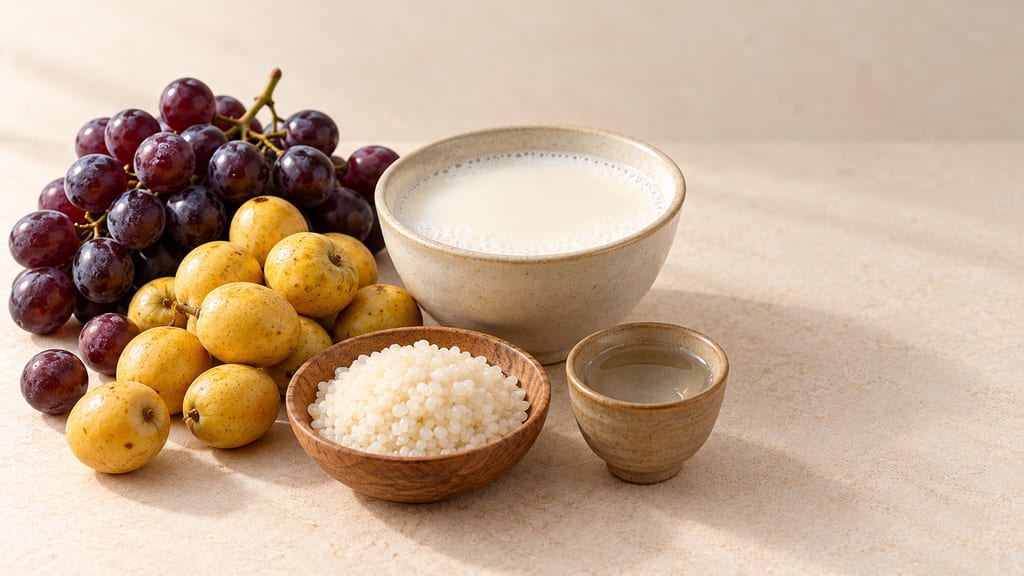
A marula harvest, a rice mash and a bowl of fermented mare’s milk reveal different ways to make alcohol, and different kinds of knowledge behind the drink.
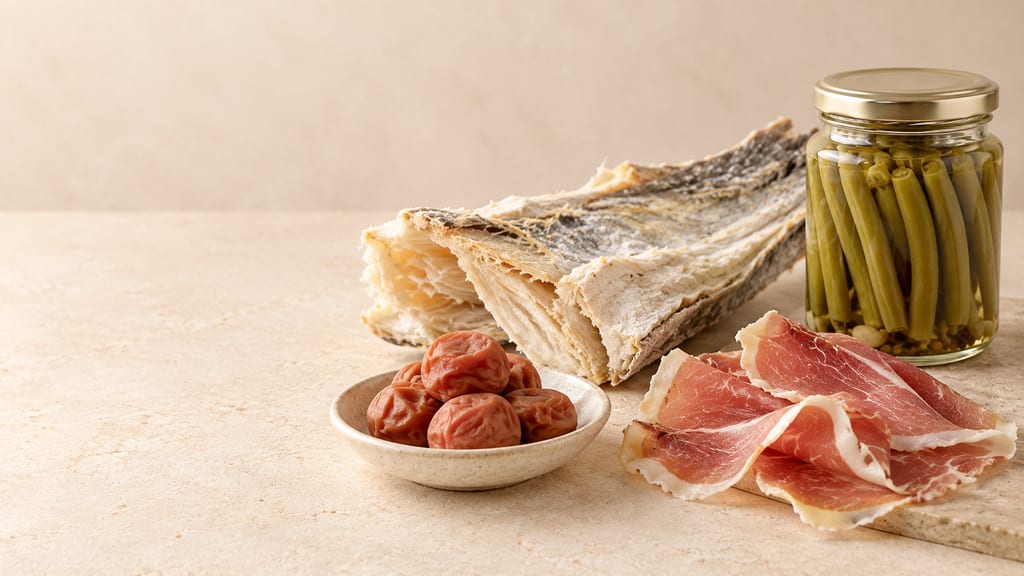
Every preserved food is a stack of barriers against microbes, enzymes, air and time. This is how they work, what a recipe's numbers measure, and how cooks worldwide build them.
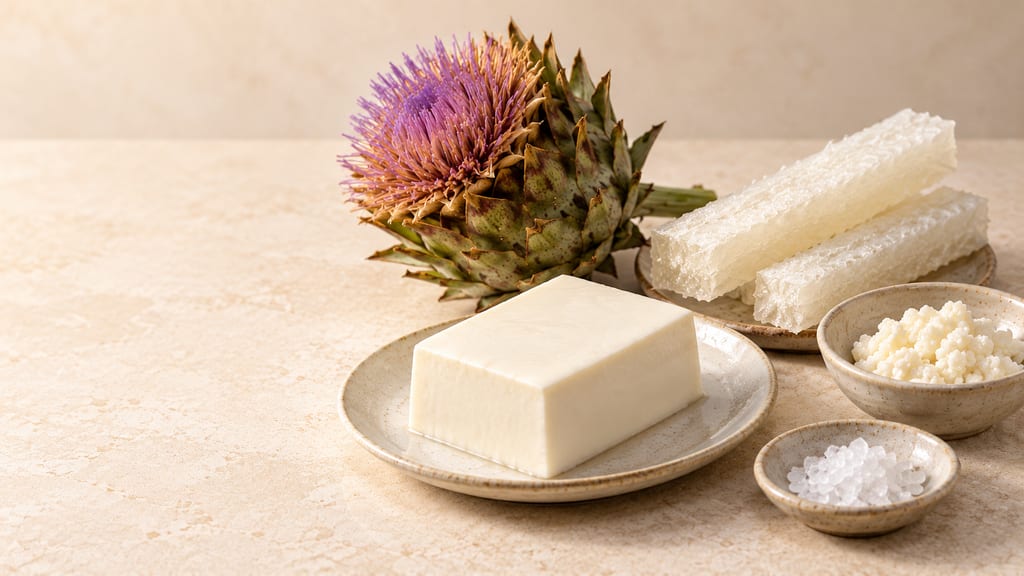
Cheese, tofu, agar, nixtamal and cured ham all begin with a liquid or soft food made to set, sour or keep. Rennet is one branch of that history, beside plant enzymes, acids, minerals, alkalis, gels, finings and curing salts.
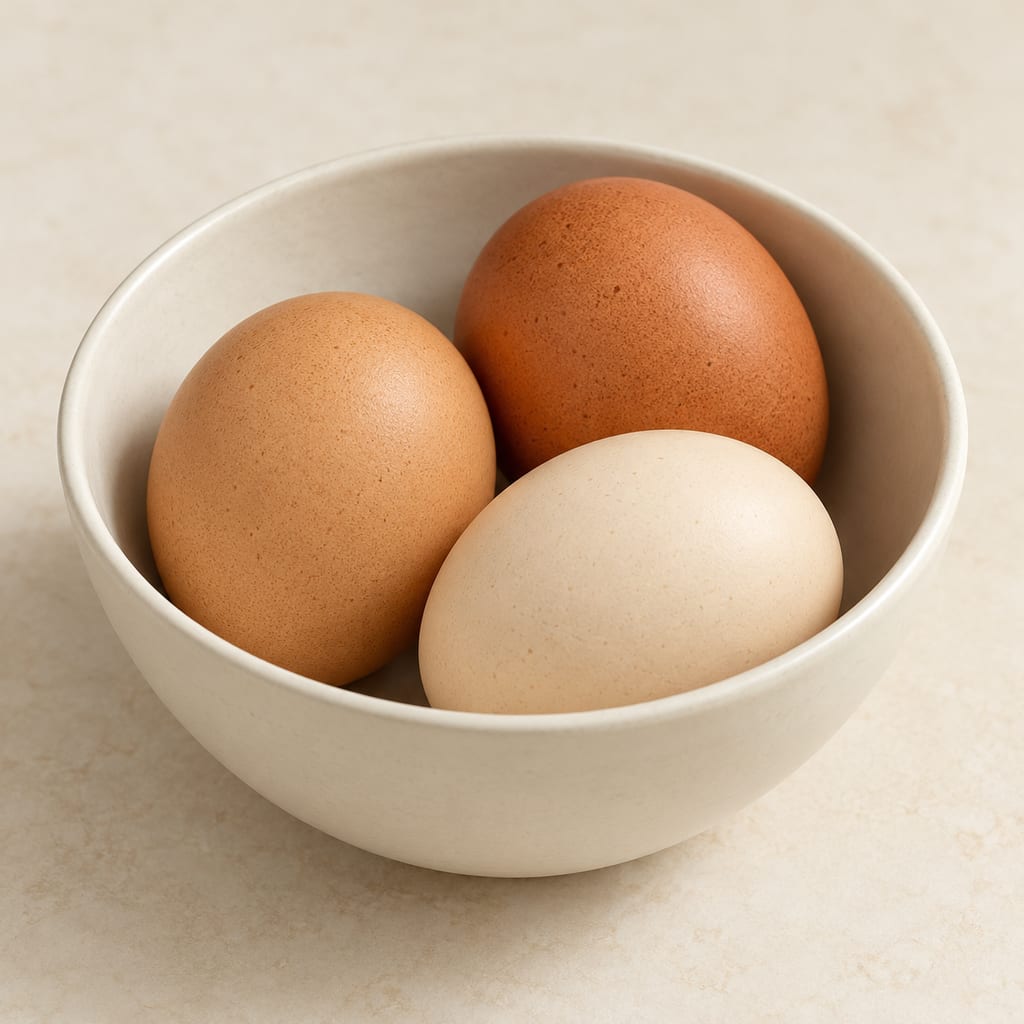
Chicken eggs supply proteins and yolk fats that set and emulsify. Atlas breads use them in enriched doughs, surface washes and a sourdough pancake batter mixed after fermentation.
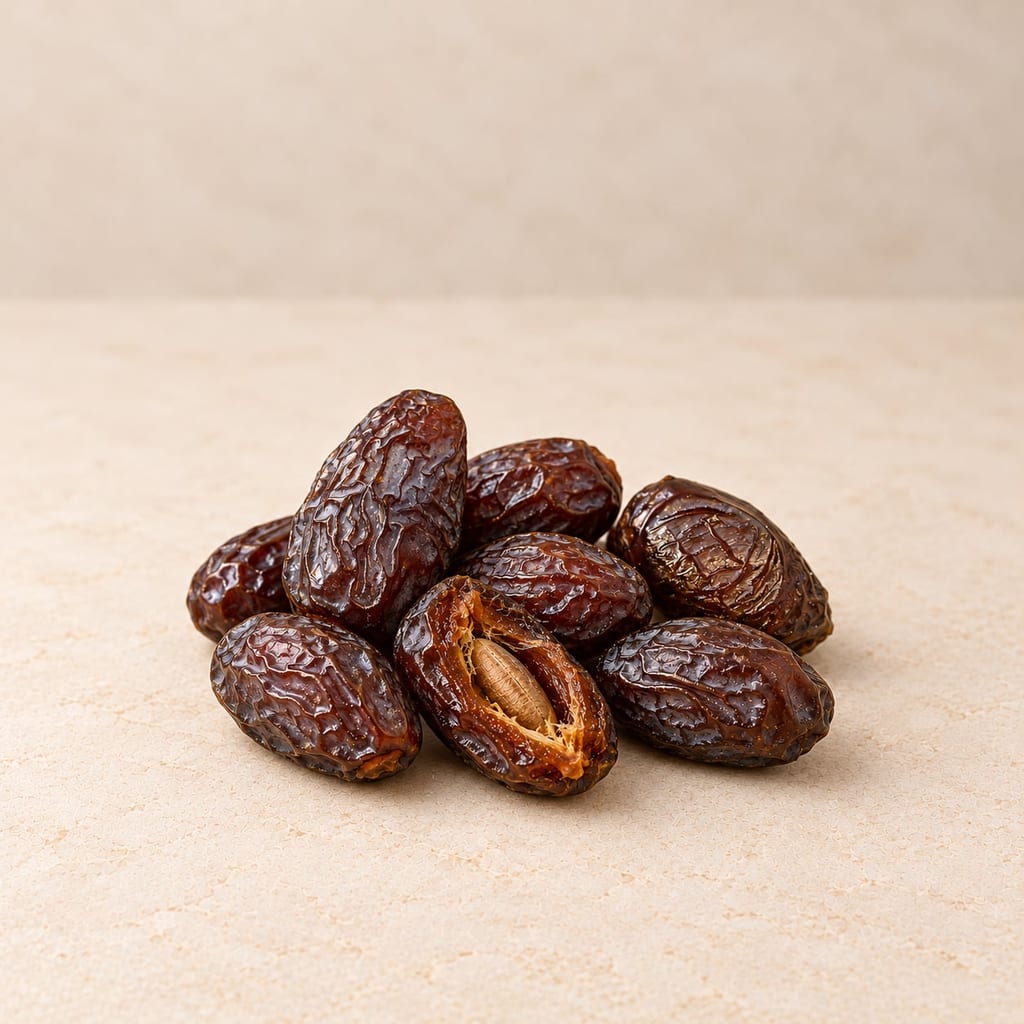
Dates are the sugar-rich fruit of the date palm, eaten soft or dried and used whole, pitted, as syrup or as paste. In sauces and chutneys they add sweetness and body.
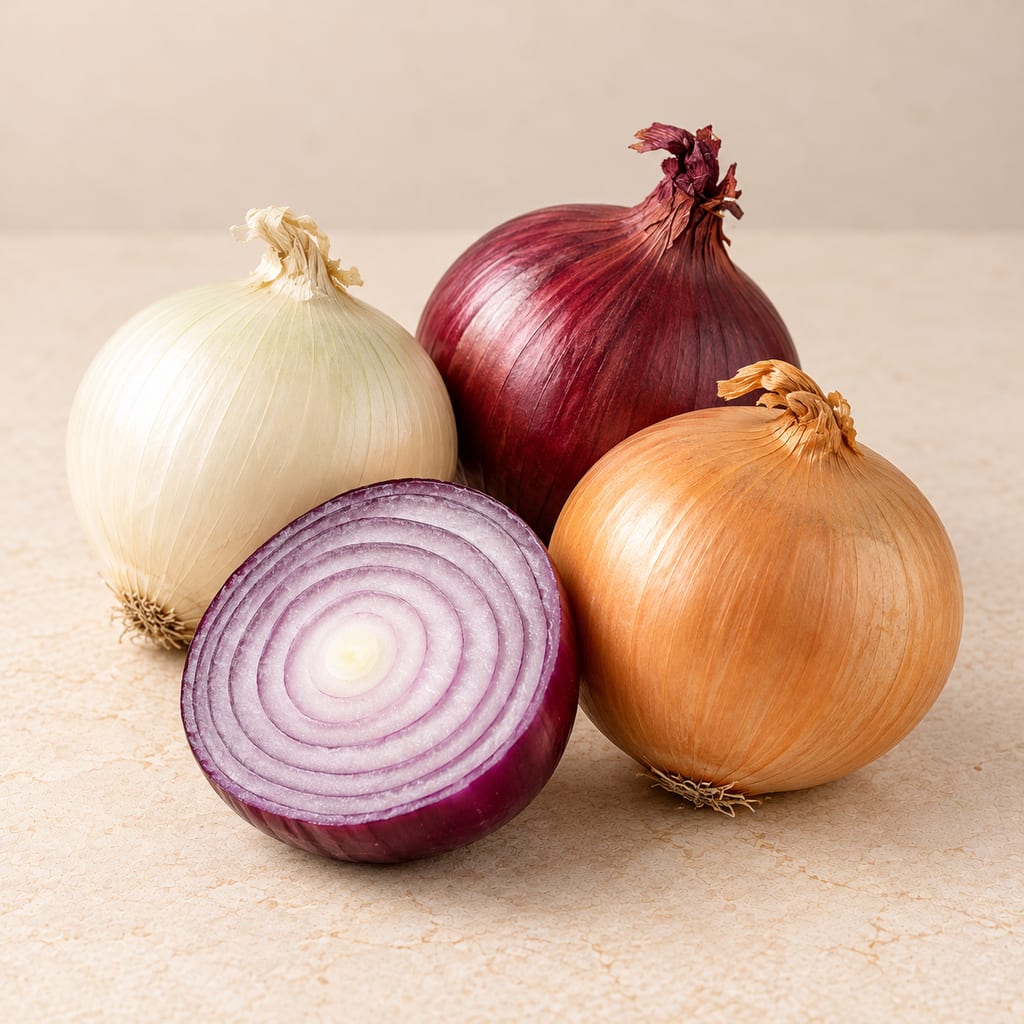
The onion is the bulb of Allium cepa, built from swollen leaf bases, and is eaten raw, cooked, pickled and as a seasoning in ferments. It is known only from cultivation and probably began in Central Asia.
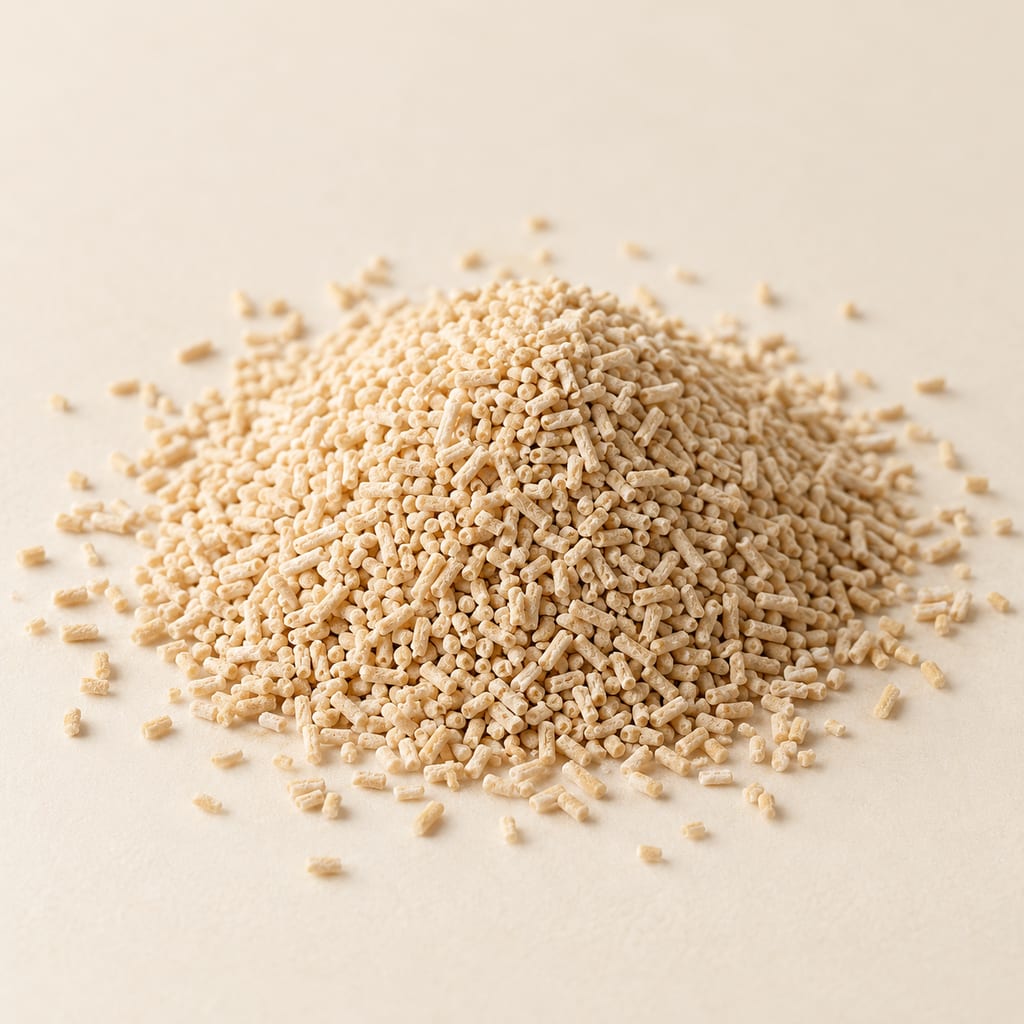
Saccharomyces cerevisiae is the budding yeast that raises bread, ferments most wine and ale, and is sold as named strains whose behaviour in dough or wort differs.
Water buffalo milk comes from Bubalus bubalis and appears in regional dairy traditions across Asia and beyond. Its richer average fat and casein profile affects processing, while composition and raw-milk risk depend on the actual supply.

At North Abydos in Egypt, a fixed early Dynastic brewery comprised parallel semi-subterranean installations with rows of ceramic mash vats; excavation reports revise their number, scale and estimated batch capacity.

Ají amarillo is the orange-yellow Peruvian chilli cultivar group of Capsicum baccatum, used to colour and season huancaína sauce and ají de gallina. Published heat estimates do not establish one range for the named cultivar.

Toasted almonds are whole sweet almond kernels dry-roasted until golden to brown. Heat replaces their marzipan note with a roasted, nutty one; they thicken and flavour romesco.

Kodiak salmon, halibut and cod cut as seg'aq and hung on an initaq rack to become tamuuq, with kac'amaasaq and kupcuunaq named as different results.

Aniseed is the dried ripe fruit of Pimpinella anisum, an aromatic Apiaceae spice commonly called a seed. It adds a sweet, warm aroma to breads such as Moroccan krachel and South African mosbolletjies, and is distinct from star anise.

A fixed Late Chalcolithic installation in Areni-1 cave combined a shallow clay pressing basin with a large jar set into the cave floor and storage vessels nearby.

Ripe avocado flesh is the soft, buttery, fat-rich pulp of Persea americana, eaten raw. It is low in acid, so it is a fresh ingredient that needs care in chilled dishes.

A portable dome and pan used over a hearth, with embers on the lid and heat from below. Regional peka and saç forms share this principle while differing in materials, pan shape and how the food is cooked.
No community contributions have been published for this entry yet.
Sign in to contribute. Published comments and photos are free to read.
Food and Agriculture Organization / World Health Organization, Codex AlimentariusStandard · Composition · Labelling
Codex Standard for Honey, CODEX STAN 12-1981 (adopted 1981, revisions 1987 and 2001)Definition of honey; blossom and honeydew honey.
Moisture, fructose plus glucose, sucrose, water-insoluble solids limits; annex limits for acidity, diastase, hydroxymethylfurfural and electrical conductivity.
No additions; no fermentation or effervescence; labelling by floral source, region, extraction method and style.
Cited in: A food made by bees from other plants’ sugar; Honey in atlas breads; What is in the jar; Why honey keeps, and how it spoils; Types, grades and where honey comes from; Buying and handling, and who should not eat it
Centers for Disease Control and PreventionSafety
Botulism preventionHoney can contain the bacteria that cause botulism; do not feed honey to a child younger than 1 year.
Several babies in Texas became ill with infant botulism after using honey pacifiers.
Cited in: Buying and handling, and who should not eat it
WikipediaComposition · History · Production · Secondary
HoneyHow bees make honey; sugar, water and pH figures; nutrition per 100 g.
Crystallisation temperatures; honey types; 2023 production figures; USDA grading; adulteration.
History and religion passages. A secondary source; its history claims are used with the date conflicts noted.
Cited in: How nectar becomes honey; What is in the jar; Crystallisation and texture; Types, grades and where honey comes from; Buying and handling, and who should not eat it; Open points
WikipediaHistory · Secondary
BeekeepingEarly hives, Egyptian reliefs, Tel Rehov apiary, medieval skeps, movable-comb hives.
Cited in: Open points
WikipediaFermentation · Secondary
MeadMead definition, ratios, yeast and nutrients, timing, variants and regional names.
Cited in: Honey as a fermentable sugar; Open points
New Zealand Beekeeper, November 2018 (Steve Howse, Analytica Laboratories)Spoilage · Fermentation
Managing the risk of fermenting honeyFour risk factors for honey fermentation; moisture thresholds from USDA Agriculture Handbook 335; temperature range; effect of crystallisation; heat treatment guideline.
Cited in: Why honey keeps, and how it spoils; Honey as a fermentable sugar
Universidad Católica Argentina; Zamora, Chirife and RoldánWater activity · Science
On the nature of the relationship between water activity and % moisture in honey (Food Control 17, 2006)Water activity of honey is set by the concentration of dissolved sugars; limiting water activity for osmotolerant yeasts about 0.61 to 0.62; yeasts in honey occur naturally.
Cited in: Why honey keeps, and how it spoils
Proceedings of the National Academy of SciencesFermentation · History
Fermented beverages of pre- and proto-historic ChinaChemical analyses of Jiahu pottery residues were interpreted as evidence for a mixed fermented beverage of rice, honey and fruit (hawthorn and/or grape) by the seventh millennium BCE; the study does not provide a recoverable recipe.
Cited in: Honey as a fermentable sugar
Danish Journal of ArchaeologyFermentation · History
A biomolecular archaeological approach to “Nordic grog”The combined archaeological, biomolecular and archaeobotanical evidence from sites in Denmark and Sweden supports a reconstructed hybrid beverage with honey, local fruits and cereals, sometimes with imported grape wine; this is a historical interpretation, not a standard recipe.
Cited in: Honey as a fermentable sugar
Food Science & NutritionFermentation · Method · Geography
Application of starter cultures in the production of Enturire – a traditional sorghum-based alcoholic beverageThe primary study describes Enturire as a sorghum-and-honey beverage from southwestern Uganda; the traditional method adds honey after an initial sorghum-malt fermentation, and the experiment compares a modified order and starter cultures.
Cited in: Honey as a fermentable sugar
The Metropolitan Museum of ArtHistory · Geography
Fragment from a jar with a label identifying contents as honeyCatalogues an Egyptian New Kingdom jar fragment labelled for honey, dated ca. 1386–1347 BCE; records findspot and country.
Cited in: Honey before and during early beekeeping
Proceedings of the National Academy of Sciences of the United States of AmericaHistory · Geography · Beekeeping
Industrial apiculture in the Jordan valley during Biblical times with Anatolian honeybeesIdentifies bee remains within clay cylinders at Tel Rehov as evidence for an apiary dated to the 10th–early 9th centuries BCE; discusses a possible Anatolian bee origin, not a single origin for honey.
Cited in: Honey before and during early beekeeping
Epicurious, reprinted from The Soul of a New CuisineBread use · Geography · Modern preparation
Honey BreadThe 2009 recipe is titled Honey Bread and is introduced as Ethiopian dabo; honey is included in a modern yeast-loaf dough. It does not establish that this is a universal or historic dabo formula.
Cited in: Honey in atlas breads
Infos Tourisme MarocBread use · Geography · Documented use
Baghrir with honeyThe recipe serves cooked baghrir with honey mixed with butter; this source documents one contemporary Moroccan serving use.
Cited in: Honey in atlas breads