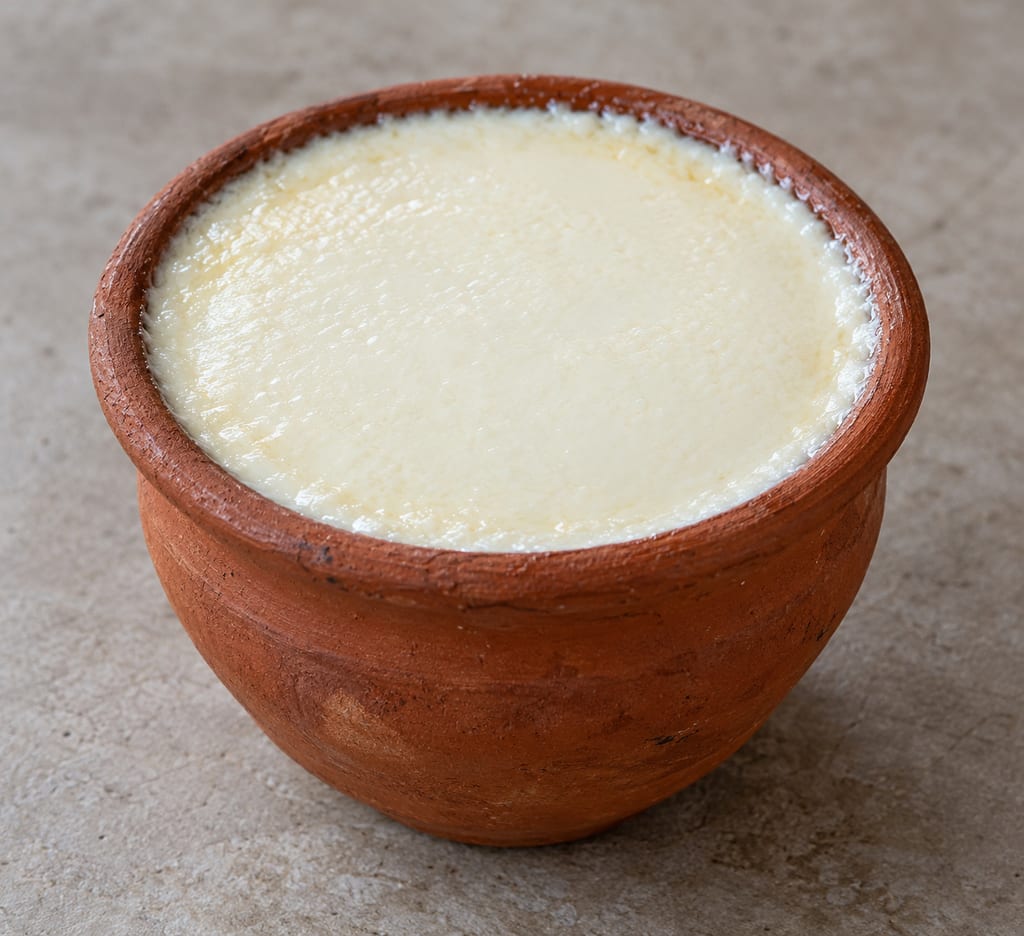
Juju dhau
Juju dhau is a rich Newar cultured milk associated with Bhaktapur, Nepal. A local account describes buffalo milk concentrated by boiling, inoculated with previous-day curd and set in earthen pots.
 FermenteaWhere food goes to change
Substrates
Water buffalo milk comes from Bubalus bubalis and appears in regional dairy traditions across Asia and beyond. Its richer average fat and casein profile affects processing, while composition and raw-milk risk depend on the actual supply.
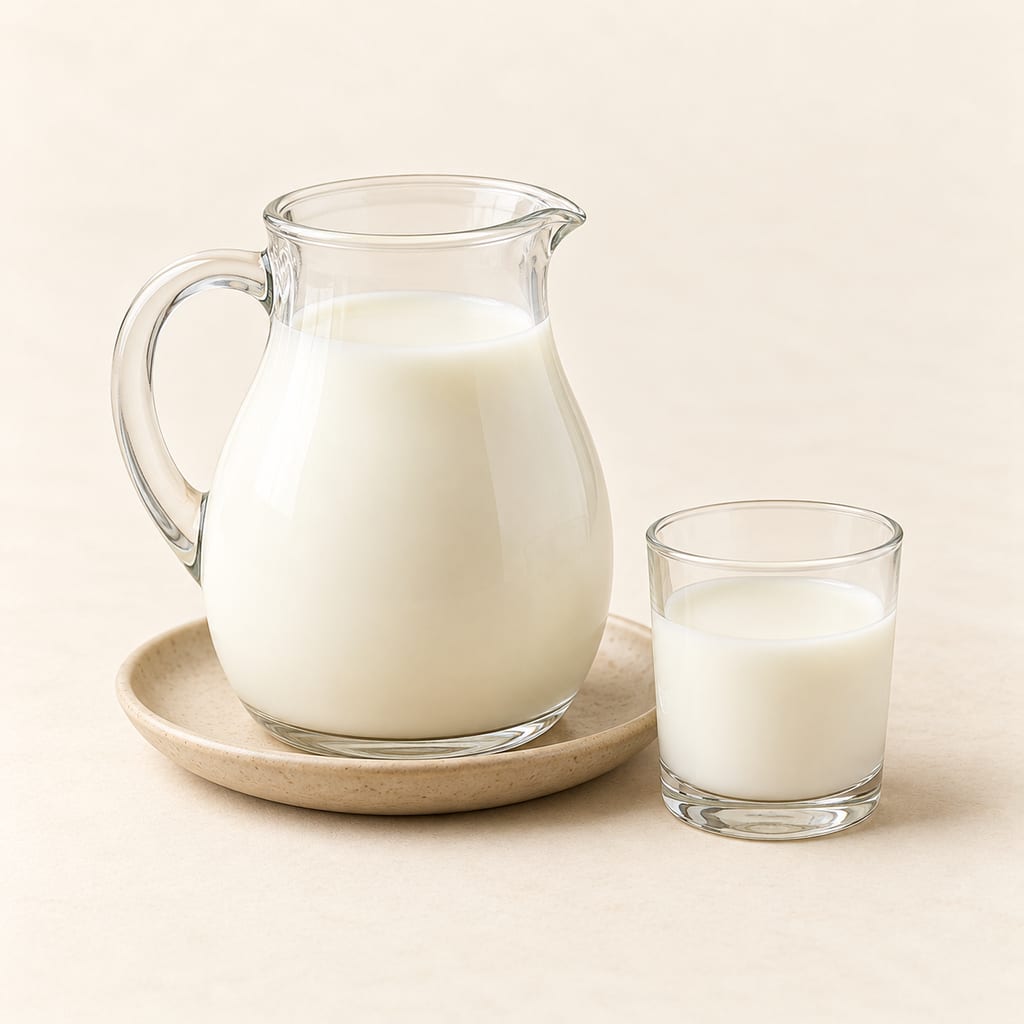
Water buffalo milk is the milk of the domesticated Asian water buffalo, Bubalus bubalis. The species name matters: the African buffalo is Syncerus caffer, a different animal. In trade and everyday speech, “buffalo milk” can leave that distinction unstated, while “water buffalo milk” names the dairy animal directly. The ingredient is milk, not a finished cultured product or cheese.
A milk name describes its animal source, not everything that has happened to it. Freshly drawn milk, pasteurized milk, homogenized milk, cream-separated milk and dried milk have different handling histories and forms. A product label or supplier record should identify both the animal source and any processing that matters to the recipe. The words “buffalo milk” alone do not establish that a supply is raw, pasteurized, standardized or suitable for every process.
This species-specific page narrows the subject of the broader “cow or buffalo milk” entry. That entry documents a recipe’s choice between two dairy substrates. Here the focus is water buffalo milk itself: its production, variation, chemistry, regional uses and limits. A recipe that permits cow or buffalo milk still needs its own method to explain whether either choice works.
Domestic water buffalo include river and swamp types. River buffalo make up most of the global population and are the principal dairy type. Swamp buffalo are concentrated in eastern Asia and are more often kept for draught work; FAO reports lower milk yields than for river buffalo. These are broad husbandry patterns, not a rule for every herd or a claim that swamp buffalo are never milked.
Dairy populations include many breeds, among them Murrah, Nili-Ravi, Kundi, Surti, Jaffarabadi, Bhadawari and Mehsana. The names mark a diverse livestock resource rather than a uniform milk specification. A milk line in a recipe rarely records the breed, feed, season or lactation stage, so a reader should not infer those details from the word “buffalo.”
The animal’s broader role also shapes the supply. Buffalo are kept for milk and draught work in mixed crop-and-livestock systems, and in some places contribute meat as well. A dairy supply is tied to local farm systems, animal care, breeding and collection practices. The species label gives a starting point for understanding the milk; it does not describe the whole farm.
Research places the history of domestic water buffalo within a wider Asian history of livestock, movement and contact between people and wild populations. Genetic studies distinguish river and swamp lineages and describe complex domestication processes. Their results do not provide a simple date when people first began milking buffalo, and genetic ancestry is not direct evidence of a milk product.
Archaeological pottery residues preserve evidence of dairy processing, but often do not identify the animal species. At Kotada Bhadli in Gujarat, lipid-residue research places dairy processing at approximately 2300–1950 BCE. The evidence is consistent with cattle and possibly buffalo milk; it does not prove that the residue came from a water buffalo or identify a named cheese or cultured milk.
For this ingredient, the earliest securely dated use of water buffalo milk remains unknown in the sources reviewed. That is a limit of the evidence, not a claim that the practice began recently. Later named foods and current dairy populations show documented use in particular regions, but they cannot be projected backwards as proof of an ancient recipe.
India and Pakistan are the largest water buffalo milk producers. Buffalo milk also matters in the Near East. Nepal, China and Egypt have large dairy-buffalo populations. These statements describe different measures: an animal population is not the same thing as a volume of milk, and neither measure establishes the birthplace of a food made with that milk.
Buffalo dairying is also found beyond its largest production regions. The species occurs in parts of Europe, Africa and South America, alongside its concentration in Asia. Modern farms and cooperatives turn milk into fresh cheeses, cultured products, butter, cream and sweets according to local demand. A Somerset producer, for example, sells buffalo milk alongside mozzarella and ice cream; that contemporary operation is one local supply, not a historic origin story.
Milk production changes with the animal and the production system. FAO gives a broad river-buffalo lactation range and notes that reproductive seasonality, age at first calving, long calving intervals and dry periods constrain commercial output. Breeding programs have sought higher yields in several countries. Those sector-level observations do not predict an individual animal’s yield or a household’s available quantity.
Water buffalo milk is generally richer in fat than cow milk. FAO describes its average fat content as about twice that of cow milk and gives a fat-to-protein ratio near 2:1. It also has a higher casein-to-protein ratio than cattle milk. These averages help explain why buffalo milk is useful in many cheese-making traditions, but they are not a laboratory result for a particular container.
Breed, age, diet, lactation stage, parity, farming system, environment and season all affect milk composition, colour and flavour. The same species can therefore supply milk with different processing behaviour over time and between farms. A recipe should retain the actual source’s measured values when it gives them; a reader should not replace them with a typical table value.
Processing changes the ingredient again. Standardizing fat, separating cream, homogenizing, heating, drying or culturing each alters some part of the milk’s form or history. “Whole buffalo milk” may identify a fat class on a label, but it does not specify breed or microbial status. When a recipe depends on a particular state, its instructions need to name that state.
Milk carries lactose and soluble minerals in water, while fat is dispersed as droplets and much of its protein is arranged in casein micelles. Buffalo milk’s higher average casein-to-protein ratio and fat content change the material that a cheesemaker begins with. This is one reason a recipe written for one milk cannot be assumed to produce an identical curd with another.
Acid-producing cultures use lactose and lower the milk’s pH. That change affects the mineral balance around casein and helps protein particles form a gel. Rennet works through a different action on casein. Calcium participates in the aggregation of the altered protein particles. A cheese can use culture, rennet or both, but milk by itself is not a fermentation process.
When curd is cut and drained, water and dissolved material leave with the whey while much of the casein and fat remains in the cheese. The size of the cut, stirring, heating, moulding and pressing change how much whey escapes. Buffalo milk’s composition interacts with those steps; it does not dictate one texture, yield or rennet dose across all recipes.
Mozzarella di Bufala Campana is a fresh stretched-curd cheese associated with a protected area in Campania and specified adjoining parts of southern Italy. The buffalo-milk designation separates it from cow-milk mozzarella; the two names are not interchangeable geographic claims.
In Egypt, Domiati may use cow milk, buffalo milk or documented mixtures. Its method adds salt before rennet. This example shows a regional cheesemaking tradition where milk choices can vary, but it does not give a universal ratio for mixing the two species. A recipe should say which option it actually supports.
Other traditions transform buffalo milk into cultured milk, fresh curd, clotted cream or sweets. In Sri Lanka, meekiri is set cultured buffalo milk. Afyon kaymağı in Türkiye is a rich clotted cream produced through heating and cooling. Philippine kesong puti is a fresh white cheese associated with buffalo milk, although other milk appears in modern training systems. These foods share an ingredient, not one process.
In Minangkabau areas of West Sumatra, Indonesia, dadih (also written dadiah) is traditionally made by fermenting buffalo milk in bamboo. The result is a cultured gel. This is a specific inherited milk practice, not a general recipe for buffalo milk. Its name, vessel and place belong together in the documented tradition.
An Indonesian Ministry of Agriculture research paper describes spontaneous fermentation in bamboo and separately tests starter-culture adaptations using cow milk. That distinction matters: an experimental cow-milk version does not erase the buffalo-and-bamboo tradition, and a starter-culture trial is not automatically the process used in every household.
Dadih in Sunarlim’s study fermented spontaneously in bamboo for 24–48 hours at room temperature. That timing belongs to a specific research and cultural context. It is not a validated safety limit or an instruction to ferment any raw buffalo milk at home. A page about the ingredient can identify this use, while a preparation page must separately establish its ingredients, controls and safety evidence.
The supplied research atlas records further buffalo-milk uses that are easy to confuse if the ingredient is treated as one kind of cheese. In North Sumatra, dali ni horbo is a buffalo-milk curd made with plant coagulants and heat. That is different from West Sumatran dadih. Plant-enzyme coagulation does not by itself establish microbial fermentation.
In South Sumatra, gula or gulo puan and sagun puan are cooked milk-and-sugar products. In the Philippines, carabao milk supports kesong puti and pastillas de leche, a milk-and-sugar confection. These preparations reflect local dairy economies; they should not be recast as a single national milk recipe.
The examples also show how the same raw ingredient supports both fermented and non-fermented foods. Some products set through microbial acidification, others through enzymes, heat or concentration. The word “buffalo” names the milk source, not the process. A recipe’s evidence must determine whether its finished product is fermented, coagulated, cooked or served as milk.
Choose milk with a clear species and processing label. Raw, pasteurized, homogenized, standardized and dried milk are different starting materials; a recipe should say which one it uses when the difference affects the process. Follow the supplier’s handling instructions and package date rather than assigning one shelf life to every buffalo milk.
Keep milk cold as directed by the supplier and protect it from contamination during transport, storage and processing. Use clean containers and equipment. Pasteurization is a controlled heat treatment intended to destroy harmful bacteria, but it does not protect milk from contamination after treatment. Refrigeration remains important for pasteurized milk.
The sources reviewed do not provide a species-specific home pasteurization method, universal storage duration or single safe processing temperature for this ingredient page. Those values should remain unstated here. A recipe that gives a validated process may state its own supported limits; a generalized milk article cannot supply those limits by assumption.
Raw buffalo milk can carry disease-causing germs, as raw milk from other dairy animals can. Good farm practices can reduce contamination but cannot guarantee the absence of harmful organisms. FDA and CDC advise choosing pasteurized milk for safer consumption, with particular concern for young children, pregnant people, older adults and people with weakened immune systems.
A sour smell, clean appearance, bubbling or familiar taste does not prove milk is safe. Fermenting raw milk does not replace a tested control, and traditional use does not establish a validated safety process. Do not rely on tasting or cooking suspect milk to decide whether it can be rescued.
Pasteurized and raw milk retain the same lactose concentration and milk-allergy proteins, according to FDA. Pasteurization changes pathogen risk; it does not make milk lactose-free or remove proteins that cause milk allergy. Safety, digestion and allergy are separate questions.
Buffalo milk contains milk proteins and lactose. Lactose intolerance concerns the body’s ability to digest lactose; it is not the same condition as milk-protein allergy. A change from cow milk to buffalo milk should not be presented as a safe substitute for someone with cow-milk allergy. The sources reviewed do not establish that a different buffalo supply avoids a person’s reaction.
Heat treatment does not make ordinary buffalo milk lactose-free and does not remove all milk-allergy proteins. Ingredient labels and dietary choices need to reflect the actual milk used. People who must avoid milk proteins or lactose need product-specific information rather than an assumption based on the animal name.
Buffalo milk’s richer composition is a cheesemaking property, not evidence of a health benefit or a clinical recommendation. It can be useful in dairy processing while remaining unsuitable for some diets. Keeping those claims separate lets a reader understand the ingredient without mistaking a traditional or nutritional description for personal medical guidance.
The evidence reviewed here does not establish the first date when people milked water buffalo, a universal composition for every herd, or one substitute ratio for cow and buffalo milk. Archaeological traces at Kotada Bhadli are not species-specific. Current dairy figures describe production, not a point of origin.
No single preparation explains the ingredient’s uses. Dadih, mozzarella, meekiri, Domiati, kesong puti, clotted cream and cooked milk sweets each have their own process evidence and safety questions. Their differences should remain visible rather than being flattened into a generic buffalo-milk method.
This page records the ingredient and its documented uses. It does not validate a home fermentation, promise a shelf life or set a critical temperature. Where a recipe supplies evidence for a specific process, that evidence belongs with the recipe and must not be generalized to every buffalo milk product.
Milk proteins; contains lactose
FAO identifies India as a leading water buffalo milk producer; this is a production association, not a species or recipe birthplace.
FAO identifies Pakistan as a leading water buffalo milk producer; this is a production association, not a species or recipe birthplace.
FAO describes river-buffalo milk as important in this broad region; no single production locality is asserted.
The buffalo-milk association of Mozzarella di Bufala Campana is protected for a defined area; this is not the birthplace of all buffalo milk.
Traditional buffalo milk for Minangkabau dadih; no origin claim is made for buffalo milk.
Buffalo milk is used for set cultured meekiri; no narrower place is asserted here.
Documented uses include kesong puti and pastillas de leche; practice is not claimed to be uniform nationwide.
The supplied research atlas documents buffalo milk in dali ni horbo in Batak areas; this is a regional product association.
The supplied research atlas documents cooked buffalo-milk and sugar products; this is a use association.
Afyon kaymağı is buffalo-associated clotted cream; this does not make all Turkish kaymak buffalo milk.
FAO documents buffalo milk as one possible Domiati substrate; this does not imply that all Domiati cheese uses it.
Juju dhau is a rich Newar cultured milk associated with Bhaktapur, Nepal. A local account describes buffalo milk concentrated by boiling, inoculated with previous-day curd and set in earthen pots.
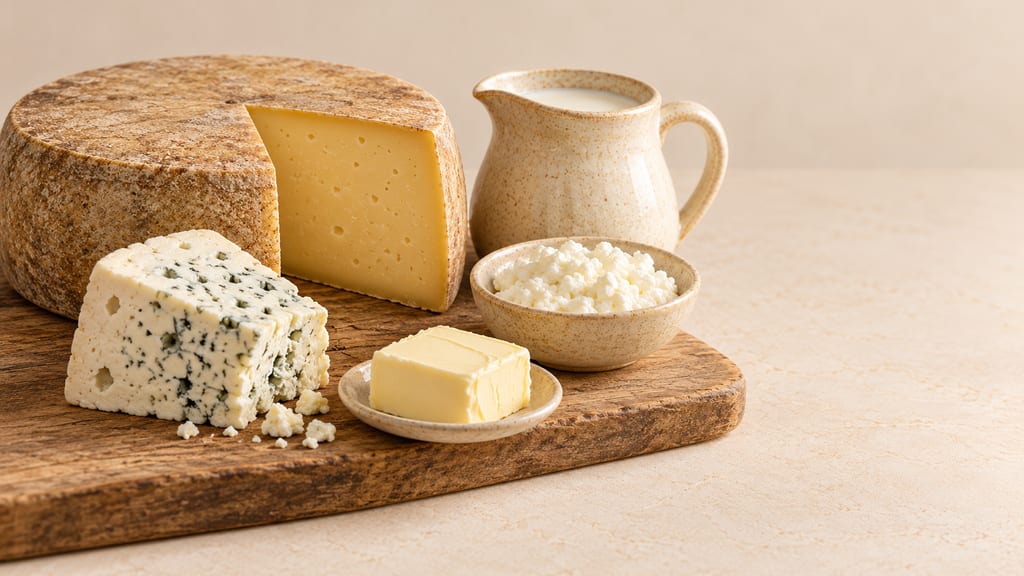
Follow milk into cheese, cultured drinks, butter, dried curds and sweets: a journey through the animals, seasons and household decisions behind the world's dairy foods.
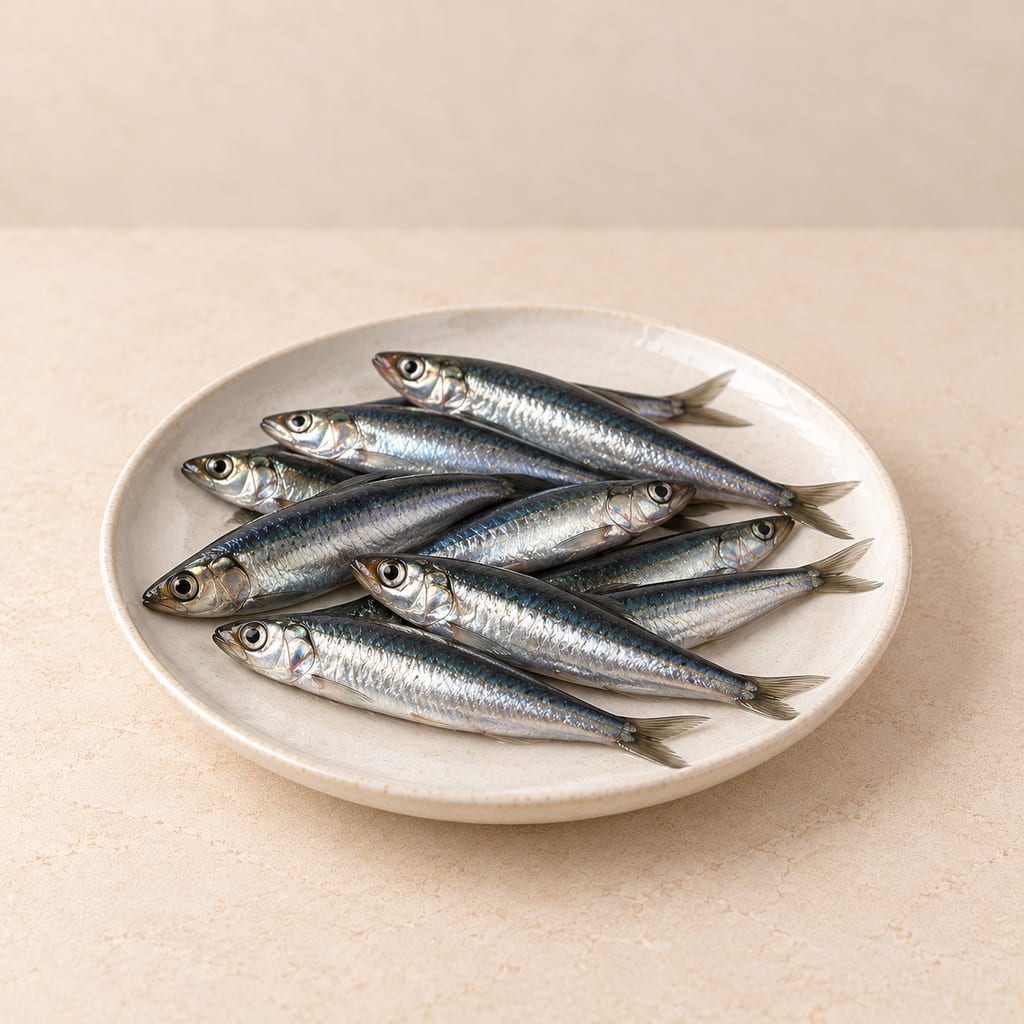
Anchovies are small schooling sea fish of the family Engraulidae, eaten fresh or dried and above all salted: as fillets in oil, whole salted fish or fish sauce.
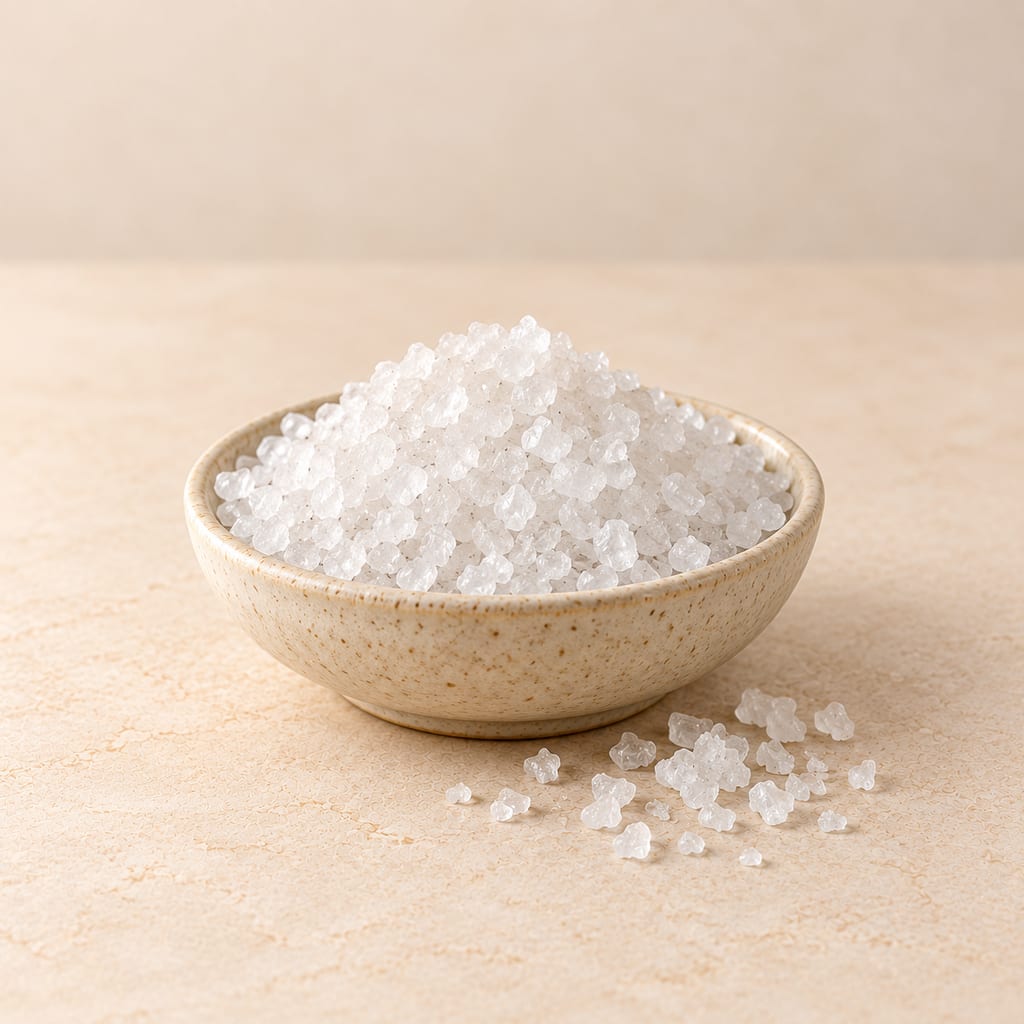
Coarse salt is food-grade salt in large grains, from sea, rock deposits or brine, used for curing, brining, pickling and packing fish.
No community contributions have been published for this entry yet.
Sign in to contribute. Published comments and photos are free to read.
Food and Agriculture Organization of the United NationsIdentity · Composition · Processing
Milk compositionFAO compares buffalo and cattle milk composition and describes variation by species, breed, age, diet, lactation stage, farming system, environment and season.
Buffalo milk has higher average fat and a higher casein-to-protein ratio than cattle milk; these are broad comparisons, not a batch guarantee.
Cited in: What the name identifies; Composition changes from herd to herd; Why the milk behaves differently in a vat; Milk allergy and lactose
Food and Agriculture Organization of the United NationsIdentity · Production · Geography
Buffaloes: Gateway to dairy production and productsFAO describes domestic water buffalo (Bubalus bubalis), river and swamp types, dairy and draught roles, and milk-production regions.
FAO gives a broad river-buffalo lactation range; it is not a household yield or a single-animal guarantee.
Cited in: What the name identifies; River and swamp buffalo; Where buffalo milk is produced; Composition changes from herd to herd; Choosing and handling buffalo milk; What the sources do not establish
Food and Agriculture Organization of the United NationsIdentity · Production · Geography
Buffaloes | Livestock SystemsFAO distinguishes domestic Asian water buffalo, Bubalus bubalis, from African buffalo, Syncerus caffer.
FAO describes the species' Asian concentration, small-scale farms and mixed milk and draught roles.
Cited in: What the name identifies; River and swamp buffalo; Where buffalo milk is produced
PLOS ONEHistory
Mitochondrial DNA Variability of Domestic River Buffalo (Bubalus bubalis) Populations: Genetic Evidence for Domestication of River Buffalo in Indian SubcontinentThe original genetic study discusses uncertainty about river-buffalo domestication and supports a complex process in the Indian subcontinent.
Domestication evidence does not date first milking.
Cited in: Domestication is not the same as the first milk
Scientific ReportsHistory
Compound specific isotope analysis of lipid residues provides the earliest direct evidence of dairy product processing in South AsiaPrimary archaeological research identifies dairy processing at Kotada Bhadli, Gujarat, around 2300–1950 BCE; evidence is consistent with cattle and possibly buffalo, not species-specific.
Cited in: Domestication is not the same as the first milk; What the sources do not establish
Indonesian Ministry of Agriculture repository; Buletin Teknologi Pasca PanenDocumented use · Fermentation
Potensi Lactobacillus Sp. Asal dari Dadih sebagai Starter pada Pembuatan Susu Fermentasi Khas IndonesiaOriginal Indonesian research describes West Sumatran dadih as buffalo milk fermented spontaneously in bamboo, and separately studies cow-milk starter adaptations.
The stated 24–48-hour room-temperature description is specific to the research account, not a validated universal home process.
Cited in: Fermented milk and the dadih tradition; What the sources do not establish
Qualivita / QualigeoDocumented use · Geography
Mozzarella di Bufala Campana PDOThe supplied verified atlas cites this product dossier for the protected buffalo-milk mozzarella area and its distinction from cow-milk mozzarella.
Cited in: One ingredient, several kinds of dairy food; What the sources do not establish
Wayamba University of Sri LankaDocumented use
UReS 2024 proceedingsThe supplied verified atlas cites the proceedings for buffalo-milk meekiri and traditional clay and modern plastic packaging comparisons.
Cited in: One ingredient, several kinds of dairy food; What the sources do not establish
Indonesian Ministry of Agriculture repositoryDocumented use · Production
Upaya Peningkatan Produksi Susu Kerbau untuk Kelestarian Produk Dadih di Sumatera BaratThe supplied verified atlas cites this field account for North Sumatran dali ni horbo and South Sumatran cooked buffalo-milk confections.
Cited in: Other documented uses across Asia and Europe
Philippine Journal of Veterinary and Animal SciencesDocumented use · Geography
A Case Study of the Indigenous Technology for Making White Soft Cheese Kesong Puti in Lumban, Laguna, PhilippinesThe supplied verified atlas cites this case study for Lumban kesong puti, its buffalo-milk association and specific family businesses.
Cited in: One ingredient, several kinds of dairy food; Other documented uses across Asia and Europe; What the sources do not establish
Philippine Carabao CenterDocumented use · Production
Newsletter feature on dairy processing and milk productsThe supplied verified atlas cites the Philippine Carabao Center for carabao-milk pastillas and other contemporary products.
Cited in: Other documented uses across Asia and Europe
Turkish Culinary Culture AtlasDocumented use · Geography
Afyon KaymağıThe supplied verified atlas cites this official cultural entry for buffalo-associated Afyon kaymağı, a clotted cream made by heating and cooling.
Cited in: One ingredient, several kinds of dairy food
Food and Agriculture Organization of the United NationsDocumented use · Processing
The technology of traditional milk products in developing countries: DomiatiFAO documents cow and buffalo milk as possible Domiati substrates, including variable proportions, and salt before rennet; this gives no universal blend.
Cited in: Why the milk behaves differently in a vat; One ingredient, several kinds of dairy food; What the sources do not establish
U.S. Food and Drug AdministrationSafety · Handling
Raw Milk Questions & AnswersFDA explains raw-milk pathogen risks and pasteurization; pasteurized milk needs refrigeration and retains lactose and milk-allergy proteins.
Cited in: Choosing and handling buffalo milk; Raw milk carries a separate safety question; Milk allergy and lactose
Centers for Disease Control and PreventionSafety
Raw MilkCDC states raw milk can carry harmful germs and farm practices cannot guarantee safety; pasteurized dairy is safer, especially for higher-risk groups.
Cited in: Choosing and handling buffalo milk; Raw milk carries a separate safety question
Health CanadaAllergen
Milk – A priority food allergenHealth Canada identifies milk as a priority food allergen; buffalo milk should not be presented as an assumed safe replacement for cow milk in allergy-sensitive diets.
Cited in: Milk allergy and lactose