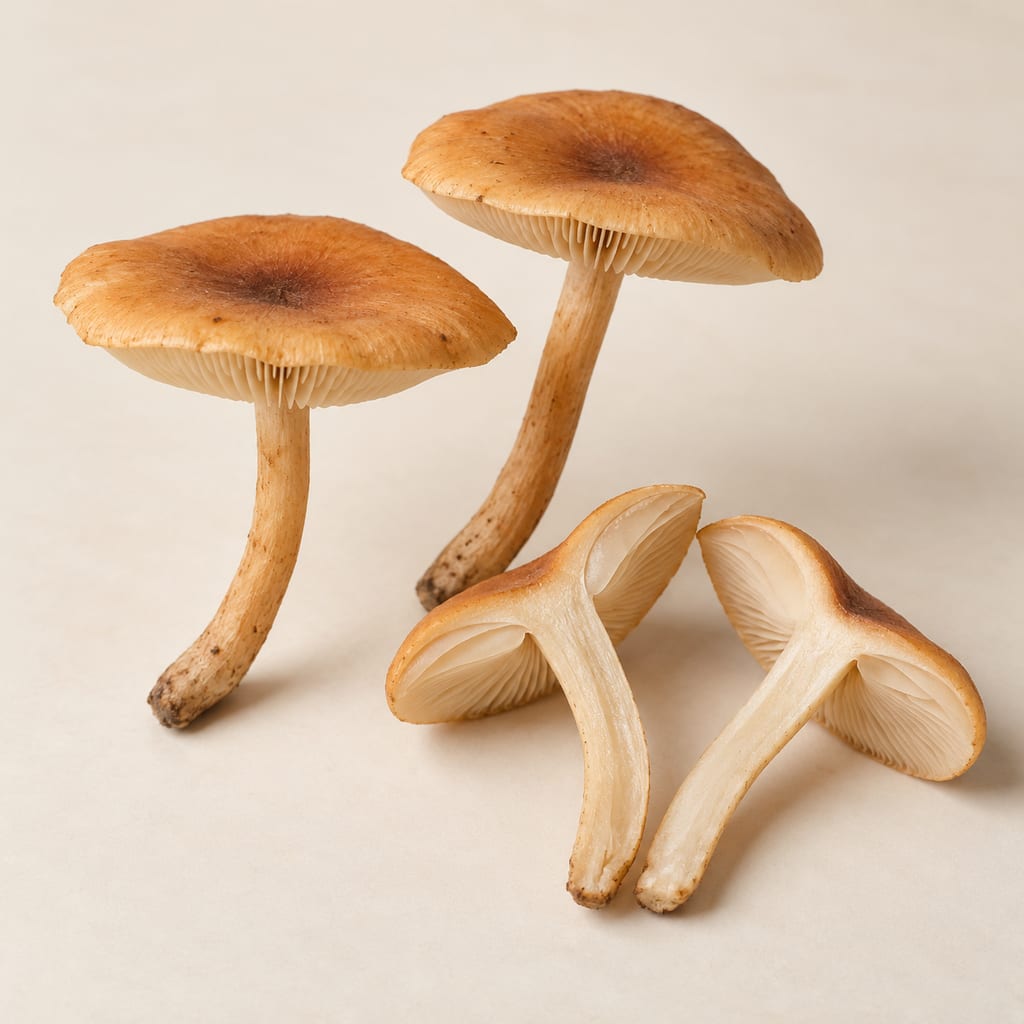
Armillaria bruneocystidia
A wood-associated Armillaria recorded in Yunnan and Sichuan, China, and listed as edible in a 2026 Chinese catalogue.
 FermenteaWhere food goes to change
Cultures
A formed grain starter (daqu) for Chinese baijiu, classed as medium-temperature because its bricks reach a higher peak than low-temperature daqu; used mainly for strong-flavor baijiu.
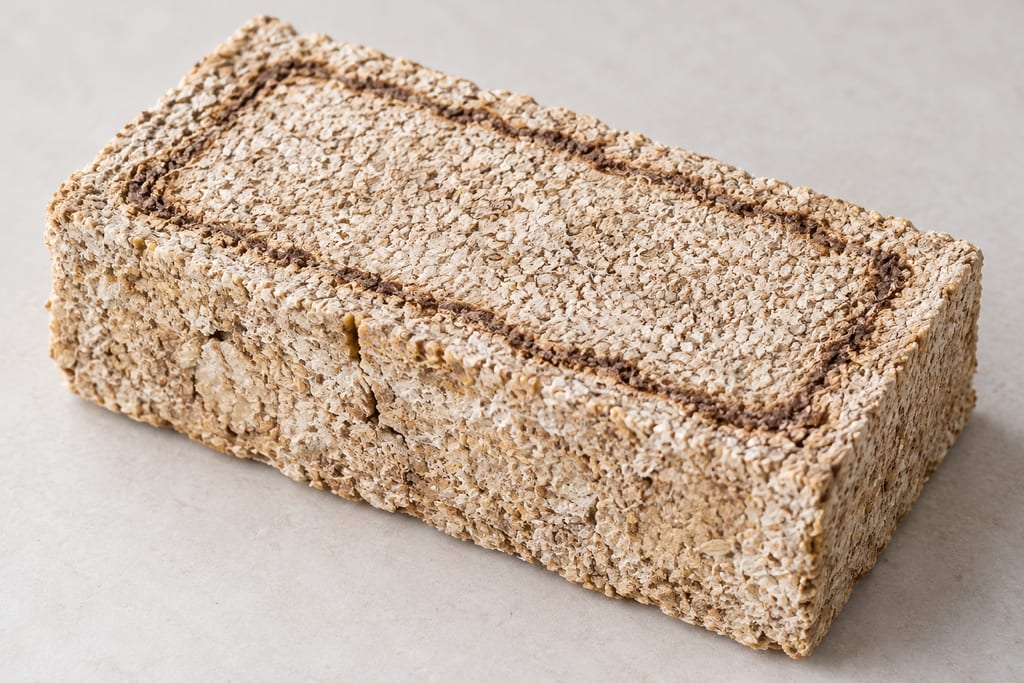
Medium-temperature daqu is a formed grain starter used in baijiu production. It is a brick containing a mixed community selected during open solid-state fermentation. The brick supplies microorganisms and enzymes to the later grain fermentation and contributes flavor compounds. It is not a named species, an isolate, a commercial pure culture or the distilled spirit.
Sources classify daqu by the maximum temperature reached inside the fermenting bricks. A 2017 study gives the medium-temperature band as 50 to 60 °C. The studied Luzhou Laojiao batch rose from 29.1 °C to a measured core average of 53.4 °C by day 4, stayed between 53.4 and 56.2 °C through day 12, and then cooled. That batch curve is one measured industrial process. It is not a universal preset, and it is not a home temperature target.
The studies document particular production in Luzhou, Sichuan, sampled in January 2013 and September 2016; in Yibin, Sichuan, from a May 2022 production batch; and at a Songhe Co. facility in Henan, where a summer batch was made. A 2020 Henan study sampled a strong-flavor daqu process at several stages. These are modern examples, not an exclusive origin or a single national method.
The sampling dates describe the studied batches. They do not establish a universal manufacturing season.
The ASM introduction lists wheat, barley, peas and sorghum among the materials used in daqu making generally. The 2024 Yibin study identifies its substrate as wheat, and the Songhe study describes a wheat or wheat-mixture brick. The sources support cereal-brick construction, but not one fixed formula or cereal ratio for medium-temperature daqu.
During early propagation the Luzhou batch heated itself. Rapid growth over the first four days raised the brick core to about 55 °C. That bioheat was associated with a succession in which several thermotolerant taxa persisted and others declined. Bacterial groups in that sample included Weissella, Leuconostoc, Lactobacillus and later Bacillus. Fungal groups included Thermoascus, Candida, Wickerhamomyces and later Thermomyces. These are time-specific observations from one batch, not an inoculation list.
Medium-temperature daqu is used as a saccharifying and fermenting starter in strong-flavor baijiu. The later solid-state fermentation of the grain mash, distillation and the finished spirit are separate stages. The Luzhou study reports that daqu also contributes enzymes and flavor-related metabolites that may be transformed later in brewing. The Songhe study associates mature daqu with volatile aroma compounds, including pyrazines and alcohols. These findings describe the studied systems and do not quantify a universal flavour contribution.
The 2022 Songhe study found different communities and physicochemical measurements in the outer and inner layers of the brick. It cultured and identified isolates as well as analysing sequence-based communities; those methods answer different questions, and neither makes a named isolate a suitable commercial or home culture. The 2024 Yibin study likewise reports spatial and temporal variation across the surface, middle and core. The research does not reduce this mixed system to one organism or one mechanism.
No complete home recipe or validated home-production process for medium-temperature daqu was found. The studies do not give ingredient quantities for a home batch, validated endpoints, a sanitation plan, a stock-retention method or food-specific safety controls. The studied batches ran for about 30 days, and the Songhe study sampled up to four months of storage, reporting relative stabilization in some indices after three months. These are distinct study batches, not a shared schedule.
Sample refrigeration or freezing in the research methods concerns laboratory analysis, not viable starter storage. A species detected in a brick is not automatically a suitable inoculum, and smell, taste, visible growth or a home thermometer reading cannot establish that a brick is safe to use.
The earliest attestation of the temperature-defined class is not established. A producer-specific process specification, food-specific safety evidence and retained-stock guidance are not in the inspected material. The class must be kept apart from low-temperature and high-temperature daqu, which are related categories and not interchangeable.
Wheat, Barley
Catalogue country association; no narrower origin established.
A studied Luzhou Laojiao batch; a modern example, not an exclusive origin.
A studied Yibin batch.
A Songhe Co. facility batch, not a regional origin.
A wood-associated Armillaria recorded in Yunnan and Sichuan, China, and listed as edible in a 2026 Chinese catalogue.
Tuber huidongense is a subterranean truffle of pine forests in south-western China, known from Sichuan and Yunnan. A recent Chinese catalogue lists it as edible, but no culinary tradition for it has been documented.
No community contributions have been published for this entry yet.
Sign in to contribute. Published comments and photos are free to read.
Applied and Environmental MicrobiologyScience · Method
Bio-Heat Is a Key Environmental Driver Shaping the Microbial Community of Medium-Temperature DaquThe medium-temperature band is given as 50 to 60 °C in a 2017 study.
In the Luzhou Laojiao batch the brick core rose from 29.1 °C to a measured average of 53.4 °C by day 4, held between 53.4 and 56.2 °C through day 12, then cooled.
Thermotolerant bacterial and fungal taxa persisted through the bioheat while others declined; the taxa are time-specific observations.
Cited in: What it is; Where it is made and studied; Ingredients and making; Role in strong-flavor baijiu; Open questions
Frontiers in Microbiology; PubMed CentralScience
Quantitative metaproteomics reveals composition and metabolism characteristics of microbial communities in Chinese liquor fermentation startersDaqu contributes microorganisms and enzymes to Chinese liquor fermentation.
Cited in: What it is
Food Research InternationalScience
Insights into the bacterial, fungal, and phage communities and volatile profiles in different types of DaquA May 2022 Yibin batch was studied; its substrate is wheat and its communities vary across the brick surface, middle and core.
Cited in: Where it is made and studied; Ingredients and making; Spatial variation within the brick
PubMed CentralScience · Method
Microbial community assembly patterns at the species level in different parts of the medium temperature DaquA Songhe Co. batch in Henan was made in summer; outer and inner brick layers differ in communities and physicochemical measurements.
Mature Daqu was associated with volatile aroma compounds, including pyrazines and alcohols.
Cited in: Where it is made and studied; Role in strong-flavor baijiu; Spatial variation within the brick; Storage, handling and safety
Frontiers in MicrobiologyScience
Comparative analysis of the microbiotas and physicochemical properties inside and outside medium-temperature DaquInside and outside brick layers were compared in microbiota and physicochemical properties.
Frontiers in MicrobiologyScience · History
Deciphering the fungal symphony: unveiling the fungal dynamics during the fermentation of traditional Chinese baijiu daquModern introduction describes medium-temperature daqu as a saccharifying starter used for about a thousand years; the statement is not a primary attestation.
A 30-day fermentation followed by three months of maturation in a 2020 Henan study.
Cited in: Storage, handling and safety
Frontiers in MicrobiologyScience
Integrative analysis of fungal communities in three types of Baijiu Daqu using third-generation sequencing and culturomicsMedium-temperature samples are compared with low- and high-temperature samples; a comparative figure identifies a medium-temperature Sichuan sample.
Sina FinanceHistory
Making qu: an epic of how Chinese people turn grain into liquorSecondary account of the history of Chinese qu; it does not specifically attest the medium-temperature class.