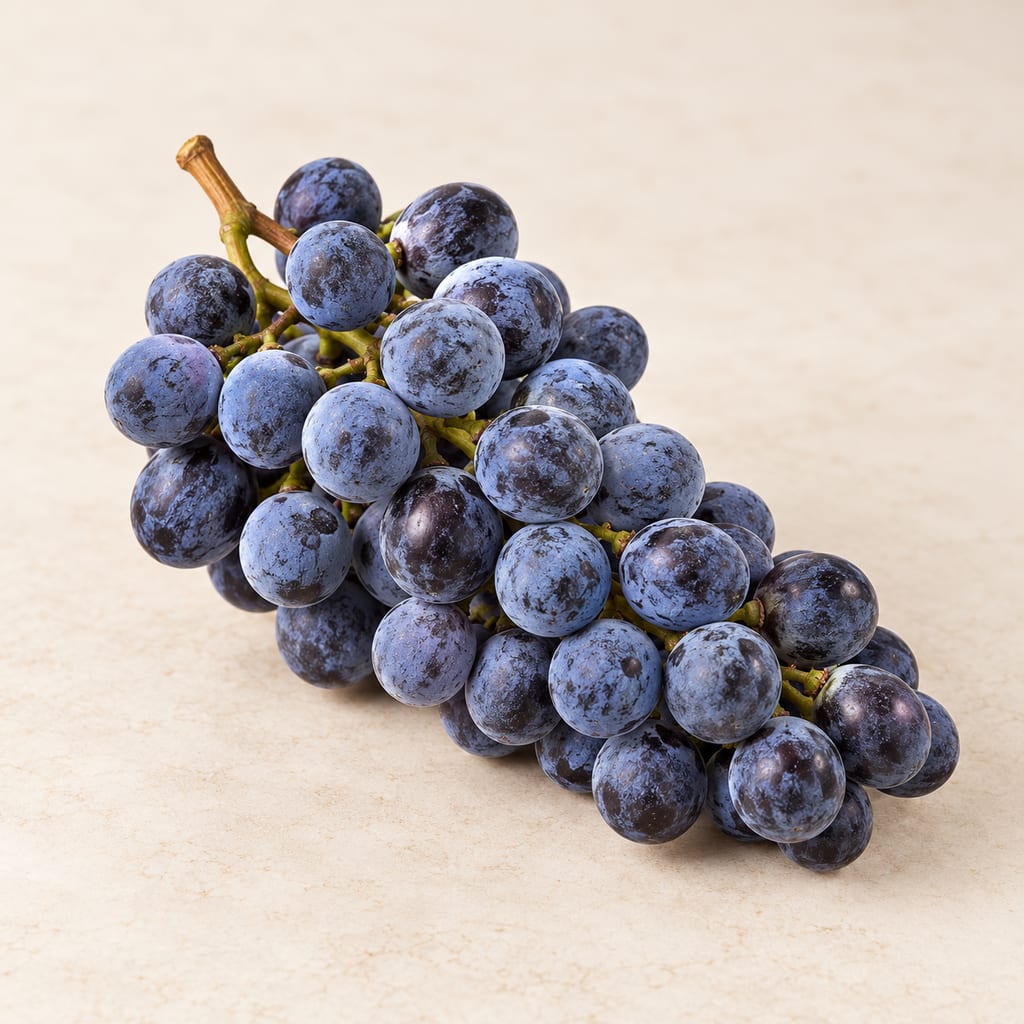
Concord grapes
Concord is a seeded, blue-black slip-skin grape with a distinctive aroma, used fresh and in juice, preserves, pies and wine.
 FermenteaWhere food goes to change
Mushrooms
Agaricus meijeri is a Brazilian wild edible mushroom recorded in Paraná and Rio Grande do Sul. Its season and preparation are undocumented.
Agaricus meijeri is a named species of the gilled-mushroom genus Agaricus, in the family Agaricaceae. Heinemann described it in 1993 from Brazilian material. Later work places it among fungi known from Paraná, while a 2024 national audit lists it in Paraná and Rio Grande do Sul. A name and an occurrence record do not by themselves explain how often people find the mushroom or how they use it as food.
Putzke and Putzke’s 2017 review reproduces the published description: a cap around 7–12 cm wide, first hemispherical and later flattening, with a smooth dark-brown centre and brown-violet to greyish red-brown scales over a pale background. The gills are free or nearly free from the stem; they begin pale, may show pink or orange tones when bruised, and darken brown as spores mature. The white stem has a simple upper ring, and the flesh can yellow slightly when exposed. The authors describe spores that look bean-shaped from the side under a microscope.
This is taxonomic evidence, not a field identification key. The same paper notes that earlier authors called for additional collections to confirm the identity. Agaricus includes poisonous species, and species-level identification matters; resemblance to a description is not enough to identify a wild specimen.
Drewinski and colleagues’ 2024 audit categorizes A. meijeri as BEM1, one of its Brazilian wild edible mushroom categories. Their framework uses this category for edible species with robust occurrence evidence, including those with documented consumption or those treated as potential food resources. For this species, the table records a Brazilian type and a complete morphological description as the occurrence basis. This classification is not a species-specific toxicological assessment, a cooking method, or a guarantee about a specimen found in the field.
The audit says Agaricus remains insufficiently studied in Brazil and that identification can be challenging because visible features vary with environment and within species. A broader FAO overview describes limited and small-scale reporting of wild edible fungi use in Brazil, but does not attribute a named preparation to A. meijeri. No precise recipe, preservation method, harvest practice, or named community tradition for this species was located. Generic Agaricus recipes should not be attached to this record without direct evidence.
Paraná is the clearest documented place. The 2017 review lists the species from that state and discusses Heinemann’s caution that more material would help confirm identity. A related specimen record cited in the review is from São José dos Pinhais, dated 21 October 1979. That is one historical collection date, not evidence of an annual October season.
The 2024 audit lists A. meijeri in Paraná and Rio Grande do Sul at state level. These are occurrence contexts; the table does not establish local abundance, harvest frequency, or consumption separately for each state. The sources therefore support a Brazilian range record including these states, but not a reliable seasonal calendar.
The taxonomic treatment describes the mushroom growing on soil in forest interiors. It does not establish a preferred tree, narrow forest type, or cultivation method. No commercial grower or regular retail supply for A. meijeri was identified. The fact that other members of Agaricus are commercially cultivated cannot be transferred to this species.
No species-specific preparation is documented, so this account does not recommend sautéing, drying, fermenting or storing A. meijeri. The available record establishes its taxonomic and edible-mushroom context.
A fuller account needs further voucher-backed collections with exact localities and dates; examination of the original description and herbarium material; rights-cleared photographs confidently identified as this species; and direct documentation of who eats it and how. The 2024 audit establishes a Brazilian edible-mushroom record but not those practical details. Until better evidence is available, this page should remain qualified and should not be used as foraging guidance.
National audit classifies A. meijeri as BEM1; this is not evidence of a particular preparation or local tradition.
State-level occurrence in the 2024 audit and taxonomic records in the 2017 review; not a claim of state-specific consumption.
State-level distribution in the 2024 audit; not a claim of local consumption or abundance.
Concord is a seeded, blue-black slip-skin grape with a distinctive aroma, used fresh and in juice, preserves, pies and wine.
No community contributions have been published for this entry yet.
Sign in to contribute. Published comments and photos are free to read.
IMA Fungus / Springer NatureIdentity · Uses · Geography · Safety
Over 400 food resources from Brazil: evidence-based records of wild edible mushroomsA. meijeri is categorized BEM1; the paper defines occurrence and consumption evidence.
Agaricus remains insufficiently studied in Brazil and can be hard to identify.
The species table includes Brazilian state distribution.
Cited in: A Brazilian species with a narrow paper trail; What the edible classification says; Places and season; Habitat, supply, and kitchen use; Research still needed
Neotropical Biology and ConservationIdentity · Ecology · Safety
The Genus Agaricus L. ex. Fr. (Agricales, Basidiomycota) in BrazilMorphological description and Paraná occurrence of A. meijeri.
Identity caveat and forest-soil habitat.
Agaricus includes poisonous species.
Cited in: A Brazilian species with a narrow paper trail; Appearance in taxonomic descriptions; Places and season; Habitat, supply, and kitchen use; Research still needed
FAOHistory · Uses
Wild edible fungi: a global overview of their use and importance to peopleGeneral context that use of wild edible fungi in Brazil is reported as limited/small-scale; not species-specific.
Cited in: What the edible classification says; Habitat, supply, and kitchen use