Meijer’s agaric
Agaricus meijeri is a Brazilian wild edible mushroom recorded in Paraná and Rio Grande do Sul. Its season and preparation are undocumented.
 FermenteaWhere food goes to change
Substrates
Concord is a seeded, blue-black slip-skin grape with a distinctive aroma, used fresh and in juice, preserves, pies and wine.
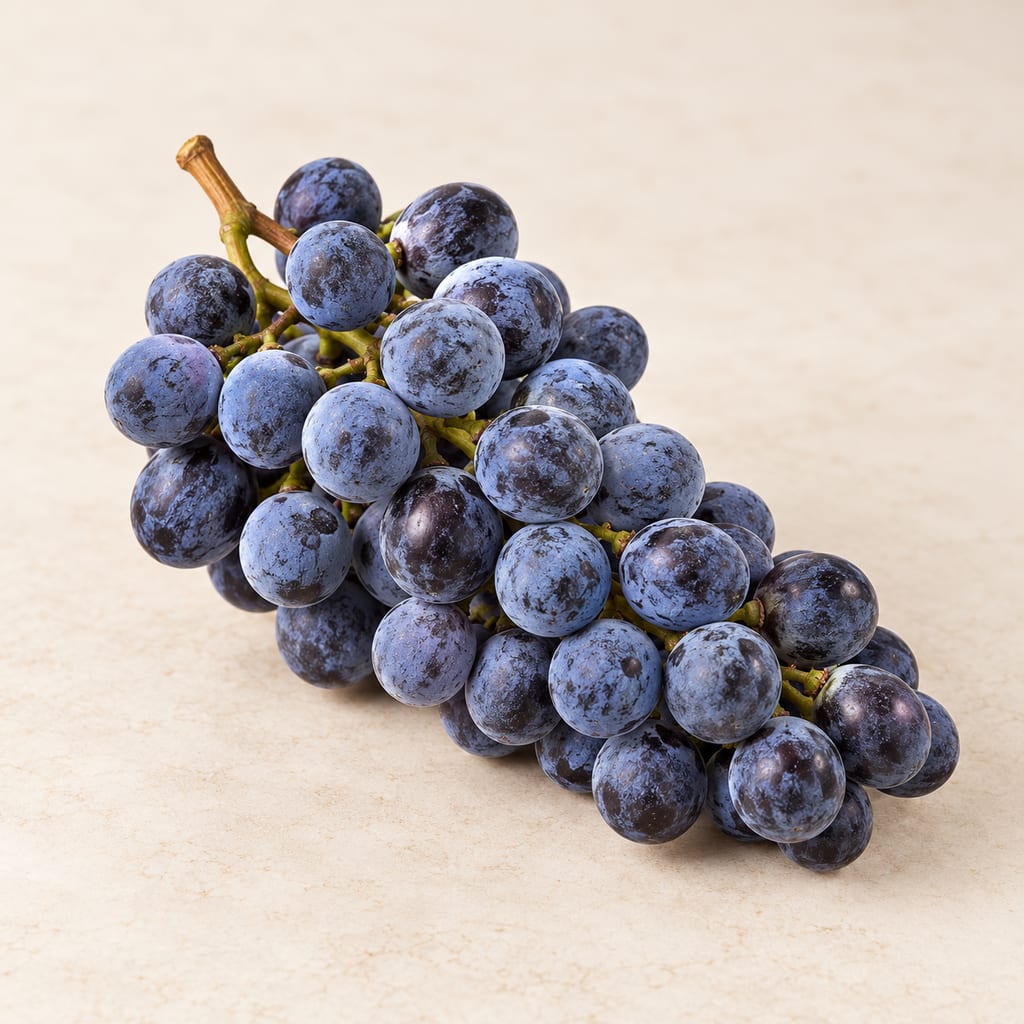
Concord is a named grape cultivar with blue-black berries, a pale waxy bloom and an aroma familiar from purple grape juice. Beneath its substantial skin is a soft, seeded pulp. It belongs to the slip-skin grapes: the skin separates readily from the flesh, a feature that shapes how cooks turn the fruit into pie, preserves or juice. This is a different experience from biting through a thin-skinned, seedless supermarket grape.
Its appeal does not depend on everyone finding that aroma delicate. The word foxy has long appeared in descriptions of Concord and related grapes, sometimes as praise and sometimes as criticism. It refers to a recognizable aromatic character rather than an animal ingredient. The fruit can carry that identity into several preparations, but fresh berries, grape juice and fermented wine do not have the same balance of sugar, acidity, texture and aroma.
A dark berry alone does not establish Concord identity. Other cultivars also produce purple fruit, and modern grapes with a Concord-like flavour may have different skins, seeds and growing behaviour. When a recipe specifies Concord, the cultivar name is part of the ingredient information. A photograph or a loose description such as black grapes cannot establish that another bunch is the same fruit.
Everest Seedless makes the distinction concrete. Cornell's breeders describe it as a separate blue table grape with a flavour similar to Concord, larger berries and a seedless eating character. Its ancestry includes several grape varieties, and it has its own cultivar identity. It was developed for fresh eating rather than simply to reproduce the processing properties of traditional Concord. A grower or shopper may value that different combination, but the resemblance in flavour does not turn its name into a synonym for Concord or establish an untested substitution in a preserve or wine formula.
The name comes from Concord, Massachusetts, where Ephraim Wales Bull raised the seedling. U. P. Hedrick's 1908 account records a sequence that separates growing a promising plant from distributing a new cultivar: seed planted in autumn 1843, fruit in 1849, an exhibition before the Massachusetts Horticultural Society in autumn 1852, and commercial introduction by Hovey & Co. of Boston in spring 1854. Concord did not arrive on every grower's land at once; it moved through the networks that sold and exchanged plants.
Hedrick records its appearance on the American Pomological Society's list of promising new varieties in 1854 and on the regular recommended list in 1858. He also repeats a report that buds had reached Hermann, Missouri, from Galena, Illinois, by the winter of 1855. These details show how quickly growers were trying the plant beyond New England. The history is about the movement of living planting material, not the invention of grape juice or the origin of every wine later made from Concord.
For growers, the attraction was practical. Hedrick emphasized adaptability to different soils, productive cropping, hardiness and the ability to mature in northern conditions. In his account of the Chautauqua grape region, Concord led on several different soil types. A cultivar that could produce dependable harvests across many farms offered something different from an exquisite fruit that performed well only in a narrow setting.
His appraisal was not a sales brochure. He objected to the tough skin, abundant seeds and flavour that some people disliked, and compared its keeping and shipping unfavourably with other grapes. He also worried that its commercial dominance discouraged attention to varieties he preferred. Read together, the praise and criticism explain its position: Concord became important because growers could produce and sell it widely, while its strong character gave consumers a recognizable fruit. Those are a horticulturist's observations from 1908, rather than guarantees for a modern vineyard or a verdict that every eater must share.
Older botanical descriptions often placed Concord straightforwardly within Vitis labrusca, the eastern North American species associated with many slip-skin grapes. Hedrick used visible plant characters to support that interpretation, while recording that others suspected an influence from Vitis vinifera, the species behind many European wine grapes. His history even noted a nearby Catawba vine and the possibility of cross-pollination. The uncertainty existed before genetic sequencing made it possible to ask different questions.
A modern study led by Jun Wen compared nuclear and chloroplast sequences. The two kinds of evidence placed Concord differently: the nuclear evidence associated it with V. labrusca, while chloroplast evidence associated it with V. vinifera. The researchers interpreted the pattern as hybrid ancestry followed by a backcross towards V. labrusca. That is stronger evidence for a mixed ancestry than the old shorthand classification, but it does not recover a witnessed record of Bull's pollinations or identify every immediate parent with certainty.
The useful distinction is between a cultivar and a proposed pedigree. Concord remains a particular cultivated grape even while its ancestry is investigated. A regional guide may still use V. labrusca as a familiar classification; that should not erase the genetic evidence. Conversely, a proposed family tree should not become a claim that another grape with one of those ancestors will behave like Concord in a kitchen or fermenter.
Ripening changes several parts of the berry together. In the Lake Erie Regional Grape Program's account, developing Concord fruit passes through rapid growth, a slower phase dominated by seed development, and a later ripening phase. At veraison, the transition into ripening, the flesh softens and accumulates water and sugar while purple anthocyanin pigments accumulate in the skin. Organic acids and chlorophyll also decline as the fruit develops.
The flesh and skin therefore make different contributions to the harvested ingredient. Much of the water, sugar and acidity can be pressed from the flesh; much of the purple colour must be extracted from the skin. Crushing berries and separating their juice does not automatically put every skin component into the liquid. This helps explain why a deeply coloured bunch can yield different-looking products under different extraction methods.
The Lake Erie observations also connect fruit development with weather and crop management. Water status, seasonal temperature and crop load affect berry size and the progress of ripening. A named cultivar is not a fixed chemical formula. A harvest date or soluble-solids figure from a regional processor's guide describes that context, rather than a universal date or target for every grower and household batch.
Methyl anthranilate is an important contributor to Concord's characteristic aroma. Research led by Yingzhen Yang examined a gene for anthraniloyl-CoA:methanol acyltransferase, usually shortened to AMAT, an enzyme involved in making this compound. The study linked differences in gene regulation with strong expression in Concord berries. It offers a biological explanation for a familiar sensory trait without reducing the whole fruit to one molecule.
Foxy aroma is more complex than methyl anthranilate alone. Other volatile compounds, and the surrounding taste of the food, contribute to what a person perceives. A sweet juice, a tart berry and a dry wine can therefore remain recognizably related while presenting the grape differently. Fermentation changes the material in which the grape's compounds are encountered; it does not simply reproduce a glass of fresh juice with alcohol added.
The same research discussed greater expression of a polygalacturonase gene as a possible contributor to easy skin separation. Polygalacturonases act on pectin, part of the structural material between plant cells. That proposed explanation concerns the living berry's development. It should be kept distinct from a processor adding a commercial pectolytic enzyme to crushed fruit, even though both accounts involve changes to pectin.
Concord also has a substantial history in southern Brazil. Embrapa's cultivar account records its arrival in Rio Grande do Sul in the second half of the nineteenth century and its later spread into Santa Catarina and Paraná. It describes a fruit used for juice, red wine and fresh eating, with aroma and flavour helping to sustain its importance for juice even where its sugar level is comparatively modest.
The regional names preserve some of that movement. Francesa and Francesa Preta are recorded in Rio Grande do Sul; Bergerac in Paraná and Santa Catarina; and Uva Telha around Pelotas. These are locally documented names, not permission to identify every fruit sold under an ambiguous name as Concord. A cultivar name is most useful when its regional context travels with it.
Embrapa also connects increased demand with the development of concentrated grape-juice production in the mid-1970s and subsequent growth in planted area in Serra Gaúcha. This is a different part of the cultivar's story from Bull's seedling: a processing industry helped shape what farmers planted. The same grape could support fresh markets, wineries and juice factories, each making different demands on the harvest.
Juice making selects and rearranges parts of the berry. The FAO processing account distinguishes hot extraction, used to draw colour and other material from dark skins, from immediate or cold pressing. Pectolytic enzymes can help break down pectin and facilitate extraction or clarification. Pressing, heating, enzymatic treatment and filtering are separate operations, with different effects on the liquid; none should be called fermentation merely because the resulting juice may later be fermented.
Concentration is another physical change. Removing water reduces the volume that has to be stored and transported, while a producer can later restore water for a single-strength juice or use concentrate in another food. The result is not interchangeable by volume with whole fruit or ordinary juice. Nor does a Concord name establish whether a purchased product is pure juice, a blend or a sweetened beverage. The product's ingredient list and form matter alongside the cultivar.
These distinctions are especially useful when reading fermentation recipes. A formula written for crushed grapes includes pulp, skins and seeds during some stages; one written for filtered juice begins with a different material. Keeping those inputs separate preserves the source method instead of treating every purple liquid as equivalent.
Concord enters a fermentation as a fruit with a particular imbalance. Winemakers describe it as a table grape in a wine grape's job: its juice sits around 14 to 16 degrees Brix, a measure of dissolved sugar, where European wine grapes are picked at 21 to 24, and its acidity runs above the 8 to 10 grams per litre of a typical wine grape. Left alone, that must would ferment to a weak, sharp wine, so Concord is almost always adjusted. One common remedy is chaptalization, adding sugar to bring the must to about 22 to 23 degrees Brix so that the finished wine reaches 11 to 12 percent alcohol. Another is amelioration, replacing part of the juice with sugar water, at about one part water to four parts juice, which dilutes the acid at the same time as it carries sugar in. A solution of known strength is easier to control than dry sugar, which can overshoot the intended alcohol.
The yeast converts the sugars to ethanol and carbon dioxide, and the grape contributes the rest. The slip-skin that cooks value makes the crushed fruit slow to press, so winemakers add pectic enzyme to the crushed grapes to break down pectin and prevent haze, and some use rice hulls in the press to improve yield. Colour and aroma both live in the skins. Anthocyanin pigments are extracted into the liquid during the days the must spends on the skins, and a wine fermented on its skins is darker and more saturated than one fermented from juice, which comes out medium red or blush. A soak of a few hours before fermentation, adjusted to the colour wanted, and stirring at least twice a day for the first days of fermentation keep the skins wet and the extraction going.
The same contact carries the foxy aroma. Methyl anthranilate, the compound behind much of that character and found at the highest levels in Vitis labrusca grapes, is extracted along with colour, so a short soak gives a lighter, less foxy wine, and a long maceration a darker, more aromatic one. The wine keeps the grape's signature in a way that few other fruits do: even a small proportion of Concord in a blend has a large effect on flavour. Fermenting cool, at about 18 to 20 degrees C (65 to 68 F), is recommended to keep the strongest foxy notes in check, and malolactic fermentation is usually avoided so the wine stays fresh and fruity.
The styles follow from those choices. Fermented dry on the skins, Concord makes a deep, full-bodied red; pressed early, a medium or pink wine; and with residual sugar of 2 to 8 percent balanced against 0.7 to 0.8 percent acid, the sweet wine that the grape is best known for, the base of kosher wines such as Manischewitz. A fermentation on filtered juice and one on crushed whole fruit start from different materials, which is why a recipe has to say which it uses.
The slip-skin structure gives cooks a way to separate the useful parts of the fruit. In the James Beard Foundation's Concord pie, skins are reserved while the pulp is heated and passed through a sieve or food mill to remove seeds. Skins and pulp are then reunited in a flour-thickened filling. The separation is a response to the fruit's anatomy, rather than a reason to discard the skin's colour and character.
The National Center for Home Food Preservation's grape conserve uses a related separation, then brings the grapes together with orange, raisins and nuts. Its named Concord fruit belongs to a particular tested preserve formula. That example shows how the berry fits into a textured spread; it does not make a pie method a canning process or establish that arbitrary grape mixtures can be stored in sealed jars.
Fresh fruit, juice, wine, pie and conserve thus retain different combinations of skin, flesh, seed, water and added ingredients. Their common cultivar explains a family resemblance, while the preparation explains why they feel and taste different. A recipe should identify which of those forms it actually needs.
For fresh Concord grapes, look for plump berries, pliable green stems and fruit that remains attached to the bunch. The pale bloom is a normal surface feature, rather than a reason to expect a glossy berry. The New York institutional buying guide advises avoiding excess moisture in a package and washing close to use rather than before storage. These are practical selection and handling observations, not a promise of a fixed shelf life.
Keep fresh-fruit guidance separate from instructions for a bottled juice, frozen product or preserve. Those products have their own processing and storage conditions. Check the form named by the recipe before choosing a bunch, opening a bottle or measuring a concentrate.
Grape allergy appears in the medical literature as case reports. Where it occurs it has been traced to a lipid-transfer protein called Vit v 1, a small protein in the grape; one patient reacted to grapes, raisins and wine with severe anaphylaxis, and skin tests were positive for both red and white wine. Because the protein is in the fruit, a person with such an allergy meets it in juice, wine and preserves made from Concord as well as in fresh berries.
grape (documented lipid-transfer-protein allergy)
Documented cultivar development and introduction; this is not a claim about the origin of the later wine recipe.
Documented nineteenth-century introduction and later cultivation/juice use, not the cultivar birthplace.

A Cap-Pelé boucanière is an Acadian herring-smoking building. The documented Willie Niles example is a one-storey wood-frame structure with a ridge smoke vent and interior bays for hanging fish-bearing cannes.

Achcharu is a family of Sri Lankan vinegar pickles made with mixed vegetables or seasonal fruit and a piquant spice dressing. This version is a quick, refrigerated, non-fermented mixed-vegetable pickle.

The acocote is a long, hollowed and dried gourd used to draw aguamiel from a mature maguey. It is a harvesting tool: the sap is transferred to a separate vessel before it ferments into pulque.

Adrak murabba preserves young ginger in sugar syrup, a sweet South Asian preparation recorded in Indian cookery and food-processing sources.

Parkia biglobosa seeds are fermented into regional West African seasonings, including nététou, iru, dawadawa and soumbala. The yellow fruit pulp is a separate food, and names and methods vary by place.

Japanese reddish-brown vinegar from sake lees matured about three years, turned to vinegar by acetic bacteria; the vinegar of Handa and Edomae sushi rice.

A refined common-wheat flour blended for a broad range of baking; its protein and behavior vary with wheat, milling and market.

The almond mushroom, Agaricus subrufescens, was cultivated in eastern North America in the 1800s, lost its market, and returned as a cultivated mushroom from Brazil, where it is grown under several names.
No community contributions have been published for this entry yet.
Sign in to contribute. Published comments and photos are free to read.
New York Agricultural Experiment Station; J. B. Lyon, Albany; Gutenberg transcription
The Grapes of New YorkConcord entry: cultivar milestones, period cultivation and quality appraisal, nursery distribution; old pure-Labrusca classification qualified by modern evidence.
Cited in: A berry with a skin of its own; Bull's seedling and a nursery trade; An ancestry that appearance could not settle
Frontiers in Plant Science 11:263
Nuclear and Chloroplast Sequences Resolve the Enigmatic Origin of the Concord GrapeNuclear/chloroplast placements and qualified hybrid/backcross interpretation, not certain immediate parents.
Cited in: An ancestry that appearance could not settle
Horticulture Research 7:67
A key ‘foxy’ aroma gene is regulated by homology-induced promoter indels in the iconic juice grape ‘Concord’AMAT/methyl anthranilate mechanism, complex aroma and proposed polygalacturonase slip-skin explanation.
Cited in: A berry with a skin of its own; Why the aroma survives the squeeze; What Concord does in the winemaking vat
Cornell AgriTech
Everest Seedless™ Grape: A blue seedless table grapeSeparate cultivar identity, seedless/larger Concord-like fruit for table use; no recipe substitution inferred.
Cited in: A berry with a skin of its own
Lake Erie Regional Grape Program
Seasonal Concord Fruit Development in the Lake Erie RegionBerry stages, flesh softening, water/sugar accumulation and skin anthocyanins; local observations, no home processing targets.
Cited in: What changes on the vine
Embrapa Uva e Vinho
ConcordRegional synonyms and uses, nineteenth-century southern Brazilian diffusion and mid-1970s concentrate-associated demand.
Cited in: Concord beyond New England
Food and Agriculture Organization of the United Nations
Principles and practices of small- and medium-scale fruit juice processing: Chapter 12, Grape JuiceHot/cold extraction, pectolytic processing and concentration as physical/enzyme operations; no industrial controls transferred.
Cited in: From whole fruit to juice; What Concord does in the winemaking vat
James Beard Foundation
Concord Grape PieSpecific culinary example: separating skins/pulp, sieving seeds and returning skins into a flour-thickened pie filling.
Cited in: Skins and seeds in the kitchen
National Center for Home Food Preservation
Grape ConserveOne tested preserve with Concord grapes, orange, raisins and nuts; separate skins/pulp, sieve seeds and return skins. No canning parameters transferred.
Cited in: Skins and seeds in the kitchen
Farm to Institution New York State
Concord GrapesFresh-fruit selection: plump berries, green stems, attached fruit and bloom; excess moisture and washing/storage distinction. Health, production and shelf-life claims excluded.
Cited in: Choosing a bunch
WineMaker Magazine (Chik Brenneman)Winemaking
Foxy Concord: Finding the Sweet Spot with This American ClassicConcord at about 14 to 16 degrees Brix with acidity above 8 to 10 g/L; chaptalization to about 22 degrees Brix; skin contact, pectic enzyme, rice hulls at pressing; foxy character from methyl anthranilate in Vitis labrusca; Manischewitz base.
Cited in: What Concord does in the winemaking vat
WineMaker Magazine (Alexis Hartung)Winemaking
Concord: Varietal FocusSugar to 22 to 23 degrees Brix, amelioration at one part water to four parts juice, cool fermentation 65 to 68 F, skin fermentation versus juice, style options, malolactic usually avoided.
Cited in: What Concord does in the winemaking vat
World Allergy Organization Journal 3(1) (Schad and colleagues, 2010)Allergen
Wine Allergy in a Wine-Growing District: Tolerance Induction in a Patient With Allergy to Grape Lipid-Transfer ProteinSingle-patient report of IgE-mediated anaphylaxis to grapes, raisins and wine through the lipid-transfer protein Vit v 1.
Cited in: Allergy and dietary notes