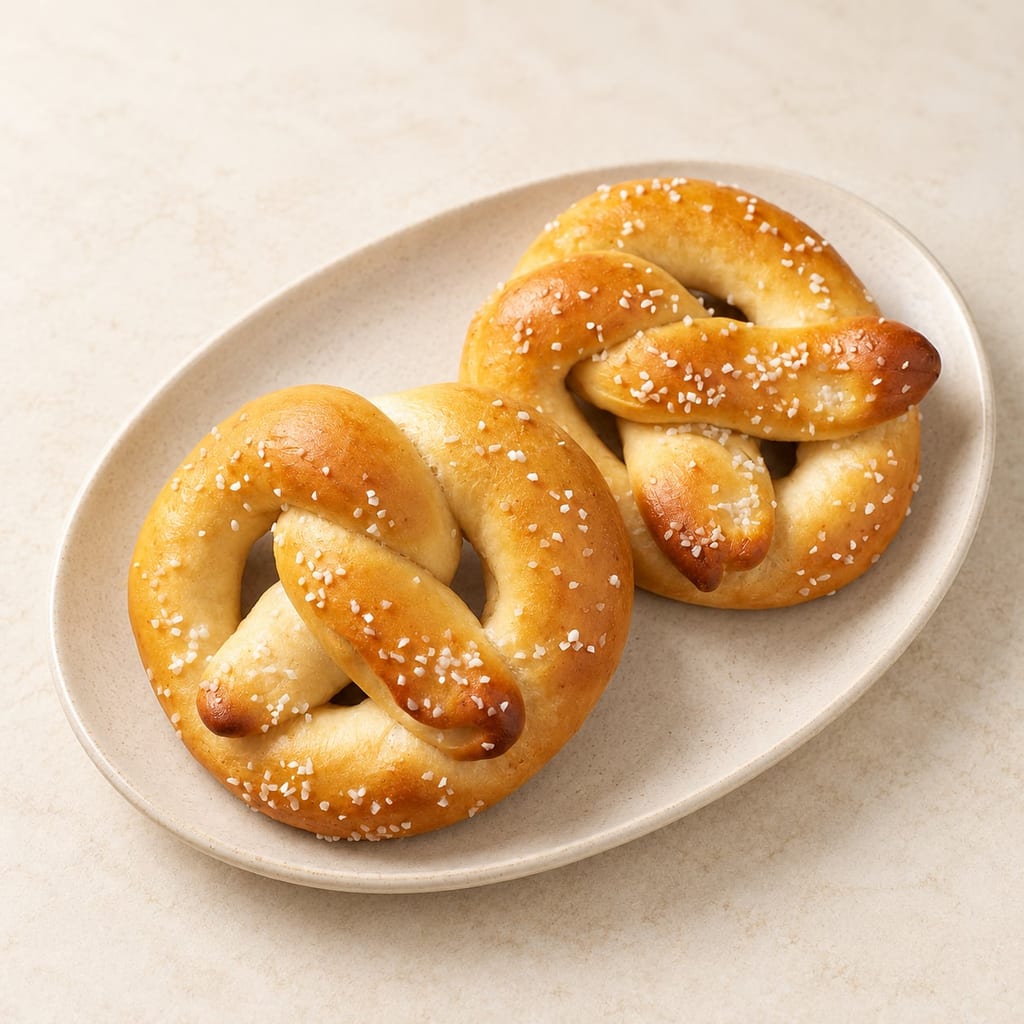
Sourdough discard pretzels
Unfed sourdough starter flavours a soft pretzel dough raised with instant yeast. After a short rest, the dough is shaped, brushed with a sweet wash, salted and baked without a final proof.
 FermenteaWhere food goes to change
Sugar sources
Enzyme-inactive malt powder adds malty flavor and crust color. In King Arthur's sourdough discard pretzels it is an optional choice in both the dough and a brushed wash, each with a separate sugar alternative.
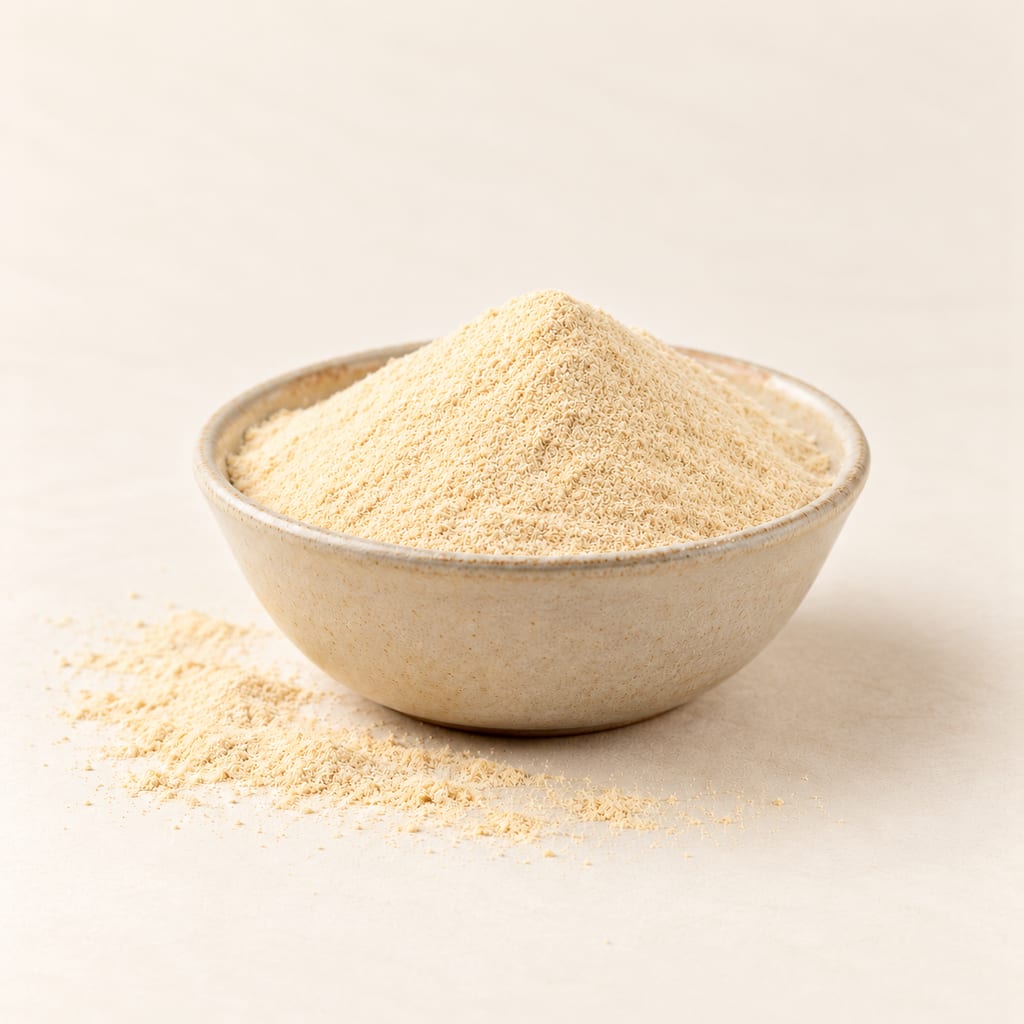
Non-diastatic malt powder is a dry, sweet, malty baking ingredient made from malted grain that has been processed until its starch-converting enzymes are no longer usefully active. In a typical barley product, the grain is first allowed to germinate, then dried and roasted or kilned more intensely than a pale, enzyme-active malt. It is milled to a powder, or it may be made as an extract and dried. The result is not a single standardized flavour: the grain, malting, heating and milling all affect colour, sweetness and aroma. Pale versions may taste softly cereal-like and sweet; more heavily roasted versions can be darker, toastier and more assertive. Product labels matter because the category includes more than one manufacturing route and malt can be made from grains other than barley.
The adjective “non-diastatic” is a practical baking distinction. Diastatic malt still has active amylase enzymes, which break some flour starch into sugars during dough making. Non-diastatic malt has lost that useful enzyme activity through heat. Its contribution comes from sugars and flavour compounds already present, rather than from an ongoing enzymatic conversion of the dough’s starch. This is why the powder can add a rounded malt taste and deepen browning without being a dough improver whose main purpose is faster fermentation.
It is also different from malt syrup or malt extract. Those are concentrated liquids made by extracting soluble material from germinated grain; syrup is viscous and carries water as well as malt solids. A dried malt extract is powder, but it is an extract powder rather than simply ground malted grain. The names can overlap in retail baking language, so the package’s ingredient statement is the clearest guide to the product in hand. Neither syrup nor powder is the same thing as granulated sugar: sugar sweetens cleanly, while malt brings a cereal, roasted or biscuit-like flavour alongside its sweetness.
Malting begins with a grain seed that is steeped in water and encouraged to germinate. Germination is the seed’s own preparation for growth: enzymes become active and begin mobilizing stored material in the kernel. Barley is especially common because its grain structure and enzyme system make it useful to maltsters, although wheat, rice and other cereals can also be malted. The purpose of malting in brewing is to make the grain’s reserves accessible for later processing; in baking, malted grain or its extract can be used for flavour, colour and, in some products, enzyme action.
Once the grain has developed as much as the maltster wants, drying arrests germination. How that drying is managed determines what kind of malt results. Standard pale malt is dried at comparatively gentle temperatures to retain much of its enzyme activity. Specialty malts may be kilned longer or hotter, roasted, or both. These treatments alter aroma and colour and can remove the useful activity that defines diastatic malt. Some products are then milled as malt flour. Others are steeped and extracted into water, after which the liquid is concentrated and possibly dried. Those routes explain why two packages both called “malt powder” need not have identical ingredients, sweetness, solubility or colour.
The word “malt” therefore describes a processed grain, not a sweetener formula. In a powder made from malted barley, the package may list malted barley alone. A dried extract can concentrate only the soluble fraction of the malt, and a blended commercial product may have other declared ingredients. One manufacturer’s product page calls its own non-diastatic powder a sweet derivative of roasted barley, while its general explanation describes malt powder as sprouted, dried and ground grain. That is useful product-specific evidence, not a reason to assume every powder on the shelf has the same composition.
Amylases are enzymes that act on starch. During barley germination, the seed produces or activates enzymes needed to use its stored food. In dough, active malt amylases can continue breaking some starch into smaller sugars, including sugars that yeast can ferment. That can feed yeast and influence fermentation speed, dough handling and crust browning. The effect depends on the flour, the malt’s activity and the amount used. A baker who adds too much active malt can over-soften the dough’s starch structure; King Arthur’s baking guidance warns of a sticky, gummy result when diastatic malt is overused.
Non-diastatic malt powder is chosen precisely because it lacks that active starch-converting role. The heat treatment does not turn the ingredient into inert dust: sugars and the grain’s characteristic flavour remain. Baking references explain that reducing sugars in malt extracts react with amino compounds as the crust heats, contributing to colour and aroma. The exact sugar profile of an individual ground malt powder still depends on its production. The malt’s own roasted notes are also carried into the finished food. The balance is product-dependent: the baker may notice a darker surface, a more rounded cereal sweetness, or a roasted note before noticing a large change in the crumb.
This is different from saying that non-diastatic malt cannot feed yeast. It can contain sugars that yeast can use, just as other sweeteners can, but it does not generate additional sugar by enzymatically breaking down flour starch. In a formula already using instant yeast, malt powder is therefore not a substitute for yeast or a reliable way to accelerate the rise. A product’s enzyme status and its sugar content are related to how it was made, but they are not the same property: enzyme inactivity does not mean sugar-free, and malt flavour does not prove that active enzymes remain.
A baker may choose non-diastatic malt when the food benefits from more than sweetness. Malt adds a flavour that can read as cereal-like, toasted, biscuit-like or gently roasted, depending on the product. It can also contribute a deeper baked colour because malt contains reducing sugars that take part in browning. In breads and bagels, that combination is part of the taste and appearance people expect; malt can also help a crust develop the warm amber or brown tones associated with those baked goods.
Granulated sugar has a different character. It dissolves into the dough or wash and brings sweetness without malt’s grain-derived aroma. The two can perform a related broad role in a formula, but they are not chemically or sensorially identical. Equal weights should not be assumed to taste equally sweet or brown in the same way. Industrial and baking references describe malt products in different forms—malt flour, syrup, extract, dried extract—and their moisture, concentration and sugar levels vary. A substitution that works in one tested recipe is not a universal conversion table.
The effect also depends on where the malt goes. In dough, its dry solids are dispersed among flour, liquid, yeast and salt; the malt flavour becomes part of the crumb and crust. In a wash or water bath, malt reaches the surface, where it can influence the outer colour and flavour. Bagel makers commonly use malt in the boiling solution, while the pretzel recipe discussed below brushes a dissolved sweetener mixture onto shaped dough. Those are related applications of surface malt, but the bath and brush methods are not identical, and a non-diastatic malt wash should not be confused with the alkaline dip associated with some pretzel styles.
King Arthur Baking’s contemporary sourdough pretzel formula gives the cook a choice in two places. For the dough, use 18 g non-diastatic malt powder or 14 g granulated sugar. For the wash, use 9 g non-diastatic malt powder or 14 g granulated sugar, dissolved in 28 g water. The wash is brushed on shaped pretzels before coarse pretzel salt is added. The recipe then bakes the pieces without a second rise. It yields twelve pretzels and uses unfed sourdough starter together with instant yeast.
These amounts belong to their distinct jobs in that published recipe. The 18 g dough option seasons the dough throughout; the smaller powder amount in the wash dissolves into a measured quantity of water for brushing. The source does not explain why it gives different powder-to-sugar weights in the dough and wash, nor does it give a controlled taste comparison. The careful reading is simply to preserve each option as written: choose one dough sweetener and, separately, one wash sweetener. Do not add both options in either place unless intentionally changing the formula.
The starter contributes flavour and is used in a dough that is also raised with commercial yeast; the recipe is not a slow, starter-only pretzel method. That context matters when describing the powder. Its non-diastatic character means it is not being asked to supply active amylases for a long fermentation. The dough rests for 45 minutes and rises only a little, while the recipe already includes instant yeast. The malt’s clearest documented role here is the sweet, malty flavour and browning associated with malt in baking. In the wash, it is a surface flavour choice, not a chemical pretzel bath.
Malted grain is much older than the modern baking products sold in small jars and bags, but the history of malt is not a single history of one powder. Barley malt has long been central to brewing because malting makes grain starch available for later conversion. Malt also entered baking as flour, extract and syrup, each with different enzyme activity and concentration. These forms should not be collapsed into one ingredient simply because their names share the word “malt.”
A clear early twentieth-century baking record appears in the 1910 *Book of American Baking*, published by the American Trade Publishing Company. Its chapter “Malt Extract in Bread-Making” describes malt extract as a cereal-sugar syrup used in commercial bread formulas. It reports that some bakeries used the ingredient, although the surveyed formulas show it was not universal. The chapter compares malt extract with granulated sugar and records the baker’s interest in fermentation, crust colour, flavour, moisture and cost. A second section by Henry A. Kohman, associated with a University of Kansas baking-technology fellowship, reports experiments with commercial malt extracts whose diastatic activity varied considerably. It treats the active enzyme content as important to their sugar-producing behaviour.
The 1910 evidence records commercial malt extracts, including products with active enzymes. It does not date the dry, enzyme-inactive powder sold to home bakers today. Malt-derived baking ingredients have a documented place in commercial baking by that year, while the first formulation and retail history of this particular powder remain open.
For a recipe that says “non-diastatic malt powder,” look for those words on the package rather than relying on “malt” alone. A product sold as diastatic malt powder is a different tool: its active enzymes can change the dough’s starch and fermentation behaviour. Malted milk powder is also a separate product, typically a flavored sweetener blend that includes milk ingredients; it is not a direct replacement for baking malt. Barley malt syrup is a liquid extract, and ordinary sugar is a non-malt sweetener. If a package’s label says “malt extract powder,” its ingredients and use directions should guide how it is handled; avoid assuming that its sweetness, colour or dissolving behaviour matches a ground roasted malt flour.
Barley-based malt is not gluten-free. Barley contains gluten proteins, and the U.S. Food and Drug Administration says barley malt and malt extract are derived from a gluten-containing grain that has not been processed to remove gluten and therefore cannot be used in a food making a U.S. gluten-free claim under the rule. This is a celiac-relevant ingredient distinction, not an assertion that barley is one of the U.S. statutory major food allergens. Because malt may come from other grains and manufacturers may use different formulations, read the exact ingredient and allergen declaration on the package instead of generalizing from one brand. The pretzel recipe also contains wheat flour and dry milk, so the recipe as a whole is not gluten-free or dairy-free.
Powdered malt is a dry ingredient and should be kept dry, sealed and protected from humidity, heat and pests. A manufacturer’s bulk-handling guidance notes that moisture uptake is a particular concern for preground malt and advises low-humidity storage, monitoring the supplier’s shelf-life information and keeping product dry. That is general handling guidance, not a household shelf-life promise for every retail product. Follow the package date and storage directions; do not transfer a commercial malt’s shelf-life number to another product. Keep the package sealed between uses and check its date and directions, rather than borrowing a bulk malt ingredient's shelf-life for another product.
gluten
The linked recipe is published by a U.S. baker, but the exact origin of the powder used in it is not stated.
Unfed sourdough starter flavours a soft pretzel dough raised with instant yeast. After a short rest, the dough is shaped, brushed with a sweet wash, salted and baked without a final proof.
No community contributions have been published for this entry yet.
Sign in to contribute. Published comments and photos are free to read.
Briess Malt & IngredientsIngredient
Malting & RoastingBriess explains steeping, germination and drying of barley malt, and that higher heat inactivates useful enzymes in nondiastatic malts.
Cited in: A malt that brings flavour, not enzyme power; From a sleeping seed to a baking ingredient; What enzymes change—and what roasting leaves behind
King Arthur BakingIngredient
What's the difference between diastatic and non-diastatic malt?The baking article distinguishes active-enzyme diastatic powder, enzyme-inactive non-diastatic powder and barley malt syrup, including effects on dough and crust.
Cited in: A malt that brings flavour, not enzyme power; What enzymes change—and what roasting leaves behind; Why bakers reach for malt instead of plain sugar; The two malt choices in sourdough discard pretzels
King Arthur BakingIngredient
Non-Diastatic Malt PowderThe seller describes its barley-derived powder as contributing malty flavor and browning and shows dry powder in a bowl.
Cited in: A malt that brings flavour, not enzyme power; From a sleeping seed to a baking ingredient; Why bakers reach for malt instead of plain sugar; Choosing, storing and naming the ingredient
Briess Malt & IngredientsIngredient
Extraction & Starch ConversionThe manufacturer describes extracting soluble material from malt and concentrating it into distinct malt extract ingredients.
Cited in: From a sleeping seed to a baking ingredient
IREKS Compendium of Baking TechnologyIngredient
Effect of malt flour and malt extractThe baking producer distinguishes enzyme-inactive malt flour from active malt and explains reducing-sugar browning in malt extracts.
Cited in: From a sleeping seed to a baking ingredient; What enzymes change—and what roasting leaves behind; Why bakers reach for malt instead of plain sugar; A documented baking history, with a boundary
King Arthur BakingIngredient · Method
Sourdough PretzelsThe updated 10 September 2026 recipe gives 18 g malt powder or 14 g sugar in dough, and separately 9 g malt powder or 14 g sugar in a 28 g water wash for twelve pretzels.
Cited in: The two malt choices in sourdough discard pretzels; A documented baking history, with a boundary
King Arthur BakingIngredient · Method
Make pretzels from your discard starterThe 2011 post gives a modern discard-starter pretzel adaptation and its malt-versus-sugar dough choice; it does not date older pretzel traditions.
Cited in: The two malt choices in sourdough discard pretzels
American Trade Publishing CompanyIngredient · History
Book of American Baking (1910)The 1910 trade book documents malt extract syrup in bread and experiments on extracts with differing diastatic activity, not the modern enzyme-inactive powder.
Cited in: A documented baking history, with a boundary
U.S. Food and Drug AdministrationIngredient
Questions and Answers on the Gluten-Free Food Labeling Final RuleFDA explains that barley malt and extract are derived from a gluten-containing grain and cannot support a U.S. gluten-free claim as ordinarily formulated.
Cited in: Choosing, storing and naming the ingredient
U.S. Food and Drug AdministrationIngredient
Food AllergiesFDA's U.S. major-allergen list does not include barley; this does not remove the celiac-relevant gluten concern.
Cited in: Choosing, storing and naming the ingredient
Briess Malt & IngredientsIngredient
Handling and Storing Briess IngredientsThe manufacturer's bulk malt-handling guidance addresses dry storage and moisture exposure; it is not a household shelf-life for every retail powder.
Cited in: Choosing, storing and naming the ingredient