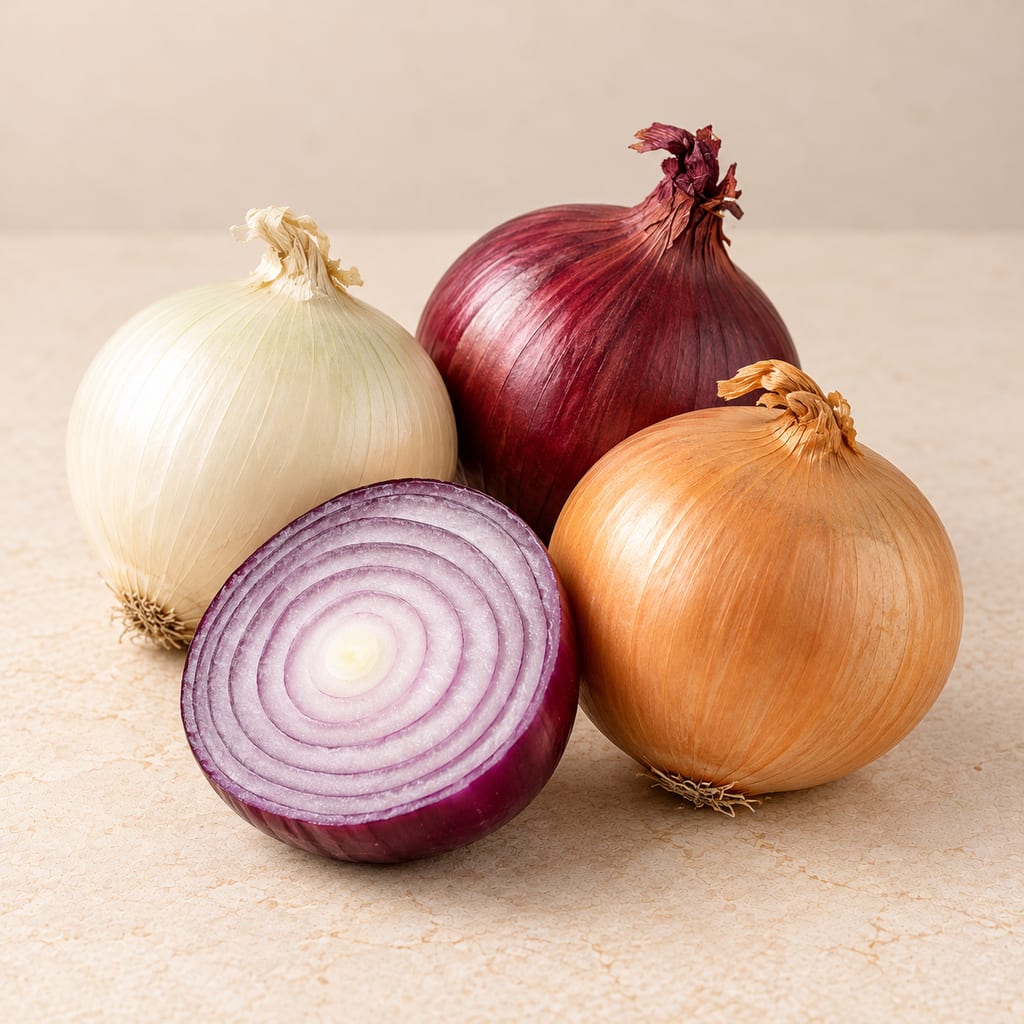
Onion
The onion is the bulb of Allium cepa, built from swollen leaf bases, and is eaten raw, cooked, pickled and as a seasoning in ferments. It is known only from cultivation and probably began in Central Asia.
 FermenteaWhere food goes to change
Onions and shallots are aromatic layered bulbs used raw, cooked and in fermented or preserved condiments.
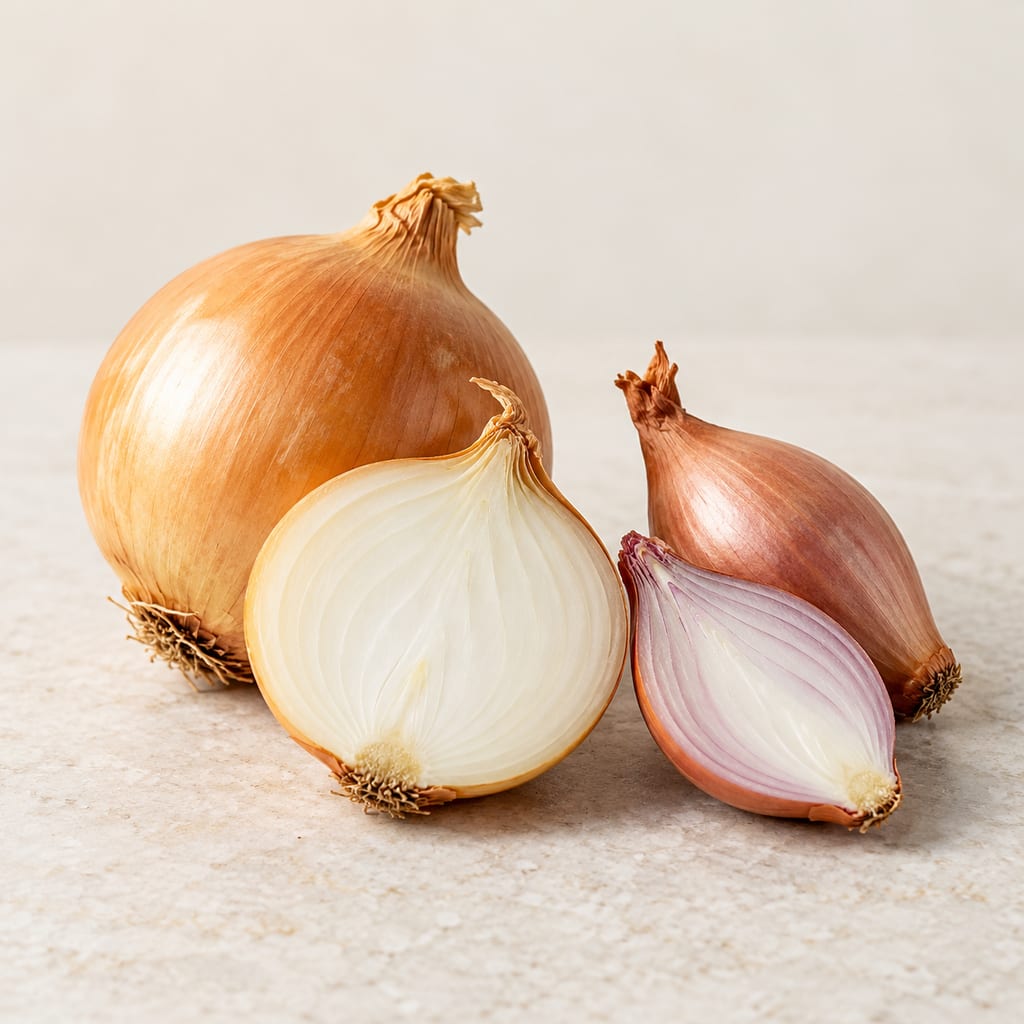
Onions and shallots are related alliums grown for their layered edible bulbs. Bulb onions vary in colour and pungency, from sharp storage onions to milder varieties. Shallots are often smaller and elongated, with copper or reddish skins and a flavour that can be delicate as well as pungent. Their size and shape vary, so the name alone does not specify a single cultivar.
Both can be eaten raw or cooked. Cutting disrupts their tissues and releases pungent compounds; cooking changes the flavour and softens the layers. Their differences matter in a finely sliced garnish or a sauce where a large onion can change the balance of a small quantity of shallot.
Choose firm, sound bulbs without soft or mouldy areas. Cured storage onions keep best in a cool, dry, ventilated place; fresh or cut material needs different handling. Peel away the dry outer layers and trim as the recipe requires. Use clean equipment and keep cut onion refrigerated.
A recipe may call for slices, a fine dice or a paste. Cutting size changes texture and the speed at which flavour enters the mixture. When substituting onion for shallot, begin with the recipe’s intended amount and taste where appropriate rather than assuming one bulb of each is equivalent.
Onion and shallot can provide aroma, sweetness and texture in condiments, pickles and fermented vegetable mixtures. In a study of onion fermentation with and without salt, researchers observed changing microbial populations, increased lactic and acetic acids, and changes in aroma compounds. The measured result belongs to those experimental conditions, not every household jar.
Salt concentration, ingredient proportions, handling and storage matter in a fermented preparation. A fresh onion or shallot is a flavouring ingredient, not a complete preservation method. Use the directions for the specific tested product, and do not treat adding an allium as proof that a mixture is safe for unrefrigerated storage.
No source in this record establishes a place.
The onion is the bulb of Allium cepa, built from swollen leaf bases, and is eaten raw, cooked, pickled and as a seasoning in ferments. It is known only from cultivation and probably began in Central Asia.
No community contributions have been published for this entry yet.
Sign in to contribute. Published comments and photos are free to read.
University of Minnesota ExtensionContext
Growing onions in home gardensonion cultivation and storage
Cited in: Two related kitchen bulbs; Selecting, storing and preparing
North Carolina State University ExtensionContext
Allium cepaidentity
edible bulbs
Cited in: Two related kitchen bulbs
Journal of Food ScienceContext
Microbial diversity and flavor formation in onion fermentationonion fermentation observations
Cited in: Fermentation and condiments