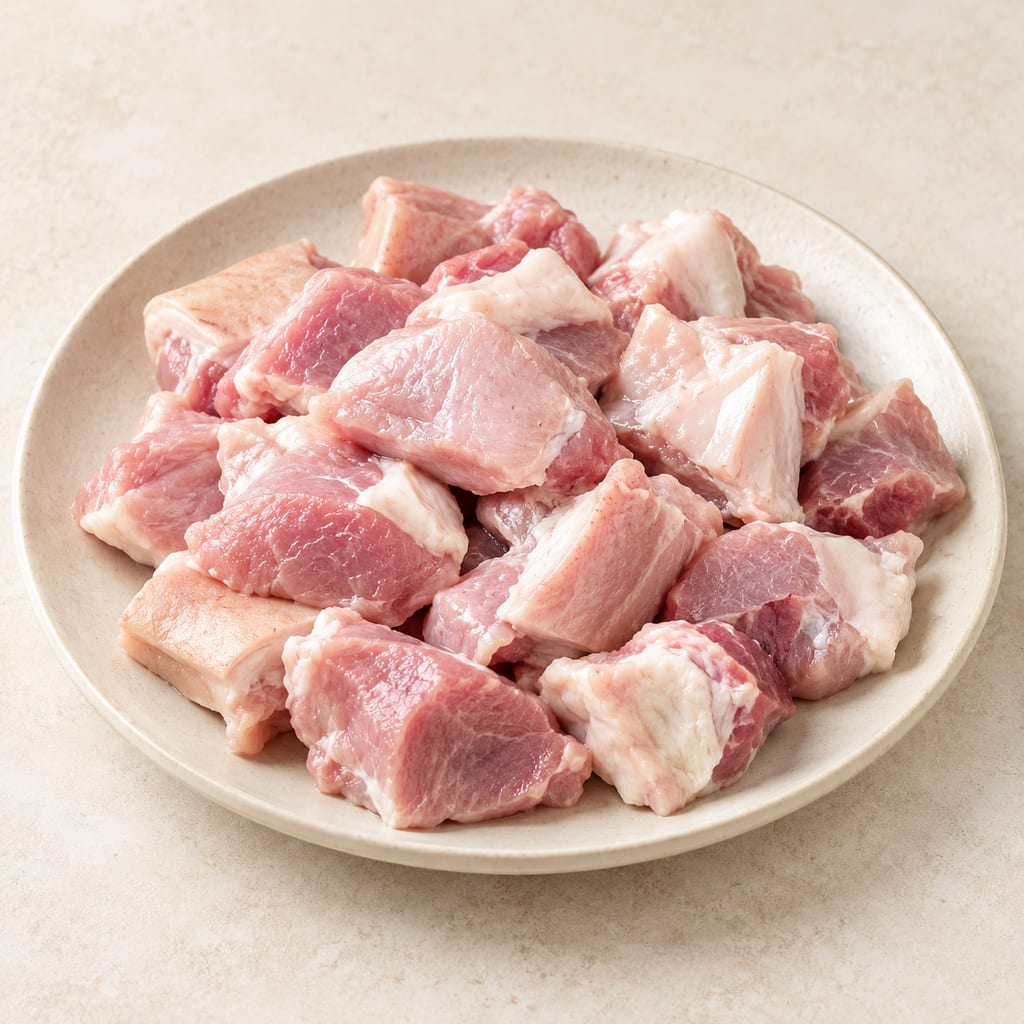
Pork
Pork is meat from domestic pigs, sold as distinct cuts, ground meat and fat; its form and composition shape its roles in fermented foods.
 FermenteaWhere food goes to change
Mushrooms
Tuber melanosporum is the Périgord black truffle, a mycorrhizal fungus of southern Europe grown in inoculated oak and hazel orchards and used as a high-value aromatic seasoning.
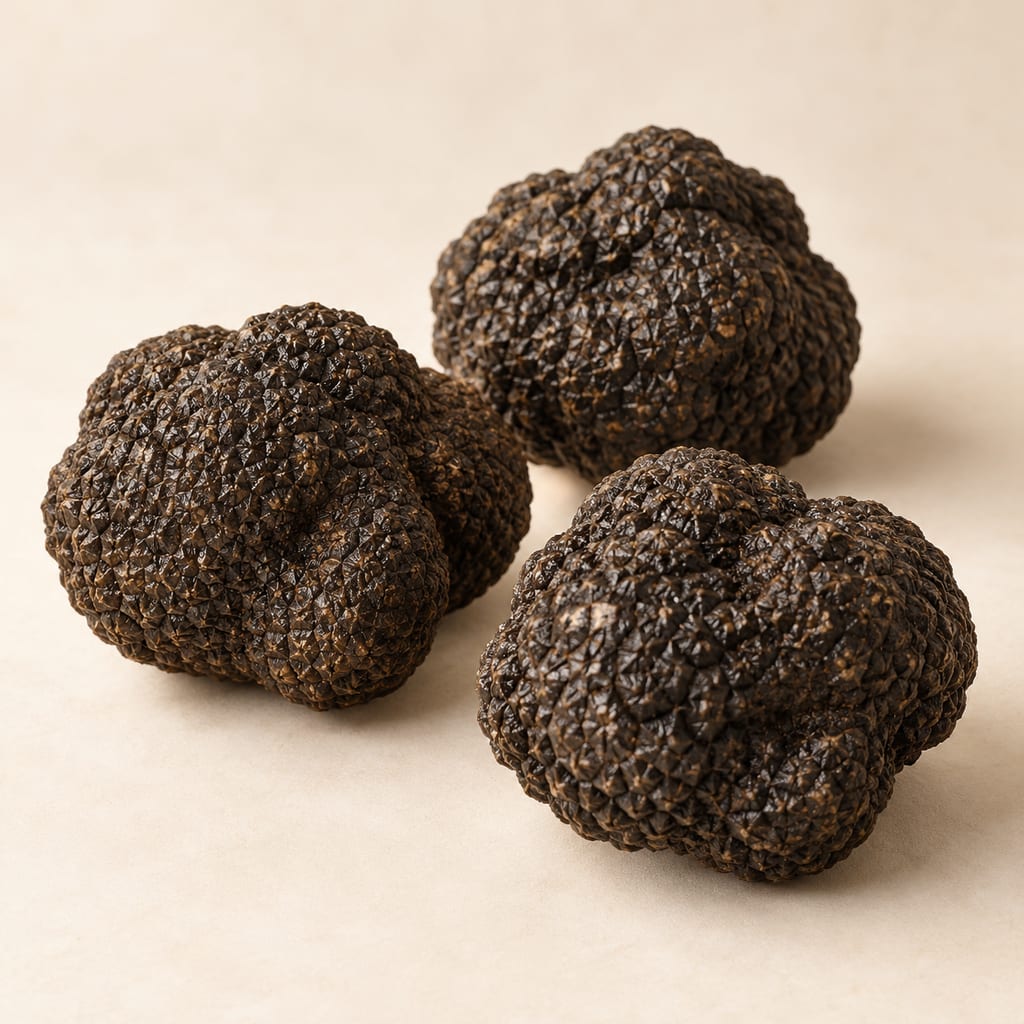
Tuber melanosporum, the Périgord or French black truffle, is an underground fungus native to southern Europe and one of the most expensive edible fungi in the world. The Italian naturalist Carlo Vittadini described it in 1831. The catalogue records it as a high-value aromatic seasoning, supplied by regional cultivation.
The fruit body is the truffle. The fungus lives mainly in the soil as mycelium, forming ectomycorrhizal partnerships with the roots of host trees.
Wild populations occur in parts of Spain, France, Italy and Croatia. The fungus forms ectomycorrhizae 5 to 50 cm deep, usually in loose calcareous soil near the roots of host trees such as holm oak, French oak, hazel and cherry. The encyclopedia entry notes that the fungus suppresses other plants nearby, leaving a barren patch sometimes called a burnt area.
The catalogue states that orchard cultivation depends on host trees and site conditions, not on mushroom compost alone.
In the Northern Hemisphere the fruit bodies develop from April to June and are harvested from November to March. Markets are busiest in January, when the truffles are mature.
Searching for and cultivating black truffles in these regions is described as a tradition of more than 200 years. Wild truffles are still gathered by hand in natural forests, but since about 2010 those forests have seen a significant drop in productivity, which the encyclopedia entry links to climate change.
Cultivation involves inoculating the roots of a host tree, typically hazel, with truffle mycelium. Research published around 2010 found the species is heterothallic, so growers need neighbouring trees of different mating types. The first truffles can be harvested four to ten years after planting. Several thousand hectares in central Spain are now given to cultivation. The species is also grown in Australia, New Zealand, Chile, North America, Argentina, South Africa and Wales.
France produces about 45 per cent of the world's black truffles, Spain 35 per cent and Italy 20 per cent. Output fell during the 21st century to around 20 metric tonnes a year, with peaks near 46 tonnes, compared with about 1,000 tonnes in France in 1937. Spain has been closing the gap with subsidised plantations, especially in Teruel province, Aragón.
The largest truffle market in France, and probably the world, is at Richerenches in Vaucluse. The largest in south-west France is at Lalbenque in Quercy. In 2013 black truffles cost between 1,000 and 2,000 euros per kilogram.
Black truffles are the second most expensive truffles after white truffles. Unlike white truffles, their aroma does not fade when heated and can become more intense. They are used to flavour meat, fish, soups, cheese and risotto, and are often shaved raw over a dish or infused into olive oil or butter.
The sources reviewed describe the aroma and the market, not a safety assessment. Truffles can be confused with other truffle-like fungi, and spongy, hollow or powdery specimens are not edible. This page is not an identification guide, and anyone collecting truffles should identify them with an expert.
Native range given as southern Europe; wild populations in Spain, France, Italy and Croatia.
About 45 per cent of world production; Richerenches and Lalbenque markets.
About 35 per cent of world production; cultivation in central Spain and Teruel, Aragón.
About 20 per cent of world production.
Wild populations recorded.
Cultivated.
Cultivated.
Pork is meat from domestic pigs, sold as distinct cuts, ground meat and fat; its form and composition shape its roles in fermented foods.
No community contributions have been published for this entry yet.
Sign in to contribute. Published comments and photos are free to read.
WikipediaTaxonomy · Habitat · Season · Cultivation · Markets · Use
Tuber melanosporumVittadini 1831; host trees and rooting depth; burnt-area effect
Harvest and fruiting months; January market peak
Inoculation, heterothallism, first harvest after four to ten years; cultivation countries
Production shares, output tonnage, Richerenches and Lalbenque markets, 2013 price
Culinary use, heat-stable aroma
Nordic CouncilCatalogue record
Nordic study of edible truffles (supplied catalogue source F-d5b8c13a0bc7)Supplied source listed for this species; not read in full for this page