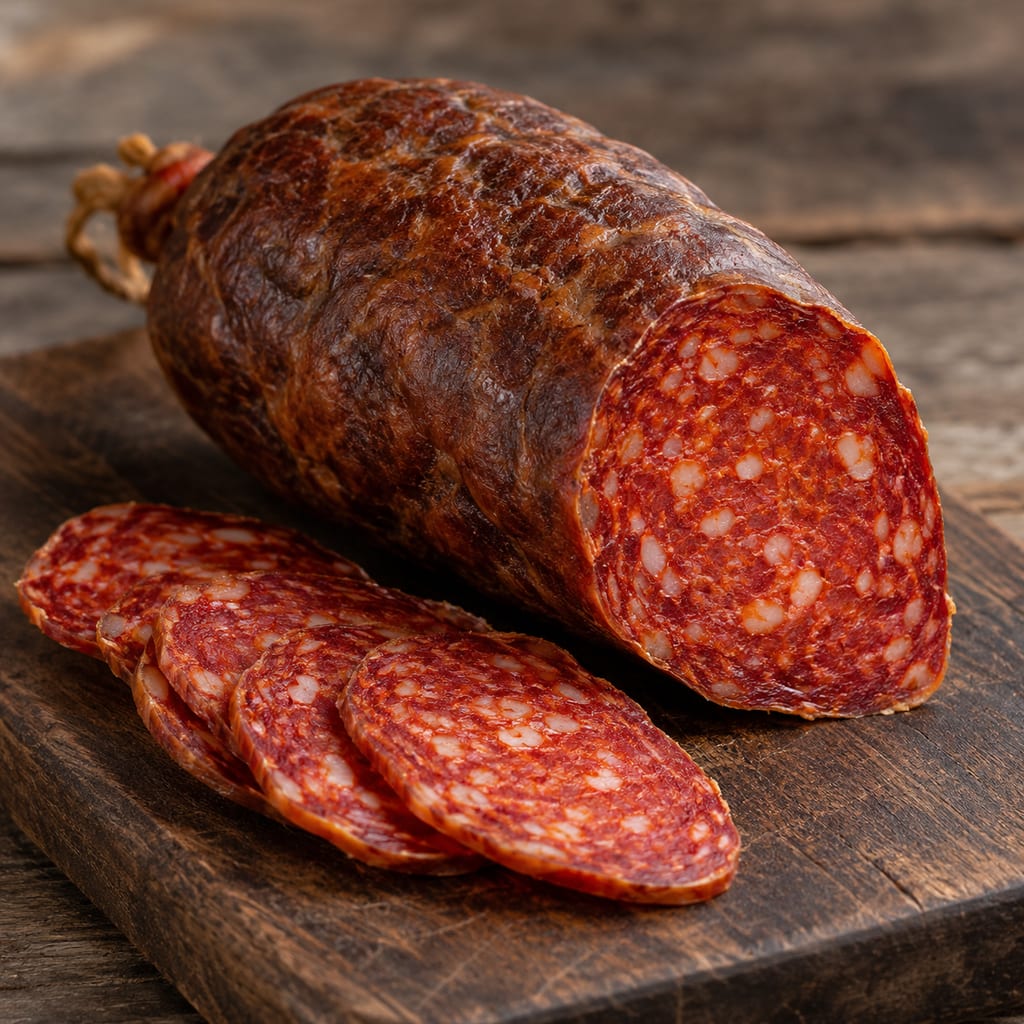
Baranjski kulen
Baranjski kulen is a Croatian protected fermented pork sausage seasoned with sweet and hot paprika, garlic and white pepper, stuffed into a pig’s caecum called katica, cold-smoked and matured.
 FermenteaWhere food goes to change
Substrates
Pork is meat from domestic pigs, sold as distinct cuts, ground meat and fat; its form and composition shape its roles in fermented foods.
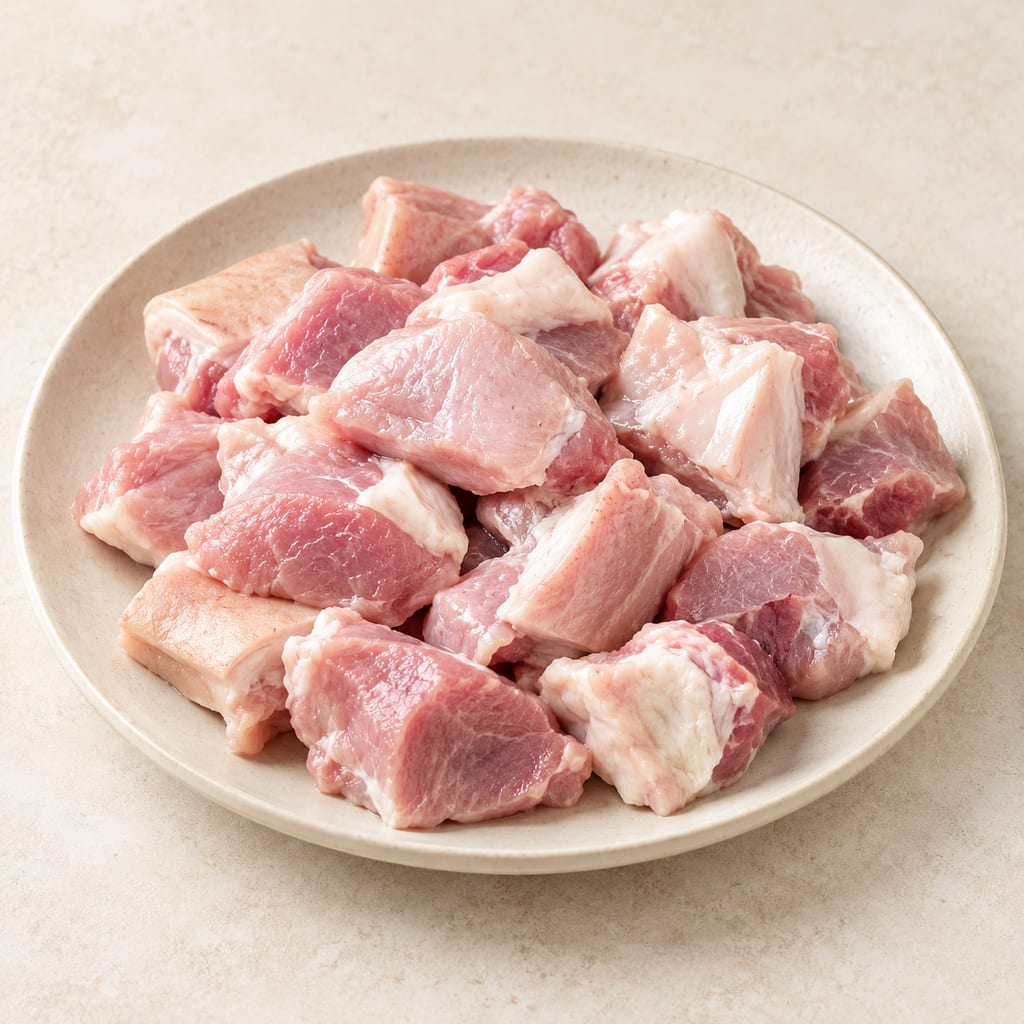
Pork is meat from a domestic pig, most often sold as a cut or as ground meat. It may be a whole muscle such as loin, shoulder, or leg; a fatty section such as belly; minced meat; or a trim mixture chosen for another purpose. The name alone does not say which muscle, how much fat is attached, whether the meat is fresh or frozen, or whether it has been salted. Those are separate details a recipe should make clear.
The domestic pig is usually called Sus scrofa domesticus, while some taxonomies use Sus domesticus at species rank. Pork is not one standardized tissue. Muscle, fat, connective tissue and skin differ in composition and behavior, and named cuts carry different proportions of them. The USDA’s four broad pork primals are shoulder, loin, side and leg. Each is further divided into retail cuts and processing materials, including chops, ribs, bacon, ham and ground meat.
These divisions matter in a fermentation recipe. Lean muscle forms much of the protein-rich meat matrix. Separate fat, skin or organ material can have their own functions and are not interchangeable simply because all came from a pig. When a source says only “pork,” it does not authorize guessing a shoulder, belly, ham, carcass half or proportion of fat.
Pork’s history follows the history of domestic pigs, but an animal’s domestication is not the same evidence as the first named pork dish. Ancient DNA, animal remains and archaeological context have changed earlier single-origin narratives. Research supports early pig domestication in more than one part of Eurasia, including East Asia and the Near East, with substantial later movement and mixing. A 2025 genomic study places the origin of modern East Asian domestic pigs in northern China and traces dispersal and admixture in China across several millennia.
In western Eurasia, pigs arrived in Europe with early farming communities from the Near East. Ancient genome comparisons show that European wild boar later contributed heavily to domestic pig ancestry; over thousands of years, most of the earlier Near Eastern ancestry was replaced. The European record therefore reflects movement and gene flow, not a simple, unchanged line from one founding herd. The particular breeding history of a modern commercial or heritage pig is more specific than the broad word pork.
Food histories must be dated separately. A cured ham, fermented sausage, fresh pork dish and salted side of pork may share a raw material while having different documentary records. One precise historical association on this page comes from Penally in Wales: Amgueddfa Cymru records a sycamore pig-salting trough used there from 1850 to 1900. The museum record supports the use of a trough for curing pork; it does not identify the meat cut, give a salt amount, describe a reproducible process or establish that the pork fermented.
People raise pigs in a wide range of systems. The Food and Agriculture Organization describes production from large capital-intensive units to small family holdings where pigs may forage or scavenge. Pigs are kept primarily for meat, although their hide and hair can also be used. Their distribution varies with cultural and religious practices as well as livestock systems; the species is not raised or eaten uniformly across the world.
Breed, feed, age, husbandry and environment shape the animal and the carcass. Modern commercial lines have been selected for particular production traits, while local populations and heritage breeds retain different histories and characteristics. That diversity matters to a food historian, but a recipe that only says pork does not document a breed. Nor does the broad name establish a country of rearing, slaughter or sale. Those details require information about the actual meat purchased.
The pig’s adaptability has helped people keep it under contrasting conditions, from intensive farms with controlled inputs to household settings tied to local food and labor. These are descriptions of different production contexts, not a ranking. The source record for the Welsh trough names a place and a period of use for that implement; it does not establish where the pigs were raised or which breed supplied its contents.
Meat begins as living tissue. Muscle contains long fibers grouped into bundles, connective tissues that support them, and fat found within and around muscle. Its proteins include the contractile proteins that powered movement in the animal. After slaughter, chemical and physical changes continue: muscle metabolism shifts, proteins change their ability to hold water, and the tissue gradually becomes meat with properties important to cutting and processing.
Different muscles perform different work and contain different amounts and arrangements of connective tissue and fat. Cuts from the shoulder, loin, side and leg therefore do not behave identically. The same is true of lean trim compared with fat trim, skin or organ meat. Grinding changes the structure again by dividing fibers and increasing exposed surface. A coarse grind leaves distinct pieces; a fine grind produces a more uniform matrix. The chosen cut and particle size affect the eventual texture.
Fat is a structural ingredient as well as a source of flavor. Firm fat can remain as discrete flecks in a comminuted sausage. If it softens during chopping and smears, the mixture loses definition; in dry sausage, smeared fat may grease the casing and obstruct moisture movement. This is one reason many methods call for cold meat and fat. The recipe’s own instructions control the conditions: a general explanation of why firm fat cuts cleanly is not a process schedule.
Pork’s nutritional composition varies with the cut, trimming, animal and preparation. A review comparing cuts reports substantial differences in fat and energy content, while protein values are more similar across the cuts it examined. This makes “pork” a poor stand-in for a particular nutritional profile. A lean trimmed loin and fatty belly are both pork, but their composition is visibly and materially different.
Nutrition tables describe a specified cut and state, such as raw or cooked. They cannot be transferred without adjustment to a mixture of unknown trim, a cured ham or a fermented sausage whose water content has changed. Drying concentrates what remains in a smaller mass; added salt and other ingredients also change the final composition. A raw-ingredient page should explain those distinctions rather than report a single value as if all pork were uniform.
The review classifies pork as red meat. Its discussion of health outcomes also describes disagreement and limits in the evidence. This page does not turn that review into a dietary recommendation. Individual dietary choices depend on health, culture, religion and personal preference; for a specific product, cut and serving, use its own ingredient and nutrition information.
In fermented meat, pork supplies the moist, protein-rich tissue in which the mixture is formed. Salt helps extract some muscle proteins into the surrounding mixture; those proteins help bind particles and hold fat and seasoning in a cohesive mass. A recipe may add a fermentable carbohydrate for its chosen culture. Lactic acid bacteria use available sugars to produce acids, while starter choice, the meat mixture and the prescribed conditions influence how that change proceeds.
The lean portion and the fat portion have related but distinct roles. Lean meat supplies much of the protein structure and contributes flavor precursors. Fat carries its own aroma compounds and alters mouthfeel and the way volatile flavors are perceived. During ripening, enzymes can break proteins and lipids into smaller compounds. In one study of Harbin dry sausage, selected bacterial starters increased free fatty acids and reduced measured lipid-oxidation products compared with the study’s control. Those findings apply to that sausage and its tested cultures, not to every pork ferment.
Salt, fermentation and drying must not be collapsed into a single idea. Salting changes the mixture and can draw out water; fermentation is microbial metabolism; drying moves water from the product into its surroundings. A recipe may combine them in a carefully specified order, or may document only some of them. The Welsh trough record establishes salting for curing, not managed microbial fermentation. Pork itself is not fermented until a particular process makes that claim.
Pork appears in fermented meat traditions across several continents, but it does not make one universal product. Dry sausages may combine lean meat and back fat, with fermentation followed by prolonged maturation and drying. Other products are softer and sourer, use added rice, or are eaten after cooking. Their names and methods belong to their own communities and evidence, not to pork in general.
In Thailand, the Japan International Research Center for Agricultural Sciences describes naem as a sour fermented meat preparation using minced pork, cooked pork skin, garlic, salt and cooked rice. The JIRCAS account of sai krok Isan describes pork, fat, sometimes skin, cooked rice and seasonings stuffed into a casing and allowed to sour. It distinguishes this from Thai sausages that are simply seasoned and cooked. The examples show why “fermented pork sausage” is too broad to stand in for a specific local preparation.
Other Fermentea records document pork used as lean meat and fat in Italian dry sausages, as meat pieces in regional salami, or in fermented fat preparations. Even within a named tradition, cuts, ingredients and methods can vary. A raw ingredient page cannot settle those recipe-specific questions; follow each linked preparation for its named ingredients, sources and process. Do not infer safety or a home method from the fact that a product is fermented, traditionally eaten, or made with pork.
Before using pork, identify its form: whole cut, ground meat, fat, skin or another part; note whether it is fresh or frozen and whether its label names a cut. Keep supplier and package information with the batch record. Recipes that require a certain balance of lean and fat need those ingredients selected as described; a package labelled only pork may not supply that specification.
Raw pork can carry bacteria and parasites. The USDA Food Safety and Inspection Service lists Trichinella and bacteria including E. coli, Salmonella, Staphylococcus aureus and Listeria monocytogenes among hazards associated with raw or undercooked pork. Keep raw meat separate from ready-to-eat foods and clean hands, surfaces and equipment that touch it. Smell, color or a taste cannot prove meat is free of hazards.
For ordinary cooking of whole pork steaks, chops and roasts, USDA advises a minimum internal temperature of 145°F (62.8°C), followed by a rest of at least three minutes. That is cooking guidance for those cuts; it is not a validation step for a fermented, salted, dried or cured product. Use only the process controls supported for the exact recipe and its formulation. A household storage chart lists raw pork steaks, chops and roasts for three to five refrigerated days, and ground pork for one to two days at 40°F (4°C) or below. Those periods do not apply to finished fermented products.
The sources do not give pork one precise birthplace. Pig domestication and later genetic exchange happened over broad regions and long spans of time; the history of a particular cut or pork preparation is narrower and needs its own evidence. A present-day supermarket purchase also does not inherit the origin of a species or the history of a distant food tradition.
The museum’s Penally association is precise but limited: it records a pig-salting trough used in that Welsh locality from 1850 to 1900. The trough’s measured height and width are measurements of the object, not dimensions of pork, a salt ratio or a recipe. The museum lists an inconsistent length measurement, which should not be used as a reliable dimension. Its catalogue does not show a pork photograph or say which cuts were salted.
Fermentea therefore records the historical geography as separate associations: early pig history in northern China and the Near East, European movement with farming, and a documented Welsh curing context. These are not claims that pork originated in those named modern regions, or that every pork product has the same history.
Pork is mammalian meat and may contain alpha-gal; individual dietary needs require product-specific and clinical guidance.
The genomic study identifies this as the origin region of modern East Asian domestic pigs; it is not claimed as the single origin of pork.
Early domestic pigs reached Europe with farming communities from the Near East; this does not define one birthplace for pork.
Museum Wales records a pig-salting trough used in Penally between 1850 and 1900; the association is a curing context, not a pork origin or recipe.
Baranjski kulen is a Croatian protected fermented pork sausage seasoned with sweet and hot paprika, garlic and white pepper, stuffed into a pig’s caecum called katica, cold-smoked and matured.
A Tujia sour pork preparation documented in southeastern Chongqing. Its rice-flour pork method is distinct from the wider suān ròu forms; a sixth-century pork-zha text is an earlier attestation, not proof of direct continuity.
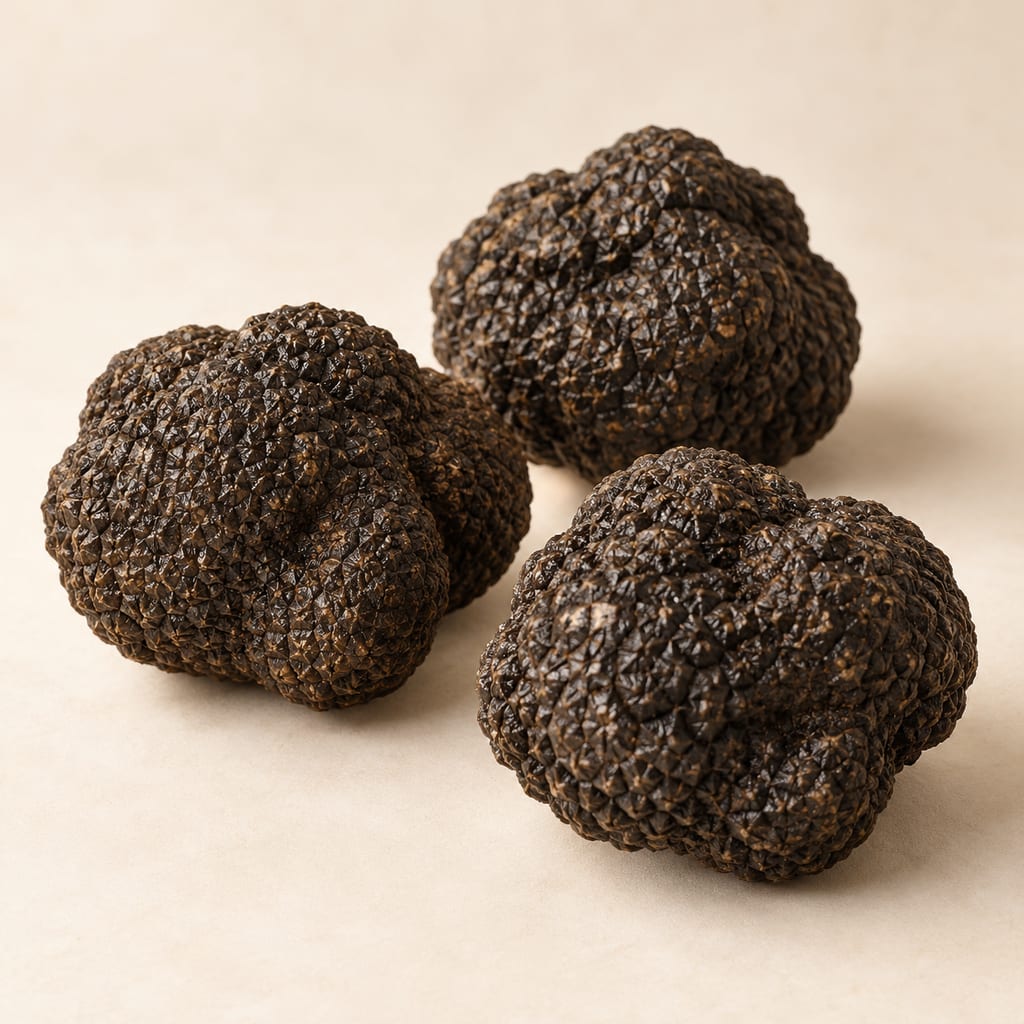
Tuber melanosporum is the Périgord black truffle, a mycorrhizal fungus of southern Europe grown in inoculated oak and hazel orchards and used as a high-value aromatic seasoning.
No community contributions have been published for this entry yet.
Sign in to contribute. Published comments and photos are free to read.
Food and Agriculture Organization of the United NationsIdentity · History · Geography · Production
Pigs | Livestock SystemsDomestic pigs are raised mainly for meat; production ranges from large capital-intensive units to small family systems, including scavenging systems; pig distribution is influenced by cultural and religious factors.
Cited in: How pigs are raised
Molecular Biology and Evolution; PubMed recordHistory · Geography
Ancient Genomics Reveals the Origin, Dispersal, and Human Management of East Asian Domestic PigsThe 2025 genomic study identifies northern China as the origin of modern East Asian domestic pigs and traces later dispersal and admixture using ancient genomes from 5,800 BCE to 1,300 CE.
Cited in: Pigs and people over time; A specific place, not a single birthplace
Proceedings of the National Academy of SciencesHistory · Geography
Ancient pigs reveal a near-complete genomic turnover following their introduction to EuropeArchaeological evidence places pig arrival in Europe alongside Near Eastern farmers about 8,500 years ago; later interbreeding with European wild boar replaced most Near Eastern ancestry over roughly 3,000 years, complicating a single-origin story.
Cited in: Pigs and people over time; A specific place, not a single birthplace
Amgueddfa Cymru – Museum WalesHistory · Geography
Salting trough, F78.94.3The museum associates a large oval sycamore pig-salting trough with use in Penally between 1850 and 1900; it records iron hoops, handles at each end, height 39 cm and width 77 cm. The museum record describes a curing implement, not a fermented pork recipe, and its displayed length unit is inconsistent.
Cited in: Pigs and people over time; How pigs are raised; What pork contributes to fermentation; A specific place, not a single birthplace
Food and Agriculture Organization of the United NationsScience · Fermentation
Meat as raw material, non-meat ingredients and basic techniques in meat processingMuscle proteins, connective tissue, fat depots, postmortem change, salt extraction and binding, particle formation, fat smearing, and drying; general mechanisms only, with no numerical operating limits transferred.
Cited in: What pork names; Muscle, fat and the cut; What pork contributes to fermentation
Foods, 13(12), 1905Identity · Science · Nutrition
Pork Meat Composition and Health: A Review of the EvidencePork composition varies by cut, source and preparation; cited cut data show wide differences in fat and energy content. Pork is classed as red meat in the review. The review describes ongoing disagreement in diet-health evidence; no health recommendation is inferred here.
Cited in: Muscle, fat and the cut; Composition and the limits of general labels
USDA Food Safety and Inspection ServiceIdentity · Handling
What are the cuts of fresh pork?Four basic primal cuts are shoulder, loin, side and leg; the named retail cuts include chops, tenderloin, ribs, bacon, ham, picnic and sausage-ground pork.
Cited in: What pork names
LWT, 77, 389–396Science · Fermentation
The role of bacterial fermentation in lipolysis and lipid oxidation in Harbin dry sausages and its flavour developmentA study of Harbin dry sausages found the inoculated bacterial treatments increased free fatty acids and decreased measures of lipid oxidation compared with its control; this result is specific to the studied product and starters.
Cited in: What pork contributes to fermentation; Many traditions use pork differently
Japan International Research Center for Agricultural SciencesUse · Regional variation
NaemDescribes a Thai fermented meat preparation with minced pork, cooked pork skin, garlic, salt and cooked rice, and notes regional and commercial variation.
Cited in: Many traditions use pork differently
Japan International Research Center for Agricultural SciencesUse · Regional variation
Sai krok Isan / Sai-krork-prieoDescribes fermented pork sausage associated with Isan and distinguishes sour-fermented sai krok from Thai sausages that are seasoned and cooked without that fermentation.
Cited in: Many traditions use pork differently
FoodSafety.govHandling · Safety
Cold Food Storage ChartFor raw pork at 40°F (4°C) or below, the chart lists 3–5 refrigerated days for steaks, chops and roasts, and 1–2 days for ground pork. These are household raw-food storage periods, not fermented-product shelf lives.
Cited in: Buying and handling raw pork
USDA Food Safety and Inspection ServiceSafety · Handling
What foodborne organisms are associated with pork?Raw or undercooked pork may carry bacteria and parasites; the page lists Trichinella and bacteria including E. coli, Salmonella, Staphylococcus aureus and Listeria monocytogenes.
Cited in: Buying and handling raw pork
USDA Food Safety and Inspection ServiceSafety · Handling
Is a rare steak safe to eat?For whole-muscle pork steaks, chops and roasts intended to be cooked, USDA advises a minimum internal temperature of 145°F (62.8°C) and a rest of at least three minutes. This cooking advice is not a fermentation or curing control.
Cited in: Buying and handling raw pork