
Salt: the mineral, the work and the foods it makes
Salt seasons a meal, shapes fermentation and preserves food. Its history follows the people who mine, harvest, trade and transform it, and the choices hidden inside an ordinary packet.
 FermenteaWhere food goes to change
Historical attestation
Salted ham in Cato, De agricultura 162
Cato the Elder records a second-century BCE sequence for salting, air-drying, and smoking ham. This historical account is not a validated modern curing protocol.
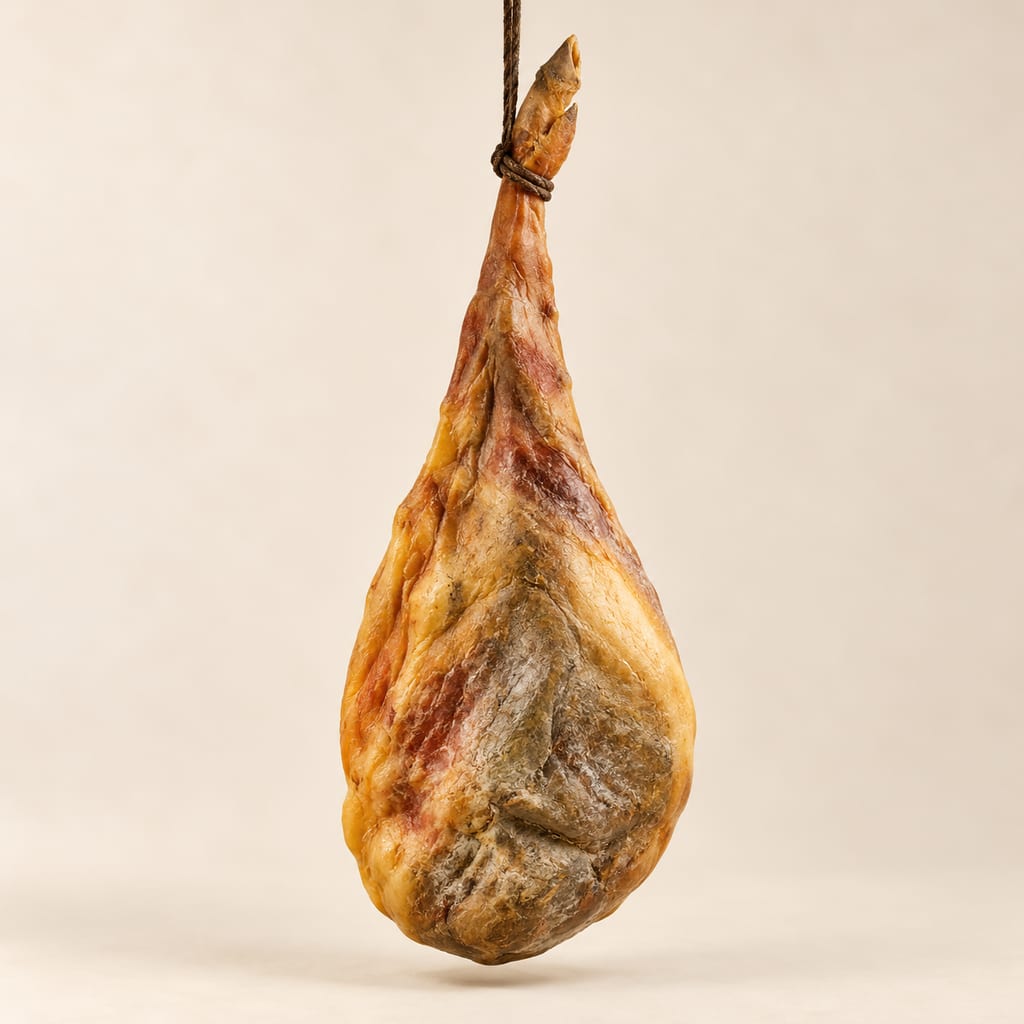
Cato the Elder’s De agricultura is a Roman farming and household-management text assembled in the second century BCE. Section 162 gives a sequence for salting hams in a jar or large vessel, then drying, oiling, smoking, and treating the surface with oil and vinegar. The passage is unusually concrete: it names the salt, gives a measure for each ham, distinguishes the five-day first stack from the twelve-day total, and describes when to turn, dry, smoke, and rub the meat.
The record is useful because it shows how an agronomic writer made preservation legible as a set of timed operations. It is not evidence that every Roman household followed this formula, that every ham was made this way, or that the process began with Cato. A written method is an attestation, not an origin story.
Cato’s heading also names Puteolan ofellae. The instructions that follow address hams; they do not give a distinct recipe for small ofella pieces. The philological discussion of Cato 162 and Columella 12.55 cautions against treating the heading as proof that this ham procedure itself was a named Puteolan speciality. The food and the text’s title must be read separately.
The recipe starts with bought hams, and Cato says to cut off the hocks. The text does not specify breed, age, feed, ham weight, fat cover, or whether the meat has already been chilled or otherwise treated. It names ground Roman salt and gives a semodius for each ham. That ancient dry measure is preserved here as written: equating it to a modern volume or weight would require a defensible account of the unit, the salt’s packing and grind, and the meat’s size. None is supplied by the passage.
Cato’s use of a large amount of salt is not a standardized contemporary formula. The source does not say how much salt remains on the ham, how much penetrates it, or what final moisture or salt concentration results. The difference between a measure placed around a ham and a measured proportion absorbed by its muscle matters: they describe different things.
Oil and vinegar appear at the end, after salting, air-drying, and smoking. Cato gives no amounts and does not identify the vinegar. We should not replace that silence with familiar modern quantities, assume the oil is an antimicrobial control, or infer that the vinegar makes the meat safe. The text presents these as surface treatments and gives a pest-deterrence claim.
Cato first beds the jar or tub with salt and lays a ham skin-side down. Each ham is surrounded by salt, with meat kept from touching meat; when the vessel is full, the top is covered so no flesh shows. This creates repeated contact between meat and salt and keeps the pieces separated. Salt draws water from tissue and lowers the availability of some water to microorganisms, but the passage reports neither a measured water activity nor a microbiological endpoint.
After five days, the hams are lifted out with their salt and re-stacked in reverse order. Turning the stack changes which ham occupies each position and redistributes the salt that travels with it. Cato’s directions show that he considered arrangement and contact important, but they do not identify a chemical or microbial mechanism for the turning step. After twelve days total, the hams leave the salt.
The next stage hangs the hams in moving air for two days. On the third day, the surface is sponged and oiled; smoke follows for two days. A final oil-and-vinegar rub precedes hanging in a meat store. The operations combine salt contact with water loss and smoke exposure. Cato does not say what wood is used, how hot the smoke is, how air moves, how damp the room is, or what the ham should weigh at the end.
This is curing and smoking, not a fermentation recipe. A modern scientific review explicitly distinguishes Cato’s cured and ripened ham from microbially fermented meats. No starter culture or intentional microbial acidification appears in the text. Describing the process as fermentation would add a biological stage that the source does not give.
The sequence separates operations rather than treating time as one uninterrupted cure. Salt contact takes place in a covered vessel; the later air stage exposes the surface; oiling precedes smoke; and the final oil-and-vinegar mixture comes only after the smoke. The text does not tell us whether Cato expected the ham to be cooked before eating, how it was served, or how long it was stored. We should not fill these absences with assumptions imported from a modern cured ham.
Cato wrote in Latin within the Roman Republic’s agricultural world, so the method is securely attested in Roman literature. The passage does not say where the pigs were raised or where the hams were cured. Puteoli appears in the chapter heading beside ofellae, but that alone cannot locate the ham’s production. The geography for this record is therefore an attestation in Roman Italy, not a claim that the preparation originated in a particular town.
The broader ancient record is not a single uniform ham culture. Rzeźnicka, Kokoszko, and Jagusiak compare agronomic and medical writers across antiquity and the early Byzantine centuries and discuss named places associated with cured meat. Those accounts document a wider food world in which preserved pork had dietary and culinary roles, while differences in author, period, and terminology matter. Later references cannot simply be folded back into Cato’s recipe.
The exact value of Cato’s account is its boundedness. It tells us that this author described salt-packed hams, re-stacking, air, smoke, and finishing treatment. It does not establish the scale of production, the social class of every maker, a commercial route, or an unbroken technical lineage to a present-day protected ham.
Preserving pork extended the time in which a large cut could be kept and moved, a practical advantage when slaughter produced more meat than a household would eat immediately. The later ancient and Byzantine sources surveyed by Rzeźnicka and colleagues discuss ham in gastronomy and dietetics, showing that cured meat circulated among several kinds of writing. Medical claims in those texts are historical evidence about belief and use, not present-day health advice.
Cato’s own nearby chapter 158 uses a ham hock or a small quantity of ham scraps in a complicated boiled preparation. This demonstrates one textual use for ham offcuts in his book, but it is presented as a purge, not an ordinary meal. It would be misleading to infer from this isolated medicinal recipe that it was the usual way Romans ate cured ham.
The preserved cut could be sliced or cooked, but Cato 162 does not prescribe serving portions, accompaniments, cooking methods, or a dish in which the finished ham should appear. Later Roman recipes and modern charcuterie traditions give other contexts for ham, yet they belong to their own sources and periods. This page keeps those contexts visible as comparisons rather than silently adding them to Cato’s method.
The article on ancient and Byzantine cured meats brings together multiple authors and preparations, while modern ham styles add further variation in cuts, salt blends, drying conditions, smoking, maturation, and regulation. These are not interchangeable versions of a single recipe. Cato’s account has no stated temperature, humidity, curing-room design, water-loss target, or microbial culture. A modern ham’s named style and verified process cannot be reconstructed from those missing values.
There is also an important difference between historical and present technical language. Cato’s salt-only description predates modern curing systems. USDA FSIS describes contemporary curing in terms of specified salt and, in some products, nitrate or nitrite ingredients; it explains that nitrite and salt can inhibit Clostridium botulinum under applicable conditions. That modern definition is not proof that Cato used those ingredients, nor does it license translating the ancient salt measure into a current formula.
The same caution applies to shelf stability. Modern FSIS guidance associates shelf-stable dry-cured ham with low water content and defined processing; Cato supplies no measured moisture loss or endpoint. A modern prosciutto, country ham, or other cured leg may help readers recognize the broad category of preserved pork, but its appearance and processing controls do not establish what Cato’s finished ham looked or tasted like.
Regional names in later literature can point to genuine differences in reputation, supply, or technique, but they do not make every salted ham a geographically fixed specialty. Cato’s Latin line identifies a type of salt and a series of operations, not a farm, coastal saltern, workshop, or export port. The geography metadata therefore records only the Roman literary attestation, with the production locality left unresolved. This distinction matters when a food’s modern fame tempts readers to retroactively assign an ancient origin.
Cato gives a salt measure and a calendar, but not the information a modern process needs to control foodborne hazards: ham weight and thickness, starting temperature, salt formulation, environmental temperature and humidity, airflow, smoke temperature, validated internal or water-activity endpoint, or a tested storage instruction. The steps should be read as an ancient historical procedure and not as a home-curing guide.
Current food-safety guidance treats curing as a controlled process. The presence of salt, a smokehouse, or a long wait does not by itself validate safety. Nor can later cooking be assumed to correct all hazards in a mishandled cured product. Anyone preparing pork for eating needs an authoritative current formula matched to the cut and process; the ancient passage is not such a formula.
Cato’s final statement that moths and worms will not attack the ham describes the result he valued. It is not a shelf-life test, microbiological analysis, or guarantee against spoilage. The record therefore preserves his observation as historical context while refusing to turn it into a modern safety assurance.
The four ingredients named in the structured record reflect the words in the passage rather than a reconstructed modern shopping list. Cato does not call for sugar, curing salts, herbs, starter cultures, or additional liquid. That absence is informative when comparing the historical text with later recipes, but it does not mean that a salt-only method is suitable under present conditions. A source-based page can preserve an old method faithfully while declining to turn it into a safe contemporary procedure.
The most responsible way to use this passage is to compare its stages with other sources and ask what it reveals about Roman farm practice. It shows deliberate sequencing: salt before drying, a mid-course re-stack, air before smoke, and surface treatment after smoking. It also shows where the written record stops. Cato does not explain every choice, and the work’s practical confidence should not be mistaken for a modern validation study.
The source title’s combined reference to ham and Puteolan ofellae, the uncertain conversion of its measure, and the absence of environmental controls are not gaps to be filled by guesswork. They are part of the recipe’s history. Keeping them explicit lets readers learn from an early technical text without confusing a valuable document with an actionable contemporary curing protocol.
Cato's agronomic work preserves a detailed ham-curing passage at section 162. The title also mentions Puteolan ofellae, but the surviving instructions describe hams and do not explain a separate ofella preparation. The passage is historical evidence, not a modern validated process.
Scaling: source batch only
The ancient text supplies no measured temperature, humidity, salt uptake, water activity, pathogen control, or validated endpoint. It cannot establish that a modern ham made by following it would be safe.
Hazard sourceCurrent curing guidance describes specific curing ingredients and controls that are not present in Cato's text; the historical process must not be represented as equivalent.
Hazard sourceDo not use this historical description as instructions for curing pork for consumption. Use a current, validated process from an authoritative food-safety source instead.
Control sourceHistorical method, not a safe modern recipe. Cato’s stated duration and salt measure do not supply the controls needed to validate cured pork.
The text’s claim that oil and vinegar deter pests is a historical claim about pests, not evidence of food safety or shelf stability.
The text attests the method in a Roman work but names no production location; Puteoli in the heading does not establish the ham's origin.
Salt seasons a meal, shapes fermentation and preserves food. Its history follows the people who mine, harvest, trade and transform it, and the choices hidden inside an ordinary packet.

Kylmäsavuporokeitto is a creamy cold-smoked reindeer soup with onion, stock and cheese, served with bread.

Pork belly receives a measured salt-and-sugar cure with coffee and spices, then is refrigerated before cooking or hot smoking.

Finnish pea soup simmers dried peas with palvikinkku or a vegetable alternative, then is served with mustard and chopped onion.
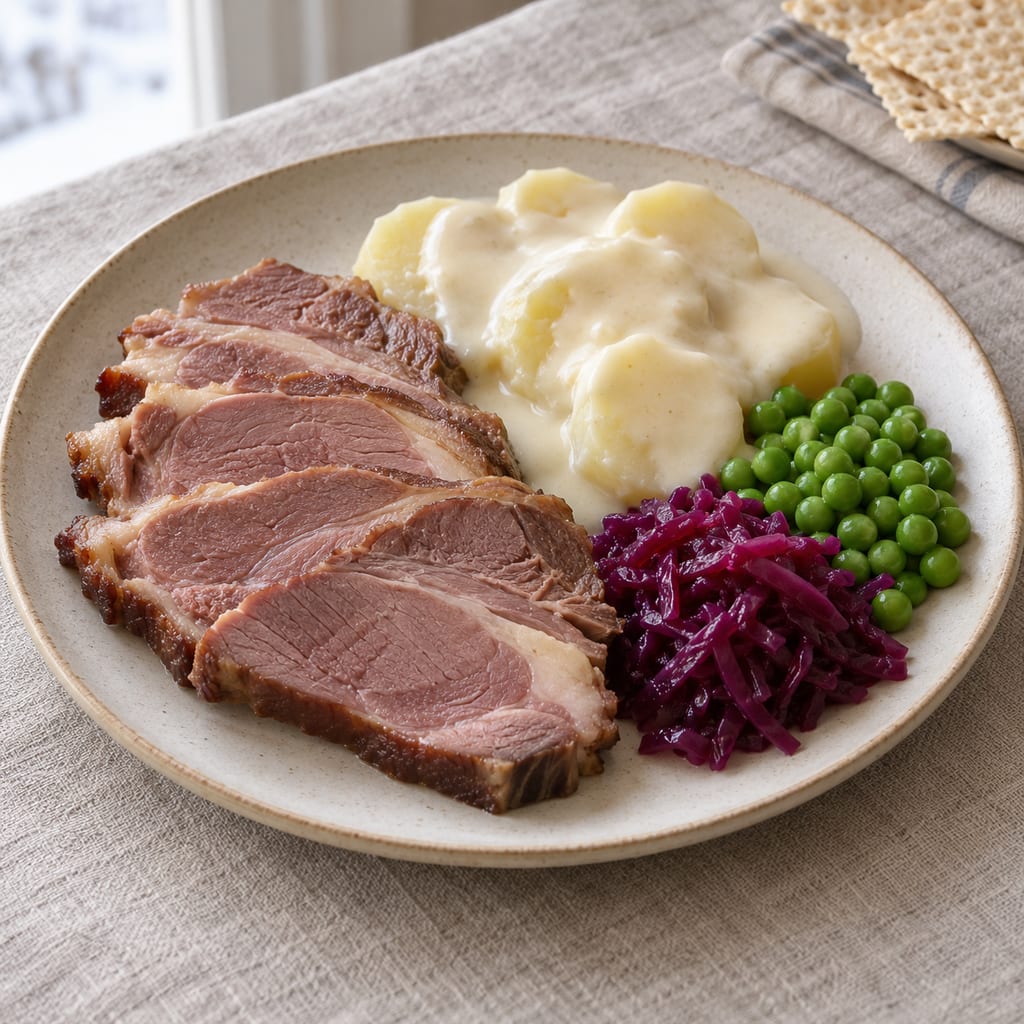
A six-person Icelandic Lamb serving recipe for deboned hangikjöt with potato bechamel, pickled cabbage, peas and laufabrauð. It cooks the product; it does not smoke or cure it.

A protected pork sausage associated with Liszki and Czernichów; its application describes commercial curing and smoking, not a home batch.

A two-portion cabbage soup with onion, potato and finished Geselchtes, served with garlic sour cream.
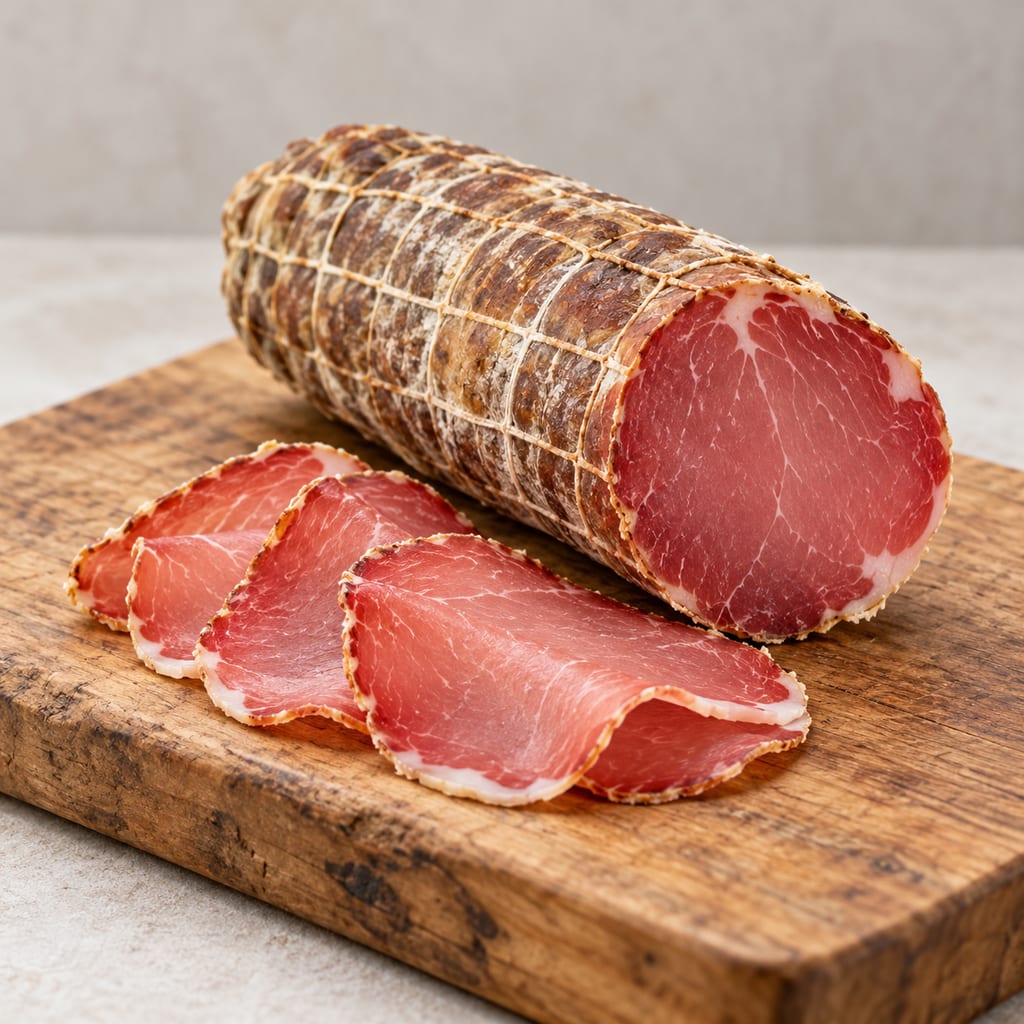
Documentary account of Italian regional cured-loin traditions, including Tuscan and Marche variations; no home-cure instructions are provided because the published professional methods lack validated safety controls.

A refrigerated pork-belly brine combines beer and maple syrup with salt, garlic powder and measured Cure #1.

At North Abydos in Egypt, a fixed early Dynastic brewery comprised parallel semi-subterranean installations with rows of ceramic mash vats; excavation reports revise their number, scale and estimated batch capacity.

Ají amarillo is the orange-yellow Peruvian chilli cultivar group of Capsicum baccatum, used to colour and season huancaína sauce and ají de gallina. Published heat estimates do not establish one range for the named cultivar.

Toasted almonds are whole sweet almond kernels dry-roasted until golden to brown. Heat replaces their marzipan note with a roasted, nutty one; they thicken and flavour romesco.

Kodiak salmon, halibut and cod cut as seg'aq and hung on an initaq rack to become tamuuq, with kac'amaasaq and kupcuunaq named as different results.

Aniseed is the dried ripe fruit of Pimpinella anisum, an aromatic Apiaceae spice commonly called a seed. It adds a sweet, warm aroma to breads such as Moroccan krachel and South African mosbolletjies, and is distinct from star anise.

A fixed Late Chalcolithic installation in Areni-1 cave combined a shallow clay pressing basin with a large jar set into the cave floor and storage vessels nearby.

Ripe avocado flesh is the soft, buttery, fat-rich pulp of Persea americana, eaten raw. It is low in acid, so it is a fresh ingredient that needs care in chilled dishes.

A portable dome and pan used over a hearth, with embers on the lid and heat from below. Regional peka and saç forms share this principle while differing in materials, pan shape and how the food is cooked.
No community contributions have been published for this entry yet.
Sign in to contribute. Published comments and photos are free to read.
LacusCurtius, University of ChicagoPrimary text · Method · History
Cato, On Agriculture, sections 158–162Section 162 gives the salt measure per ham, layering and re-stacking instructions, the total twelve-day salting period, two days in moving air, oiling, two days in smoke, and a final oil-and-vinegar rub.
Section 162's Latin heading mentions Puteolan ofellae, while the method itself describes hams.
Cited in: A farm text preserves a ham process; What the source means by ham and salt; The sequence and the work each stage does; A Roman agricultural setting, not a proven birthplace; How salted ham could be used; Reading the recipe today
Università Cattolica del Sacro CuorePhilology · History
La salatura delle carni: nota a Catone, agr. 162, 1-3 e Columella, rust. 12, 55The article analyzes the wording and interpretation of Cato 162 and Columella 12.55.
The title's references and the process text require care; the Cato passage does not supply a separate ofella recipe.
Cited in: What the source means by ham and salt; Reading the recipe today
Studia CeraneaHistory · Uses · Variations
Cured Meats in Ancient and Byzantine Sources: Ham, Bacon and TuccetumThe authors compare agronomic, medical, and culinary references to cured meat from antiquity through the early Middle Ages.
The article discusses ham's role in diet and gastronomy and distinct regional associations without making Cato's method a universal Roman process.
Cited in: A Roman agricultural setting, not a proven birthplace; How salted ham could be used; Variations and later comparisons
FEMS Microbiology Reviews, Oxford AcademicScience · Classification
Meat fermentation at a crossroads: where the age-old interplay of human, animal, and microbial diversity and contemporary markets meetThe review identifies Cato's ham as a cured and ripened meat product, not a microbially fermented meat product.
It places Cato's account in its second-century BCE agricultural context.
Cited in: The sequence and the work each stage does; Variations and later comparisons
USDA Food Safety and Inspection ServiceSafety · Modern comparison
What is curing?Modern curing uses specified curing ingredients for preservation, color, and flavor, and nitrite and salt inhibit Clostridium botulinum under applicable conditions.
This current definition is not a validation of Cato's historical formula.
Cited in: What the text cannot tell a modern maker
USDA Food Safety and Inspection ServiceSafety
How do I safely cure meats at home to avoid botulism?Current home-curing safety requires a process designed to control serious hazards; this source is cited for the warning not to treat an ancient text as validated instructions.
Cited in: What the text cannot tell a modern maker
USDA Food Safety and Inspection ServiceModern comparison · Safety
Are dry-cured hams shelf stable?Modern shelf-stable dry-cured ham depends on moisture reduction and a defined process; the conditions in Cato's text are insufficient to infer shelf stability.
Cited in: Variations and later comparisons; What the text cannot tell a modern maker