
Fermented meat around the world
Dry salami, sour pork with rice, matured sheep and aged blubber follow different paths from animal to food. Their stories connect microbes with climate, slaughter, migration and the meals people share.
 FermenteaWhere food goes to change
Traditional method
หม่ำ · mam · Mum-moo · Mam-moo · Mam-neua
Mum is a Thai family of fermented meat preparations with distinct pork Mam-moo and beef Mam-neua forms. Sources document ingredients, casing and serving traditions, but not a validated home process.
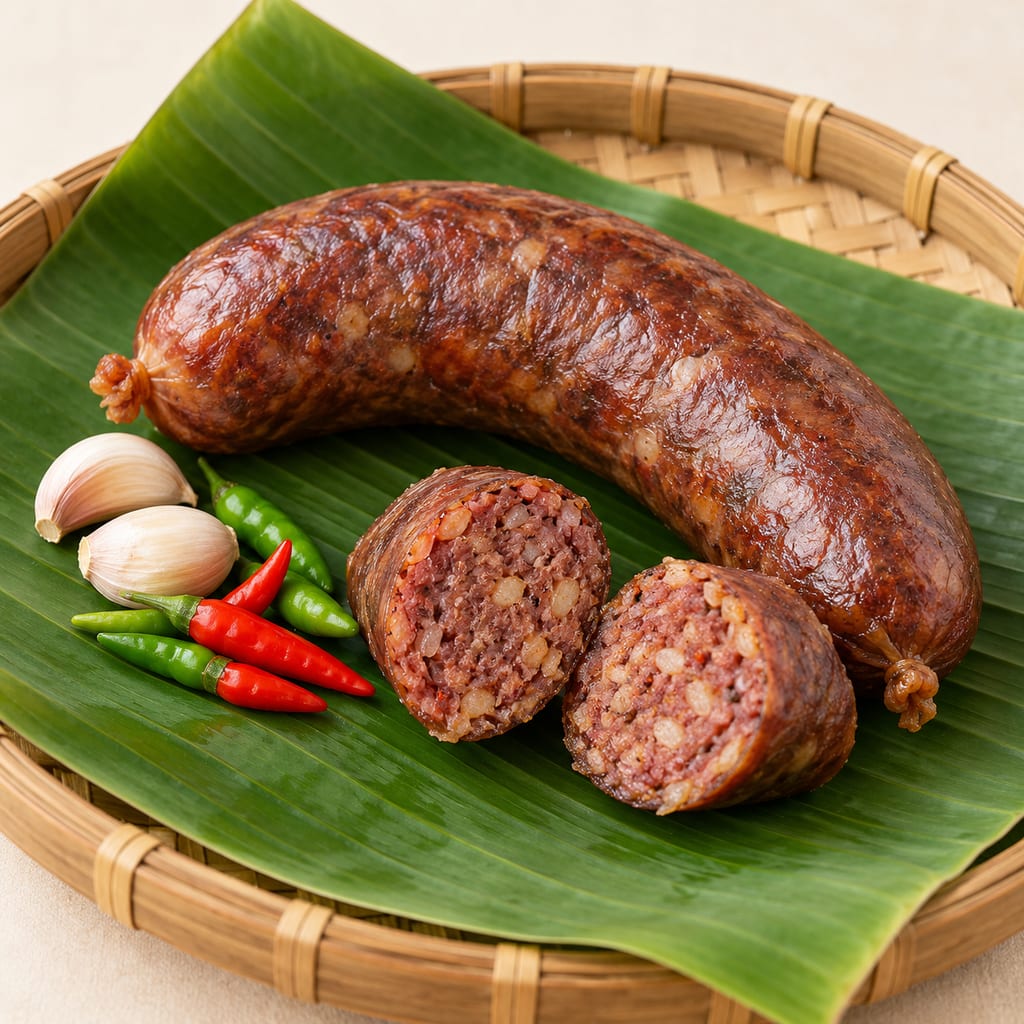
The Thai name หม่ำ is used for a family of fermented meat products. JIRCAS records two local names: Mam-moo for fermented pork and Mam-neua for fermented beef. The distinction is the animal species, not a pair of interchangeable spellings. The supplied meat-atlas record notes that wider usage can include buffalo and other named regional forms; those details should not be assumed to describe the JIRCAS formulations.
English spellings vary across publications, including Mum-moo in a 2024 research paper. This page keeps the established atlas identity “Mum (mam)” and treats Mam-moo and Mam-neua as named forms within it. It does not imply the two forms share one exact formula.
JIRCAS lists ground meat and the matching liver, salt, minced garlic, ground roasted rice and cooked rice. It says meat is usually the main ingredient but gives no fixed meat-to-liver ratio or weights. The 2024 study’s sample table independently describes Mum-moo as minced pork and liver with salt, roasted rice and garlic; it does not list cooked rice for that sampled product. This difference indicates that recorded formulations vary; it is not a reason to combine the accounts into one exact recipe.
The JIRCAS account includes a covered overnight rest, stuffing into cleaned intestine or stomach, and hanging in shade or an airy place. It also records plastic casing in contemporary Mam-moo and a paste form for Mam-neua. A customary fermentation span is recorded, but no measured temperature, validated acidity or other critical process limit is given. This entry preserves those details as documentation rather than turning them into a reliable home protocol.
JIRCAS records raw Mam served with fresh garlic, bird’s-eye chilli and vegetables as a main dish, alongside a contemporary practice of deep-frying before eating. It documents use; it does not test the safety of raw servings. Fermentation time alone cannot be treated as proof that a meat product is safe.
The German Federal Institute for Risk Assessment advises consumers to avoid raw pig-meat products, including raw sausages, unless sufficiently heated, with particular concern for people at higher risk of severe hepatitis E. CDC notes that curing, drying or smoking alone does not consistently kill Trichinella and that homemade sausage can be a source of infection. These sources do not provide a Mam-specific validated method, so this record supplies no critical limit.
Krongkeha’s 2024 study obtained ten lactic-acid-bacteria isolates from one Mum-moo sample. The authors identified isolate MU-9 as Lactiplantibacillus plantarum and found that its culture supernatant inhibited selected test bacteria in laboratory assays. They describe possible future use of selected strains as starter cultures. These findings concern isolated organisms and laboratory tests; they do not show that the sampled sausage was pathogen-free, establish which organisms dominate every Mam batch, or validate a household process.
JIRCAS associates home-industry Mam production with northeastern Thailand, supporting a regional production association but not a particular village or birthplace. Its reference list includes a 1995 book, which shows the tradition had been recorded by then but does not establish an earliest attestation. The 2024 paper adds a later study of a Mum-moo sample without dating the product’s beginning.
JIRCAS distinguishes Mam-neua (beef) from Mam-moo (pork) and cites The traditional fermented foods of Thailand (1995). That citation and the database entry do not date the beginning of the tradition. A 2024 study sampled Mum-moo and isolated lactic-acid bacteria; the study examined strains in laboratory assays, not a validated household process.
Scaling: source batch only
The documented serving practice includes raw Mam-moo. BfR advises against raw pig-meat products unless sufficiently heated; CDC documents raw or undercooked pork and homemade sausage as possible sources of Trichinella.
Hazard sourceThe available descriptions give customary handling, but no validated controls for pathogens in this formulation.
Hazard sourceThe reported fermentation duration is descriptive evidence, not a safety-validated limit. Raw or lightly fermented pork and liver can carry foodborne hazards. CDC notes curing alone does not consistently kill Trichinella; BfR advises against raw pig-meat products unless sufficiently heated. No safe home process is established here.
JIRCAS places Mam home-industry production in the northeast; this is a documented production association, not a precise origin.
The inspected sources do not establish when or where the wider Mam family began.
Dry salami, sour pork with rice, matured sheep and aged blubber follow different paths from animal to food. Their stories connect microbes with climate, slaughter, migration and the meals people share.
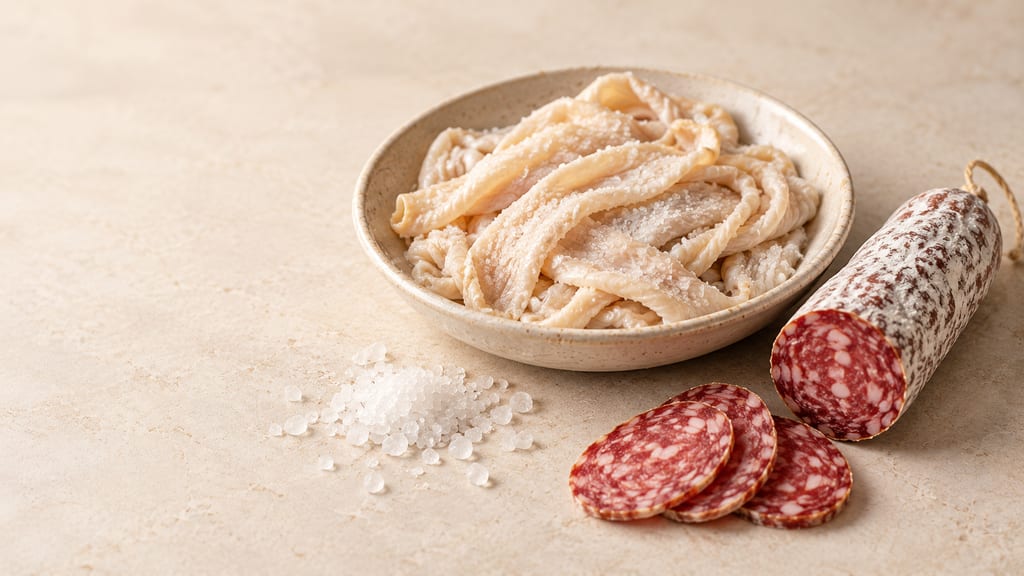
Gut, stomach, bladder, caul and skin have held food for as long as recipes have been written down. Which part of the animal a cook chose still decides a food's shape, how it dries and smokes, and how it is eaten.
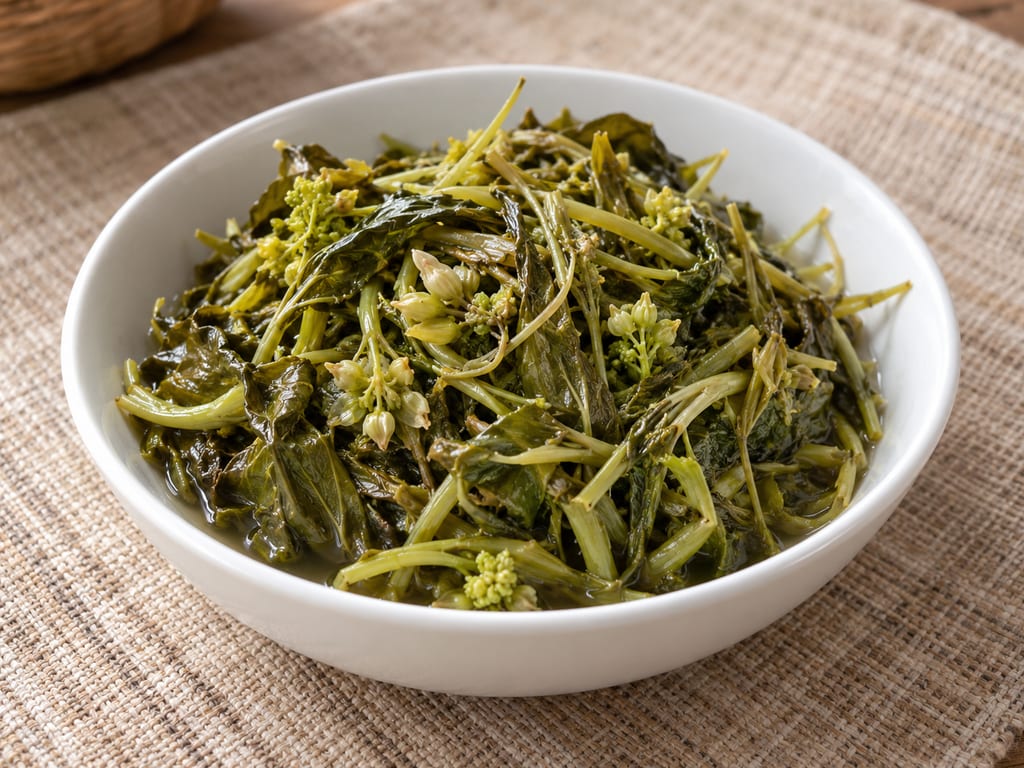
Phak sian dong is a Thai pickle of spider-plant tips and flowers (Cleome gynandra), salted and packed with cooked rice. Northeastern Thai and Lao Khrang accounts give different methods.

A 2023–2025 proof-of-concept made separate fermented extracts from beef heart and lung with Staphylococcus xylosus and protease. It reports supervised pilot findings, not a validated household method or a blended heart-and-lung formula.

Naem is a Thai sour pork preparation made with minced pork, rind or ear, glutinous rice, garlic and salt. Its documented room-temperature method has no validated food-safety endpoint.
A Tujia sour pork preparation documented in southeastern Chongqing. Its rice-flour pork method is distinct from the wider suān ròu forms; a sixth-century pork-zha text is an earlier attestation, not proof of direct continuity.
No community contributions have been published for this entry yet.
Sign in to contribute. Published comments and photos are free to read.
Japan International Research Center for Agricultural Sciences (JIRCAS)History · Use · Geography · Ingredients · Method
MamRecords Thai name หม่ำ and distinguishes Mam-neua (fermented beef) from Mam-moo (fermented pork).
Lists ground meat and matching liver, salt, minced garlic, ground roasted rice and cooked rice; says meat is usually the main ingredient but gives no fixed ratio.
Describes a covered overnight rest, casings, shade or airy hanging, a customary fermentation duration, plastic casing for contemporary Mam-moo and a paste form for Mam-neua.
Associates home-industry production with northeastern Thailand and documents raw and fried serving practices without validating safety.
Cites The traditional fermented foods of Thailand (1995), which does not establish first origin or earliest attestation.
Cited in: Two names, two meat variants; Ingredients and recorded method; A food with changing serving practice; Place and historical limits
Rajamangala University of Technology Suvarnabhumi Academic JournalMicrobiology · Ingredients
Screening and identification of bacteriocin-producing lactic acid bacteria from Thai fermented meat productsReports a Mum-moo sample described as minced pork and liver, salt, roasted rice and garlic; ten isolates were obtained from that sample.
Identifies isolate MU-9 from Mum-moo as Lactiplantibacillus plantarum and reports laboratory inhibition assays; the study does not validate product safety or a home process.
Cited in: Two names, two meat variants; Ingredients and recorded method; What the microbiology study establishes; Place and historical limits
German Federal Institute for Risk Assessment (BfR)Safety
Hepatitis E virus: avoiding transmission via domestic pigs and wild boars and food derived from themRecommends avoiding raw pig or wild-boar meat products unless sufficiently heated; identifies particular concern for severely immunocompromised people and people with pre-existing liver disease.
Cited in: A food with changing serving practice
Centers for Disease Control and PreventionSafety
About TrichinellosisNotes that raw or undercooked pork can transmit Trichinella, that homemade sausage has been a source, and that curing, drying or smoking alone does not consistently kill the parasite.
Cited in: A food with changing serving practice