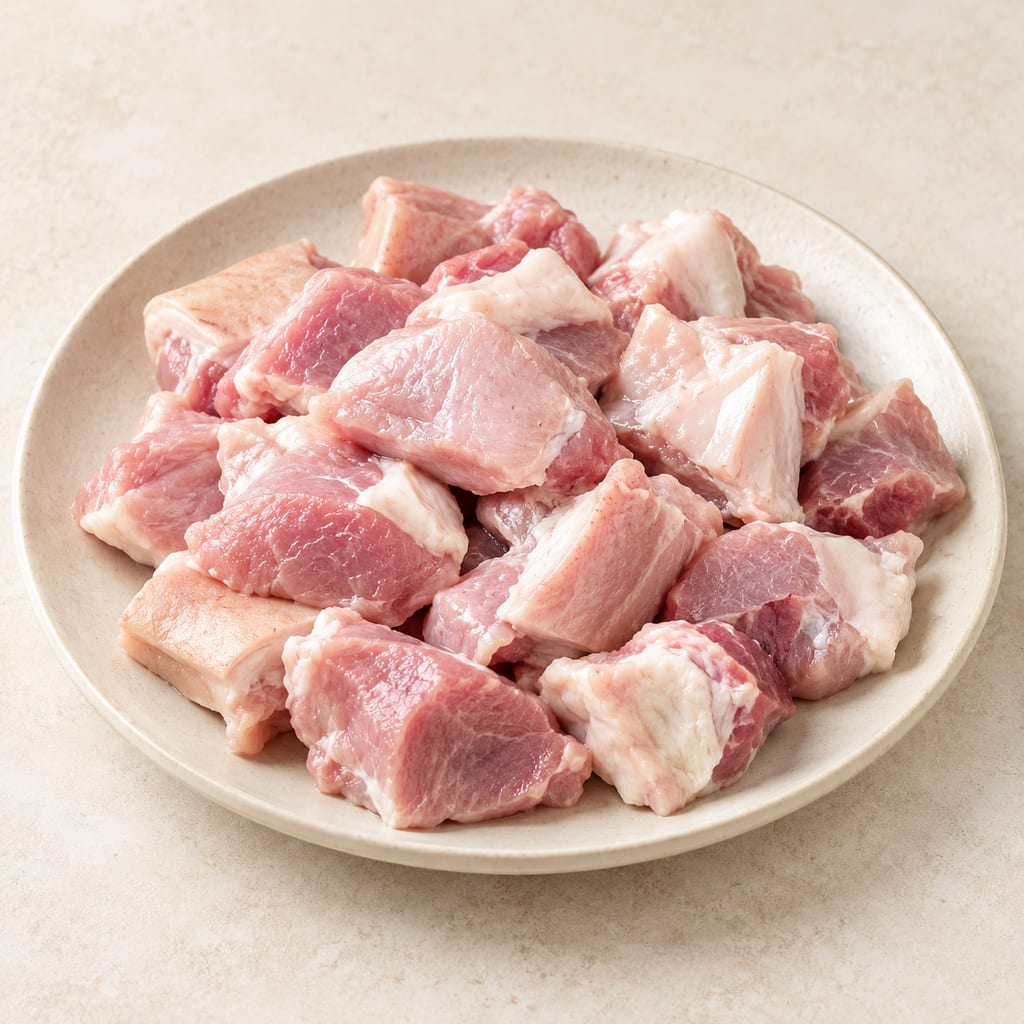
Pork
Pork is meat from domestic pigs, sold as distinct cuts, ground meat and fat; its form and composition shape its roles in fermented foods.
 FermenteaWhere food goes to change
Traditional method
酸鲊肉 · Tujia sour zha pork · Tujia sour pork with rice flour
A Tujia sour pork preparation documented in southeastern Chongqing. Its rice-flour pork method is distinct from the wider suān ròu forms; a sixth-century pork-zha text is an earlier attestation, not proof of direct continuity.
Suān zhǎ ròu (酸鲊肉) is recorded as a Tujia preparation from southeastern Chongqing. The source describes pork belly combined with rice flour, chilli and salt, then fermented in a jar. This is a distinct named preparation from the wider suān ròu grouping for Miao, Dong and Buyi foods. The names share the word suān, “sour,” but the available evidence does not justify combining their recipes or histories.
The same paper explains that zhǎ (鲊) is a broader food category. It discusses chopped ingredients mixed with rice flour or wheat flour, salt and seasonings, and names sour-chilli, meat and fish forms. The word can refer to more than one preserved food; suān zhǎ ròu here means the meat preparation documented in the article, not all foods called zhǎ.
Ran and colleagues describe fresh pork belly being washed and sliced, then mixed with rice flour, chilli and salt. The mixture is packed into an earthenware jar and fermented naturally under anaerobic conditions. The article characterizes the Tujia product as a lactic-acid-bacteria-type fermented meat. It does not give quantities or a complete validated household specification in that description.
Rice flour is part of the named Tujia preparation, not a generic grain addition borrowed from the separate Miao, Dong and Buyi evidence. The source associates flour with the broader zhǎ category but does not quantify its role in the traditional product. Chilli and salt are listed as seasonings; their amounts and the exact contribution of each to this particular fermentation are not established in the cited description.
The 2019 study explored a laboratory pure-culture pre-fermentation using pork, rice flour, added sugar and a selected Lactiplantibacillus plantarum culture. The authors sterilized the experimental substrate and varied fermentation time, temperature, inoculum and sugar to measure enzyme activity. Their model selected conditions for comparatively high lactate dehydrogenase, protease and lipase activity in the early-stage material.
Those measurements help explain the research question. The authors describe lactate dehydrogenase as part of converting pyruvate to lactic acid, which contributes sourness; they discuss proteases and lipases as contributing to later flavour development. The study's optimized early-stage experiment is a modern research branch, not the traditional recipe above or a complete consumer product. Its laboratory conditions are not used as household targets here.
The sixth-century Qimin yaoshu contains a short passage titled “Method for pork zha.” It calls for fatty pork cut into pieces, salt, and cooked rice used as the grain component; the text says the food is ready when a sour aroma appears. This is an early written attestation of a pork-zha preparation.
The 2019 article's introduction says the Qimin yaoshu recorded suān zhǎ ròu more than 2,000 years ago. Cambridge University Press dates the book to between 533 and 544 CE, so that two-millennia claim is too early. The medieval passage is not a Tujia description, and it does not show that the modern Chongqing food descends unchanged from the older preparation.
The article places the traditional preparation among Tujia communities of southeastern Chongqing and notes that materials and fermentation practices differ between localities and communities. The evidence supports that regional association, but it does not pinpoint a single birthplace or show that the same formula covers every Tujia household.
The authors caution that natural fermentation can vary and discuss biogenic amines and nitrite accumulation as food-safety concerns. WHO separately warns that undercooked pork containing Taenia solium cysticerci can cause taeniasis. Neither source establishes a validated household control scheme for suān zhǎ ròu. The source-described jar preparation therefore carries no inferred time, temperature, salt or storage limit in this record.
The modern Tujia preparation is documented in southeastern Chongqing. Ran et al. cite the Qimin yaoshu while discussing the broader zha category. The sixth-century text contains a pork-zha method using pork, salt and cooked rice until sour aroma appears. That is an early attestation of a related pork-zha preparation, not proof of direct continuity or shared method with the modern Tujia food.
Scaling: source batch only
Ran et al. note that traditional natural fermentation varies between batches and may allow accumulation of biogenic amines and nitrite. Their paper does not give a validated household control scheme for this traditional preparation.
Hazard sourceWHO identifies undercooked pork containing Taenia solium cysticerci as a route to taeniasis. This general guidance does not establish whether or how suān zhǎ ròu fermentation controls the parasite.
Hazard sourceThe source-described traditional method is not a validated household safety process. Do not infer a safe fermentation time, temperature, salt level or storage period from the laboratory trial.
The starter-culture experiment measured early-stage enzyme activities; it did not validate a consumer-ready process.
Ran et al. document a traditional Tujia suān zhǎ ròu preparation in southeastern Chongqing. The source does not identify a more precise origin or establish continuity with the medieval pork-zha text.
Pork is meat from domestic pigs, sold as distinct cuts, ground meat and fat; its form and composition shape its roles in fermented foods.
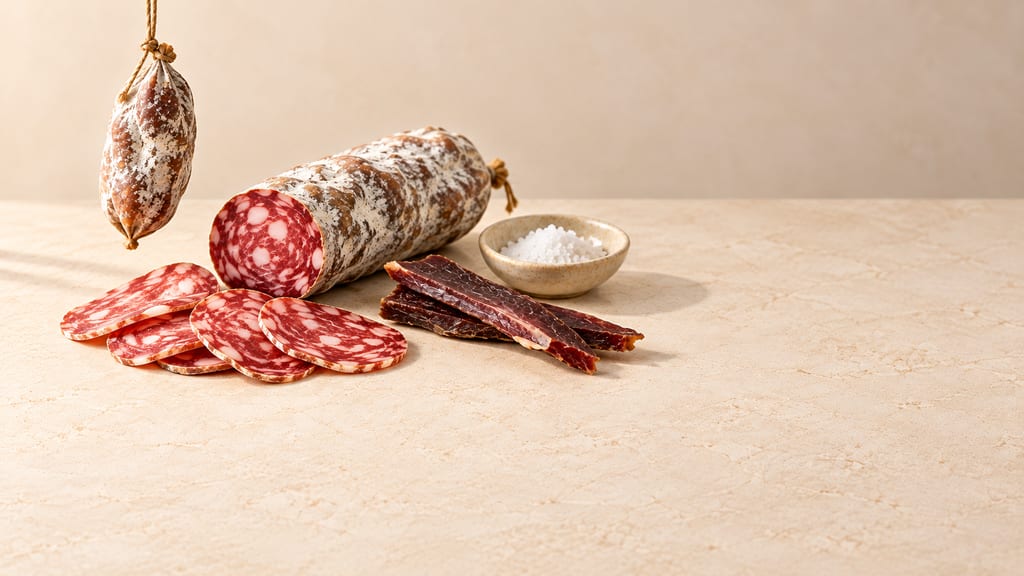
Dry salami, sour pork with rice, matured sheep and aged blubber follow different paths from animal to food. Their stories connect microbes with climate, slaughter, migration and the meals people share.
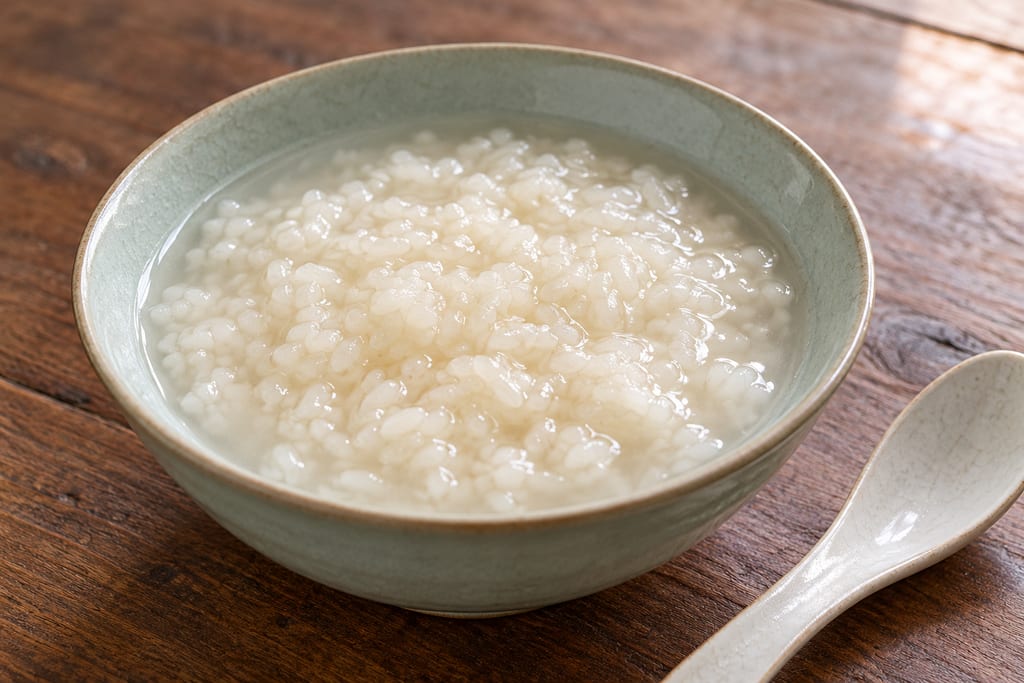
Chinese sweet fermented glutinous rice: steamed rice and a mixed jiuqu starter, where mould enzymes release sugar and yeast makes a little alcohol, eaten with its sweet liquid.

A 2023–2025 proof-of-concept made separate fermented extracts from beef heart and lung with Staphylococcus xylosus and protease. It reports supervised pilot findings, not a validated household method or a blended heart-and-lung formula.
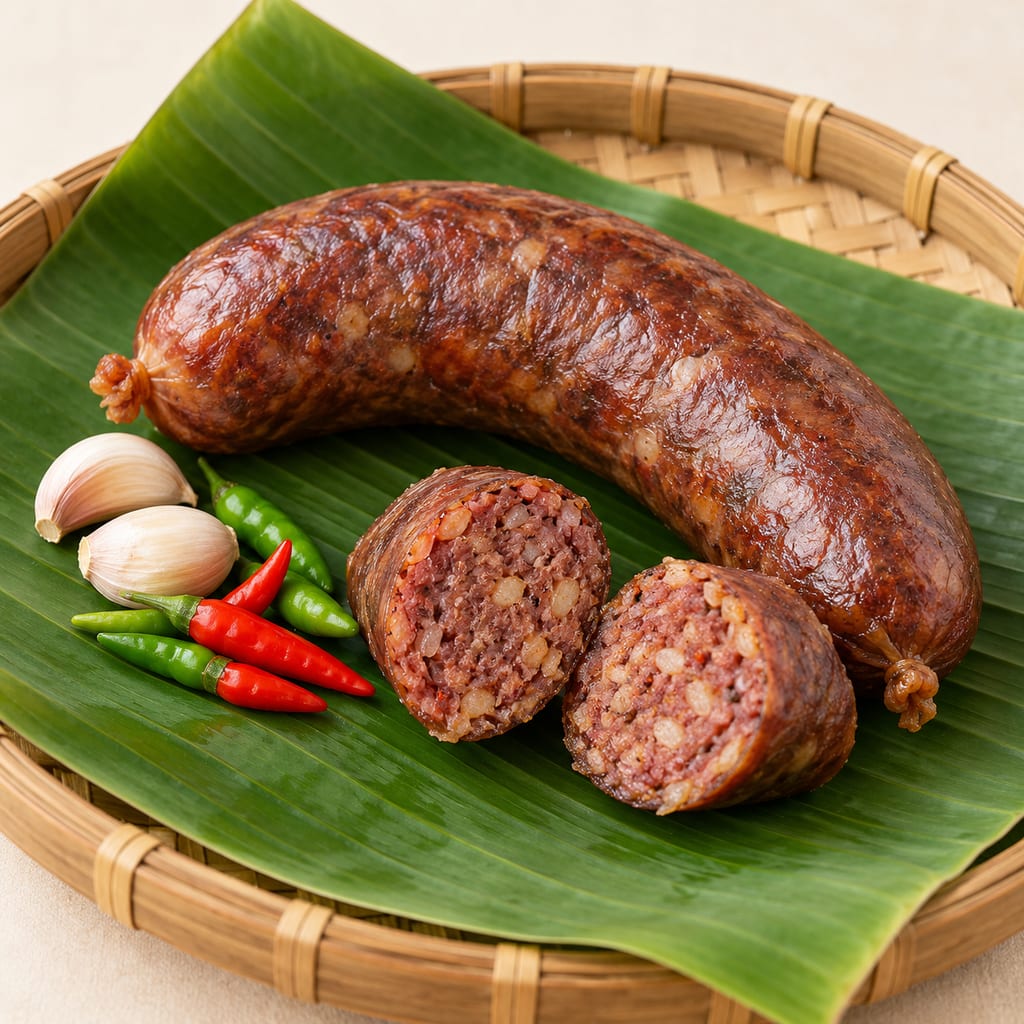
Mum is a Thai family of fermented meat preparations with distinct pork Mam-moo and beef Mam-neua forms. Sources document ingredients, casing and serving traditions, but not a validated home process.

Naem is a Thai sour pork preparation made with minced pork, rind or ear, glutinous rice, garlic and salt. Its documented room-temperature method has no validated food-safety endpoint.

Protected Italian vinegar made only from cooked grape must, fermented and aged in a battery of wooden barrels for at least 12 years: sweet, sharp and syrupy.

Airag is Mongolia’s fermented mare’s-milk drink, traditionally churned with saved starter in a reusable cowhide khokhuur.

Appam, or hoppers, are South Indian and Sri Lankan rice pancakes made from a fermented coconut-and-rice batter and cooked in a curved pan to a crisp lacy rim and a soft, spongy centre.

Auricularia tremellosa is a wood ear fungus of the genus that supplies most dried wood ear sold in China; its own food record is thin, and the culinary practice described here comes from the closely related wood ear species.

Ayran is Turkey’s cold, savoury yogurt drink: plain yogurt is loosened with water and lightly salted, then whisked smooth or aerated into a soft cap of foam.
A thin stone griddle used over an open hearth. Norwegian archaeology documents the established tradition from the early Middle Ages; a Viking-period origin is only a cautious suggestion linked to Shetland.

Crushed or milled barley cooked in water until the starch softens and the mixture thickens, the plainest way a northern household turned stored grain into a meal, here with apple and hazelnut.

Black carrot is the anthocyanin-pigmented Eastern carrot (Daucus carota var. atrorubens), the purple root that preceded orange types and still colours kanji and şalgam.
No community contributions have been published for this entry yet.
Sign in to contribute. Published comments and photos are free to read.
Meat ResearchMethod · History · Geography · Microbiology · Safety
渝东南地区土家特色酸鲊肉纯种发酵前期发酵条件优化 [Optimization of Early Pure-Culture Fermentation Conditions for Tujia Suān Zhǎ Ròu in Southeastern Chongqing]The article describes traditional Tujia suān zhǎ ròu in southeastern Chongqing as fresh pork belly mixed with rice flour, chilli and salt, placed in a jar and naturally fermented under anaerobic conditions.
The article defines zha broadly and notes regional and community differences in raw materials and process; it also discusses fermented fish under the same broad zha terminology.
Its historical introduction claims the Qimin yaoshu records the food more than 2,000 years ago; the text is sixth century and the specific continuity with modern Tujia suān zhǎ ròu is unproven.
The modern experiment studied pure-culture early fermentation with Lactiplantibacillus plantarum and optimized enzyme-activity responses; it was not presented here as a validated household process.
The authors warn traditional natural fermentation is variable and may involve biogenic amine and nitrite accumulation.
Cited in: A Tujia sour pork preparation; What the traditional description says; The modern experiment tested an early stage; A medieval pork-zha text, not a proven lineage; Geography, variation and safety
识典古籍 (Shidianguji)History · Ingredients · Method
猪肉鲊法 [Method for pork zha], Qimin yaoshuThe digitized text gives a pork-zha method using fatty pork cut into pieces, salt, cooked rice as the grain component, and says the food may be eaten when it has a sour aroma.
This passage is evidence for a historical pork-zha preparation; it does not identify the Tujia community or establish continuity with modern suān zhǎ ròu.
Cited in: A medieval pork-zha text, not a proven lineage
Cambridge University Press, The Cambridge History of China, Chapter 16History
AgricultureCambridge dates completion of the Qimin yaoshu to sometime between 533 and 544 CE.
The date applies to the text, not to the modern Tujia preparation or a claim of unbroken continuity.
Cited in: A medieval pork-zha text, not a proven lineage
World Health OrganizationSafety
Neglected tropical diseases: Taeniasis and cysticercosisWHO identifies undercooked pork containing Taenia solium cysticerci as a route to taeniasis.
This general pork-parasite guidance does not assess suān zhǎ ròu fermentation.
Cited in: Geography, variation and safety