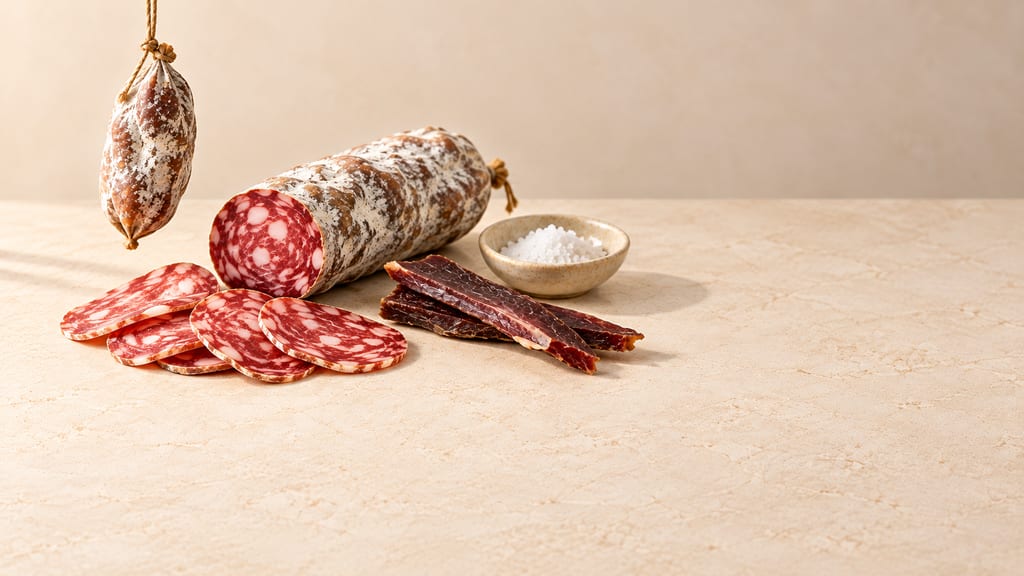
Fermented meat around the world
Dry salami, sour pork with rice, matured sheep and aged blubber follow different paths from animal to food. Their stories connect microbes with climate, slaughter, migration and the meals people share.
 FermenteaWhere food goes to change
Modern method
A 2023–2025 proof-of-concept made separate fermented extracts from beef heart and lung with Staphylococcus xylosus and protease. It reports supervised pilot findings, not a validated household method or a blended heart-and-lung formula.

The atlas row that led to this candidate named an experimental beef-offal sauce but provided no process detail. The source trail identifies Meat & Livestock Australia project P.PSH.1475, “Fermented meat sauce – A proof of concept using beef lung and heart.” MLA funded the work, which AgResearch Group carried out with a pilot plant in New Zealand. The project ran from August 2023 to November 2025; MLA published its project page in February 2026.
The title groups two prototype families. The report tested lung and heart separately and produced lung extracts and heart extracts, each in heated and unheated versions. It does not describe one sauce blended from both organs. The project asked whether a meat starter, Staphylococcus xylosus, together with protease could create flavour extracts from abattoir co-products. Its aim was a proof of concept for further product development, not a household recipe.
The researchers obtained cattle organs from a commercial supplier in Wellington with export certification. The report describes frozen storage, thawing, manual chopping, sterilised sea salt, protease and Staphylococcus xylosus. Three 5 kg batches were prepared for each tissue. The lung and heart treatments were separate. These are study inputs from a supervised facility; they should not be read as directions for home preparation.
The project fermented the lung and heart materials for different durations, separated liquid from solids, clarified the extracts and divided each into heated and unheated prototypes. The heated versions received retort-type treatment; the report notes that the pilot treatment was not under high pressure. Unheated bottles retained live starter culture. The project stored sealed bottles frozen. Its own risk-management plan and facility procedures formed part of the setup; reproducing selected ingredients or timings would not reproduce those safeguards.
The reported pH results differed between extracts. Lung liquid remained around 6.1 in the sampled weeks, while heart liquid moved from about 5.3 toward 4.9. The researchers proposed that heart's glycogen content could support greater starter growth, while lung offered less readily available carbon. These are observations and an explanation from this project, not general targets or safety thresholds.
The reported liquid yield was about 43% from lung and 51% from heart. The report discusses heart's higher protein content and lung's collagen as possible reasons for the difference. The lung prototypes contained about 10% protein and heart prototypes about 14%; final salt values ranged from about 16% to 18%. Those figures describe specific test batches and should not be treated as a formulation for other materials, equipment or scales.
The pilot team used inspected commercial raw material and a safety plan developed for the project. It considered sanitation, salt, measured acidification, heat treatment and storage together. The team tested prototype extracts for Salmonella, Staphylococcus aureus, Escherichia coli and Clostridium perfringens and reported that risky concentrations were not detected. That result applies to these tested samples and methods; it does not establish safety for other organs, starter cultures, settings or processes.
The report notes that the lung extract did not acidify to the cited pH 4.6 benchmark and that Staphylococcus xylosus was a weaker acidifier than some lactic-acid bacteria. The heart followed a different pH course. The study's combined safety plan, monitoring and pathogen tests cannot be replaced by a general salt percentage or fermentation time. Japan's health ministry separately warns that cattle organs can carry pathogens and that enterohemorrhagic E. coli has been found inside bovine liver.
Two researchers conducted a semi-formal in-house sensory evaluation. The prototypes were strongly salty and had pronounced liver or offal notes; some lung samples had an ammonia-like aroma. Heart extracts were described as meaty and roasted, while lung extracts showed fruity notes and subtle sweetness. Heating changed the aroma and taste profiles, especially for heart. Dilution reduced some intense salt and offal notes.
The researchers also tried prototypes in prepared soup. Concentrated additions overwhelmed the soup with salt, and the lung prototype integrated poorly in that particular test. This small in-house evaluation is not a consumer-preference study. The report calls for more product-development trials and market investigation, including possible future chef-led formulation work.
This account records New Zealand as the setting of a modern research project and the Australian meat industry's development context. It does not establish a New Zealand culinary tradition or a historical origin for fermented beef heart or lung. The project and atlas row provide no evidence of an earlier household sauce, consumer-ready formula or established serving custom.
This is a contemporary research project, not evidence of a historical or traditional beef-offal sauce. MLA funded the proof-of-concept; AgResearch tested Staphylococcus xylosus and protease in separate lung and heart extracts. The report calls for more product-development and market work.
Scaling: source batch only
The project used inspected commercial organs under a risk-management plan. Japan's health ministry notes that cattle organs can carry pathogens and that enterohemorrhagic E. coli has been detected inside cattle liver; project findings do not establish control for other sourcing or processes.
Hazard sourceSafety results belong to one supervised pilot with project-specific material sourcing, equipment, monitoring and laboratory tests; further product-development and market work remains.
Hazard sourceThis entry summarizes an industrial research proof-of-concept. Its salt level, fermentation periods, pH results, retort treatment and storage belong to the tested project and are not validated household limits. Negative pathogen tests apply only to its prototypes.
AgResearch and FoodPilot conducted the project in New Zealand with organs from a Wellington supplier. This is a research setting, not a local culinary tradition.
Dry salami, sour pork with rice, matured sheep and aged blubber follow different paths from animal to food. Their stories connect microbes with climate, slaughter, migration and the meals people share.
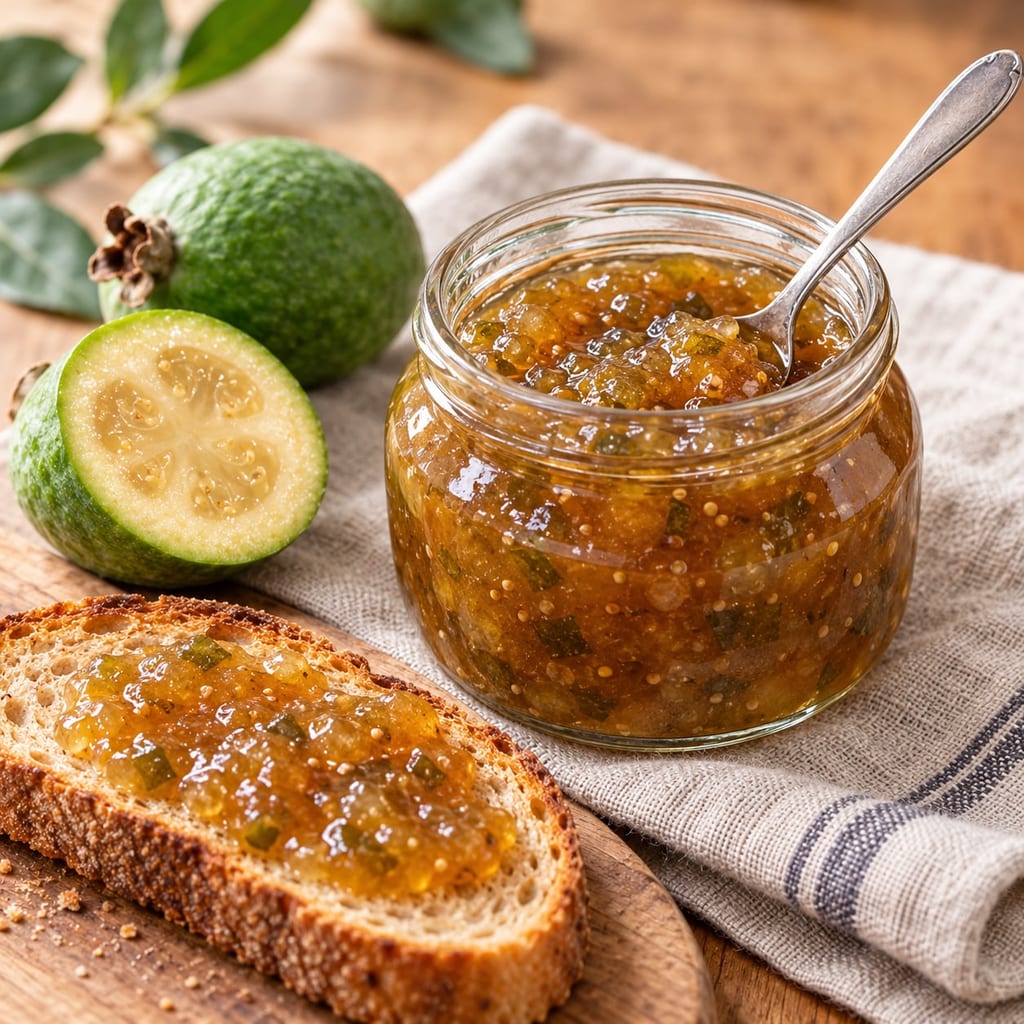
Blended whole feijoas simmer into a skin-on jam with lemon, sugar and vanilla. The skins remain for a more textured finish; keep this batch refrigerated or frozen because its method has no validated shelf-stable canning process.

A yeast-leavened Māori fried bread recipe shared by Aunty Gina Harding, with a 12–14 piece batch, two rises and a 165°C fry.

Christall Lowe's whānau takakau is an eight-piece wheat flatbread enriched with milk and oil or butter, rested briefly, then cooked one at a time in a skillet.
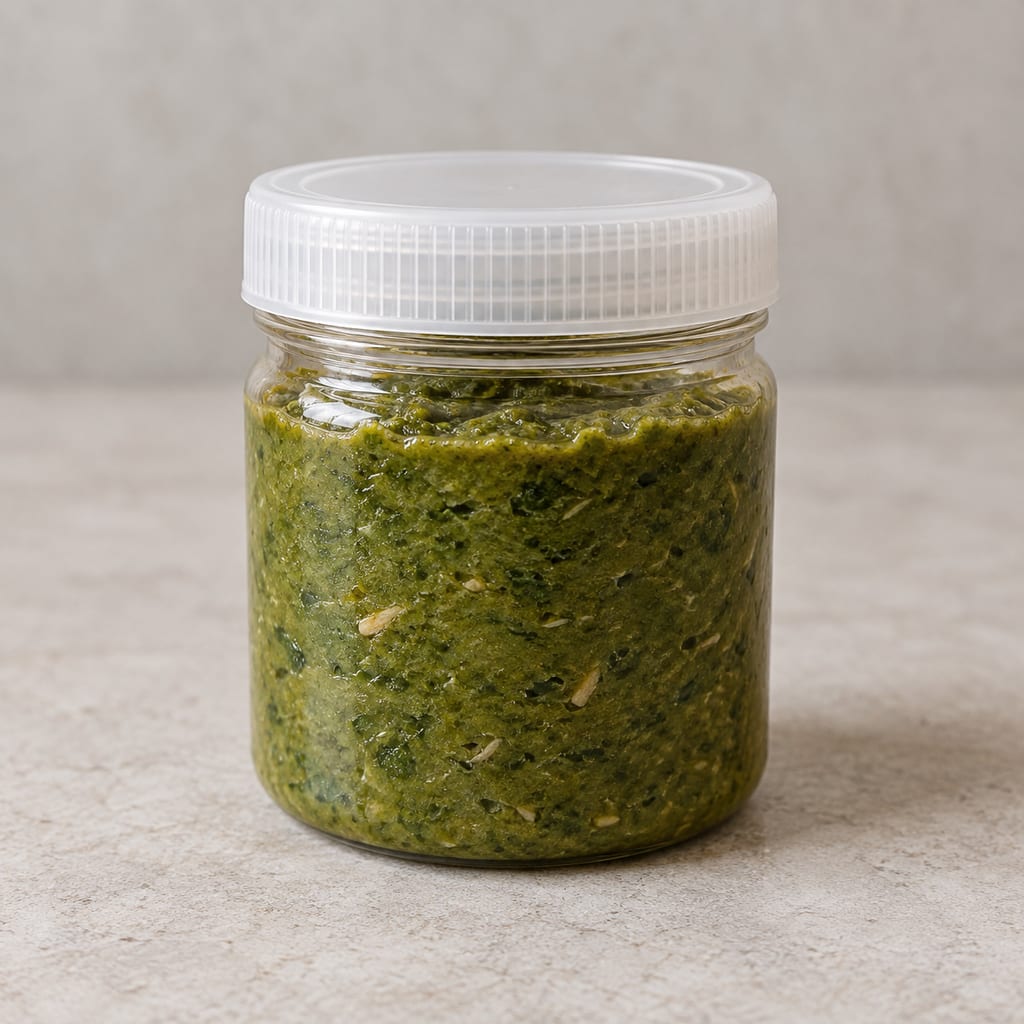
Dixon's 2007 thesis records ten toroi study batches, five with puha and five with watercress, each from 2 kg of shell-on green-lipped mussels and about 600 g of greens. Its method is a laboratory one.
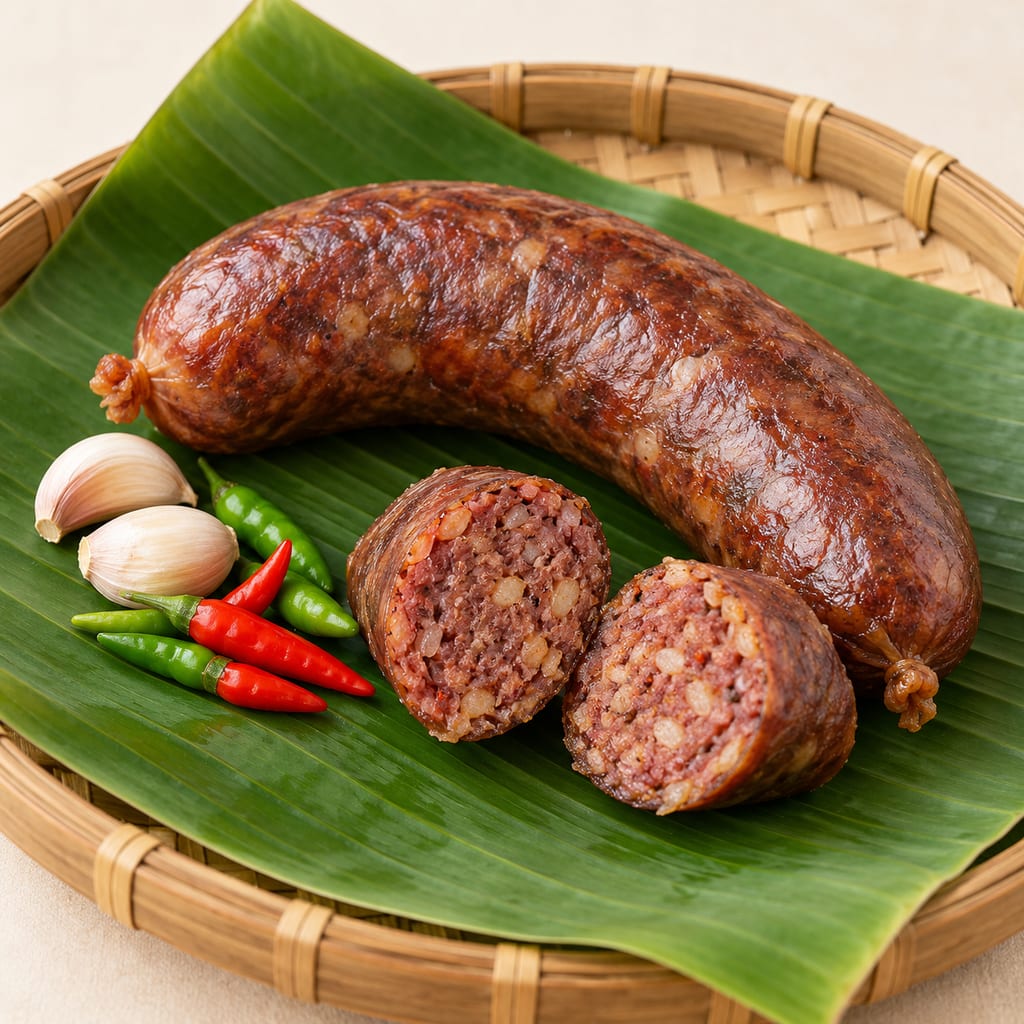
Mum is a Thai family of fermented meat preparations with distinct pork Mam-moo and beef Mam-neua forms. Sources document ingredients, casing and serving traditions, but not a validated home process.

Naem is a Thai sour pork preparation made with minced pork, rind or ear, glutinous rice, garlic and salt. Its documented room-temperature method has no validated food-safety endpoint.
A Tujia sour pork preparation documented in southeastern Chongqing. Its rice-flour pork method is distinct from the wider suān ròu forms; a sixth-century pork-zha text is an earlier attestation, not proof of direct continuity.

Soft, spreadable Calabrian pork sausage made with a great deal of red chilli and fatty pork, stuffed into natural casings, sometimes smoked and matured while staying soft.

A way to add independent temperature logging to an existing food dehydrator without changing its built-in controls or protections. It is a monitoring method, not a rewiring plan.

Pleurotus cystidiosus is the abalone mushroom, a cultivated oyster-type fungus with dark brown caps that grows more slowly and is more demanding than other Pleurotus species.

A dark, balanced vinegar from Emilia-Romagna made by combining cooked or concentrated grape must with wine vinegar, then acetifying and refining it in wood under a protected specification.

A living dairy inoculum that starts controlled cream fermentation, developing acidity and aroma before sour cream or cultured butter is finished.

A small electric incubator holds jars at a selected temperature for yogurt and other documented warm food preparations. Controls, capacity and vessel arrangement vary by model.

Adygean salt is a seasoned table salt associated with Adygea and the wider North Caucasian culinary tradition. Salt is blended with garlic and a variable selection of herbs and spices; the exact mix depends on the named style and maker.

The African Caesar-group mushroom, Amanita masasiensis, is a wild ectomycorrhizal species of central and southern African woodlands, eaten locally. The genus contains deadly poisonous species, so identification needs care.
No community contributions have been published for this entry yet.
Sign in to contribute. Published comments and photos are free to read.
Meat & Livestock Australia; AgResearch Group, New Zealand Institute for Bioeconomy ScienceResearch · Method · Microbiology · Safety · Sensory · Geography
Fermented meat sauce – A proof of concept using beef lung and heartDescribes separate beef-lung and beef-heart trials with salt, protease and Staphylococcus xylosus.
Pilot used three 5 kg batches per tissue, 20% w/w sterilised sea salt, about one month for lung and three months for heart; these are study conditions, not home directions.
Produced four prototypes, lung and heart extracts with heated and unheated variants; not one blended sauce.
Reports study-specific pH, yield, composition, sensory and microbial results and supervised safety controls.
Calls for further product-development trials and market investigation before consumer-ready products.
Cited in: A modern research prototype; Pilot setup and its limits; Different tissues, different measurements; Safety findings stay within the project; Early sensory results; Geography and historical scope
Meat & Livestock AustraliaResearch · Geography · History
P.PSH.1475 - Fermented meat sauce – A proof of concept using beef lung and heartGives project start/end dates, publication date, status and objectives.
Frames outputs as proof-of-concept prototypes for further discussion, product development and market work.
Cited in: A modern research prototype; Early sensory results; Geography and historical scope
Ministry of Health, Labour and Welfare, JapanSafety
お肉はよく焼いて食べよう (Cook meat thoroughly)States cattle slaughter and processing can contaminate meat and organs and reports enterohemorrhagic E. coli detected inside cattle liver.
This general safety advice does not assess the MLA project.
Cited in: Safety findings stay within the project
Food and Agriculture Organization of the United NationsHandling
Guidelines for slaughtering, meat cutting and further processingStates meat-processing raw materials must be fit for consumption and inspected organs should be moved promptly to a cooler.
Mentions beef lung in cooked sausage manufacture, not fermented sauce.