What the ingredient is
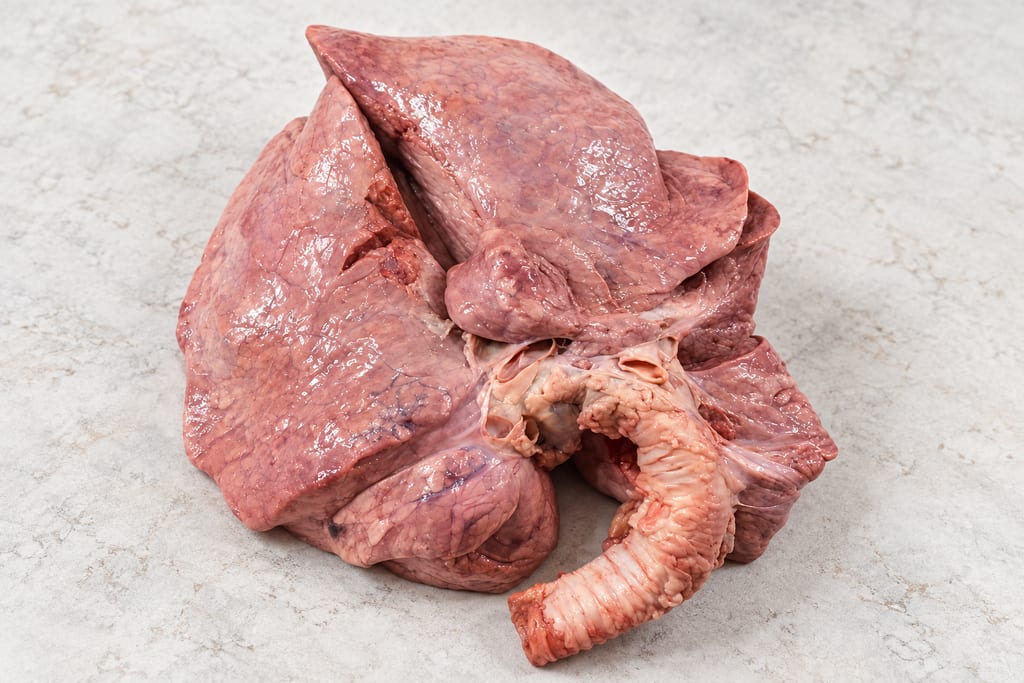
Beef lung is the respiratory organ of cattle, sold in places where regulations and slaughter inspection permit it for food. It is an offal ingredient rather than a skeletal-muscle cut. That distinction matters: lung has a different texture and processing behaviour from ordinary meat, and a mention of “lung” in a dish or technical paper should not be silently broadened to all animal species. “Ox lung” and “cow lung” are common English names for the same cattle organ; “bovine lung” is the more technical form. The Indonesian word *paru* means lung, while *paru sapi* makes the cattle source explicit.
The word *offal* groups organs and other non-carcass tissues whose food use differs by culture and jurisdiction. It does not mean that every organ is automatically fit for food. The Food and Agriculture Organization’s meat-processing guidance lists beef lungs among tissues that can be used in cooked sausages, while emphasizing local regulations and eating habits. Ontario’s meat-plant guidance illustrates why that qualification matters: it permits bovine lungs for human food only under specified inspection and dressing conditions and also limits their use in processed meat because of poor binding and water-holding properties. These are jurisdiction-specific rules, not a universal statement of legality.
Sources for this section
Regional uses and the limits of the record
Beef lung appears in several Indonesian culinary contexts documented by a 2023 review of offal dishes. The review describes *paru goreng*, fried lung associated with West Sumatra; *pecel tumpang* from East Java, served with lung jerky; and *sop saudara* from South Sulawesi, a soup that includes cattle lung among other offal. These examples show several distinct roles: lung may be fried as a featured component, dried and used as a topping, or combined with other organs in soup. They should not be collapsed into one “Indonesian beef-lung dish,” and they do not establish that all versions use identical cuts, seasonings, or preparation.
The review places these foods within a broad history of Indonesian offal cookery shaped by regional livestock, trading and cultural histories, religious practice, and economics. Its catalogue covers 139 dishes across 23 provinces, but lung appears less often than liver, intestine, and tripe. The authors count lung among organs used in more than ten dishes and identify cattle as the most frequently represented offal source across their dataset. This supports describing cattle lung as a recognized ingredient in Indonesian regional cooking; it does not establish a single origin or an uninterrupted ancient tradition for every named preparation.
The review is a literature synthesis that draws on books, journals, websites and online documents published from 1965 to 2023; it also reports small field observations and interviews with cooks, food entrepreneurs and gastronomy experts in Yogyakarta. Its map is a researched profile, not a census of every kitchen, and a dish’s listing does not mean that all local versions use identical organs or procedures.
A useful contrast appears in the review’s table for *rendang paru*: it records cattle and water buffalo as sources for the West Sumatran dish. That record documents a lung preparation, but it does not make every serving beef lung. Cattle-specific examples such as *paru goreng* and *sop saudara* are stronger matches for a beef-lung page; when a dish can use buffalo, that difference should remain visible.
The same review reports *sop saudara* as a South Sulawesi dish developed in the 1950s and says cattle lung is among its ingredients, alongside tendon, tripe, and intestine. Its name is interpreted as “brotherly soup,” associated by the authors with post-independence social ideals. This is a dated modern dish history reported by the review, not a date for the first consumption of lung. *Pecel tumpang* is described as an East Javanese salad with a lung-jerky topping. In that dish, lung contributes a prepared topping rather than defining the whole meal. Regional labels should follow these documented dishes rather than imply that beef lung itself belongs exclusively to one province.
The review's map is a researched profile assembled from books, journals, websites and online documents published from 1965 to 2023, with small field observations and interviews in Yogyakarta. It identifies 139 offal-based dishes across 23 provinces, but those counts describe the published record the authors assembled, not a census of current meals or a measure of how often each family cooks lung.
In that synthesis, cattle is the most frequently represented offal source, while lung appears less often than intestine, liver and tripe. The authors count lung in more than ten dishes and show it in more than one role: a featured fried preparation, a dried topping, or one part of a mixed-organ soup. That variety makes it useful to follow the dish and place named by a source rather than treating “Indonesian beef lung” as one formula.
Sources for this section
Texture, handling, and culinary roles
Lung’s porous, delicate tissue behaves differently from dense muscle. Technical food-processing sources discuss it mainly as a material for cooked sausage or as an experimental extract, not as a direct substitute for steak or ground beef. FAO guidance notes that beef lung can be used in cooked sausages. Ontario’s inspection guidance gives a contrasting processing constraint: because lung binds and holds water poorly, its addition to some processed meats is restricted under that jurisdiction’s rules. These sources describe different regulatory and product contexts; neither supports a universal formula or substitution ratio.
Regional cooking traditions also use texture in different ways. Fried *paru goreng* is served as a distinct fried preparation; lung jerky in *pecel tumpang* is a dried topping; and *sop saudara* uses lung among several simmered offals. Those names are useful for showing culinary range, but a catalogue entry for the ingredient should not turn them into instructions or suggest that one method can be transferred to another product.
For raw handling, use lung only from an inspected source where the local rules allow it for human consumption. Slaughter and inspection controls matter because contamination can occur during dressing; Ontario’s guidance specifically calls out contamination from scald water or ingesta and requires prompt chilling after harvesting and preparation. FAO’s general guidance likewise says that organs intended for processing must be fit for human consumption and moved to a cooler after inspection and dressing. These are professional-chain controls, not proof that rinsing or home trimming can make an uninspected organ safe. Keep the content clear that raw lung is perishable and that neither appearance, odor, taste, nor fermentation activity demonstrates safety. The available sources do not justify a universal household storage time or a safe fermentation parameter set.
The same legal category can have different culinary and regulatory boundaries from one place to another. Ontario’s meat-plant guidance is a clear example: its inspection and dressing rules describe when bovine lungs may enter human food and restrict their use in certain processed products because of functional limitations. A reader elsewhere should follow the rules and inspection system in their own jurisdiction rather than importing Ontario’s allowance or restriction.
A technical description is not a kitchen instruction. FAO and Ontario sources address industrial processing, inspection and product rules; they do not give one household preparation for all markets. Their different purposes explain why one source can list lung as an ingredient while another limits it in a particular processed product. Readers should not turn either statement into a claim that lung is always allowed, always excluded or interchangeable with muscle meat.
Sources for this section
Modern fermentation research
The atlas’s R43 record points to a 2025 Meat & Livestock Australia project, *Fermented meat sauce — A proof of concept using beef lung and heart*, carried out with AgResearch in New Zealand. The project tested whether *Staphylococcus xylosus*, a commercial starter used in meat products, could support development of sauces from beef offal. The report treated lung and heart as separate raw materials, compared process and heat-treatment conditions, and evaluated the extracts for yield, composition, fermentation performance, microbiology, and sensory properties.
The public report separates beef lung from beef heart in its design and results. It treats lung as one raw material in a controlled product-development study, then evaluates the resulting liquid extracts as potential flavour ingredients. That makes the work relevant to the possible uses of the organ, but it does not show that lung is a fermenting culture or that a finished household dish called beef-lung sauce has become established.
The researchers reported that their experimental lung extracts developed a fruity aroma with subtle sweetness at preferred dilutions, while all extracts also retained strong offal, ammonia, and salty notes that may challenge consumers. The report stresses that these were proof-of-concept results and calls for further product development, chef-led formulation, and market work before consumer-ready products are established. The study therefore documents a modern research use for beef lung as a fermentation substrate; it does not establish a traditional sauce, a commercial product, or a home-fermentation method.
Although the project report describes its tested extracts as meeting its own microbiological and technical targets, those findings apply only to the project’s materials and controlled conditions. Do not copy its salt levels, processing times, pH readings, heat treatment, or other process details into a generic recipe. Do not imply that the project validates an untested batch or that smell, taste, visible change, or a single measurement is proof of safety. The atlas entry should say directly that no consumer-ready procedure or generally applicable safety schedule is supplied here.
The investigators describe the project as a proof of concept and identify further formulation and market work as next steps. That distinction matters in a food catalogue: an experimental substrate demonstrates a research question, not an accepted everyday use. Any process figures reported by the team belong to that complete controlled setup and are not a reusable instruction for another supplier, species, batch or kitchen.
The report also distinguishes its analytical work from a finished condiment. The team made liquid extracts from separately prepared lung and heart mixtures, separated liquid from solids, and compared heated and unheated bottled extracts. It assessed microbial growth and proteolysis as well as yield, chemical composition and sensory response. Those stages belong to the pilot's specific experiment; they do not provide a consumer-ready sequence or a way to infer safety from a successful laboratory result.
The raw materials mattered to the outcome. The report describes lung extract as having a fruity aroma and subtle sweetness at preferred dilutions, while the overall extracts also retained strong offal, ammonia and salt notes that may put off some consumers. It reports those observations as an in-house sensory result, not a general preference study. A future chef-led formulation or market test could produce a different product, and the project itself says more development is needed.
Sources for this section
Geography and what remains unknown
The strongest culinary geography in this account comes from named Indonesian dishes: West Sumatra for *paru goreng*, East Java for *pecel tumpang* with lung jerky, and South Sulawesi for *sop saudara*. Those associations describe dishes, not exclusive territories for the ingredient. The contemporary fermentation research belongs to a New Zealand product-development setting, with a national red-meat industry context. It should be mapped as a research association only if the content schema supports that distinction; it should not be presented as a historical origin.
The available evidence does not date when cattle lung first entered human diets, identify a single birthplace for eating it, or show that lung fermentation is an old practice. It also does not resolve how legal treatment differs in every country. Preserve those gaps rather than replacing them with a speculative global history.
New Zealand belongs in this record only as a contemporary research setting. AgResearch worked with the Australian red-meat industry's Meat & Livestock Australia on the proof of concept. That partnership is evidence of modern product-development interest in offal; it is not evidence that beef-lung fermentation is a New Zealand custom or that the tested sauce belongs to a local cuisine.
Sources for this section
Places
West Sumatra
Documented use · Region evidenceThe review lists cattle lung in paru goreng and other lung dishes associated with West Sumatra; this is a regional use, not an ingredient birthplace.
East Java
Documented use · Region evidenceThe review documents pecel tumpang with lung jerky; some table entries allow cattle or water buffalo, so species is not inferred when unstated.
South Sulawesi
Documented use · Region evidenceThe review describes cattle lung among the offal in sop saudara; this is a documented dish association, not a date for lung consumption.
New Zealand
Documented use · Country evidenceModern beef-offal sauce research involved AgResearch; this research setting is not a culinary tradition.
Unknown
Relationship not established · Place not establishedThe reviewed sources document regional dishes and modern research but do not identify first use or a single birthplace.