
Casings intake
Natural casings: the animal envelopes of sausages, puddings and cheeses
Gut, stomach, bladder, caul and skin have held food for as long as recipes have been written down. Which part of the animal a cook chose still decides a food's shape, how it dries and smokes, and how it is eaten.
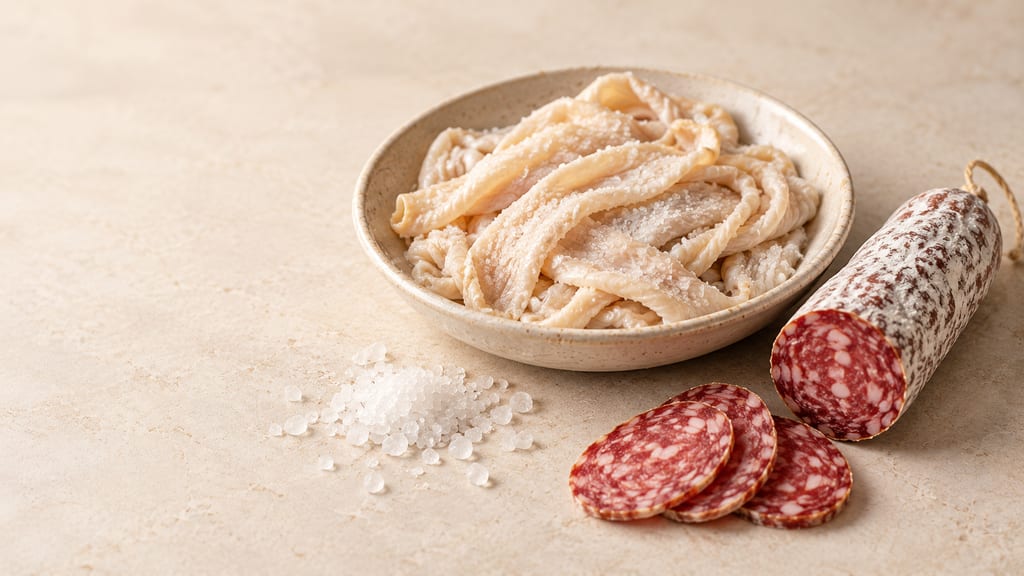
Salted hog casings and a salami in its natural casing: the animal envelope that shapes a sausage.
A food that is also a container
A sausage is two things at once: a filling and the thing that holds it. The holder is easy to overlook because it is usually eaten without a second thought, but someone chose it. A fine sheep gut makes a short, tight grilling sausage. A pig's blind gut makes a heavy, rounded salami that hangs for months. A sheep's stomach makes a pudding to boil whole. A sheepskin bag holds cheese for the two months it ripens.
Sausage makers describe casings as the forms and containers of their products. A casing binds the filling and protects it, and it lets the sausage shrink and swell as it cooks or dries. That plain job covers a wide range of foods. Some envelopes are long tubes, tied off into links. Some are pouches with a closed end of their own: a stomach, a bladder, or the blind gut of the large intestine. Some are sheets, like the lacy membrane of fat called caul, folded around a parcel of meat. Some are skins sewn into bags. And some are not part of the food at all: a cowhide in which mare's milk ferments, a seal stomach packed with berries and oil, a bison-hide bag of pemmican.
These uses overlap, and none of them is the same thing as preservation. A stomach holds an oatmeal-and-offal pudding together while it boils; it does not make that wet mixture keep. A salami's casing is one part of a process that also depends on salt, fermentation, smoke and time in the drying room. Even in a fresh sausage the envelope changes what happens inside. Pushing minced meat into a casing forces the particles together and leaves little air in the middle, which slows the bacteria that need oxygen, while spoilage carries on just under the skin, where some air remains. Within a day, the surface beneath the casing of a fresh boerewors can turn brown-grey as the meat's red pigment is cut off from the air.
This account follows the envelope rather than the filling: what it is made of, where it appears in the written record, what it does to the food, and how different places used different parts of the animal for different work. What stands out is variety. People have used a gut as a tube, a blind gut as a closed pouch, a stomach as a cooking bag, a bladder as a wrapper for a whole muscle, caul as a net of fat, skin as a sewn container and hide as reusable kitchen equipment. Regional identity often survives in exactly which part was chosen and what it was asked to do.
What a natural casing is made of
Natural casings come almost entirely from the digestive tract of pigs and ruminants, and each animal supplies several kinds. A pig gives its stomach; its small intestine, which the trade calls smalls or rounds; its large intestine, sold as caps and middles; the straight final stretch of the large intestine, called the bung; and its bladder. Cattle give the oesophagus, sold as weasands; the small intestine, called rounds or runners; the caecum, which for cattle is the bung; the large intestine, sold as middles; and the urinary bladder. Of the sheep, only the small intestine normally becomes a sausage casing, used for fresh frying sausages, frankfurters, wieners and chipolatas. The sheep's fore-stomachs go to haggis and similar puddings.
Cleaning changes the tissue. The wall of the gut has four layers: the mucosa that lines the inside, the submucosa, which is rich in collagen fibres, two layers of muscle, and an outer serosa. Pig small intestine prepared as casing is stripped until only the submucosa is left, a thin tube of collagen-rich tissue. A pig's large intestine is treated differently: the mucosa and serosa come off, but the submucosa and both muscle layers stay. "Natural casing" therefore does not mean an untouched gut, and it does not mean one uniform membrane either. A pork round and a pig middle are different materials before anyone fills them.
Diameter matters as much as species. Casings are graded by width, and the range is wide. Chinese-style dried sausages go into narrow pig or sheep casings of 18 to 24 mm. In one published drying study, cured beef for bresaola went into beef bung casings of 115 to 130 mm. The protected description of the Nürnberger bratwurst asks for a grilling sausage only 7 to 9 cm long in a tight sheep casing, weighing about 20 to 25 g raw. Each of those sizes implies a different speed of heating and drying, which is why size belongs in any description of a sausage.
Casings can also be built. Sewn beef middles are made by sewing two or more pieces of middle together, and other sewn casings join beef middles to small pig bungs. A large salami in a sewn casing may come from several organs rather than one.
The trade names need care. Among pig casings, the bung is the terminal straight end of the large intestine; among cattle casings, the same word means the caecum. A catalogue line that says only "bung" or "cap" has not said which organ it means, or from which animal. Everyday words such as paunch, maw, tripe and bag are looser still. They describe a rough shape, not a piece of anatomy, and the safest way to record them is to keep the original word and add the organ beside it when it is known.
Pouches, bladders, caul and skin
Not every envelope is a tube. The caecum, or blind gut, is a pouch of the intestine closed at one end. A sausage stuffed into it needs only one tie, and it takes the gut's own rounded, irregular shape. Roman writers noticed the difference. Varro, explaining Latin food words, derived the name fundolus from fundus, "bottom", because unlike other guts it is open on one side only.
Some of Europe's heaviest sausages are made in it. Slavonski kulen, from the Slavonia region of Croatia, fills a pig's caecum with lean pork seasoned with salt, sweet and hot paprika and garlic. Baranjski kulen, from Baranja, goes into the same organ, which local makers call the katica. Lithuanian skilandis may be made in a cow's caecum, and then it is tied crosswise every 4 to 5 cm as well as along its length.
The stomach is the largest pouch of all. Pfälzer Saumagen, from the German Palatinate, is a cleaned pig's stomach filled with potatoes and pork belly seasoned with salt, pepper, marjoram and nutmeg, then cooked in hot water that is kept below the boil. A handwritten recipe survives from 1865, and the dish probably began in the western part of the region. When a pig's stomach is to be used as a casing, it is cleaned through a single small opening so that it stays whole. Ruminant stomachs are divided into compartments. In the north-east of Brazil, buchada is made from the offal of goats and sheep, chopped, seasoned and cooked inside bags called buchos. These are made from the rumen and reticulum, and in industrial processing from the omasum as well; once filled, they are closed with a needle and kitchen thread or tied with a strip of the animal's own gut. Here "stomach casing" means several prepared compartments, not one uniform bag.
Another compartment, the abomasum, can do more than hold. In Sardinia, caggiu de crabittu starts with a kid that has drunk nothing but its mother's milk and is allowed to suckle just before slaughter, so that the abomasum is full. The stomach is emptied straight away, the milk is filtered and returned, and the stomach is tied, dried in an airy room and smoked over a fire for 15 to 20 days. The milk inside becomes a semi-solid, sharply acidic and pungent cream, weighing 250 to 700 g in all, which the regional description credits to the lactic organisms already present in the stomach. The envelope takes part in making the food.
The urinary bladder is a rounded, stretchy pouch with a narrow neck. Pig bladders are emptied, trimmed of fat, turned inside out and soaked in ice water or brine before use. Ventricina from the Vasto area of Italy is pork cut by hand into pieces two or three centimetres across, seasoned with equal weights of salt and sweet pepper powder and sometimes wild fennel, then pushed into a pig's bladder and matured for 120 days. Culatello di Zibello shows a bladder holding a whole muscle instead of a mince. The salted muscle is wrapped in a pig's bladder, or in the pig's peritoneum, and bound with string in a spiral net crossed by vertical turns. The binding is pulled tight so that no air pockets remain. As the meat loses weight during curing, the net gradually loosens.
Caul is a wrapper rather than a container: a thin, lacy sheet of fat. The Roman recipes collected under the name of Apicius wrap forcemeat in caul and fry it, or wrap morsels in caul and laurel leaves and hang them in smoke. In Cyprus, sheftalies are small parcels of minced meat wrapped in pork or lamb caul and grilled over charcoal, turned until cooked on every side; the net holds each parcel together without any tube at all.
Skin makes the most individual casings. Zampone Modena is stuffed into the skin of the pig's front leg, so the finished sausage keeps the shape of a trotter. Its filling of pork and rind is close to that of cotechino Modena, which goes into an ordinary casing, natural or artificial. In the Ashkenazi kitchen of eastern Europe, sheika or helzel was traditionally made in the skin of a chicken's neck, filled with flour, onions and chicken fat and simmered; one cook today sews the skin of a whole chicken into a bag instead. In Mortara, a goose salami introduced by the town's Jewish communities is made with the goose's own neck skin, stitched by hand around chopped lean goose.
What the oldest texts show
No one knows who first stuffed a gut, or where. An animal's organs offer a ready-made, flexible container on the day of slaughter, so early use is easy to imagine. But organic envelopes rarely survive, and a text that names a sausage often says nothing about what held it. The written record gives anchors, not a birth date, and each anchor answers a narrower question than the one people usually ask of it.
In Book 18 of the Odyssey, the suitors in Odysseus' hall set up a fistfight between two beggars, one of them the disguised Odysseus. The prize lies by the fire: goats' paunches, filled with fat and blood and set there for supper. The winner may choose whichever he likes and will eat with the suitors from then on. A stomach used as a cooking bag for blood and fat was familiar enough to serve as a prize in an epic. The scene gives no date of invention and says nothing about narrow sausages.
In Rome, Varro's notes on Latin vocabulary show that the shape of the gut already mattered to how foods were named. He records that the stuffed gut called lucanica took its name because soldiers learned it from the Lucanians, and he sets the fundolus apart because it is closed at one end. The cookery collection known under the name of Apicius goes further and gives recipes. Its sausage chapter pounds fresh pork with pepper, cumin, savory, rue and parsley, fills the casings, and hangs the Lucanian sausage up to smoke. Other sausages mix cooked spelt with chopped pork. Forcemeats and liver are wrapped in caul. The collection carries the name of a famous gourmet of the early first century, Marcus Gavius Apicius, but the recipes were compiled late in the fourth or early in the fifth century, so its contents cannot all be dated to his lifetime.
In northern China, the Qimin Yaoshu, a manual of farming and food compiled by Jia Sixie under the Northern Wei, gives two gut recipes in detail. In the first, a sheep's coiled intestine is washed clean and filled with finely chopped mutton seasoned with scallion, salt, the liquid from fermented soybeans, ginger and pepper; two lengths are clamped together and roasted, then sliced to eat. The second is a blood sausage. Five measures of sheep's blood are mixed with chopped sheep fat, ginger, orange peel, pepper, a clear bean-paste liquid, fermented-soybean liquid and a paste of flour and rice. The large intestine is opened out, washed, and rinsed through with wine, then filled, folded into lengths of five cun, and boiled until no blood seeps out. It is cut into pieces an inch long and eaten with vinegar and sauce. Blood, fat and grain in a gut, cooked until set, is the principle behind many later blood puddings. The resemblance shows a shared logic, not a shared origin.
In 1253–1255, the Franciscan friar William of Rubruck travelled to the Mongols as envoy of King Louis IX of France and wrote down what they ate. They made sausages from horse intestines, he reported, better than pork ones, and ate them fresh. They boiled cow's-milk butter down until it was perfectly dry and stored it in sheep's paunches kept for that purpose. Milk was poured into a big skin, and a skin of milk stood on a bench at the entrance with cups beside it. In a single medieval account, gut, stomach and hide appear doing three different jobs.
Haggis, read carefully
Haggis is the best-known stuffed stomach in English, and its history shows why a name and a casing have to be read separately. In Scots usage, a haggis is the pluck of a sheep, its heart, lungs and liver, minced with suet, oatmeal, onion and seasoning and boiled in the sheep's maw or stomach. The word is recorded in Scotland from about 1500, and in Middle English, as hagese and similar spellings, from about 1420. The dish is now thought of as Scottish, but it was also popular in England until the beginning of the eighteenth century and is still made in northern England with some variation. Modern haggis is often made in beef caps or bungs or in manufactured casings, and its traditional envelope was a cooking container, not a guarantee of long keeping.
An early English recipe under that name, in a verse cookery book dated to about 1420–1440, calls for a sheep's heart and kidney, boiled and chopped fine with parsley. As the verse survives, it does not say what the mixture went into. In the same book, a forcemeat of pork with eggs, pepper and cinnamon is closed "in chapon necke", a capon's neck, "or elles in paunche of grys", a pig's paunch, then roasted and coated in batter. The cook was offered a choice of envelope.
Today the sheep's fore-stomachs are still listed among the materials used for haggis. But three questions stay separate: when a word was first written down, when the first surviving recipe was copied, and when people first boiled chopped offal in a stomach. The record answers the first two only in part and the third not at all. Similarity does not settle it either. Haggis, the Brazilian buchada and stuffed stomachs elsewhere show that the same kind of organ is useful in many places. They do not show that one recipe descended from another.
Shape, drying and smoke: what the envelope does
A casing's diameter decides how heat and water move through a sausage. In fermented and dried sausages, diameter is a critical process parameter because it governs heat transfer: in a fatter sausage, the core takes longer to reach the intended temperature and acidity, and fewer bacteria may be killed than in the thinner sausage a process was tested on. Drying works the other way round. A thin sausage dries faster, and that shorter drying time may not reduce bacteria as far as the longer drying of a fat one, even when both end at the same water activity. Neither the recipe nor the final dryness alone shows that two processes are equivalent, and a larger sausage cannot simply borrow a smaller one's schedule.
The casing material matters too, though less simply than its reputation suggests. Impermeable, semi-permeable and permeable casings exchange moisture with the air differently, which can change how quickly a sausage acidifies, how heat gets into it and how hot its centre becomes; the size of the casing's pores affects the rate of drying. Yet studies of pork salami fermented and dried in natural, collagen or fibrous casings found no difference in how far bacteria were reduced. "Natural" describes where the casing came from. On its own it promises nothing about safety.
Regional rules make the link between envelope and time visible. Salame di Varzi may be made only in natural casings: plain pig casing, the pig's rectum, which makers call the budello gentile, or a doubled pig casing sewn together, the cucito doppio. Small salami under 500 g may also go into curved beef gut. The names of the formats follow the envelope, from the small torto to the large sewn cucito of 1 to 2 kg and more. A 1989 Italian law protecting the name set minimum curing times that rose with size and casing: 45 days for a filzetta of 0.5 to 0.7 kg, 60 days for a filzettone, 120 days for a sottocrespone of 1 to 2 kg in a single casing, and 180 days for the cucito in its double one. Those articles were later repealed, but the scale shows the reasoning: a thicker, doubled wall and a bigger mass need longer.
A lean, heavy sausage in a broad gut is the hardest of all to dry. Slavonski kulen is mostly meat, with no more than 10 per cent fat, which its makers value and which, they say, makes it difficult to dry properly. The caecum it fills has a relatively large cross-section, so tying, smoking, drying and maturing all demand particular skill. The stuffed gut is fermented, cold-smoked over hornbeam, beech or ash, dried and matured, and the whole process takes at least 150 days. Production runs from 1 November to 31 March, in the cold months of a continental climate, a timing that comes from the traditional winter pig-killing.
Skilandis shows the casing's work during drying in detail. Chopped pork and minced beef are stuffed into a pig's bladder or a cow's caecum, wider than the casings used for ordinary cold-smoked sausages. The filling has to be packed so tightly that no gap opens between meat and casing as the filling shrinks during smoking and drying, and any air that slips in is squeezed out by hand. The sausage, at least 80 mm across and shaped like a flattened teardrop, matures in the cold for at least three days while the filling compacts and its colour settles. It is then smoked over deciduous wood in bursts for 2 to 15 days and dried for at least 30. The inside dries slowly and ferments intensively. Micro-organisms and the meat's own enzymes keep working through the drying, and they give skilandis its sour, spicy, salty taste.
At the other extreme, Chinese-style dried sausage, sweetened and seasoned with sugar and soy sauce at unusually high levels, goes into narrow casings of 18 to 24 mm and is dried at 48 to 50 °C for 72 hours. A narrow casing and warm, fast drying on one side; a broad blind gut and months of cold on the other. The filling recipe is only half of each food. The envelope sets the pace of everything that happens to it.
The animal outside is not the animal inside
The species of the casing often differs from the species of the filling, and descriptions that record only one of them mislead. A Nürnberger bratwurst is pork in a sheep casing. A Swiss cervelas from one large producer lists pork and beef in its filling and cattle intestine as its casing. Boerewors, South Africa's coiled fresh sausage, is a mixture of beef and pork stuffed into cleaned pork, beef or sheep intestine. South African law requires raw boerewors to be held in an edible casing and allows offal in it only as that casing.
This matters most to people who avoid certain animals. A sausage's name and its main meat do not settle whether it suits a particular diet; the casing counts too. The goose salami of Mortara was known as a "peace salami" because it contained no pork and could be eaten by people of several faiths, and its casing is goose skin. Among the Muslim Chăm community of An Giang in Vietnam, tung lò mò is beef in beef intestines. Kishke, the stuffed gut of Ashkenazi cooking, was traditionally a length of intestine filled with leftovers bound with matzo meal or flour and cooked in cholent, an overnight stew. It is now usually made without meat, but its name, the Slavic word for intestines, records what once held it.
Using the whole animal is part of this history, and it does not explain all of it. A Tibetan family that wasted nothing of a yak still gave each length of gut its own filling, and the makers of sobrassada or Salame di Varzi chose a particular organ for a particular form. The choice of envelope is a craft decision as much as a thrifty one.
Europe: foods named by their gut
On Mallorca and Menorca, sobrassada is pork lean and fat seasoned with salt, pepper and paprika, which gives it its red colour. The same paste takes different shapes depending on which part of the gut holds it, and each shape has its own name: longaniza, bisbe in the stomach, pultrú in the caecum, bufeta in the urinary bladder and culana among them. Menorcan producers and Mallorcan documentation use closely related names. Reading the name tells you the envelope, and with it the size and shape of the sausage. The protected Sobrasada de Mallorca covers two kinds, one from white pigs and one from the islands' own native breed.
In Italy, the regional salami and cured meats already described show the same habit of naming by envelope: Varzi's gentile and cucito, culatello's bladder, zampone's trotter skin. Ciauscolo, from parts of the provinces of Ancona, Macerata and Ascoli Piceno, is a soft, cylindrical salami that spreads easily on bread, stuffed into natural pig or beef intestine and tied at both ends with hemp string, and sold at between 400 g and 2.5 kg.
In northern Europe, blood and grain filled the gut, and cloth sat beside it. Swedish blood sausage mixed blood with rye or barley meal, flour, grated potato or groats, and the batter rested overnight before it was stuffed into coarse casings or the rumen. In Skåne, blood sausage is still often sweetened with syrup, raisins and pieces of apple. Folk-memory records from across Sweden describe a stuffing funnel cut from a piece of cow's horn, sausage skins sewn from cloth in Jämtland, a sheep's stomach used in place of gut in Norrbotten, and in Dalsland every intestine of cattle and sheep emptied, scraped and washed for use. In Norway, blodpølse is still filled into pig intestines or cloth bags and simmered for about an hour, while the related blodpudding is baked in a dish in the oven.
In Iceland, slátur means two foods: blood sausage made from sheep's blood and liver sausage made from minced sheep's liver, both mixed with grain and fat and stuffed into prepared sheep stomachs. Autumn is the season of slaughter, and families and groups still gather to make slátur together, in towns as well as the country. The old way of keeping it was to pickle it. Cooking the puddings and pickling them are two separate operations, and only the second was meant to make them last.
Lithuanian skilandis shows a casing changing within a living tradition. Its protected specification records that it was once made in a pig's stomach and that, since the early twentieth century, pig bladders or cow caecums have been used instead; a Lithuanian encyclopaedia of 1983 still listed stomach, bladder, cow's rectum or caecum. Simonas Daukantas, writing in 1845, described skilandis as food offered to guests, and it is still served thinly sliced with brown bread at festivals and in the busy weeks of the farming year. A protected specification documents the present product and the history submitted for it. It is good evidence for the change of casing it describes and weaker evidence for every household before it.
Asia: horse gut, yak rumen, squid and swim bladder
The food traditions of Inner Asia use several envelopes for several tasks, and a single label such as "nomadic casings" hides that. In Mongolia today, airag, fermented mare's milk, is still made in a khokhuur, a vessel of cowhide. The milk is churned inside it more than 500 times, and some of the previous batch is left in the hide as a starter to help the next one ferment. The technique and its customs were inscribed on UNESCO's Representative List of the Intangible Cultural Heritage of Humanity in 2019. Here the hide is reusable equipment, and it carries the starter from one batch to the next.
On the Tibetan plateau, a nomad family from Kham, in what is now Dzathog county of Yushu prefecture, divided the intestines of a yak or sheep among different fillings. One kind of gut sausage took blood, meat and some fat; another flour, usually barley or wheat; another liver with salt, spices, a little flour and fat but no blood; another fat alone; another meat with tsampa and fat. For winter, the finished sausages were placed inside spare yak or sheep stomachs, sewn shut and left out overnight to freeze, a casing inside a larger storage envelope, piled up to last through the winter. Nothing of the animal was wasted, but each part still had its own assignment.
In Lachung in North Sikkim, khyopeh is made by mixing chopped yak meat and innards with salt and stuffing the mixture into the yak's own rumen. The tied rumen is hung on bamboo strips above an earthen oven to ferment naturally for four to six months. A microbiological study of khyopeh identified the bacteria living in it and found no enterotoxins in the samples tested. That is a description of particular samples from one place, not a method anyone could safely repeat from a page.
China's written record of gut sausages reaches back to the Qimin Yaoshu recipes for mutton in sheep's intestine and blood in the large intestine. Modern Chinese-style dried sausage, smoked, sweet, strongly flavoured and studded with small cubes of fat, is a different product with a different process.
Korea shows how wide one food word can be. Sundae today usually means pig intestines stuffed with pork blood, glass noodles, mung bean sprouts, kimchi cabbage and sweet rice, steamed or boiled, then sliced thinly and dipped in salt mixed with red chilli powder and black pepper. In Sokcho's Abai Village, founded by refugees from North Korea during the Korean War, abai sundae fills the larger pork intestine with blood and sweet rice in the style of Hamgyeong province. Pisundae, mainly eaten in Jeonju and Suncheon, packs chunks of blood inside chewy pork intestine. Older Korean cookbooks go further. Gyuhap Chongseo describes cow intestine stuffed, tied at both ends with thread and steamed; Siuijeonseo gives eogyo-sundae, in which the filling goes into the swim bladder of a croaker and is boiled, alongside a pig-intestine version filled with pig's blood, mung bean sprouts, water dropwort, radish, tofu and kimchi. In Hamgyeong, where pollock were plentiful, a pollock was salted overnight, its innards drawn out through the mouth, its belly packed with filling and its mouth sewn shut; it was frozen and steamed a portion at a time. In Sokcho, squid is stuffed with beef and vegetables as ojingeo sundae. A blood sausage in pig gut, a stuffed fish bladder, a whole fish and a squid all share one name, and each uses a different anatomical structure.
Japan's ikameshi is squid filled with glutinous and ordinary rice, pinned shut with toothpicks and simmered. It is said to have begun during the Second World War, when rice was rationed and scarce, as a station lunch at Mori on the Hakodate main line; squid was landed in large quantities in southern Hokkaido at the time, and stretching the rice with it saved grain. Similar ideas in Korea and Japan do not make one origin story. The squid of Sokcho and the squid of Mori are separate records.
In north-east Thailand, sai krok prieo is a sour fermented sausage: pig intestines are cleaned by kneading with salt and washing with alum solution, then filled with pork meat, fat and rind mixed with cooked rice, salt, sugar, pepper and spices, and tied at intervals. It ferments for two to three days and is roasted and eaten with rice, fresh ginger, green shallots and cabbage; yeasts such as Candida krusei and Debaryomyces and lactic bacteria such as Lactobacillus have been isolated from it. Mam uses small ox intestine or stomach for ground beef or pork mixed with liver, garlic, ground roasted rice and cooked rice, hung in an airy place to ferment for three to four days; plastic casing is now also used. Naem, fermented pork with rind, garlic and cooked glutinous rice, needs no gut at all: portions are wrapped in plastic film or bags and then tightly in banana leaves. In Vietnam's An Giang province, the Muslim Chăm community's tung lò mò is coarsely chopped beef mixed with garlic, pepper, chilli, salt and roasted rice powder, stuffed into cleaned beef intestines and dried in the sun for several days, until natural fermentation gives it a gentle tang. It is then grilled over charcoal, fried or steamed.
Some Asian wrappers are not animal at all. Singapore's ngoh hiang rolls minced pork, prawn and water chestnut in a sheet of fried bean-curd skin, twists the ends to seal it, steams it and then pan-fries it until crisp. It does a casing's job with an edible plant sheet, and it is a reminder that animal envelopes belong to a larger family of food wrappers.
Africa and Brazil: rice in gut, coils on the fire
In rural Egypt, mombar is a festive dish of cow intestines washed and stuffed with a spiced mixture of rice and fresh green herbs. The ends are tied, the mombar is boiled until the rice is cooked through, drained, and then fried in oil or ghee. It is a gut filled mostly with grain, a reminder that an animal casing need not hold much meat.
In South Africa, boerewors was first made on farms from beef and pork with cubes of fat, flavoured with salt, pepper and spices, especially coriander. The minced meat was pushed through a cattle horn into cleaned pork, beef or sheep intestine, the same horn funnel that turns up in Swedish folk memory. Fresh boerewors was cooked over the fire for breakfast and supper, and it could also be dried in the wind as droëwors. The first printed Afrikaans cookbook, of 1891, already included a recipe for boerewors. Droëwors is now a dried sausage in its own right, made from beef or game mixed with vinegar and seasoning and stuffed into casings; in one published drying study it went into lamb casings. Moisture loss is the point of droëwors and not of boerewors, which is why the same family of fillings ends in two different products.
Pofadder takes its Afrikaans name from the puff adder snake. A South African cookbook of 1986 lists for it the large intestines of sheep with liver, heart and kidney, cleaned and diced. The name says nothing about what is inside.
In the north-east of Brazil, buchada is a typical dish of goat and sheep offal, chopped and cooked in buchos made from the rumen and reticulum. In some places rice goes into the bags with the chopped offal. Its relatives, tripe dishes without the bag, are called dobradinha in most of Brazil and mondongo in the south; the stomach bag is what makes buchada.
Skins, stomachs and bags that keep food
Many animal envelopes were never meant to be eaten. They held food while it ripened, fermented, travelled or waited for winter. Comparing the contents, the envelope and the process that keeps the food shows how differently the same kind of container can work.
Cheese is the clearest case. In Tusheti, in Georgia, guda is made from fresh whole sheep's milk, or sheep's and cow's milk together. Four or five pieces of cheese are layered with salt in a sheepskin bag, the bag is sealed, and it is turned several times a day so the salt settles evenly; the cheese ripens in the bag for sixty days. In Croatia, a cheese matured in lambskin sacks was studied sample by sample: milk, curd, cheese at 15, 30 and 45 days, and the sacks themselves. Leuconostoc mesenteroides and Lactobacillus plantarum predominated in the sacks, and Staphylococcus xylosus was common there too. Two-thirds of the milk, curd and cheese samples carried more staphylococci and enterobacteria than regulations allow. None had Salmonella or Listeria monocytogenes, and staphylococcal enterotoxin turned up in two samples of sheep's cheese. A skin sack is part of a cheese's microbial environment, alongside the milk, the salting, the handling and the climate. That does not make every sack a beneficial starter, and the organisms and the safety of a cheese have to be judged together.
Not every traditional cheese container is animal, and a cheese's name does not tell you which it uses. The motal of Gegharkunik in Armenia is unheated milk curdled with calf rennet, seasoned with mountain herbs, kept in brine for at least 40 days and then packed into terracotta pots sealed with beeswax, where it matures for 35 to 50 days and can age for more than six months. In Romania's Bucegi mountains, brânză de burduf starts as a curd made with lamb or calf rennet, fermented unsalted in a fir-wood tub for up to two weeks, cut, ground with salt and packed into cylinders of fir or pine bark softened in hot whey, sewn shut and closed with disks of bark. It ages for 20 days to two months and takes resinous notes from the bark. Skin, clay and bark each do the same broad job, and each leaves its own mark on the cheese.
Fat travels and waits well in a bag. Rubruck's Mongols stored dry-boiled butter in sheep's paunches. In Ireland, butter has been found buried in bogs; of 32 samples held by the National Museum of Ireland and studied by researchers at the University of Bristol and University College Dublin, five date to the Bronze Age, the oldest to around 1700 BCE. The butter may have been stored in the cool, low-oxygen, acidic peat to keep it, or the deposits may have been offerings. The oldest is thought to have been wrapped in bark, not an animal envelope. Other Irish finds come with wooden containers and other wrappings, and membrane or skin coverings are discussed among the evidence, so not all bog butter was butter in a stomach. A single find does not settle why butter went into the bog: practical storage, an offering or another kind of deposit.
Among the Alutiiq of Alaska, seal stomachs were made into pokes. To render oil, pieces of blubber were put inside a stomach and left to age until the blubber released its oil; Alutiiq women also melted blubber in ceramic pots or let it liquefy in pits and sealskin pokes. Berries, greens, oil, fish eggs and other foods were packed into the stomachs, both ends were lashed tight so nothing leaked, and by late autumn the pokes hung overhead in the house. The dark colour of the stomach shielded the oil from sunlight, which would otherwise spoil its taste. Berries and shellfish were also kept in oil inside dried seal and sea lion stomachs, the oil itself acting as a preservative.
Alaska also shows why the container matters. Most botulism in Alaska has come from traditional fermented foods such as fish heads, fish eggs, beaver tail, and seal and walrus flippers. Traditionally these fermented in a grass-lined hole in the ground or a wooden barrel sunk into it. Since the 1970s, plastic or glass containers have often been used instead, above ground or indoors. Sealed containers keep air out, warmer places speed fermentation, and when air does not circulate around fermenting food, the bacteria that cause botulism can grow and make their toxin. Public-health advice now tells people not to ferment in plastic or glass at all, and to keep the food cold and out of the sun. Replacing the envelope changed the risk, even with the same food inside.
In the fur trade of the northern plains, pemmican, dried meat mixed with fat, was poured hot into bags of bison hide, compressed as it cooled and sewn shut. The seams were sewn with rawhide and coated with tallow to keep out air and moisture. One buffalo supplied the meat, the fat and the hide bag for roughly a hundred pounds of pemmican. At Pembina, fur traders who had first come for beaver in the 1790s had turned by 1804 to hunting bison and making pemmican to feed the traders of the far north, and Red River Métis shipped the heavy bags in carts to the major northern trading posts. Here the hide was packaging for a finished food, not a casing to be eaten.
Skin vessels also carried water. A water carrier in the Australian Museum, bought in 1885 and collected between the Darling and Lachlan rivers in western New South Wales, is the skin of a bridled nailtail wallaby, pulled off the body in one piece through as few cuts as possible. Its base is sealed with knotted twine and tanned with resin, and the neck is tied with twine that was undone to reach the water. It is evidence of a hide becoming a vessel, not of any sausage tradition, and it should not be used to invent one.
Manufactured casings, briefly
Manufactured casings arrived as substitutes for gut. In 1925 Erwin O. Freund organised the Visking Corporation and began producing NOJAX casings for frankfurters in a small building in the Chicago Union Stockyards. His researchers had worked with the viscose process, which uses purified cotton cellulose, while looking for an edible replacement for animal gut. What they found instead was a casing that could be stripped off after cooking, leaving the meat inside intact and firm: the skinless frankfurter.
Four families of manufactured casing are now common. Collagen casings are made mainly from the corium, the inner layer of cattle skin, and regenerated collagen casings can be edible or inedible. Cellulose casings are made from cellulose, a chain of glucose units; fibrous casings combine cellulose with paper made from abaca, a herbaceous plant. Plastic casings come from various polymers. Cellulose and fibrous casings are in most cases peeled before the sausage is sold.
The labels need the same care as the natural ones. "Synthetic" does not have to mean plastic, "collagen" does not mean plant-based, and "natural" does not promise a thin or pleasant skin. Protected foods show both habits side by side. Cotechino Modena may be stuffed in natural or artificial casing; Salame di Varzi and Nürnberger bratwurst must use natural ones. In Thailand, mam, made in ox intestine or stomach, is now also packed in plastic casing, and naem is wrapped in plastic film before its banana leaves.
How to read a casing description
A recipe, a museum label or a product sheet tells you most about a casing when six things are recorded. First, the animal species of the envelope, kept apart from the meat or milk inside. Second, the anatomical structure: small intestine, large intestine, caecum, rectum, a named stomach compartment, bladder, oesophagus, skin, caul, or a fish or squid body. Third, the construction: an intact tube, a tied pouch, pieces cut and sewn, a doubled membrane, a skin sleeve or a reusable sack. Fourth, the contents: meat, offal, blood, fat, grain, vegetables, dairy, seafood or a mixture. Fifth, the job it does: cooking, portioning, maturing, storage, transport or moulding, often more than one. Sixth, the date and kind of evidence, because a medieval recipe, a family's account, a protected specification and a supplier's catalogue answer different questions.
Those six fields prevent the common mistakes. Beef sausage does not mean beef casing. Sundae is not always blood in pig gut; it can be a croaker's swim bladder, a pollock or a squid. A stomach is not a bladder, and "stomach" in a ruminant does not say which compartment. A cheese's name does not say whether it ripened in skin, clay or bark. A trade word such as bung changes meaning between pig and cattle. And the earliest written recipe does not mark the invention of a technique.
For anyone making food today, the practical lesson is that changing the envelope can change the process. Casing diameter and type are treated as working parameters of fermented and dried sausages, and a larger sausage cannot take a smaller one's schedule. The same lesson holds for containers: replacing a grass-lined pit with a sealed plastic tub changed the risk of a traditional Alaskan ferment. Historical accounts like the ones in this article explain how foods were made and why. They are not instructions for curing at home, and they do not supply storage times.
More casings: trade names, sizes and old uses
The trade has its own names for each part of the gut, and they matter because the same filling behaves differently in each. Sheep small intestine, sold as sheep casing or sheep runners, is chosen for its fine diameter and delicate bite and holds fine links: chipolatas, some frankfurters, Nürnberger bratwurst and merguez. Pig small intestine, called hog casing, smalls, rounds or runners, is the general-purpose casing for many fresh, smoked and dried sausages, and the species of the casing says nothing about the meat inside it. Cattle small intestine, beef rounds or runners, makes curved and ring-shaped sausages and is prepared differently from thin sheep casing. Pig colon and other parts of the large intestine, middles or chitterlings and many regional names, hold larger sausages and some salamis, though the intestine can also be the filling or the dish itself. Cattle large intestine, beef middles, holds larger salamis and puddings; in Britain it is used for black pudding, salami and hog pudding.
The caecum, or blind gut, is a closed-ended sack near the junction of the small and large intestine, often called a cap or bung, and it suits large, irregular sausages. The terminal large intestine is the after end, the descending colon, and the fat end, the rectum, called gentile or culare in parts of Italy; it holds substantial salamis and liver sausages. Here the names themselves conflict. One older manual uses "pig bung" for the end of the large bowel, while the international casing association uses "bung" for the caecum and "fat end" for the rectum, so a trade name tells the organ only once its species and anatomy are known. Beyond the gut, the abomasum, the glandular fourth stomach, distinct from both intestine and the forestomachs, holds Adana's şırdan and some Sámi blood preparations, and the oesophagus, the weasand or gullet (the food tube, not the windpipe), was once used for large sausages.
A natural casing need not be a single intact organ. Sewn casings are made from several pieces, sometimes doubled or backed with fabric; sewn beef middles and hog after-ends are sold commercially, and the Varzi salami specification describes a doubled seam, cucito doppio. Sizes, too, belong to particular products. One British natural-casing supplier lists beef runners at 43 to 46 millimetres and from 49 millimetres up, beef middles at 55 to 60 millimetres, and beef caps or bungs at 115 to 125 millimetres for haggis and salami; intended use, permeability, construction and handling matter as much as diameter.
Animal membranes were kitchen and trade equipment beyond sausage. A cookbook of 1783 moulds an enormous reconstructed egg in nested bladders, so membranes could shape even a meatless filling. Nineteenth-century household literature distinguishes bladder-lard from keg-lard: bladders were a commercial package for fat. By 1918 Armour's catalogue listed specialist casing products, including weasands and bladders, as graded industrial supplies.
The manufactured casings that followed differ by material and by whether they are eaten. Regenerated cellulose, plant cellulose processed into a tube, is used for products peeled after cooking, including skinless hot dogs. Fibrous cellulose, reinforced with a paper-like fibre structure, gives strong, dimensionally controlled casings for larger sausages, including dried ones, and is generally removed. Plastic casings, polyamide and other polymer films, sometimes in layers, either hold moisture in as a barrier or are designed to let smoke and moisture through, and are removed before eating. Within one material family, permeability, shrinkage and adhesion vary by product: "synthetic" does not mean plastic, "collagen" does not mean plant-based, and "natural" does not guarantee that a thick casing is pleasant to eat.
More casings: Europe, the Caucasus and the eastern Mediterranean
In Britain and Ireland, regional blood puddings use more than one envelope. Stornoway black pudding from Lewis, made of beef suet, oatmeal, onion and blood, is a protected product that may be made in natural or synthetic casing. Drisheen, Cork's own blood pudding, is made in animal intestine, and accounts differ on which animal's.
Sámi cooking chooses its organ by the food. Reindeer rectum, strong enough for a substantial sausage, holds a scraped-meat sausage that is dried or smoked and prepared later. Reindeer blood sausage, a mixture of blood, flour and fat, goes into the caecum or the first part of the large intestine, and also the abomasum or reticulum; pig casing is now used as a stronger substitute. Koerve, recorded at Hosjöbotten, is minced meat wrapped in the fatty membrane around the rumen, lightly smoked and then fried, a wrapped parcel rather than a tubular sausage.
Switzerland and France name sausages by their gut. In Neuchâtel, the saucisson is made in straight cattle gut and the related saucisse in curved cattle gut, so the envelope separates two products of one family. Vaud's saucisson vaudois, a smoked sausage normally cooked before eating, uses pig large intestine, called frisé or chaudin. Boutefas, from Vaud and Fribourg, fills the pig caecum, whose naturally closed end gives an irregular shape and leaves only one opening to tie. In the andouille de Guémené of Brittany, concentric layers of pig intestine form the filling inside an outer envelope of cattle baudruche, so intestine is both ingredient and container, a construction not shared by every French andouille or andouillette. The Jésus de Morteau uses pig large intestine or caecum, and a closed caecum changes how the sausage is fastened and whether it needs a peg. The specification for the saucisson de l'Ardèche diagrams named sections of pig intestine, including sewn forms (menu, sac or caecum, chaudin, suivant or robe, fuseau and rosette), a regional vocabulary of anatomy rather than interchangeable trade terms.
Iberia uses large organs. Botillo del Bierzo, from León, fills the pig caecum with seasoned pork including rib and tail on the bone; it is smoked and semi-cured, then cooked, not eaten like a salami. In Portugal, butelo de Vinhais, also called bucho or chouriço de ossos, is separately defined: pork, bone and cartilage in large intestine, stomach or bladder. Alheira de Mirandela fills salted cattle intestine with bread, pork, poultry, broth, garlic and oil; its cereal content is large, and present-day alheira is not pork-free. Morcilla de Burgos, of blood, rice, onion and fat, may use natural or manufactured casing, and an amendment to its specification widened the earlier wording on casings.
Italy adds bladders and skins. Salama da sugo from Ferrara is seasoned pork and wine tied into a pig's bladder, matured and then cooked. Salame d'oca di Mortara is a cooked goose-and-pork filling in sewn goose skin, a protected mixed product distinct from a pork-free Jewish goose preparation. Salame Felino uses natural pig casing, notably the gentile or culare, an example of a salami defined by a named, substantial gut. Salame Piemonte may use natural casing or casing reconstituted from natural material, so a protected product need not use one intact organ.
Central and eastern Europe fill gut with potato, grain and jellied meat as well as blood. Polish kiszka ziemniaczana is mostly grated potato, with onion and pork fat, in pig intestine. Polish salceson presses cooked head meat, offal and gelatinous mixtures into stomach, bladder or intestine, and regional inventories record later artificial substitutes too. Hungarian hurka, in livestock and especially pig intestine, comes in blood, liver, lung and grain versions, and in northern Tiszántúl as grain alone, without meat, blood or offal. Gömböc, in Hungary and Hungarian-speaking Transylvania, fills pig stomach or caecum with seasoned grain, sometimes with blood, meat or dried plums, and is boiled and eaten soon after making, with organ choices varying by region. In Moravian Wallachia, tlačenka or presbuřt in the household practice recorded at Růžďka is chopped meat and head broth set in pig stomach, a jellied cooked food, and the household repertoire changed over time. Estonian verivorst, blood and barley with pork and onion, strongly tied to Christmas, is made by one traditional producer in pig intestine; commercial versions vary. Faroese sperðil, or spørðil, is tallow and salt in sheep intestinal or rectal casing, a rich accompaniment, and garnatálg is a different thing, a formed lump of intestinal fat. In western Georgia, Imeretian kupati is meat in pig intestine, while Megrelian kupati is a smoked offal sausage, so neither stands for all Georgian kupati. Romanian tobă is made in pig stomach, and other regional organs are also used.
Anatolia shows how much one name can vary. Adana's şırdan dolması fills the sheep abomasum with rice, meat, onion and seasonings. Mumbar in Sivas is usually sheep large intestine filled with fine bulgur, meat, onion and seasoning; in Muğla it is goat intestine, preferably small intestine, filled with rice or rice and bulgur with chickpeas; and in Şırnak the related parcels are sewn stomach pieces and large intestines, so both bags and tubes belong to the family. In Lebanon, a Saida butcher family's fawaregh (fweregh) fills lamb intestine with rice and ground beef and is cooked rather than stored, while kroush (keresh) cuts and sews a lamb's stomach into several pouches for rice, beef, chickpeas and onion. Iraqi pacha (patcha) includes stuffed sheep stomach and tripe with rice and meat alongside head and trotters; the modern dish is documented, but an unbroken line from ancient Mesopotamia is not.
Skins also hold cheese and yoghurt. Erzincan tulum, a named Turkish cheese, takes its identity from sheep or goat skins, though plastic drums are also used now. Lebanese darfiyeh is goat cheese with whey cheese in a goat-skin sack, the dariff, studied microbiologically. Albanian salcë shakulli from Përmet is drained yoghurt or yoghurt cream in goat or sheep skin. Motal pendiri, in Azerbaijan and neighbouring traditions, is cheese in sheep or goat skin, with local variations, while the motal of Gegharkunik in Armenia matures in terracotta, so the name alone does not mean skin. Peynir-e aftar from Semnan in Iran is sheep-milk cheese in a sheepskin sack. Romanian brânză de burduf is matured curd crumbled, salted, kneaded and packed into sheepskin, with bigger bags sewn from several skins; a Sibiu producer also uses sheep stomach, and in the Bucegi mountains pig bladder serves as well as the bark cylinder described above, so one cheese family crosses between animal and plant envelopes.
More casings: Asia
Central Asian horse sausages hold pieces, not mince. Kazakh qazy (kazy) fills horse intestine with rib meat and fat, often in large pieces, and is boiled, smoked or dried. Kyrgyz chuchuk is made in horse intestine too, with festive versions such as kabyrga chuchuk, which keeps the rib, and versions for drying or freezing for winter. Qarta (karta) is the intestine itself: the cleaned and cooked rectal section is a delicacy, not a stuffed sausage. Butter is packed into prepared sheep or goat stomachs, qaryn, in Kazakhstan and Kyrgyzstan, and field photographs from southern Kyrgyzstan show them empty and filled. In Mongolia, boodog cooks goat or marmot from the inside with hot stones, using the animal's own skin and body as the vessel. In Sakha (Yakutia), khaan is cattle blood poured into large intestine and tied into portions.
In the Himalaya and South Asia, the casing animal and the filling animal are often different. Kargyong, in the eastern Himalaya, is yak, beef or pork filling in animal intestine whose species is not always stated, cooked and then smoked or dried. The Limbu of eastern Nepal make sargyangma in pig large intestine with blood, pork, fat or offal and yangben, edible lichens, with other additions varying. In Bhutan, juma is cattle or pig intestine sausage, with regional variation and no single filling or fermentation step. In Sikkim, kheuri is recorded briefly as chopped yak or beef intestine in a sheep stomach; its fuller recipe, and how it relates to khyopeh, are uncertain. Goan chouriço (choris) is spiced pork with toddy vinegar in pig intestine, linked and dried or smoked, and a Goan family account ties it to purumenth, the stocking of food before the monsoon.
Southeast Asian sausages use intestine, stomach and bladder. Mam (mum) of northeastern Thailand is meat with liver and other ingredients in ox small intestine or stomach, and other variants use other organs. In Savannakhet, Laos, mum is made in cow intestine (mum sai ngua) and also, by local report, in a bile sac (mum thong bee), which would be a gallbladder rather than a urinary bladder, an identification not yet confirmed. Vietnamese dồi fills pig intestine with blood, herbs and often mung beans, and is cooked and sometimes fried. Thái communities in western Nghệ An make lạp xưởng from seasoned pork and fat in pig small intestine, linked and dried around Tết. Cambodian sach krok from Siem Reap uses pig intestine, with sweetness, spice and process varying between makers. Myanmar's Kayah sausage is made in pig intestine, and a recent recipe also allows collagen. Brunei's belutak is salted minced meat fermented in cow or buffalo small intestine. Balinese urutan is pork and fat with base genep spices in pig intestine, in fermented and unfermented forms. Budik, in East Nusa Tenggara, is a blood food with fat and seasonings in pig intestine, and other animals' intestines are reported too. Philippine longganisa, including Taal and Lucban styles, is made in pig intestine, with regional seasonings, and modern versions use collagen or no casing. Some remembered family recipes for embutido wrap it in caul fat, where modern home cooks use foil.
More casings: Africa, the Americas, Greenland and Oceania
Merguez, across Morocco, Algeria and Tunisia, is a fine natural sheep casing filled with lamb or beef and varying seasonings, generally a sausage for cooking; its red colour and chilli do not make it dry-cured. Libyan osban (usban), shared with neighbouring Maghrebi traditions, encloses rice, herbs and offal in pouches made from cleaned stomach, and in local forms in intestine, and is cooked; a Libyan oral-history interview distinguishes fresh osban from versions dried for later use. Musareen is its tubular intestinal relative, with names and offal varying locally. Rice in an organ does not make Egyptian mombar, Libyan osban and Turkish mumbar one dish: some are narrow links, some sewn stomach pouches, and some names cover several local forms. In North Darfur, Sudanese gariss is camel milk fermented in a goatskin container, the siin, among other vessels, so the skin is a reusable fermentation environment and the milk animal and the container animal differ; the study compares the microbial communities of different containers. Kenyan mutura, sold in Nairobi, is meat, sometimes with blood, in prepared goat or cattle intestine, cooked or grilled for sale rather than matured like salami, and formulations differ between makers. South African skilpadjies are liver parcels wrapped in caul fat, an envelope that renders in cooking rather than a tubular skin. Congo's chikwangue, fermented cassava dough wrapped in leaves, does similar work of cooking, shaping and carrying with a completely different material; it is not an intestinal sausage.
In northwestern Greenland, including Siorapaluk, kiviaq is little auks enclosed in a seal-hide envelope for a seasonal fermentation; the envelope is hide, not seal intestine or stomach, and the local account records practice, not a method for home fermentation.
North American sausages keep their organs in view. Cajun boudin in Louisiana is cooked pork, offal and rice in pig intestine, a meal in a link and nothing like a dry saucisson, while chaudin, or ponce, stuffs a pig's stomach with seasoned sausage meat. Pennsylvania Dutch hog maw fills a pig's stomach with sausage meat and potatoes. In eastern North Carolina, tom thumb is a large sausage in the pig's blind-gut pouch, called the "appendix" in kitchen speech but not the human vermiform appendix, linked to seasonal hog butchering. Mexican chorizo and longaniza are conventionally made in natural pig intestine, with modern substitutes and regional differences in filling, seasoning, thickness and linking.
In the Caribbean, gut holds grain, vegetables and seafood. A Martinique maker produces blood and white boudins and versions with fish, shrimp, conch, cod and giraumon squash, in natural casing that is imported, so the island's culinary identity and the origin of its casing are separate things.
In Brazil, natural pig casings for linguiça toscana at one Paraná plant came mostly in the 32 to 36 millimetre class, one industrial example rather than a rule for all linguiça. The Tabajara-associated chouriço doce combines blood with rapadura, cassava flour and cashew and has no casing at all, so the word chouriço does not prove an intestine.
Across the Andes and the Southern Cone, blood sausage is not one recipe. In Tumaco, Colombia, a named cook's rellena (morcilla) fills pig intestine with rice, blood and local herbs including chiyangua and chirarán; in Medellín a recorded morcilla recipe uses intestine with its own ingredients. In Tarata and Tacna, Peru, relleno fills pig intestine with blood, leafy vegetables and herbs and no rice. In Santa Elena, Ecuador, stuffed intestine is served in a soup, caldo de salchicha or manguera. In Quinchamalí, Chile, prietas are made in intestine and stomach, described in vernacular terms that do not translate neatly into small and large intestine. Salame de Tandil in Argentina is a cured pork-and-beef sausage in natural casing, and its fillings do not tell the casing's species. Argentina's meat code includes burzot, cooked meat and fat in pig-skin bags; pata rellena, stuffed pig-leg skin, similar in material though not necessarily in origin or recipe to Italian zampone; and mortadela, which may use sewn dried gut, bladder or sewn oesophagus as well as manufactured casings, a list of permitted materials rather than market shares. A 1978 Uruguayan regulation describes butifarra in pig or cattle intestine, a dated official description rather than the complete current standard.
In Australia, a Wangkangurru water bag of rabbit skin from the Lake Eyre region, acquired in the early twentieth century, replaced the skins of other animals used earlier, an adaptation of container technology to an introduced species. Southern Māori stored tītī (muttonbirds) in pōhā, bags made from bull kelp and protected in transport with other plant materials; their bag-like look does not make them bladders, and the birds are the contents, not the envelope. Kelp bags, like Congo's cassava leaves, are plant envelopes that store and carry food in the way an animal membrane can.
Notes on what this account leaves open
This is a survey, not a complete list. It is strongest where an organ is named in a product specification, a scientific study, a museum record, a historical text or a named cook's account, and weakest where a description says only "skin", "gut", "natural casing" or "stomach".
Some identifications remain open: the exact organs of some Lao mum variants; the full range of stomach compartments used for haggis and North African osban; the casing species of some Caribbean "runners"; and the animal used for drisheen. Similar stuffed stomachs in different places, such as haggis, osban and buchada, show the usefulness of the same organ, not descent from one recipe. Many West and Central African, Pacific, Central American and Indigenous South American practices are less documented in accessible sources. An absence here is not an absence from a community's history.
The early English haggis and pork recipes were read in published transcriptions rather than the manuscript edition. The Varzi curing times come from a 1989 law whose articles were repealed in 2004; the current registered specification may differ.
Related
Discussed in this article
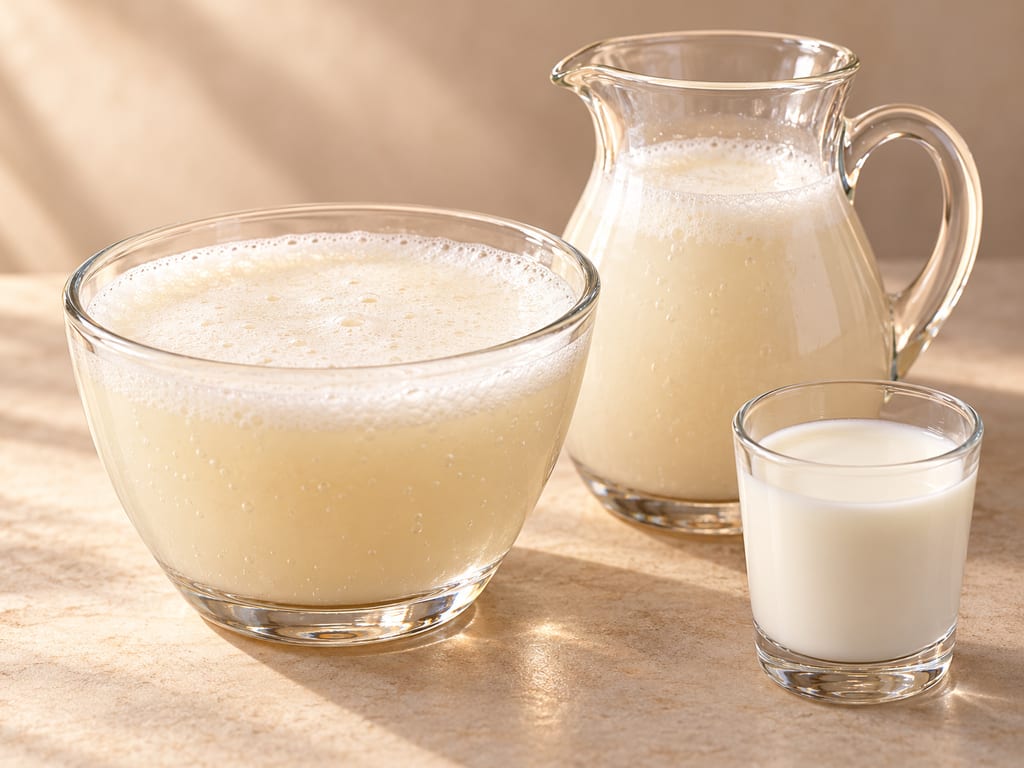
Airag
Airag is Mongolia’s fermented mare’s-milk drink, traditionally churned with saved starter in a reusable cowhide khokhuur.
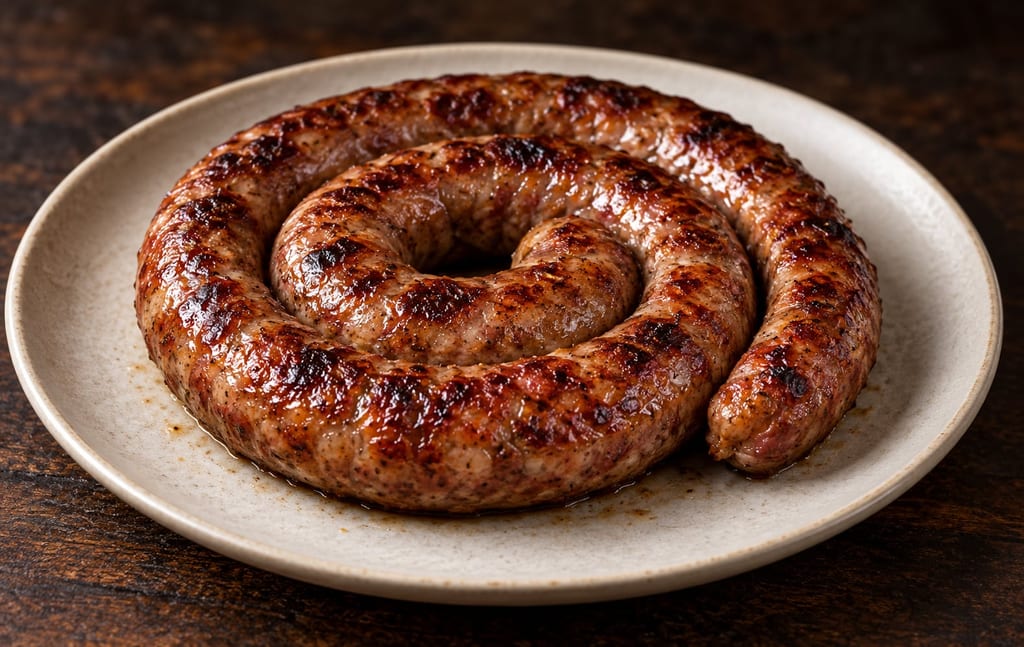
Boerewors
A coarse South African farmhouse sausage of beef with pork or mutton fat, defined by its coriander seasoning and cooked fresh over coals rather than preserved.
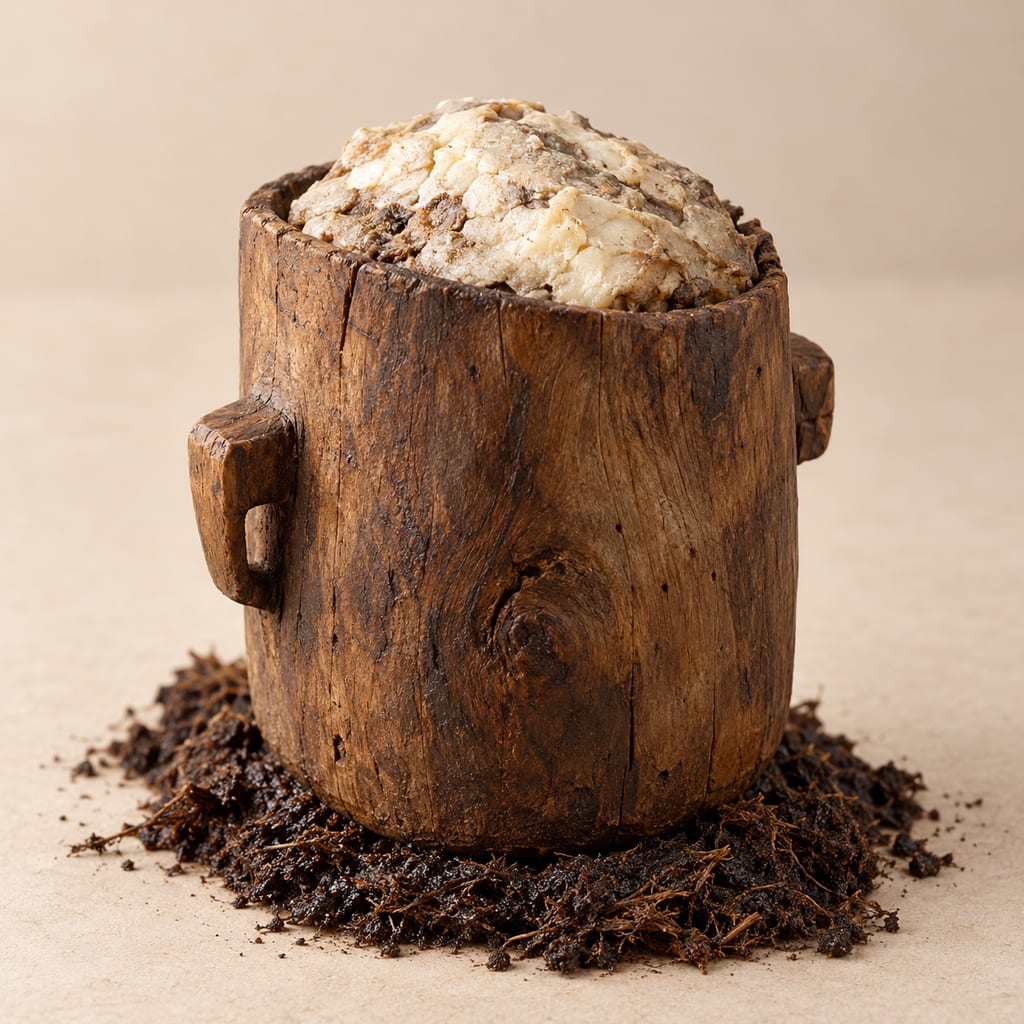
Bog butter
Butter packed into wooden containers and buried in cool, wet peat in Ireland and Scotland, a practice known from finds that may reflect storage, concealment or ritual.
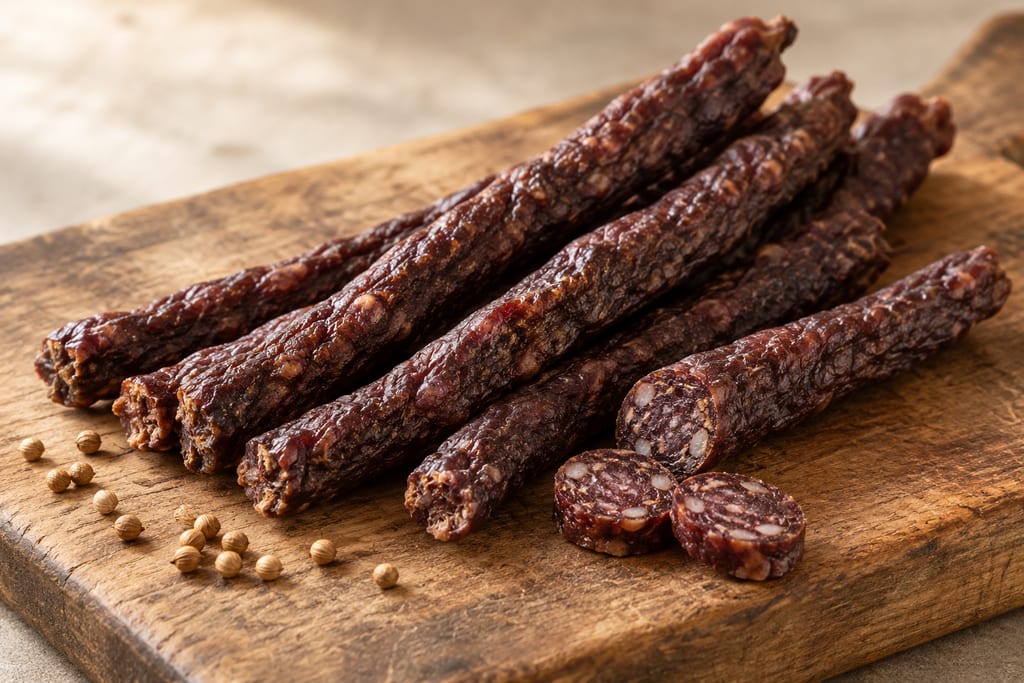
Droëwors
South Africa's dried sausage: seasoned minced meat in narrow casings, dried until it can be eaten without cooking, which makes it a far more demanding product than fresh boerewors.
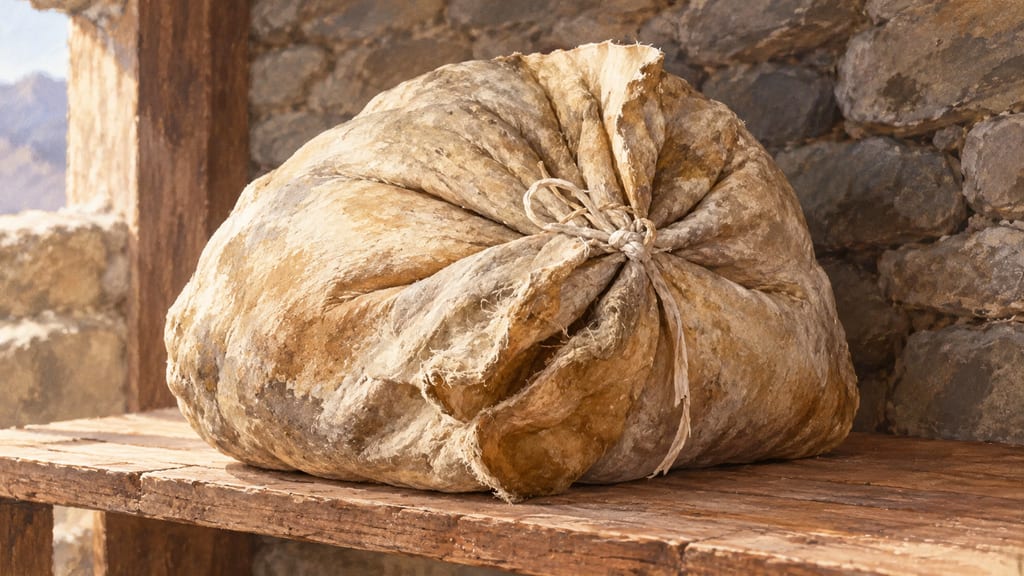
Guda sheepskin sack
A Guda is the hide sack used to mature Tushetian cheese. The evidence supports its traditional material and role but leaves standard dimensions and detailed construction open.
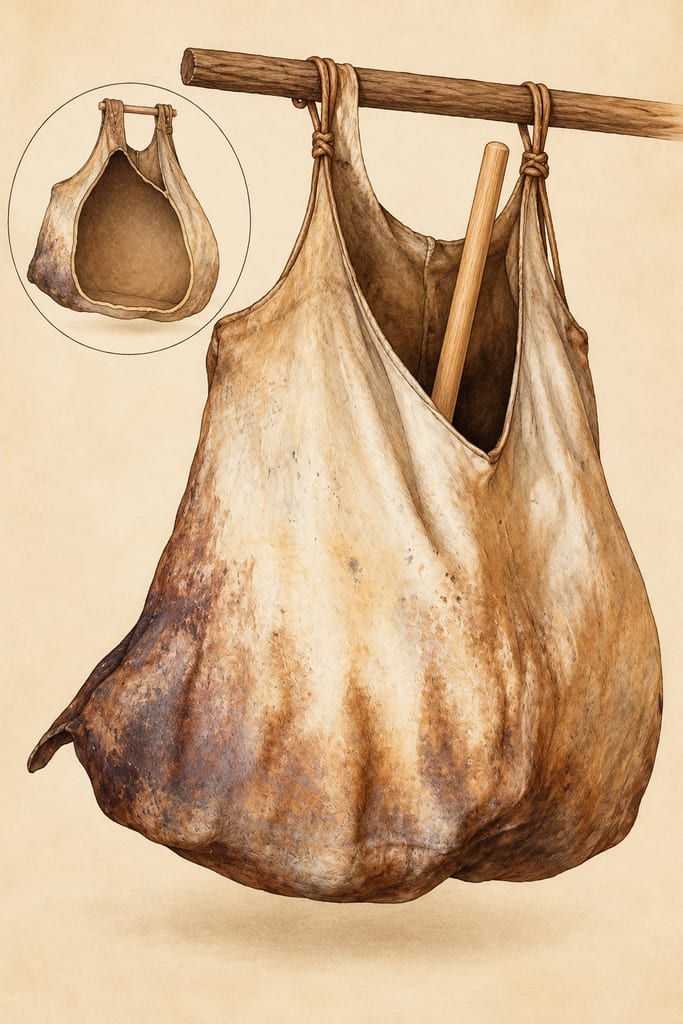
Khokhuur
The khokhuur is a traditional Mongolian airag vessel made from prepared cowhide. Its flexible leather body holds mare’s milk while it is churned with a separate wooden buluur paddle.
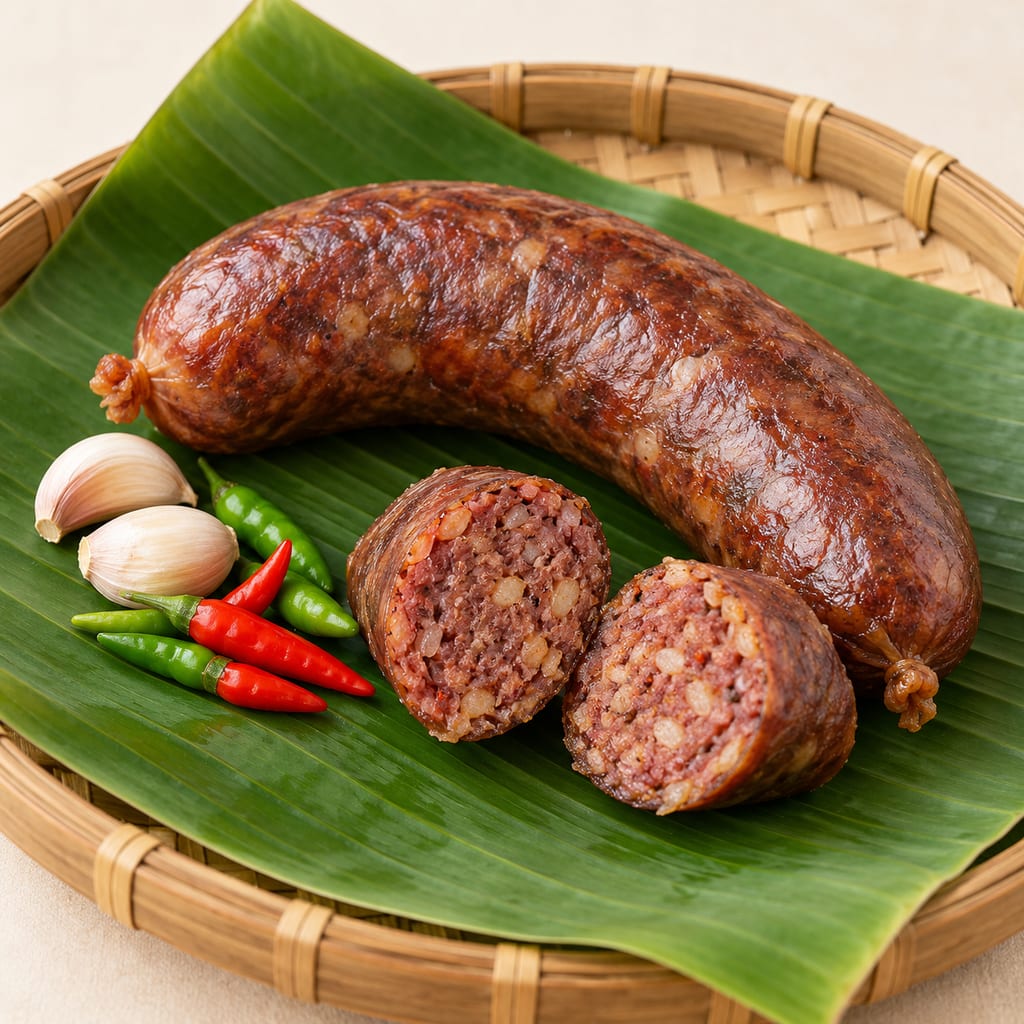
Mum (mam)
Mum is a Thai family of fermented meat preparations with distinct pork Mam-moo and beef Mam-neua forms. Sources document ingredients, casing and serving traditions, but not a validated home process.

Naem
Naem is a Thai sour pork preparation made with minced pork, rind or ear, glutinous rice, garlic and salt. Its documented room-temperature method has no validated food-safety endpoint.
Community
No community contributions have been published for this entry yet.
Share what you made
Sign in to contribute. Published comments and photos are free to read.
Sources
Food and Agriculture Organization of the United Nations (FAO), Animal Production and Health Paper 52
Small-scale sausage production, chapter 3: Sausage casingsCited in: A food that is also a container; What a natural casing is made of; Pouches, bladders, caul and skin; Haggis, read carefully; Manufactured casings, briefly; How to read a casing description; More casings: trade names, sizes and old uses; More casings: Europe, the Caucasus and the eastern Mediterranean
Food and Agriculture Organization of the United Nations (FAO)
Small-scale sausage production, chapter 6: Smoked precooked sausage production (Chinese sausages)Cited in: What a natural casing is made of; Shape, drying and smoke: what the envelope does; Asia: horse gut, yak rumen, squid and swim bladder; More casings: trade names, sizes and old uses; More casings: Asia
US Department of Agriculture, Food Safety and Inspection Service
FSIS Ready-to-Eat Fermented, Salt-Cured, and Dried Products Guideline (FSIS-GD-2023-0002, 5 May 2023)Cited in: What a natural casing is made of; Shape, drying and smoke: what the envelope does; Africa and Brazil: rice in gut, coils on the fire; How to read a casing description; More casings: trade names, sizes and old uses; More casings: Africa, the Americas, Greenland and Oceania
Charles Petrus Benjamin van Schalkwyk; University of the Free State
Evaluation of a natural preservative in a boerewors model system (MSc dissertation)Cited in: A food that is also a container; The animal outside is not the animal inside; Africa and Brazil: rice in gut, coils on the fire; More casings: Africa, the Americas, Greenland and Oceania
UNESCO Intangible Cultural Heritage
Traditional technique of making Airag in Khokhuur and its associated customsCited in: A food that is also a container; Asia: horse gut, yak rumen, squid and swim bladder; More casings: Asia
Alutiiq Museum and Archaeological Repository
Seal Stomach (Isuwim Suqaa), word of the weekCited in: A food that is also a container; Skins, stomachs and bags that keep food; More casings: Europe, the Caucasus and the eastern Mediterranean; More casings: Africa, the Americas, Greenland and Oceania
Kristopher K. Townsend; Discovering Lewis & Clark
Making PemmicanCited in: A food that is also a container; Skins, stomachs and bags that keep food; More casings: Europe, the Caucasus and the eastern Mediterranean; More casings: Africa, the Americas, Greenland and Oceania
Georgian National Tourism Administration (Georgia Travel)
Tushetian GudaCited in: A food that is also a container; Skins, stomachs and bags that keep food; More casings: Europe, the Caucasus and the eastern Mediterranean; More casings: Africa, the Americas, Greenland and Oceania
European Union; legislation.gov.uk
Commission Implementing Regulation (EU) No 973/2013 (Nürnberger Bratwürste / Nürnberger Rostbratwürste PGI)Cited in: What a natural casing is made of; The animal outside is not the animal inside; Manufactured casings, briefly; More casings: trade names, sizes and old uses
The Latin Library
Varro, De lingua Latina, book VCited in: Pouches, bladders, caul and skin; What the oldest texts show; More casings: trade names, sizes and old uses
Official Journal of the European Union C 375, 12 November 2015 (Polish edition)
Publication of an application (Slavonski kulen / Slavonski kulin), 2015/C 375/08Cited in: Pouches, bladders, caul and skin; Shape, drying and smoke: what the envelope does; More casings: trade names, sizes and old uses
Croatian application to the EU, copy hosted by the Government of Mexico (gob.mx)
Single document: Baranjski kulen (PGI)Cited in: Pouches, bladders, caul and skin; More casings: trade names, sizes and old uses
Official Journal of the European Union C 355, 27 October 2015; copy on GOV.UK
Publication of an application for 'Lietuviškas skilandis' (TSG), 2015/C 355/08Cited in: Pouches, bladders, caul and skin; Shape, drying and smoke: what the envelope does; Europe: foods named by their gut; More casings: trade names, sizes and old uses; More casings: Europe, the Caucasus and the eastern Mediterranean
Pfalz.Touristik (pfalz.de)
Pfälzer SaumagenCited in: Pouches, bladders, caul and skin; Europe: foods named by their gut; More casings: trade names, sizes and old uses; More casings: Europe, the Caucasus and the eastern Mediterranean
Lisiane Dorneles de Lima and colleagues; Embrapa Caprinos e Ovinos, Sobral, December 2020
Processamento industrial da buchada e da dobradinha (Comunicado Técnico 204)Cited in: Pouches, bladders, caul and skin; Haggis, read carefully; Africa and Brazil: rice in gut, coils on the fire; More casings: trade names, sizes and old uses; More casings: Europe, the Caucasus and the eastern Mediterranean; More casings: Africa, the Americas, Greenland and Oceania
Laore Sardegna, regional agricultural development agency; copy hosted by ONAF
Caglio di capretto (Caggiu de crabittu), traditional product sheetCited in: Pouches, bladders, caul and skin; More casings: trade names, sizes and old uses
Fondazione Slow Food per la Biodiversità
Ventricina del Vastese, Slow Food PresidiumCited in: Pouches, bladders, caul and skin; More casings: trade names, sizes and old uses
Regione Emilia-Romagna, Bollettino Ufficiale, 17 August 2021
Modifica del disciplinare della DOP Culatello di ZibelloCited in: Pouches, bladders, caul and skin; Europe: foods named by their gut; More casings: trade names, sizes and old uses; More casings: Europe, the Caucasus and the eastern Mediterranean
LacusCurtius (Bill Thayer), text of the 1936 Walter M. Hill edition
Apicius, Cookery and Dining in Imperial Rome, book IICited in: Pouches, bladders, caul and skin; What the oldest texts show; More casings: trade names, sizes and old uses
Deputy Ministry of Tourism, Cyprus (Visit Cyprus)
SheftaliesCited in: Pouches, bladders, caul and skin; Europe: foods named by their gut; More casings: trade names, sizes and old uses; More casings: Europe, the Caucasus and the eastern Mediterranean
Consorzio Zampone e Cotechino Modena IGP
Zampone Modena IGPCited in: Pouches, bladders, caul and skin; Europe: foods named by their gut; More casings: trade names, sizes and old uses; More casings: Europe, the Caucasus and the eastern Mediterranean
Consorzio Zampone e Cotechino Modena IGP
Cotechino Modena IGPCited in: Pouches, bladders, caul and skin; Manufactured casings, briefly; More casings: trade names, sizes and old uses
Jewish Food Society; recipe of Lyuba Sheynin
Sheika (Stuffed Chicken Neck)Cited in: Pouches, bladders, caul and skin; More casings: trade names, sizes and old uses
Fondazione Slow Food per la Biodiversità
Salame d'oca ecumenico, Ark of TasteCited in: Pouches, bladders, caul and skin; The animal outside is not the animal inside; More casings: trade names, sizes and old uses
Perseus Digital Library texts on the Perseids platform
Homer, The Odyssey, book 18 (A. T. Murray translation, 1919)Cited in: What the oldest texts show; More casings: trade names, sizes and old uses
Encyclopaedia Romana, University of Chicago (James Grout)
ApiciusCited in: What the oldest texts show; More casings: trade names, sizes and old uses
Wikisource (Chinese)
齊民要術 卷第九 (Qimin Yaoshu, book 9)Cited in: What the oldest texts show; Asia: horse gut, yak rumen, squid and swim bladder; More casings: trade names, sizes and old uses; More casings: Asia
Wikisource (Chinese)
齊民要術 卷第八 (Qimin Yaoshu, book 8)Cited in: What the oldest texts show; Asia: horse gut, yak rumen, squid and swim bladder; More casings: trade names, sizes and old uses; More casings: Asia
Silk Road Seattle, University of Washington
William of Rubruck's account of the Mongols (W. W. Rockhill translation, 1900)Cited in: What the oldest texts show; Asia: horse gut, yak rumen, squid and swim bladder; Skins, stomachs and bags that keep food; More casings: trade names, sizes and old uses; More casings: Europe, the Caucasus and the eastern Mediterranean; More casings: Asia; More casings: Africa, the Americas, Greenland and Oceania
Dictionary of the Scots Language (Scottish National Dictionary)
Haggis, n.Cited in: Haggis, read carefully; More casings: Europe, the Caucasus and the eastern Mediterranean
Medievalists.net
Haggis, oyster stew and more: medieval recipes (Liber Cure Cocorum)Cited in: Haggis, read carefully; More casings: Europe, the Caucasus and the eastern Mediterranean; Notes on what this account leaves open
Foods of England
For weselsCited in: Haggis, read carefully; More casings: Europe, the Caucasus and the eastern Mediterranean; Notes on what this account leaves open
Consorzio Tutela Salame di Varzi
Disciplinare di produzione del Salame di VarziCited in: Shape, drying and smoke: what the envelope does; The animal outside is not the animal inside; Europe: foods named by their gut; Manufactured casings, briefly; More casings: trade names, sizes and old uses; More casings: Europe, the Caucasus and the eastern Mediterranean
WIPO Lex
Law No. 224 of 30 May 1989 on the protection of the appellation of origin of Salame di VarziCited in: Shape, drying and smoke: what the envelope does; Notes on what this account leaves open
Thế Hạnh and Quỳnh Hoa; Viet Nam News, 7 July 2026
A sausage that tells a story: meet the Cham specialty of An GiangCited in: The animal outside is not the animal inside; Asia: horse gut, yak rumen, squid and swim bladder; More casings: Asia
Aish.com
Kishke: unraveling the gut-deep culinary traditions of Ashkenazi JewsCited in: The animal outside is not the animal inside; Europe: foods named by their gut; More casings: Europe, the Caucasus and the eastern Mediterranean
Simply Tibetan, 27 July 2012
Discussing the tradition of gyuma making with Rinchen Tashi-laCited in: The animal outside is not the animal inside; Asia: horse gut, yak rumen, squid and swim bladder; More casings: Asia
Menorca.info (Es Diari)
Consejo Regulador de la Sobrasada de MallorcaCited in: The animal outside is not the animal inside; Europe: foods named by their gut; More casings: Europe, the Caucasus and the eastern Mediterranean
Official Journal of the European Union C 328, 23 December 2008 (Hungarian edition)
Publication of an application (Ciauscolo PGI), 2008/C 328/12Cited in: Europe: foods named by their gut; More casings: Europe, the Caucasus and the eastern Mediterranean
Institutet för språk och folkminnen (Isof), Matkult
BlodmatCited in: Europe: foods named by their gut; More casings: Europe, the Caucasus and the eastern Mediterranean
Institutet för språk och folkminnen (Isof), Matkult
Korv och pölsaCited in: Europe: foods named by their gut; More casings: Europe, the Caucasus and the eastern Mediterranean
MatPrat (Opplysningskontoret for egg og kjøtt)
BlodpuddingCited in: Europe: foods named by their gut; More casings: Europe, the Caucasus and the eastern Mediterranean
Matarauður Íslands (Icelandic food heritage)
SheepCited in: Europe: foods named by their gut; More casings: Europe, the Caucasus and the eastern Mediterranean
Meera Ongmu Bhutia, Namrata Thapa and Jyoti Prakash Tamang; Frontiers in Microbiology 11 (published 11 January 2021)
Molecular characterization of bacteria, detection of enterotoxin genes, and screening of probiotic properties of their isolates from ethnic fermented meat products of SikkimCited in: Asia: horse gut, yak rumen, squid and swim bladder; More casings: Asia
Korea Tourism Organization (VisitKorea)
Sundae (Korean sausage)Cited in: Asia: horse gut, yak rumen, squid and swim bladder; More casings: Asia
Korea Tourism Organization (VisitKorea)
Dancheon Sikdang (abai sundae)Cited in: Asia: horse gut, yak rumen, squid and swim bladder; More casings: Asia
Korea Tourism Organization (VisitKorea)
PisundaeCited in: Asia: horse gut, yak rumen, squid and swim bladder; More casings: Asia
Encyclopedia of Korean Culture, Academy of Korean Studies (written by 서혜경, 1995; revised 7 February 2023)
순대 (sundae)Cited in: Asia: horse gut, yak rumen, squid and swim bladder; How to read a casing description; More casings: Asia
Korea Tourism Organization (VisitKorea)
Chungchosoo (ojingeo sundae)Cited in: Asia: horse gut, yak rumen, squid and swim bladder; More casings: Asia
Ministry of Agriculture, Forestry and Fisheries of Japan
いかめし 北海道 (うちの郷土料理)Cited in: Asia: horse gut, yak rumen, squid and swim bladder; More casings: Asia
JIRCAS Thai Fermented Foods Database
Sai-krork-prieoCited in: Asia: horse gut, yak rumen, squid and swim bladder; More casings: Asia
JIRCAS Thai Fermented Foods Database
MamCited in: Asia: horse gut, yak rumen, squid and swim bladder; Manufactured casings, briefly; More casings: trade names, sizes and old uses; More casings: Asia
JIRCAS Thai Fermented Foods Database
NaemCited in: Asia: horse gut, yak rumen, squid and swim bladder; Manufactured casings, briefly; More casings: trade names, sizes and old uses; More casings: Asia
Families for Life (Singapore)
Ngoh HiangCited in: Asia: horse gut, yak rumen, squid and swim bladder; More casings: Asia
RAWI Publishing, on Google Arts & Culture
Egyptian festive dishes: mombarCited in: Africa and Brazil: rice in gut, coils on the fire; More casings: Africa, the Americas, Greenland and Oceania
Dictionary of South African English
PofadderCited in: Africa and Brazil: rice in gut, coils on the fire; More casings: Africa, the Americas, Greenland and Oceania
Jadranka Frece and colleagues; Food Technology and Biotechnology 54(2), 2016
Microbiological quality and variability of natural microbiota in Croatian cheese maturing in lambskin sacksCited in: Skins, stomachs and bags that keep food; More casings: Europe, the Caucasus and the eastern Mediterranean; More casings: Africa, the Americas, Greenland and Oceania
Fondazione Slow Food per la Biodiversità
Motal, Slow Food PresidiumCited in: Skins, stomachs and bags that keep food; How to read a casing description; More casings: Europe, the Caucasus and the eastern Mediterranean; More casings: Africa, the Americas, Greenland and Oceania
Slow Food Foundation for Biodiversity, on Google Arts & Culture
Bucegi Mountains Brânză de BurdufCited in: Skins, stomachs and bags that keep food; How to read a casing description; More casings: Europe, the Caucasus and the eastern Mediterranean; More casings: Africa, the Americas, Greenland and Oceania
Archaeology magazine (Archaeological Institute of America), 14 March 2019
Irish bog butterCited in: Skins, stomachs and bags that keep food; More casings: Europe, the Caucasus and the eastern Mediterranean; More casings: Africa, the Americas, Greenland and Oceania
Alutiiq Museum and Archaeological Repository
Oil (Uquq), word of the weekCited in: Skins, stomachs and bags that keep food; More casings: Europe, the Caucasus and the eastern Mediterranean; More casings: Africa, the Americas, Greenland and Oceania
US Centers for Disease Control and Prevention
Alaska Native Foods and BotulismCited in: Skins, stomachs and bags that keep food; How to read a casing description; More casings: Europe, the Caucasus and the eastern Mediterranean; More casings: Africa, the Americas, Greenland and Oceania
US Centers for Disease Control and Prevention, Morbidity and Mortality Weekly Report
Botulism outbreak associated with eating fermented food, Alaska, 2001Cited in: Skins, stomachs and bags that keep food; How to read a casing description; More casings: Europe, the Caucasus and the eastern Mediterranean; More casings: Africa, the Americas, Greenland and Oceania
State Historical Society of North Dakota, 15 April 2024
Making Pemmican at the Pembina State Museum: The Food of the Fur TradeCited in: Skins, stomachs and bags that keep food; More casings: Europe, the Caucasus and the eastern Mediterranean; More casings: Africa, the Americas, Greenland and Oceania
Australian Museum
Wallaby skin water carrier, pre-1885Cited in: Skins, stomachs and bags that keep food; More casings: Europe, the Caucasus and the eastern Mediterranean; More casings: Africa, the Americas, Greenland and Oceania
Company-Histories.com, adapted from the International Directory of Company Histories, vol. 55 (2003)
Viskase Companies, Inc. company historyCited in: Manufactured casings, briefly; More casings: trade names, sizes and old uses
Viscofan
Viscofan Annual Report 2024: strategy and productsCited in: Manufactured casings, briefly; More casings: trade names, sizes and old uses
Gaps
- Accounts differ on which animal's intestine is used for Cork drisheen.
- The exact organs of some Lao mum variants, including the reported bile-sac (gallbladder) version, are not confirmed.
- Budik is described in pig intestine; the wider range of animals reported for it rests on review-level evidence.
- The full range of stomach compartments used for haggis and North African osban, and the casing species of some Caribbean 'runners', are not documented.
- The Varzi curing times come from a 1989 law whose articles were repealed in 2004; the current registered specification may differ.
Updated 2026-10-27