Thiat
Thiat is a dried mixed starter used for alcoholic beverages in Meghalaya. Field accounts differ and laboratory studies describe particular samples; none gives a universal recipe or validated household method.
 FermenteaWhere food goes to change
Mushrooms
The saffron milkcap, Lactarius deliciosus, is a pine-associated wild mushroom native to Europe, fried, grilled, salted or pickled in several regional kitchens.
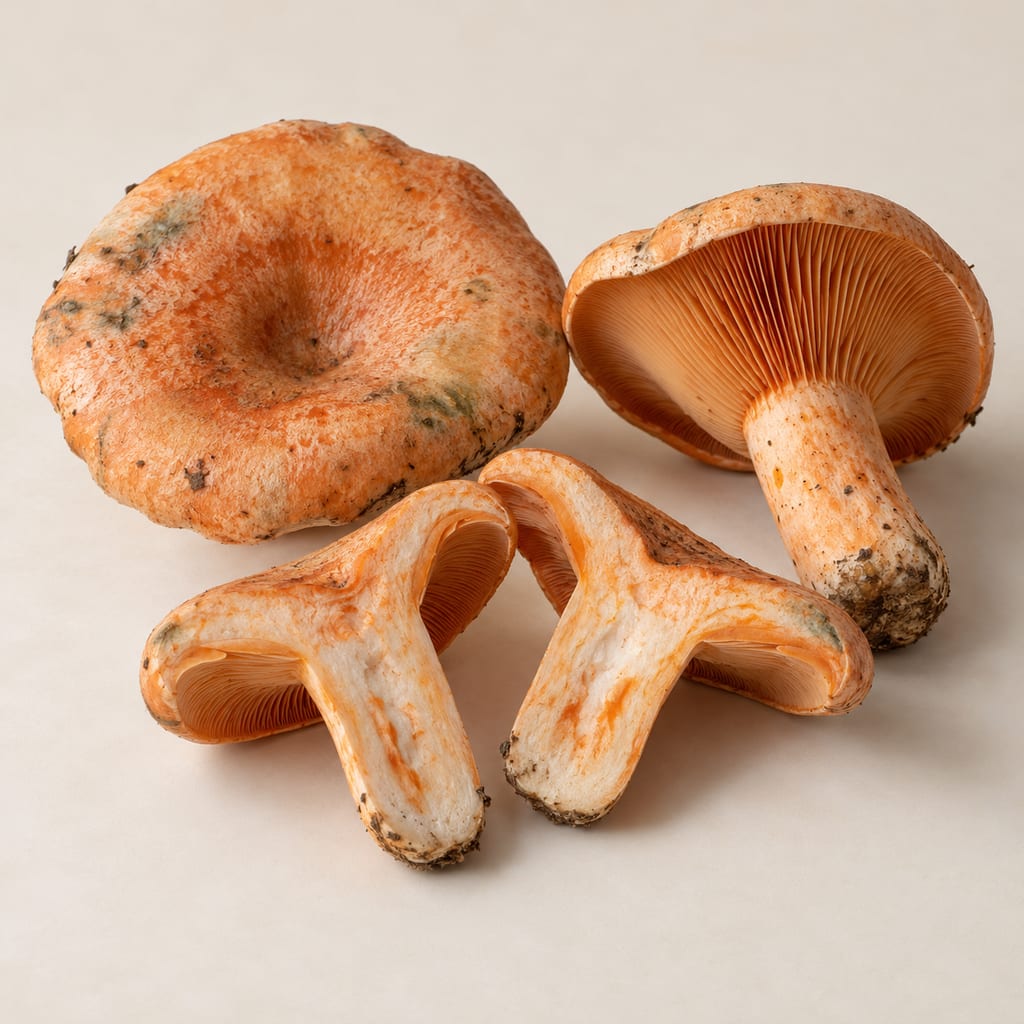
Lactarius deliciosus is one of the best-known milkcaps. Its common names include saffron milk cap, red pine mushroom and pine mushroom. Linnaeus described it in 1753 as Agaricus deliciosus, and the Latin epithet means tasty. The genus Lactarius is in the order Russulales.
Its orange to red colouring and the green staining of its flesh and gills when handled are the usual features people use to recognise it. The catalogue notes that other orange-milk species are distinct taxa.
The species forms a mycorrhizal partnership with pine trees and grows under conifers on acid soils. It is native to Europe, including the southern Pyrenees and the wider Mediterranean basin, where it grows under Mediterranean pines. In Cyprus it is abundant in high-altitude Pinus nigra and P. brutia forest.
It was introduced with pine trees to Chile, Australia, New Zealand, where it grows in Pinus radiata plantations, and South Africa. Pine plantations and Siberian pine forests are described as favourable habitats. A 2007 study concluded that the European species is genetically, morphologically and ecologically distinct from North and Central American populations.
Recipes differ by region. In Spain the caps are fried whole, cap-down, in olive oil with a little garlic, then served with raw olive oil and parsley, with only a little butter. In Poland it is fried in butter, served with cream, or marinated. In Cyprus it is grilled over charcoal and dressed with olive oil and lemon or bitter orange, sautéed with onions, or stewed with onions, coriander and red wine. In Russia it has been preserved by salting, and salting or pickling is recorded as traditional preservation, a claim the encyclopedia entry itself marks as needing verification.
The catalogue lists its uses as fried, grilled, salted or pickled. Its wild supply is recorded as seasonal, from August to early October in the Northern Hemisphere and from April to June in the Southern Hemisphere. In north-east India it is one of the ten most widely consumed mushrooms among indigenous tribes of Meghalaya.
Sources describe its taste as mild or sometimes bitter, so cooking method and seasoning matter to the result. Its flesh and gills stain deep green when handled, which is a useful feature for identification.
Look-alike milkcaps named in the encyclopedia entry include L. rubrilacteus, which stains blue and has red latex, L. olympianus, with white latex and an unpleasant taste, L. salmonicolor, which is orange but does not stain green, L. salmoneus, with a white cap, and L. quieticolor, which occurs in pine plantations in Chile and Brazil.
The encyclopedia entry calls the species edible and gives no dedicated toxicity section. It notes that high consumption can turn urine orange or red. This page is not an identification guide, and anyone collecting wild milkcaps should confirm identification with a field guide or a local expert before eating them.
Native range given as Europe and the Mediterranean basin; the sources do not name one origin.
Frying recipe as recorded by Arora (1986), cited by the encyclopedia entry.
Fried in butter, served with cream, or marinated.
Grilled, sautéed or stewed; abundant in Troodos pine forest.
Traditionally preserved by salting; the encyclopedia marks this for verification.
Introduced with pine trees.
Introduced with pine trees.
Introduced; grows in Pinus radiata plantations.
Introduced with pine trees.
One of the ten most widely consumed mushrooms among indigenous tribes, per Khaund and Joshi (2014).
No community contributions have been published for this entry yet.
Sign in to contribute. Published comments and photos are free to read.
WikipediaTaxonomy · Ecology · Culinary use · Identification · Cautions
Lactarius deliciosusTaxonomy and naming in 1753 and later; pine mycorrhiza; introductions
Regional preparations in Spain, Poland, Cyprus and Russia; collection seasons
Lookalike milkcaps; green staining; urine colouration with high consumption