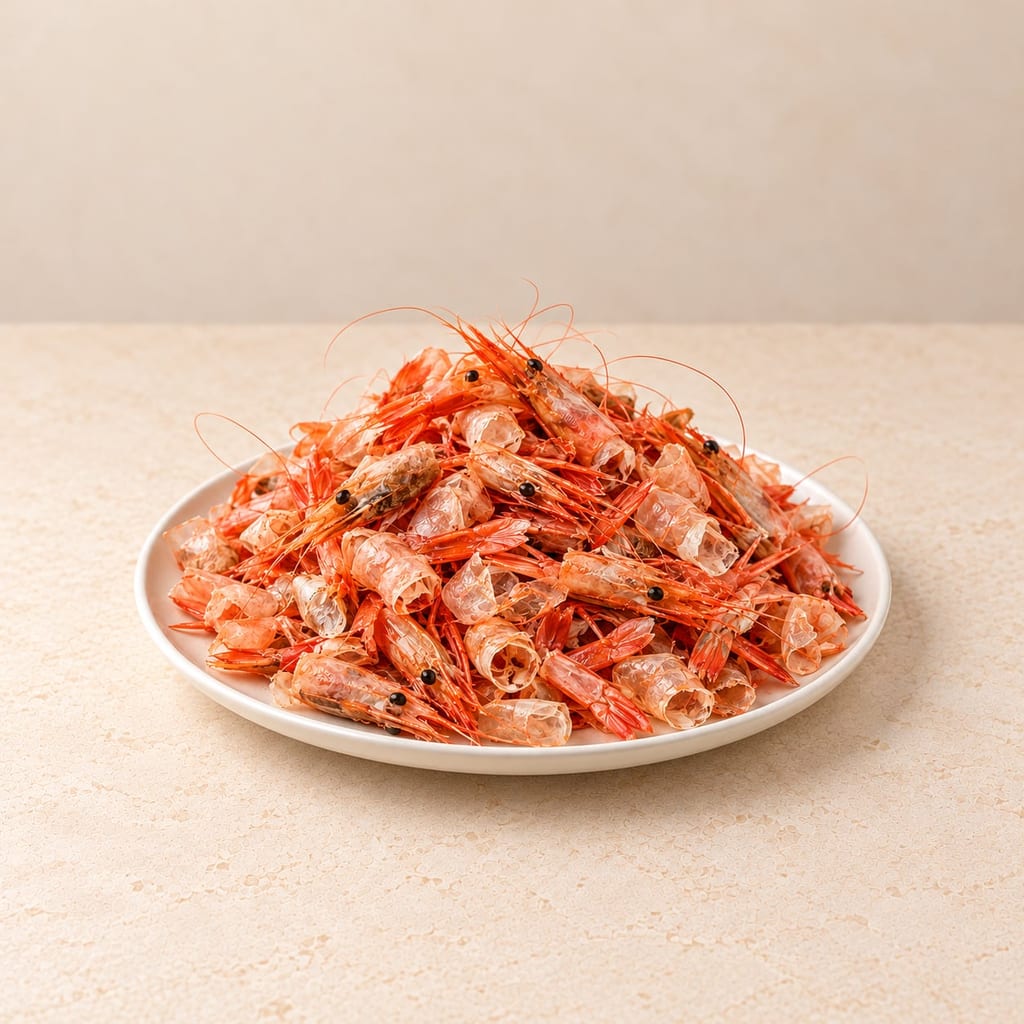
Shrimp heads and shells
The combined head tissue and shells saved during peeling; chef Alex Perry uses a weighed kilogram of this mix in a distinct shrimp garum.
 FermenteaWhere food goes to change
Substrates
Peeled shrimp exoskeleton used for strained stocks; modern quick-garum guidance names shells as a possible substrate without a shell-specific formula.
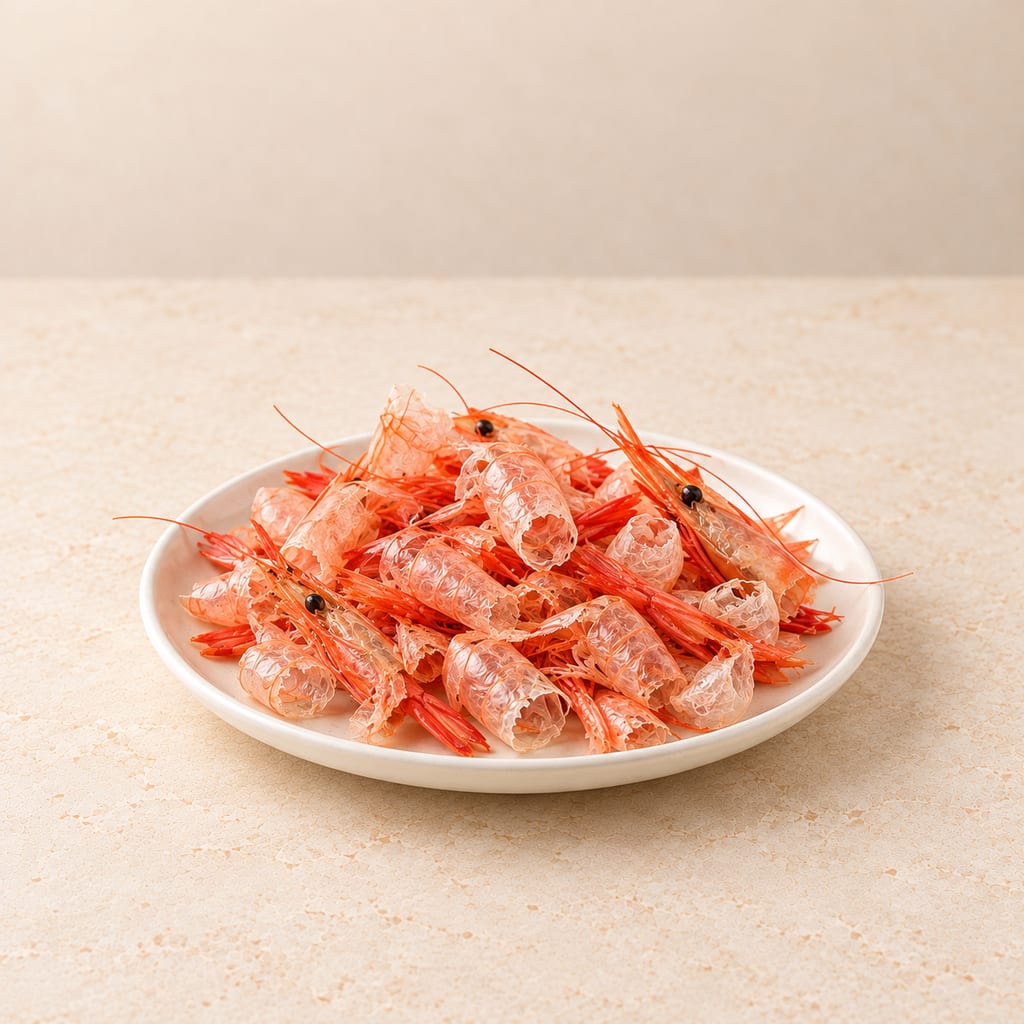
A shrimp shell is the covering removed to reach the tail meat. A pile of shells is a different ingredient from heads and shells together: the head contains softer internal tissues, while the peeled shell is mainly the outside structure. A shell-only name should describe what is actually in the bowl. If the peeling includes heads or much attached flesh, a recipe needs to say so.
Crustacean shell is a composite of chitin, proteins and minerals, with calcium carbonate prominent among the minerals. Its firmness helps explain why cooks often extract from it into liquid and then strain away the pieces. The exact composition varies by animal and handling; a named Gulf shrimp species or a universal flavour intensity cannot be inferred from the word “shells.”
Shrimp and prawn are common names and not scientific groups. Larger commercial species are generally called shrimp in the United States and prawns elsewhere in the English-speaking world, with exceptions, and the words are close to synonyms. Shrimp appears in Middle English around the fourteenth century and prawn in the early fifteenth. The suborder Dendrobranchiata, which holds the penaeid shrimp and most of the commercially important ones, has 533 species, while the caridean shrimp number 3,438.
A handful of species supply most of the shells that reach a kitchen. In 2010 the whiteleg shrimp, Litopenaeus vannamei, accounted for 2.72 million tonnes, almost all of it farmed; the giant tiger prawn, Penaeus monodon, for 992,000 tonnes, 782,000 of them farmed; the akiami paste shrimp, Acetes japonicus, for 574,000 tonnes, all caught wild; and the northern prawn, Pandalus borealis, for 361,000 tonnes. Farmed production overtook wild capture in 2007, and about 75 percent of farmed shrimp comes from Asia.
In the Gulf of Mexico the native species is the white shrimp, Litopenaeus setiferus, which grows to 7 or 8 inches, usually lives less than two years and is often called an annual crop. Its shell is softer than that of other shrimp and easier to peel, and the cooked shell turns pinkish-red while the meat is pearly white with pink and red shading. United States landings were about 107 million pounds in 2024, valued at about 159 million dollars, nearly all from the Gulf and mainly from Louisiana and Texas. White shrimp were the first commercially important shrimp species in the United States, dating to 1709.
Seen from the outside, a shrimp is a hard, jointed case. The head and thorax are fused into a cephalothorax covered by a thick carapace that also surrounds the gills. The abdomen has six segments, and the sixth ends in the telson, flanked by uropods that form the tail fan. Eight pairs of appendages come from the cephalothorax. The shells left after peeling are pieces of this case.
The main structural material is chitin, a long-chain polymer of N-acetylglucosamine units linked end to end, much like cellulose except that an acetyl amine group replaces one hydroxyl on each unit. That change allows more hydrogen bonding between chains, and the chains pack into crystalline nanofibrils. In crustacean shell chitin is combined with calcium carbonate, and the composite is much harder and stiffer than pure chitin. Chitin is the second most abundant polysaccharide on earth after cellulose, and it also forms fungal cell walls and the shells of insects. It is extracted commercially from the shells of crabs, shrimp, shellfish and lobsters.
Proportions vary by species and season. In an analysis of northern shrimp shell waste from Greenland, each kilogram of drained waste held about 73 grams of chitin, 70 grams of protein and 125 grams of calcium carbonate, with small amounts of lipid. Those are figures for one cold-water species and not a specification for Gulf shrimp. They show why shell behaves as it does in a pot: most of what it holds is mineral and a polymer that is very difficult to dissolve in water. The cook wants the flavour in the liquid, and the pieces are strained away.
The red appears on cooking, and the pigment is astaxanthin, a lipid-soluble keto-carotenoid with a long chain of alternating double and single bonds that gives it its red colour. In shellfish it is concentrated almost entirely in the shell, with little in the flesh, and it is bound to shell proteins. When cooking denatures those proteins the pigment is released and becomes visible. Raw white shrimp meat is translucent pink to grey, and the cooked shell turns pinkish-red.
The amounts are large in cold-water species: roughly 1,200 parts per million in Arctic shrimp, against about 120 in krill and about 5 in salmonids, which is why shrimp processing waste is a source for extracting it. Because astaxanthin dissolves in fat and not in water, the Greenland recovery process washes shells at pH 5 for 15 minutes, collects the red protein-rich sediment that settles, and extracts the pigment from that sediment into fish or vegetable oil.
An 1898 shrimp-purée method makes the distinction unusually clear. It tells the cook to save the shells but not the heads, wash those shells, bring them to a boil in partially thickened broth, simmer for twenty-five minutes and strain. The peeled shrimp are treated separately and brought back into the soup. Here the shells flavor a liquid; the meat provides the pieces and purée that are eaten. The old method documents one kitchen use, not the first invention of shell stock.
Mark Bittman’s later Shrimp Shell Stock takes a much shorter path. Shells from two pounds of shrimp go into about a quart of water; after the water comes to a boil, the pot comes off the heat and the shells steep as it cools. The stock is strained and the shells discarded. Compared with the 1898 purée, this is a simpler liquid intended to stand on its own or replace fish stock. Both recipes use shells alone, but their liquid, cooking time and finished dishes differ.
A modern Louisiana bisque takes the same idea a step further. Chef Dee Lavigne’s version removes the heads of three pounds of large raw shrimp, peels and deveins them, and puts the peels, with the scrapings from the heads, into two quarts of cold water. The pot is brought to a boil, taken off the heat and strained, and the stock goes into a roux-based soup. Set beside the other two methods, the contrast is in time and heat: 25 minutes of simmering in a thickened broth for the 1898 purée, a steep that continues as the water cools for Bittman’s stock, and a single boil followed by straining for the bisque.
Garum is a fermented fish sauce used as a condiment in Phoenicia, Greece, Rome, Carthage and Byzantium. The raw material was typically the innards of fatty fish, especially anchovies, fermented in brine. A tenth-century Byzantine manual, the Geōponika, says the intestines of fish are thrown into a vessel and salted. The liquid was drained through a basket, and the solids that remained were allec, a paste. Pliny the Elder, who died in 79, described its production and dilution. Garum was rich in umami from glutamates, and food historians and chefs have revived it.
Modern quick garum applies the same idea with a different engine. A rice-koji preparation held at 55 to 60 °C for two to six weeks replaces the year-long salt ferment, with protein from mushroom or cooked legume by default and meat, fish or shrimp-shell trim as other options. The koji mould is dead at that temperature, but its enzymes stay active and break the protein down. This is the context in which shrimp shells appear in a recipe, and it is a context, not a verified shell-only formula.
Shells and heads are only one route by which shrimp reach a ferment. The akiami paste shrimp, Acetes japonicus, is a species that reaches only about 30 millimetres, of which 574,000 tonnes were caught wild in 2010, and dried, salted or fermented preparations are common for it. At that size the animal is prepared whole, which is a different material from a heap of peeled shells and a different subject from the garum described here.
The distinction is practical. Peeled shells come from larger shrimp whose tail meat is eaten, and what they add to a pot is whatever the shell and its adhering tissue can give to a liquid. A paste of whole tiny shrimp is made from the entire animal. A recipe should name which it means, because the two cannot be exchanged by weight.
Treat shells as part of a perishable food. Fresh shrimp should have little or no odor, and shrimp that smells sour, rancid, fishy or of ammonia should not be eaten, raw or cooked. Seafood that will be used within two days belongs in a clean refrigerator at 40 °F or below, or it should be wrapped tightly and frozen, and it should not stand out of the refrigerator for more than two hours, or one hour above 90 °F. Raw seafood and the surfaces it touches need washing apart from ready-to-eat food.
The same logic applies to the peelings. Keep the shells cold from the time the shrimp are peeled, and refrigerate or freeze them as you would the shrimp. A finished shell stock of the Bittman kind, made by steeping the shells from two pounds of shrimp in about a quart of water, keeps in the refrigerator for up to two days or in the freezer for up to a month. Shell-only, head-and-shell and edible meat are three different materials, so a recipe or a label should say which it uses.
Shrimp are commonly treated against melanosis, the black spotting that forms after death. Sodium metabisulfite has been the long-standing treatment, but at higher levels sulfite residue can remain in the meat, and sulfite is a known allergen for many consumers and can seriously disturb people with asthma; the European Union requires labelling of shrimp with sulfite residue above 10 milligrams per kilogram. The sources do not say how much of a residue reaches the shell, so peelings from treated shrimp should not be assumed free of it.
Shrimp is also a crustacean allergen. Health Canada names crab, crayfish, lobster, prawns and shrimp as the crustaceans of concern. The species must be declared in a product’s ingredient list or in a contains statement, and a precautionary statement saying that a food may contain crustaceans should be taken seriously. Allergies tend to fall within groups, many people react to only one type, and some people eat fish safely but react to crab and lobster. In rare cases proteins carried in cooking vapours from steamed shellfish can set off a reaction. For someone with the allergy the practical rules are to read the ingredient list for the species name and to avoid any product that has no ingredient list at all, which includes a stock or seasoning bought without one. Shell stock and shell-based seasonings are not exempt, because they start from the same animal.
crustacean shellfish
The old recipe documents use but does not establish where shrimp shell extraction began or where its shellfish were sourced.
The combined head tissue and shells saved during peeling; chef Alex Perry uses a weighed kilogram of this mix in a distinct shrimp garum.
No community contributions have been published for this entry yet.
Sign in to contribute. Published comments and photos are free to read.
FoodNet ArchiveIngredient identity or culinary use
Mrs. Roundell’s Practical Cookery Book, p. 361898 shrimp purée uses washed shells without heads, simmered 25 minutes and strained
Cited in: A broth made from the peelings; Choosing, keeping and using shells
Mark Bittman via EpicuriousIngredient identity or culinary use
Shrimp Shell StockShells from two pounds of shrimp are steeped in about one quart water, then strained
Cited in: A broth made from the peelings; Choosing, keeping and using shells
Modernist Food | FermentedIngredient identity or culinary use
Quick Garum (Koji-Driven)Shrimp-shell trim is named as a possible substrate; default mushroom/legume ratio is not a shrimp-shell recipe
Cited in: What garum was
University of Florida IFASIngredient identity or culinary use
Anatomy of Shrimp-CrawfishCrustacean exoskeleton contains chitin, proteins and minerals including calcium carbonate
Cited in: What remains after peeling
Health CanadaIngredient identity or culinary use
Crustaceans and Molluscs: Priority Food AllergensShrimp is a crustacean allergen source
Cited in: Treated shrimp and allergy
Coastal MississippiIngredient identity or culinary use
Surf and Turf recipe by Alex PerryPerry uses combined heads and shells, not a shell-only batch
Smithsonian National Museum of American History, 5 August 2021Method
Chef Dee Lavigne’s Shrimp BisquePeels and head scrapings cooked in two quarts of cold water, brought to a boil, taken off the heat and strained for the bisque stock.
Cited in: A broth made from the peelings
U.S. Food and Drug AdministrationHandling
Selecting and serving fresh and frozen seafood safelyChoosing shrimp by smell; refrigerate at 40 F or below if used within 2 days, otherwise freeze; time limits out of refrigeration; separating raw seafood.
Cited in: Choosing, keeping and using shells
WikipediaIdentity · Production · Secondary
ShrimpShrimp and prawn as common names; taxonomy counts; 2010 production by species; farmed production passing wild capture in 2007; anatomy of the cephalothorax and abdomen.
Cited in: The animal behind the shell; What the shell is made of; Shrimp that are fermented whole
WikipediaComposition · Secondary
ChitinStructure of chitin; its combination with calcium carbonate in crustacean shell; commercial extraction from shrimp shells; chitosan; etymology and structure date.
Cited in: What the shell is made of
WikipediaPigment · Secondary
AstaxanthinAstaxanthin is a lipid-soluble red keto-carotenoid concentrated in crustacean shell and released on cooking; concentrations in Arctic shrimp, krill and salmonids.
Cited in: Why cooked shells turn red
NOAA FisheriesSpecies · Fishery
White shrimp (Litopenaeus setiferus)Size, life span, softer shells easier to peel, colour when raw and cooked, 2024 landings, first commercially important US shrimp in 1709.
Cited in: The animal behind the shell; Why cooked shells turn red
Technical University of Denmark; Jørgen Risum, 2007Composition · By product
Shrimp shells: a ressource (ECCE-6 poster abstract)Northern shrimp shell waste composition per kilogram: 73 g chitin, 70 g protein, 125 g calcium carbonate; Greenland quota and waste; pH 5 wash and astaxanthin recovery; insulation and chitin material uses.
Cited in: What the shell is made of; Why cooked shells turn red
WikipediaHistory · Secondary
GarumDefinition and ingredients of garum; Geoponika; allec; Pliny; revival; no mention of shrimp.
Cited in: What garum was
ICAR-Central Institute of Fisheries Technology; Laly, Jeyakumari, Kumar, Murthy, NinanQuality · Allergens
Inhibition of melanosis in white shrimp Penaeus vannamei using beetroot extract during iced and room temperature storage (Indian Journal of Fisheries 71(2), 2024)Melanosis mechanism; sulfite use and residue as an allergen and asthma risk; EU labelling above 10 mg/kg.
Cited in: Treated shrimp and allergy
Fisheries and Oceans CanadaAnatomy
Shrimp: internal and external anatomyLabelled external and internal parts of a shrimp.
Cited in: What the shell is made of