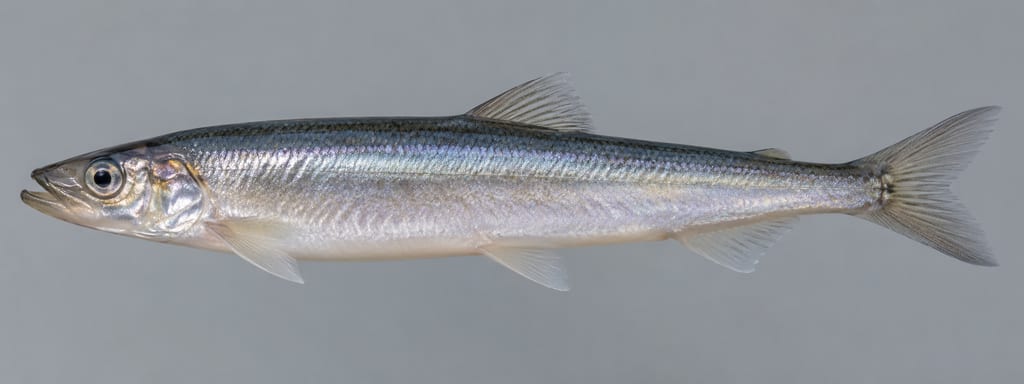
Eulachon
Eulachon (Thaleichthys pacificus) is a small anadromous North Pacific smelt used fresh, dried, smoked and, in some communities, to make rendered grease. Ripened fish and eulachon grease are separate stages and products.
 FermenteaWhere food goes to change
Mushrooms
Western matsutake is an aromatic wild mushroom native to western North American forests. Its name overlaps with related matsutake species, so field or market labels alone cannot establish a safe identification.
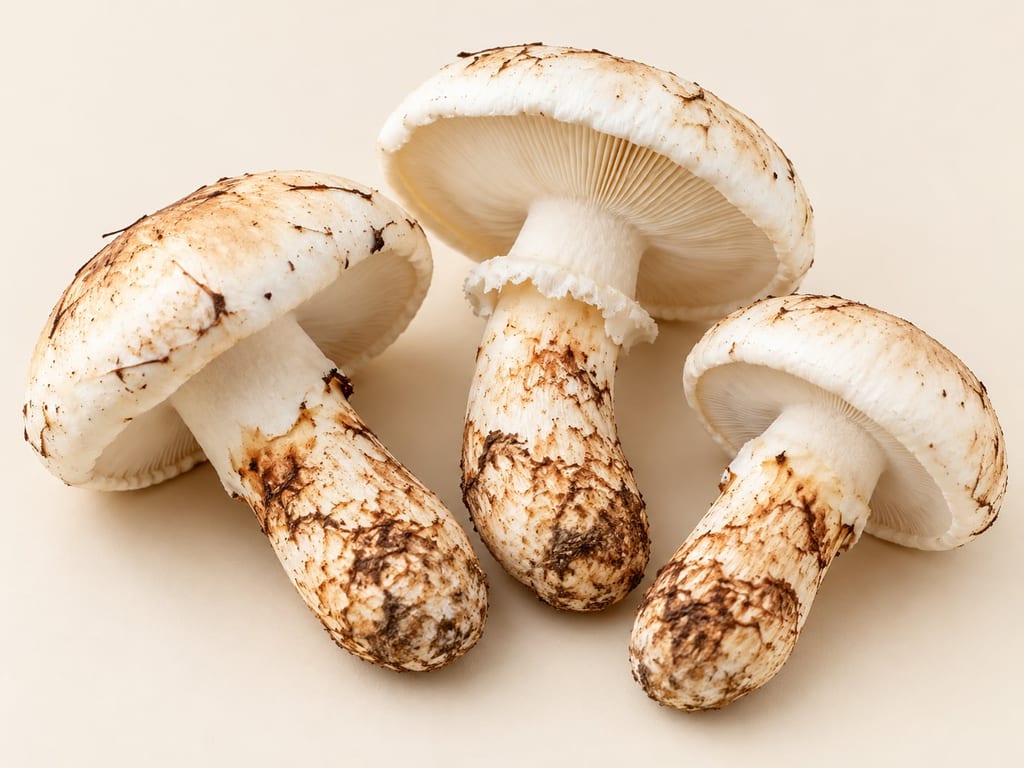
Western matsutake, often sold as pine mushroom, is the wild fruiting body of Tricholoma murrillianum. The common name matsutake is Japanese—literally “pine mushroom”—and is also used more broadly for several related, strongly aromatic mushrooms. That broad market name is useful but imprecise: western matsutake is a distinct North American species, not the Japanese T. matsutake and not the eastern North American T. magnivelare.
That distinction took time to settle. William Murrill collected a large mushroom in coastal Oregon in 1911 and described it under the name Armillaria arenicola. Later books and markets used other names, especially T. magnivelare and Armillaria ponderosa. In 2017, a study comparing DNA sequences and physical characters clarified that the western United States and Canada hold T. murrillianum; T. magnivelare belongs to eastern North America, while a third species, T. mesoamericanum, occurs in Mexico. These names record a history of changing identification, not a set of interchangeable species.
The specific epithet honours Murrill, whose early collection came from coastal sand country. “Pine mushroom” refers to a familiar forest setting and trade name, but the fungus is associated with more than one kind of tree. Its identity and food use are best discussed under the current species name, while older sources using T. magnivelare need to be read with their original geographic context in mind.
Young fruit bodies are usually robust and pale, with a firm, solid stem and a cap whose margin may remain rolled inward while the veil still covers the gills. As the mushroom expands, the partial veil tears away from the cap and leaves a conspicuous ring or skirt on the stem. The crowded gills are white and attach close to the stem, sometimes with a notch. The spore print is white. With age or handling, cinnamon, pinkish-brown or yellow-brown tones may appear as stains, fine fibres or scales on the cap and stem.
The scent is a defining sensory feature: spicy and warm, often compared with cinnamon, cedar or red-hot sweets, but also described as earthy or reminiscent of damp socks. Those comparisons capture a real mixture of sweet spice and forest-floor pungency; they do not make the smell pleasant to everyone. The flesh is firm rather than fragile, which helps the mushroom keep its shape when sliced and cooked.
Descriptions are useful for understanding what cooks and markets value, but no single feature makes a wild mushroom safe to eat. Pale caps, a ring, a firm stem or a spicy smell are not a field test for a reader. Several white Amanita species can be dangerous, and experienced mycologists are the appropriate people to identify wild specimens.
The mushroom is ectomycorrhizal: beneath the cap and stem, a network of fungal threads grows around fine tree roots and exchanges nutrients with its host. The visible mushroom is only the seasonal reproductive structure of a much larger organism in the soil. This dependence on living forest roots helps explain why a matsutake behaves differently from button mushrooms grown on prepared compost. Cultivation is difficult; a dependable harvest comes from habitat that already supports the fungus and its tree partners.
Across the inland mountains of Idaho, Washington and Oregon, accounts describe it in mixed conifer forest and second-growth Douglas-fir. Near the coast, it is associated with sandy pine forest, and California records also include tanoak and madrone communities. Shrubby understories can be part of these habitats. The species is not restricted to true pine trees, and a patch can be scattered or clustered rather than forming an even carpet.
British Columbia records extend from interior mountain country toward the coast. University of British Columbia and regional herbarium accounts also report the species in Washington, Oregon, Idaho and California. Those range records make the phrase “western North American” practical, but they do not mean every forest in those states or provinces contains the mushroom. In any one place, occurrence is tied to suitable host trees, soils and forest conditions.
Matsutake is a seasonal forest food rather than a year-round cultivated commodity. Northern accounts place fruiting chiefly from late summer through autumn, often August to November. Lower-latitude California records can extend into winter, with one regional account giving December to February. A Forest Service overview made before the western species was separated under its current name describes the same broad pattern: late summer to winter, varying with elevation, habitat and latitude.
Those ranges are observations, not a calendar guarantee. Rain, temperature, elevation and local forest conditions alter when a patch fruits and how much appears in a given year. The UBC atlas notes that matsutake can be locally common in some forest types and scarce in others. A date on a market label or a season remembered from another region should not be used to predict a harvest elsewhere.
The mushroom's dependence on forest roots links the short picking season to the slower life of the habitat. The fruit body is gathered above ground, but the fungal network persists in soil and around roots. This relationship is one reason commercial supplies remain tied to wild forest conditions and why attempts to grow the mushroom as an ordinary indoor crop have not produced a simple substitute.
In British Columbia, pine mushroom has a history in Indigenous foodways. Turner and Cuerrier's review identifies American matsutake as T. murrillianum and T. magnivelare in its source record and describes fall gathering, cooking, and preservation among Salish peoples, including Nlaka’pamux, Stl’atl’imx and Stó:lō/Halq’eméylem communities. The mushroom could be cooked fried or in soups and stews; large amounts were gathered, peeled, sliced and preserved. These are community-specific accounts rather than one universal recipe, and the paper carefully separates pine mushroom from a detailed Nlaka’pamux account of a different species, the cottonwood mushroom.
The export trade connects western forests with Japan, where matsutake has high cultural and commercial value. A 2017 taxonomic paper notes that Japanese demand exceeded domestic supply and that matsutake from western North America were imported into Japan. The broader name on an import box therefore carries a market history, while the Latin name tells us which North American species was harvested.
Japanese matsutake cooking gives a useful comparison for how cooks protect the aroma. Japan's Ministry of Agriculture describes Kyoto matsutake in rice, clear soup and sukiyaki; its rice preparation uses thin slices cooked with rice and kombu stock. The page is about a Japanese matsutake tradition, not proof that every western mushroom was prepared in exactly that way. It does show why delicate cooking methods are associated with the group: the aroma is treated as the main attraction, so strong seasonings need not dominate it.
The market also encouraged taxonomic precision. People buying a premium mushroom often encounter “matsutake” as a trade category, but botanists have to distinguish the western harvest from eastern North American and Asian relatives. That naming work helps connect a market label to a region and a forest ecology; it does not certify any individual mushroom. The western species' export story should therefore sit alongside, rather than replace, the histories of local harvest and use.
For a cook, the useful distinction is between an identified, market-sold mushroom and an wild mushroom that has not been identified by an expert. Buy from a reliable seller who can identify the species and state where it was harvested. A label saying “matsutake” can cover more than one species, so ask for the name when that matters. This page does not provide a foraging key; the lookalikes are too consequential for a written description to replace expert inspection.
The firm texture suits slicing and brief cooking, while the pungent aroma can stand up to clear broth, rice, or a simple pan preparation. In the British Columbia accounts, people cooked pine mushrooms by frying or in soups and stews. The Japanese Ministry's Kyoto example wipes the surface with a damp cloth, trims the hard tip of the stem, slices the mushroom, and cooks it with rice and kombu dashi. That is a documented regional method for matsutake, not a universal handling rule for every market product.
Forest-collected mushrooms may carry sand, needles or insects from the soil and cap folds. The documented Japanese method removes surface dirt gently and avoids soaking except for a brief light rinse when needed. Keep the mushrooms cool and follow the seller's handling advice; the sources reviewed here do not establish a universal storage duration or a home-preservation process. Indigenous accounts describe drying, canning and freezing in particular communities, but they do not supply a single validated recipe with quantities or shelf-life controls.
A Kyoto recipe offers a concrete comparison rather than a western-species formula: it calls for 3 cups of rice, 100 g of matsutake, 3 tablespoons of light soy sauce and 1 tablespoon of sake. The rice is washed and drained before the sliced mushroom and seasonings are cooked with it and left to steam. The recipe's proportions and method belong to that regional Japanese preparation; they are useful for seeing how a cook lets the mushroom's aroma season a staple, not a validated recipe for every western harvest.
When buying a fresh mushroom, the cook is paying for an aromatic wild food whose condition changes between harvest, handling and sale. A reliable seller can explain the source and identification. Gently cleaning the surface preserves the firm cap and stem for slicing, while removing embedded grit keeps soil from clouding a clear soup or rice dish. These are culinary aims, not safety tests: dirt can be removed from a correctly identified mushroom, but cleaning cannot turn an unknown species into a safe one.
The most important practical fact is that the poisonous Amanita smithiana can grow in the same region and look broadly similar: both can be substantial, pale mushrooms with a partial veil. University of British Columbia mushroom educators specifically warn readers not to confuse it with pine mushroom. The CDC has documented Amanita smithiana poisoning in western North America, including gastrointestinal symptoms followed by acute kidney injury.
A mushroom's colour, odor, ring, cap shape, or apparent freshness cannot guarantee that it is edible. Neither cooking nor drying neutralizes every mushroom toxin. Oregon's public-health guidance recommends eating wild mushrooms only after identification by an experienced mycologist. If an unknown wild mushroom has been eaten, contact the local poison center or emergency service promptly instead of waiting for symptoms.
These cautions apply to the individual specimen and the region where it was found. The edible status of a named species does not transfer to its lookalikes, and a successful identification in one country does not make a similar mushroom elsewhere safe. The western matsutake belongs in kitchens through reliable identification and supply chains, not through confidence based on this page.
Western matsutake is an ingredient gathered and cooked as a mushroom, not a starter culture or a fermented preparation. Its forest ecology explains how the fungus forms, but the food traditions described here use the fruit body directly—freshly cooked or preserved by drying, canning or freezing—rather than relying on microbial fermentation to make it edible. No controlled fermentation method or safety target for this species is established by the sources reviewed here.
That distinction matters in a fermentation pantry. A fragrant mushroom may enrich a cooked soup or rice dish, but its aroma does not make it a culture, and ordinary pickling or brining instructions should not be improvised from recipes for other fungi. The evidence supports its role as a seasonal aromatic food and traded wild harvest. It does not support a home fermentation formula, a guaranteed shelf life, or a claim that preservation makes a misidentified specimen safe.
The cited Salish food traditions are community- and place-specific; this row does not generalize them to all western matsutake habitats.
Broadly records the species' western North American food and market context; it does not claim a shared tradition across this range.
Eulachon (Thaleichthys pacificus) is a small anadromous North Pacific smelt used fresh, dried, smoked and, in some communities, to make rendered grease. Ripened fish and eulachon grease are separate stages and products.
Salmon roe is the eggs of salmon, eaten fresh, salted or dried and preserved in distinct regional ways. Nuxalk records distinguish fresh roe from aged mutsi; those accounts are historical, not safe-process instructions.
No community contributions have been published for this entry yet.
Sign in to contribute. Published comments and photos are free to read.
Mycologia / U.S. National Library of MedicineTaxonomy · History · Trade
North American matsutake: names clarified and a new species describedMolecular and morphological evidence supports three North American matsutake species: T. magnivelare in eastern North America, T. murrillianum in the west, and T. mesoamericanum in Mexico.
The study explains that western North American matsutake are commercially imported into Japan and had often been called T. magnivelare.
Cited in: A mushroom known by several names; Food traditions and the export market
E-Flora BC, University of British ColumbiaIdentity · Ecology · Season · Distribution · Safety
Tricholoma murrillianumSpecies account gives diagnostic morphology, aroma, habitat, BC/WA/OR/ID/CA distribution records, seasonal variation, commercial harvest context, and Amanita smithiana as a poisonous lookalike.
Some distribution and phenology entries derive from sources published under the former misapplied name T. magnivelare; treat the seasonal range as a regional guide rather than a guarantee.
Cited in: A mushroom known by several names; A sturdy body and a memorable aroma; A forest partnership, not a cultivated crop; A season that shifts with place; Safety depends on correct identification; Its place in a fermentation pantry
Mushrooms Up!, Beaty Biodiversity Museum, University of British ColumbiaDescription · Culinary use · Safety
Tricholoma murrillianum — western pine mushroom, western matsutakeThe species is prized for a spicy, cinnamon or cedar-like aroma and distinctive flavour.
The page warns that A. smithiana can grow with it and should not be confused with it.
Cited in: A sturdy body and a memorable aroma; Choosing, cleaning and cooking; Safety depends on correct identification
Botany / Canadian Science PublishingHistory · Traditional use · Culinary use
‘Frog’s umbrella’ and ‘ghost’s face powder’: the cultural roles of mushrooms and other fungi for Canadian Indigenous PeoplesThe authors identify American matsutake/pine mushroom as T. murrillianum and T. magnivelare in their reviewed sources and document fall harvest and cooked or preserved uses among Salish peoples, including Nlaka’pamux, Stl’atl’imx and Stó:lō/Halq’eméylem communities.
The article distinguishes its account of pine mushroom from a separate, detailed Nlaka’pamux account of cottonwood mushroom; do not transfer the latter's exact preparation details to pine mushroom.
Cited in: Food traditions and the export market; Its place in a fermentation pantry
Ministry of Agriculture, Forestry and Fisheries, JapanCulinary use · Handling
Matsutake RiceKyoto's matsutake cuisine includes matsutake rice, clear soup and sukiyaki; the regional recipe uses thinly sliced mushrooms cooked with rice and kombu dashi.
The source describes Kyoto matsutake, not a species-specific recipe for western T. murrillianum, so it is used only as a comparison of matsutake cooking traditions.
Cited in: Food traditions and the export market; Choosing, cleaning and cooking
Oregon Health AuthoritySafety
Mushroom SafetyOregon public-health guidance says wild mushrooms should not be eaten unless identified by an experienced mycologist and that cooking does not make a poisonous mushroom safe.
Cited in: Safety depends on correct identification
Morbidity and Mortality Weekly Report, Centers for Disease Control and PreventionSafety
Health Care Utilization and Outcomes Associated with Accidental Poisonous Mushroom Ingestions — United States, 2016–2018CDC describes Amanita smithiana as a regional lookalike associated with gastrointestinal illness followed by acute renal failure, and recommends expert identification before eating wild mushrooms.
Cited in: Safety depends on correct identification
USDA Forest Service, Pacific Northwest Research StationEcology · Season · Distribution
Special forest products: species information guide for the Pacific NorthwestThe older Forest Service species account under T. magnivelare describes robust white mushrooms with firm stems and veil rings and states that fruiting ranges from late summer to winter depending on habitat, elevation and latitude.
Because this report predates clarification of the western species, its range statements are read with the taxonomic limits recorded by Trudell et al.
Cited in: A mushroom known by several names; A sturdy body and a memorable aroma; A forest partnership, not a cultivated crop; A season that shifts with place
The Oregon EncyclopediaHistory · Ecology
Matsutake (mushroom)The article recounts William Murrill's 1911 coastal Oregon collection and subsequent historical names, and describes western Oregon matsutake's relationships with Douglas-fir, pines, tanoaks and firs.
Cited in: A mushroom known by several names; A forest partnership, not a cultivated crop