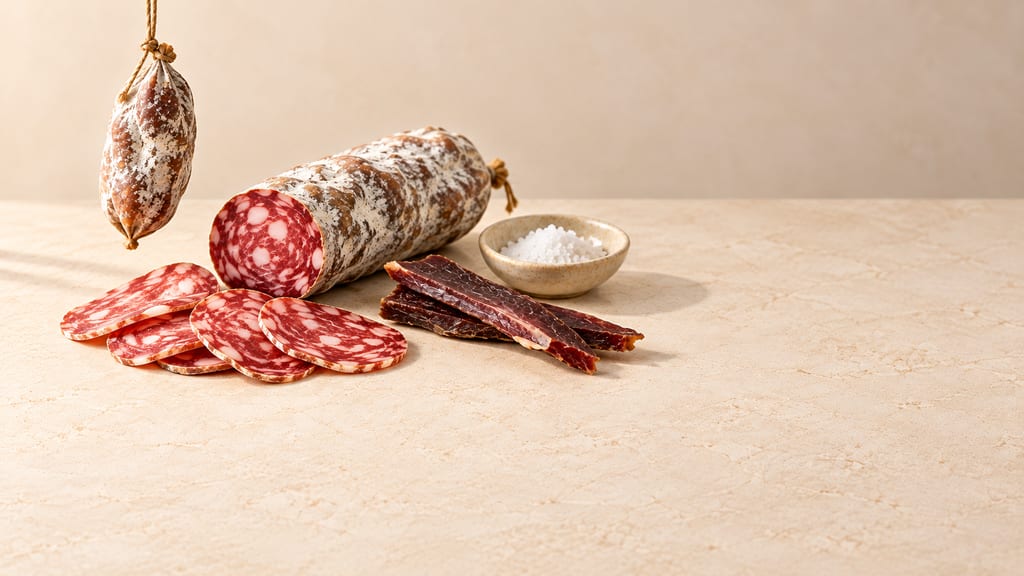
Fermented meat around the world
Dry salami, sour pork with rice, matured sheep and aged blubber follow different paths from animal to food. Their stories connect microbes with climate, slaughter, migration and the meals people share.
 FermenteaWhere food goes to change
Eulachon (Thaleichthys pacificus) is a small anadromous North Pacific smelt used fresh, dried, smoked and, in some communities, to make rendered grease. Ripened fish and eulachon grease are separate stages and products.
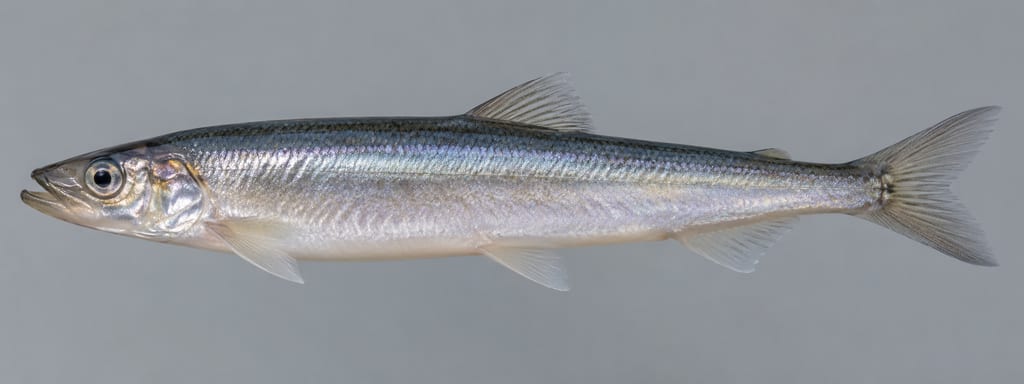
Eulachon, *Thaleichthys pacificus*, is a small anadromous smelt of the North Pacific coast. It spends much of its life at sea and returns in great runs to freshwater rivers to spawn. English sources also write the name as oolichan, hooligan, or candlefish. The fish belongs to the smelt family, not to the salmon family. Its unusual oil-rich body has made it both a food and a source of rendered fat in communities along the coast.
Those common names do not belong to a single uniform cultural vocabulary. Eulachon, oolichan and local Indigenous names appear in different regional and linguistic settings. NPS explains that the word ‘candlefish’ refers to the fish’s high oil content and historic use as a light when dried and threaded with a wick. The oil is one attribute of the raw fish; it is not itself the rendered product.
The species ranges along the Pacific coast of North America from Alaska southward into California, but individual runs use particular watersheds and do not all rise or decline together. NOAA’s species account focuses on the southern distinct population segment in the United States; Canadian conservation assessments separately consider named river populations. A species-wide range map therefore cannot substitute for a population-specific conservation or harvest account.
Eulachon hatch in freshwater, spend several years at sea, then return to rivers to spawn. The adults die after spawning; their bodies and eggs provide food for wildlife and nutrients that move from the ocean into river and forest ecosystems. During a run, sea lions, seals, birds and other fish may gather where the fish enter freshwater. The run is both a food resource for people and an ecological event.
The precise timing and strength of runs vary by river, year and population. Some populations have declined sharply, and conservation assessments describe distinct patterns rather than one condition for the entire species. The Nisga'a Nass/Skeena assessment documents the importance of the Nass River run and its management context; the three-river assessment covers other Canadian populations. NOAA’s listing and management account concerns a U.S. population segment. These documents should not be blended into one present-day status claim.
Run size shapes access. Historically, a dense return could provide a short window for harvesting, processing and sharing fish and fat. A weak run can disrupt both food access and cultural practice. A location in a species’ range does not guarantee that a run remains abundant, that fishing is allowed, or that a traditional harvest can be undertaken today. Local community knowledge and current management decisions are essential.
Coastal Indigenous communities have long used eulachon as food and as a source of fat. The 1982 ethnobiology study documents ooligan grease as a traditional fat among Native people of coastal British Columbia. Kuhnlein and Chan’s later composition study describes variation in family and community practices and examines grease as a food. These papers record important practices, but neither should be treated as a single recipe shared by every nation.
Nuxalk sources describe the fish and grease in the Bella Coola region, where Nuxalk families used a cedar-lined container often called a stink box to ripen whole fish before heating them to render oil. The Nuxalk-hosted thesis by Moody places this practice in a specific community and history. It is not evidence that all First Nations or Alaska Native communities used that vessel or the same sequence.
The Nisga'a people have their own Nass River relationship with eulachon. The COSEWIC Nass/Skeena report records the tradition and its governance under Nisga'a laws. An older three-river assessment describes grease production among several central and northern coastal British Columbia communities and some Alaska communities, while noting that some southern groups used eulachon fresh or smoked without producing grease. Those distinctions matter: a fishery, recipe, vessel, and community cannot be generalized from one ethnographic account.
The raw ingredient is the fresh fish. It may be eaten fresh, dried or smoked, depending on the community and use. A ripened whole fish is another stage, described in Nuxalk accounts before heating and rendering. Eulachon grease is a separate product made by rendering the fish’s oil. The terms are not interchangeable: a basket or box containing fish may indicate a ripening stage, while a pot of clarified fat is the rendered result.
Nuxalk descriptions explain how ripening precedes rendering in their context. They do not establish that every eulachon grease was produced in a stink box, nor that all fish were deliberately fermented before heating. NPS describes the fish’s oil-rich character and traditional uses, but its ecological article is not a preparation standard. The sources also describe communities that ate fish fresh or smoked without making grease.
Rendered grease carries a concentrated share of the fish’s fat and was historically valued for food, trade, sharing and other community uses. The process transforms the raw fish and produces a different ingredient with a different texture and culinary role. The atlas has separate items for eulachon, the rendered grease preparation, dried-and-smoked eulachon, and equipment or structures associated with grease making. Keeping those subjects linked but separate preserves the change of state and the distinct knowledge each requires.
Eulachon return to rivers at different times across their range, often when coastal communities are preparing for a brief seasonal fishery. The timing gives each run local meaning and also imposes practical limits on harvest and processing. Records from the Nass, Skeena and other river systems identify distinct populations; they should not be collapsed into a single calendar date.
Current abundance and legal access also vary. The U.S. southern population segment has federal protections described by NOAA. Canadian COSEWIC assessments offer population-specific conservation findings and discuss threats and Indigenous use. An older assessment’s category is evidence for its assessment date, not necessarily today’s status. Before fishing, readers need current local regulations and the decisions of the relevant rights-holders and managers.
Knowledge about declining or returning runs is held within communities and monitoring bodies. The sources document different programs and different population units, not an interchangeable management plan. Harvest stories should preserve that scale: a Nisga'a account is about Nisga'a law and Nass River experience; Nuxalk practice belongs to the Bella Coola context; Alaska examples need their own source and attribution.
Eulachon’s high oil content is central to its culinary history. The fish provides flesh as food and can yield a fatty product through rendering. Historical accounts describe grease as a staple, a valued trade good and a concentrated source of energy in coastal food systems. Grease was eaten in different ways, including with other foods, but the details vary by family and place.
Nutrition studies measure specific samples and preparations. Their numbers should not be transferred to all eulachon, every run, or every kind of grease. The species’ fat content, fish condition, storage and processing can all affect the product. A dried fish, ripened whole fish and rendered grease are chemically and physically different materials, and nutritional data from one stage do not automatically describe the others.
The fish also has a place beyond the human diet. Its spawning runs support marine mammals, birds and freshwater food webs. A food page can discuss that ecological connection without confusing fish conservation with personal health. A population’s conservation status does not by itself determine whether an individual fish is nutritionally suitable, and nutritional value does not resolve conservation or access questions.
Fresh fish is perishable. Health Canada’s general food-safety guidance recommends keeping food cold, separating raw fish from ready-to-eat foods and cleaning hands and surfaces after handling. Such general practices help prevent contamination during handling; they do not validate a preservation process or give a specific shelf life for eulachon.
Some traditional foods made from fish or marine mammals can pose botulism risk when preparation conditions permit toxin formation. CDC gives prevention guidance for Alaska Native foods, but its page does not specifically identify eulachon grease as a hazard or validate a particular eulachon method. It is appropriate to state the general hazard and the limits of the source without implying that every community’s grease is unsafe.
FDA’s seafood guidance explains that hazards and controls depend on species, source and process. The ethnographic and nutrition papers about eulachon grease are not controlled safety studies. The sources reviewed here do not establish critical salt, acidity, time, temperature, water-activity, storage or freezing limits for home ripening and rendering. Do not turn a historical description into a safe recipe, assume heating or fermentation always controls every hazard, or use smell, taste, bubbling or appearance to decide that food is safe.
Fish is a major food-allergen group under U.S. law. People with a fish allergy should avoid eulachon and prevent cross-contact; local allergen labelling rules vary.
Eulachon, oolichan and hooligan are common English forms, and candlefish is a name tied to the fish’s oil-rich body and use as a light. Community names differ and should be attributed with their language and source. A Nuxalk source’s account of a stink box should not be relabelled as a pan-Indigenous method; the Nisga'a Nass River tradition is likewise specific to Nisga'a people and governance.
The sources reviewed document eulachon use over generations and studies published in 1982 and 1998, but they do not establish an exact beginning for eulachon grease traditions. The date of a paper is not the date a food was invented. History should distinguish oral knowledge, modern research records, conservation reports and current community practice.
The acceptable limits and monitoring of ripening are not documented, practices differ between households, and each community selects a different fish condition or run. Incomplete ethnographic evidence does not support universal directions.
COSEWIC documents the Nisga'a relationship with the Nass River run and management under Nisga'a laws; this association is specific to the Nisga'a and does not locate the species' origin.
Nuxalk sources document local eulachon and grease practices in the Bella Coola context; they do not establish a universal coastal process.
Ethnobiological studies include coastal Alaska in their account of ooligan grease; the evidence is not a claim that all Alaska Native communities share one practice.
Dry salami, sour pork with rice, matured sheep and aged blubber follow different paths from animal to food. Their stories connect microbes with climate, slaughter, migration and the meals people share.
Salmon roe is the eggs of salmon, eaten fresh, salted or dried and preserved in distinct regional ways. Nuxalk records distinguish fresh roe from aged mutsi; those accounts are historical, not safe-process instructions.
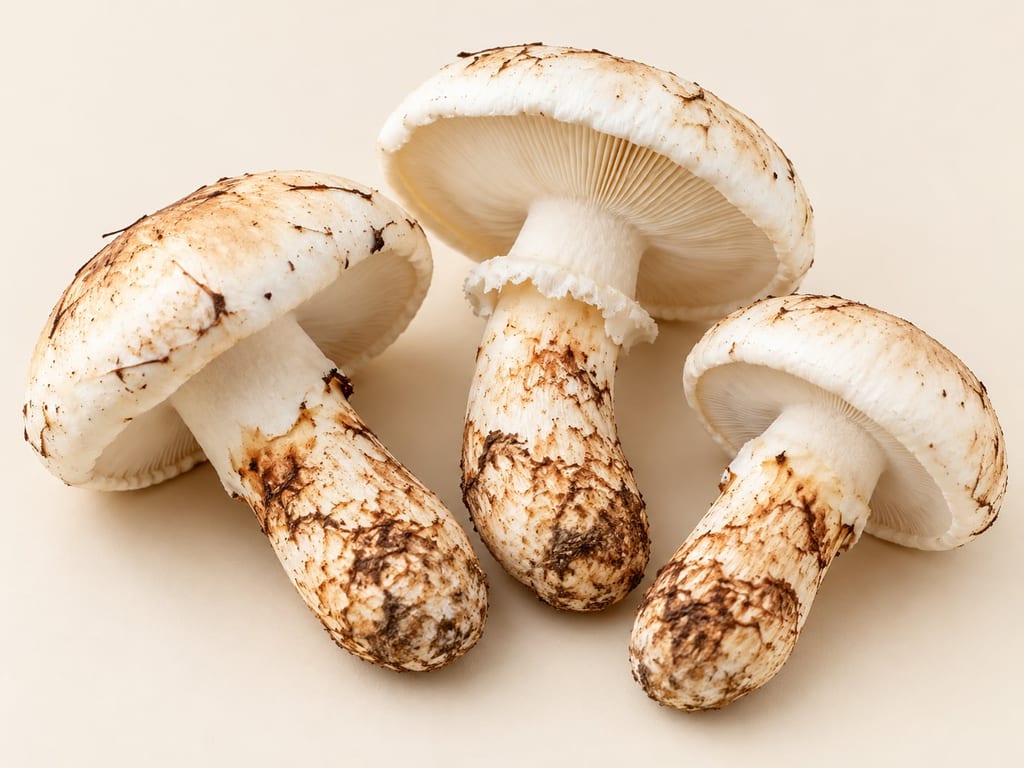
Western matsutake is an aromatic wild mushroom native to western North American forests. Its name overlaps with related matsutake species, so field or market labels alone cannot establish a safe identification.
No community contributions have been published for this entry yet.
Sign in to contribute. Published comments and photos are free to read.
Journal of Food Composition and AnalysisHistory · Use · Biology
Ooligan grease: a traditional food fat of western Canada and AlaskaDescribes ooligan grease as a traditional food fat and reports study findings on its food composition; practices vary by family and community.
Cited in: Food and trade in named communities; Nutrition and culinary roles; Names, dates and what remains uncertain
Journal of EthnobiologyHistory · Use
Ooligan grease: a nutritious fat used by native people of coastal British ColumbiaDocuments eulachon grease use among coastal British Columbia communities and records community variation; it is not a safety protocol.
Cited in: Food and trade in named communities; Fresh fish, ripening, drying and grease; Nutrition and culinary roles; Names, dates and what remains uncertain
Nuxalk NationHistory · Use · Geography
Eulachon past and presentDocuments Nuxalk Bella Coola fishery and accounts of eulachon and grease practices, including a cedar-lined stink box; does not establish a universal method.
Cited in: Food and trade in named communities; Fresh fish, ripening, drying and grease; Names, dates and what remains uncertain
Government of CanadaBiology · Geography · History
COSEWIC assessment and status report on the Eulachon, Nass/Skeena populationDescribes Nass/Skeena population context, Nisga'a traditions and management under Nisga'a laws; population-specific findings are not a whole-species status.
Cited in: River runs and coastal ecology; Food and trade in named communities; Seasonal harvest and changing access; Names, dates and what remains uncertain
Government of CanadaBiology · Geography · History
COSEWIC assessment and status report on the Eulachon in Canada, three-river populationsDocuments separate Canadian river populations and regional use of eulachon and grease; its assessment status is date-specific.
Cited in: River runs and coastal ecology; Seasonal harvest and changing access
NOAA FisheriesIdentity · Biology · Geography
EulachonSupports species identity and Pacific coast range; the current status information concerns the U.S. southern distinct population segment, not all eulachon.
Cited in: The fish behind several names; River runs and coastal ecology; Seasonal harvest and changing access
Alaska Park Science / National Park ServiceIdentity · Biology · Use
Eulachon: A Little Fish with Many Names and a Big Ecological ImpactExplains common names, run ecology and ecological impacts; helps distinguish fish from rendered grease.
Cited in: The fish behind several names; River runs and coastal ecology; Fresh fish, ripening, drying and grease; Seasonal harvest and changing access; Nutrition and culinary roles
Centers for Disease Control and PreventionSafety
Botulism PreventionProvides general prevention guidance for Alaska Native foods; the page does not specifically identify eulachon grease or validate its process.
Cited in: Handling and food safety
Health CanadaSafety
Food safety and youGeneral safe handling advice for keeping raw food cold, separating raw fish and cleaning surfaces; it does not provide eulachon-specific storage limits.
Cited in: Handling and food safety
U.S. Food and Drug AdministrationSafety
Fish and Fishery Products Hazards and Controls Guidance, June 2022 EditionExplains that seafood hazards and controls depend on species, source and process; it does not validate traditional eulachon grease methods.
Cited in: Handling and food safety
U.S. Food and Drug AdministrationSafety
What is a “major food allergen”?Identifies fish as a major food-allergen group under U.S. law.
Cited in: Handling and food safety