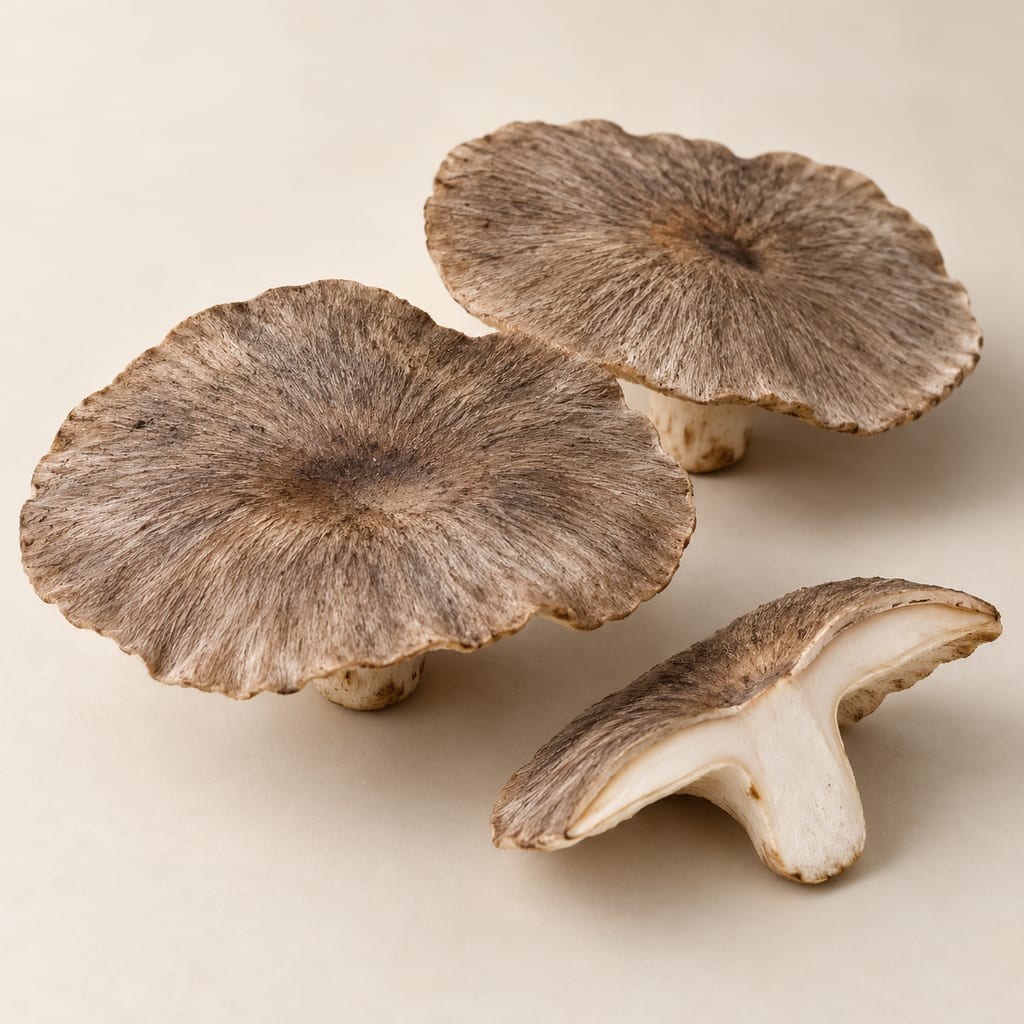
Bresadolia paradoxa
Bresadolia paradoxa is a large fungus of dead hardwood logs in Amazon and Atlantic Forest sites in Brazil and Colombia. Its only edibility source is a conservation assessment, so the claim is lightly documented.
 FermenteaWhere food goes to change
Mushrooms
The white oyster mushroom, Pleurotus albidus, is a wood-rotting oyster of Amazonian and Atlantic Forest Brazil and parts of Mexico. Its food use is catalogued, and it has been proposed for commercial cultivation.
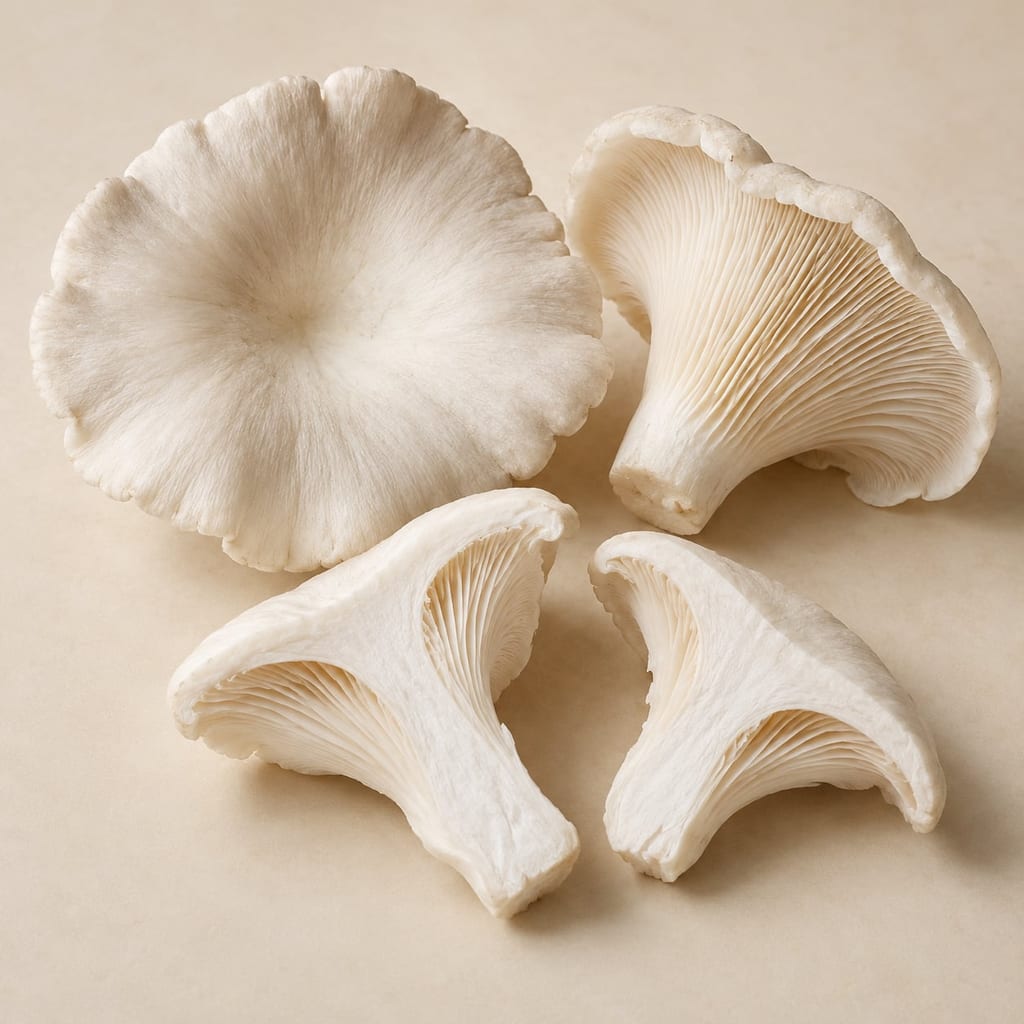
Pleurotus albidus is a white-rot fungus that grows on dead wood, usually in gregarious clusters. The IUCN entry records it from about 70 sites in the Amazon and in the southeastern and southern Atlantic Forest of Brazil, and also from Colombia, Peru, Mexico and Argentina.
It was first described as Lentinus albidus by Berkeley in 1843, from material collected on citrus in Minas Gerais, Brazil. The name was later moved into Pleurotus, and a 2013 molecular study confirmed its presence in Brazil alongside several other Pleurotus species.
The supplied catalogue records the species as a Neotropical edible oyster, and the IUCN entry describes it as edible. Neither source gives a local name, a recipe or a preparation.
In 2011 Lechner and Albertó proposed the species as a new candidate for commercial production, citing high biological efficiency and tests on willow sawdust and wheat straw substrates. A 2016 study of an Amazonian strain grown in liquid culture showed that the mycelial biomass could be increased by varying the carbon source, and it suggested that biomass could serve as food or a supplement.
Documented occurrence and consumption do not establish a standardised food-safety assessment, as the supplied catalogue states. The sources read here give no toxicity data and no poisoning records for the species.
The open questions are the local Brazilian names, the traditional preparations and whether cultivated material is sold. Identification should be confirmed from a voucher specimen by a regional expert.
The catalogue records a Brazilian food-use entry. The IUCN entry places the species at about 70 sites in the Amazon and in the southeastern and southern Atlantic Forest.
Recorded from Hidalgo, Morelos, Veracruz and Tabasco. The sources give no food use for Mexico.
Bresadolia paradoxa is a large fungus of dead hardwood logs in Amazon and Atlantic Forest sites in Brazil and Colombia. Its only edibility source is a conservation assessment, so the claim is lightly documented.
No community contributions have been published for this entry yet.
Sign in to contribute. Published comments and photos are free to read.
Springer (via supplied fungi catalogue)Food use
Supplied catalogue source for Brazilian fungi, Springer, 2024Brazilian food-use record for Pleurotus albidus as a Neotropical edible oyster on wood; documented occurrence does not establish a standardised food-safety assessment
Cited in: Identity and habitat; Safety and open questions
IUCN Red ListDistribution · Ecology · History
Pleurotus albidus, IUCN Red List species viewEdible species known from about 70 sites in the Amazon (Brazil, Colombia, Peru) and the southeastern and southern Brazilian Atlantic Forest; first described as Lentinus albidus by Berkeley in 1843 from citrus in Minas Gerais; white-rot wood decomposer that grows in clusters on dead wood; recorded from Mexico and Argentina
Cited in: Identity and habitat; Food use and cultivation; Safety and open questions
Brazilian Journal of MicrobiologyMethod · Food use
Production of mycelial biomass by Amazonian Pleurotus strain (Brazilian Journal of Microbiology, 2016)A 2016 submerged-fermentation study of an Amazonian strain found that diversifying carbon sources raised biomass and suggested the biomass could be used as food or a supplement
Cited in: Food use and cultivation