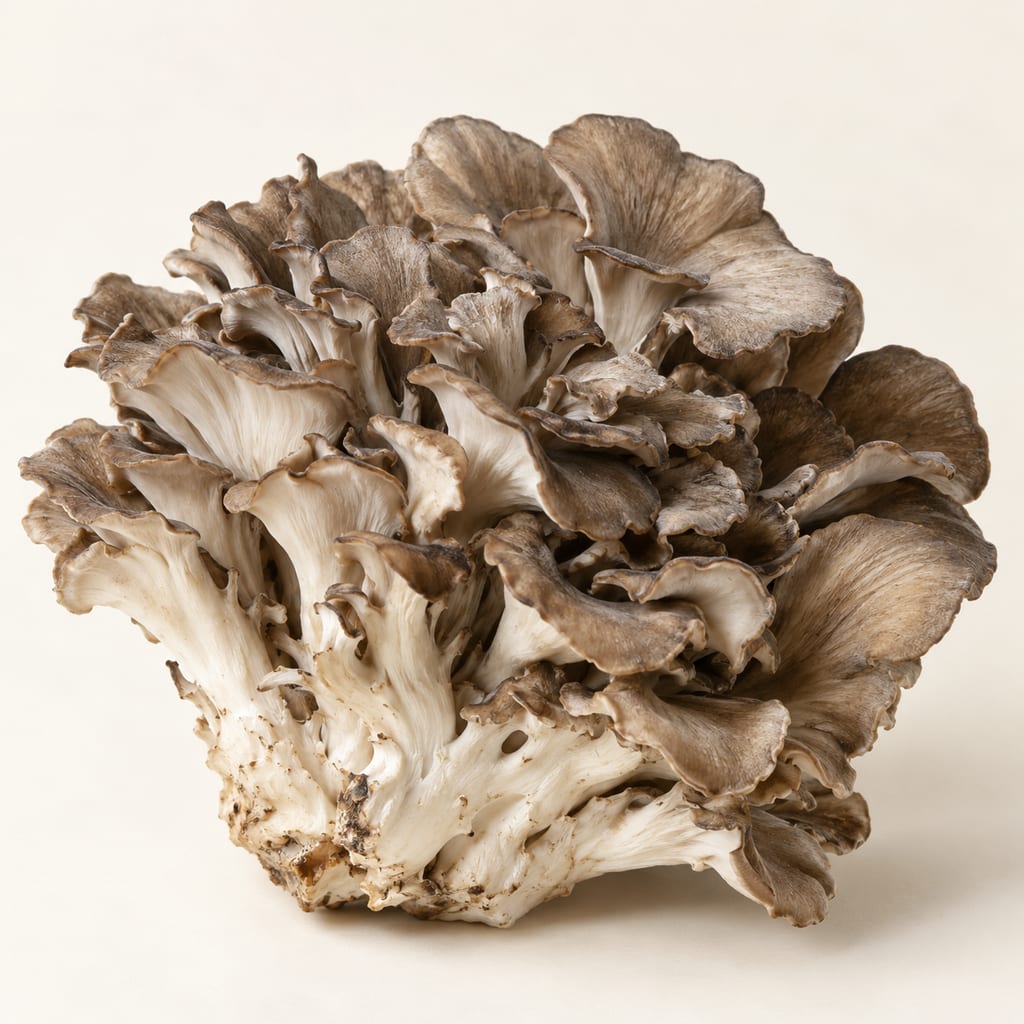
Maitake
Maitake, Grifola frondosa, is a clustered polypore that grows at the base of old trees, eaten in China and Japan for centuries and cultivated indoors since the 1980s.
 FermenteaWhere food goes to change
Mushrooms
Leccinellum rugosiceps is a bolete of oak woodland across the Americas and parts of Asia, recorded as an edible wild mushroom whose quality reviewers rate variously and whose identification needs care.
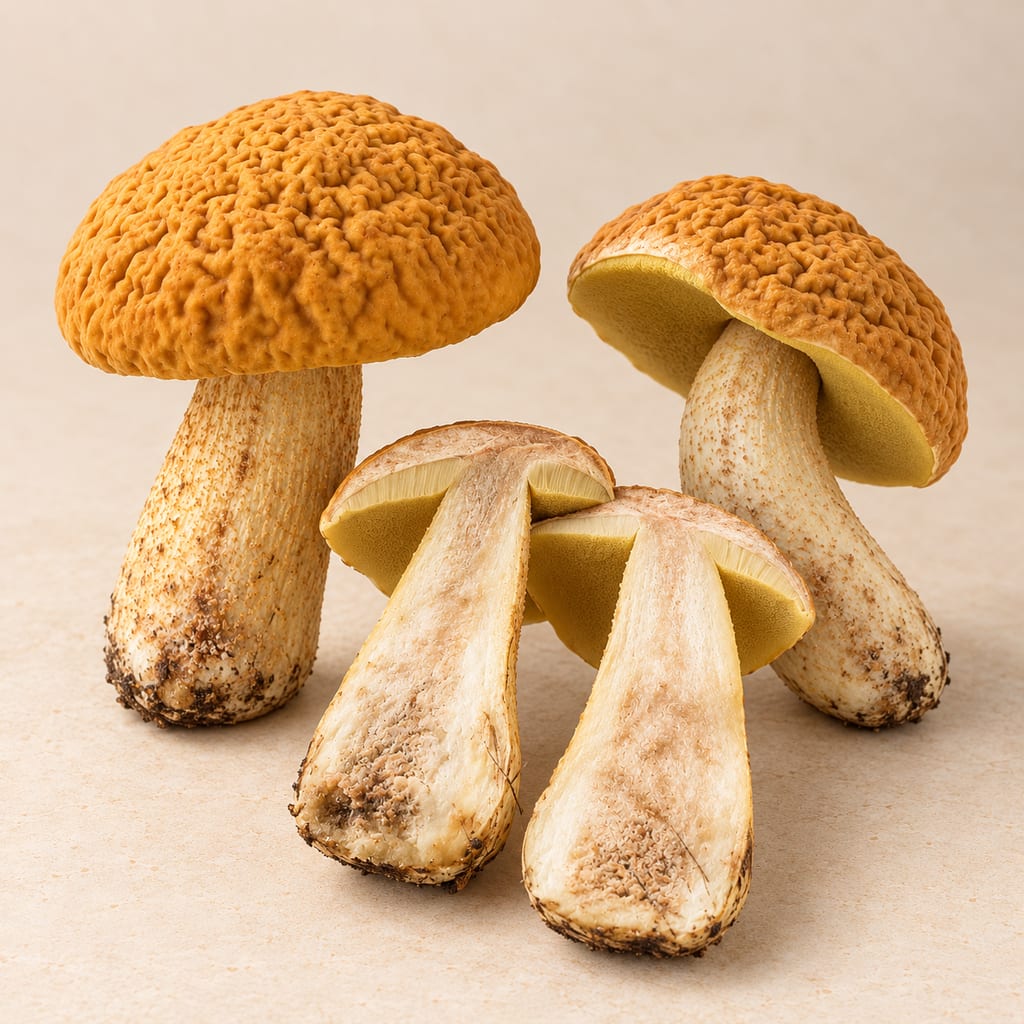
Leccinellum rugosiceps is a bolete with a wrinkled cap that is convex and orange-yellow when young and becomes wrinkled and cracked with age. Charles Horton Peck first described it in 1904 as Boletus rugosiceps, from woods at Port Jefferson, New York. Rolf Singer moved it to Leccinum in 1945, and it is now placed in Leccinellum, with the current name credited to C. Hahn (2020).
The catalogue gives the names Wrinkled-cap scaber stalk and Leccinum rugosiceps as search aliases. Earlier generic names, including Krombholzia and Krombholziella, are obsolete.
The species forms ectomycorrhizal partnerships with oaks. It grows singly or in groups in forests and shaded lawns, often in disturbed places such as pathsides and picnic areas. In eastern North America pin oak, Quercus palustris, is a frequent host. Fruiting is recorded from July to September.
In the United States it occurs from eastern Canada south to Florida and Mississippi and west to Michigan. It extends south to Mexico, Costa Rica and Colombia, and in Asia it has been reported from India, Korea, China and Taiwan. The catalogue gives Mexico as its regional food record.
The species is considered edible, though opinions on its quality vary from good to poor. It has a nutty flavour and a firm texture, and drying is recorded as enhancing the flavour. The stem often harbours insect larvae and should be cleaned before cooking.
A Chinese study found cadmium, zinc, copper and mercury above national safety limits for edible fungi in this species. That finding is a reason for caution about where the mushroom is gathered, and it should be weighed in any food use.
The cap changes colour a great deal as it develops, which makes field identification difficult. The flesh stains reddish to burgundy when cut and then turns grey to blackish over 20 to 60 minutes. Leccinellum crocipodium is a difficult look-alike, and Leccinum neotropicalis is a closely allied species. The encyclopedia entry notes that chemical tests with ammonium hydroxide, potassium hydroxide and iron(II) sulfate can help confirm identification.
This page is not an identification guide. Anyone gathering the mushroom should confirm identity with an expert before eating it.
Range from eastern Canada south to Florida and Mississippi, west to Michigan.
Regional food-use record in the supplied catalogue; the sources do not name a locality.
Range only; the sources do not record food use here.
Range only; the sources do not record food use here.
Range only, reported in Asia; food use not recorded here.
Range only, reported in Asia; food use not recorded here.
Range only; a Chinese study recorded heavy-metal levels above national limits in this species.
Range only; food use not recorded here.
Maitake, Grifola frondosa, is a clustered polypore that grows at the base of old trees, eaten in China and Japan for centuries and cultivated indoors since the 1980s.
No community contributions have been published for this entry yet.
Sign in to contribute. Published comments and photos are free to read.
WikipediaTaxonomy · Distribution · Habitat · Food use · Identification · Cautions
Leccinellum rugosicepsTaxonomy from Peck (1904) to Hahn (2020); synonyms
Oak ectomycorrhiza; pin oak host; fruiting July to September
Edibility opinions; cleaning the stem; heavy-metal study
Identification features and look-alikes
Fermentea research programmeCatalogue record
Supplied catalogue record F-d4082dfc43eaRegional food-use record for Mexico; scaber-stalk boletes need careful identification