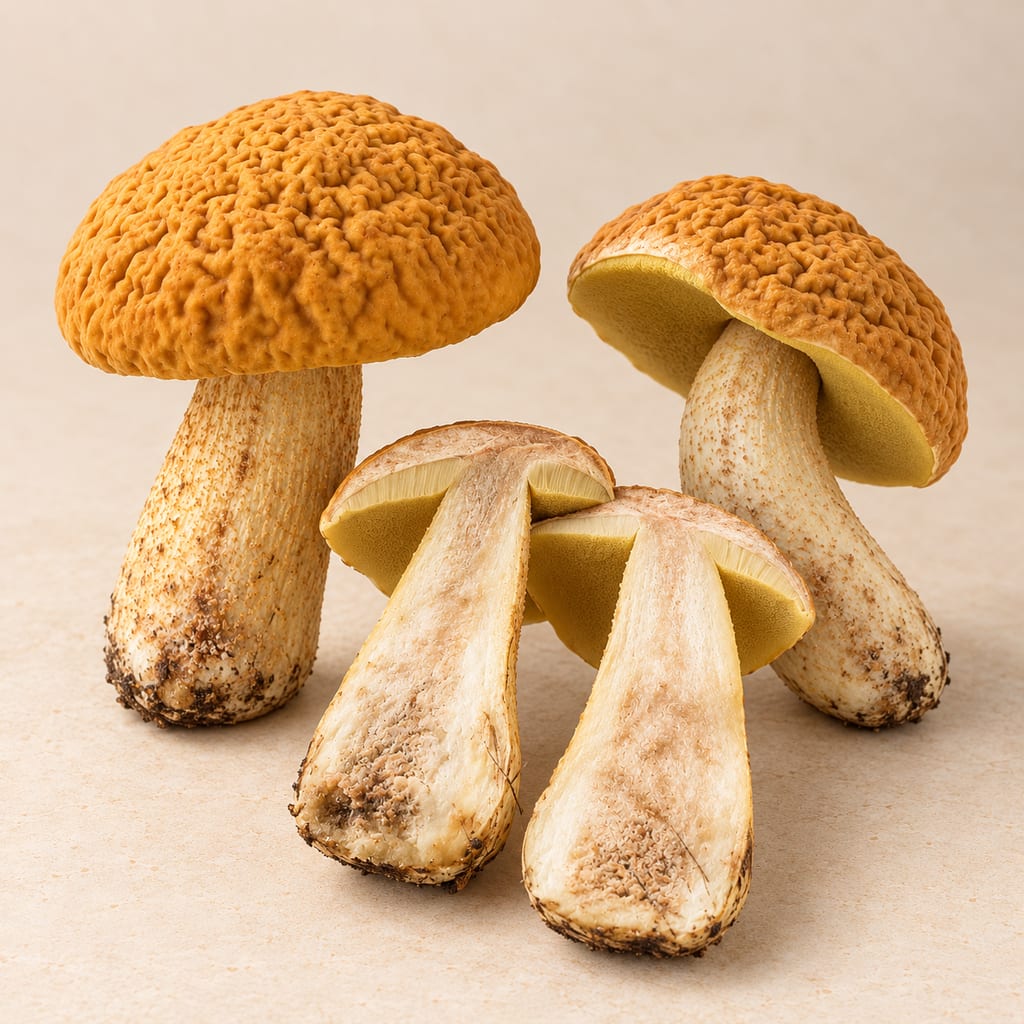
Wrinkled-cap scaber stalk
Leccinellum rugosiceps is a bolete of oak woodland across the Americas and parts of Asia, recorded as an edible wild mushroom whose quality reviewers rate variously and whose identification needs care.
 FermenteaWhere food goes to change
Mushrooms
Maitake, Grifola frondosa, is a clustered polypore that grows at the base of old trees, eaten in China and Japan for centuries and cultivated indoors since the 1980s.
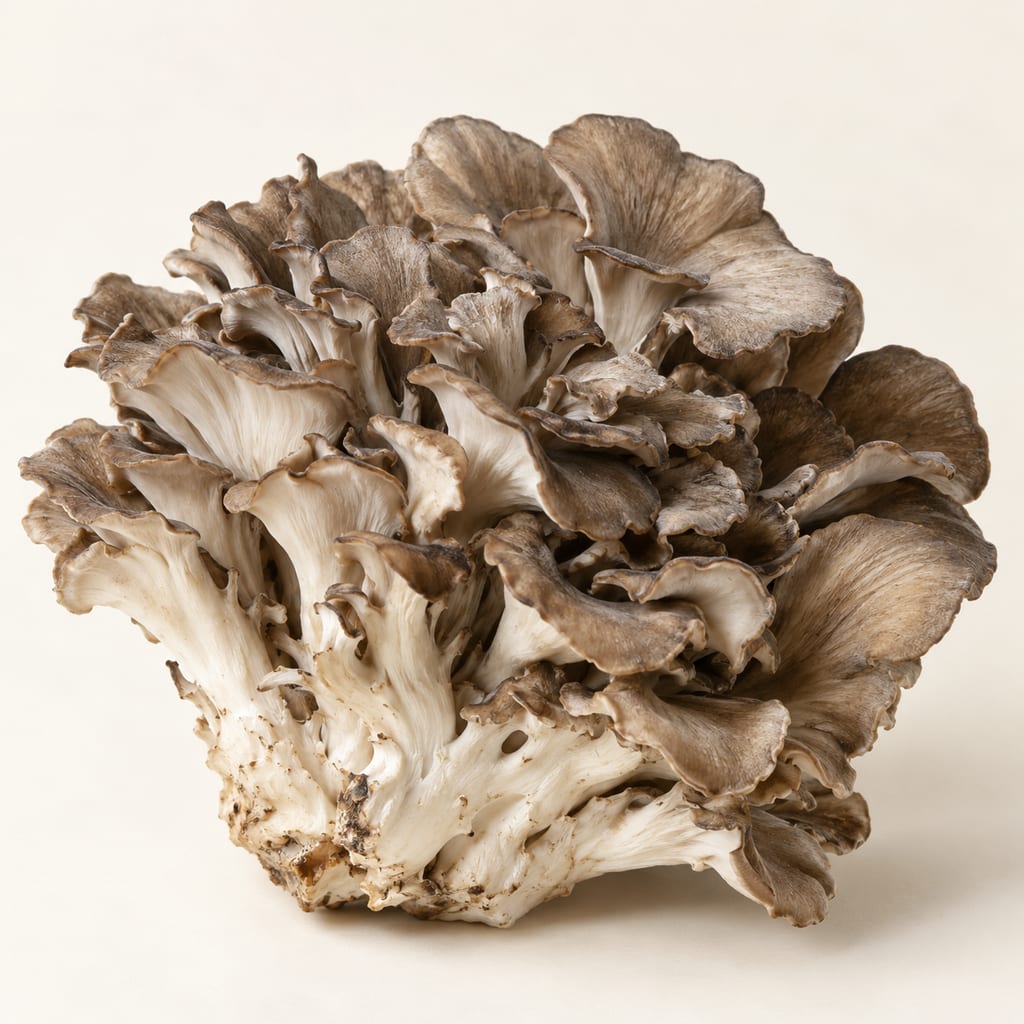
Maitake is the fruiting body of Grifola frondosa, a polypore that forms a large, branching cluster of fan-shaped caps with small pores underneath rather than gills. It is a perennial that grows at the base of trees, most often old oaks and maples, and often returns to the same place for several years. In English it is called hen-of-the-woods, and in Japanese maitake means dancing mushroom. Other names include sheep's head and ram's head.
The cluster is made of many thin caps joined at a common base. Cooks tear it into pieces by hand rather than cutting it, because the caps separate along their natural lines. The species was first described as Boletus frondosus by Dickson in 1785, and it is placed in Grifola by Gray in 1821.
The wild species occurs in China, Europe and North America. It is most common in eastern North America and has been found as far west as Idaho. Fruiting in Europe runs from August to October, and in eastern North America from September to October. It has been eaten for centuries in China and Japan, where it appears in nabemono hotpots, tempura, takikomi gohan (mixed rice), and soba.
The young caps are the most prized. The softer caps must be cooked thoroughly, and the mushroom can be pickled. Some people are allergic to it.
Japan was among the first countries to cultivate maitake artificially, starting in the mid-1980s. Researchers in the 1970s had worked on growing it at scale on logs and sawdust substrates. In the 1980s indoor techniques allowed temperature, humidity and carbon dioxide to be controlled closely. Bag culture on a sawdust-based substrate is now the most common method in Japan, mainly because it is cheap and the indoor environment is easy to control. The sources do not give yields, cycle lengths or substrate recipes, so this page does not give them.
The same encyclopedia entry places wild and cultivated maitake under the category of fungi in cultivation, and cultivated maitake is now widely sold. The catalogue record for the species describes it as widely cultivated.
Maitake tastes sweet and savoury. The encyclopedia entry attributes this to its trehalose, to glutamic and aspartic acids, and to 5'-nucleotides. Those are the compounds that give the mushroom its depth in broth and in fried dishes. The softened caps need longer cooking, and the firm inner parts stay textured after frying.
In Japanese cooking the clusters are added to rice dishes, simmered in hotpots, dipped in tempura batter and added to soba. The clusters hold their shape well in broth, which is why they suit nabemono and slow-simmered dishes.
Maitake is widely promoted for health. Its antitumour activity was first reported in the 1980s from hot-water extracts of the fruiting body, and later research has focused on its polysaccharides. The Wikipedia article reports that no high-quality clinical evidence supports medicinal use, and that as of 2019 no completed high-quality Phase III trials existed. A 2009 study found a sulfated polysaccharide from the species could act as an immunomodulator in breast cancer survivors, and its authors noted the whole mushroom may not produce the same effect. This page treats those claims as preliminary.
The Wikipedia article gives no cultivation history section, so the Japanese dates here come from the encyclopedia entry. The catalogue treats the scientific name as a research label rather than a settled name. The sources do not give a shelf life or a drying method, so this page gives none.
Japan is documented for early indoor cultivation from the mid-1980s and as the main market for bag culture.
The Wikipedia article reports centuries of eating in China and Japan; the sources do not give a single region.
Wild occurrence documented, most common in eastern North America and found as far west as Idaho; wild collection is the source's description, not a food record.
Leccinellum rugosiceps is a bolete of oak woodland across the Americas and parts of Asia, recorded as an edible wild mushroom whose quality reviewers rate variously and whose identification needs care.

Soft, spreadable Calabrian pork sausage made with a great deal of red chilli and fatty pork, stuffed into natural casings, sometimes smoked and matured while staying soft.

A way to add independent temperature logging to an existing food dehydrator without changing its built-in controls or protections. It is a monitoring method, not a rewiring plan.

Pleurotus cystidiosus is the abalone mushroom, a cultivated oyster-type fungus with dark brown caps that grows more slowly and is more demanding than other Pleurotus species.

A dark, balanced vinegar from Emilia-Romagna made by combining cooked or concentrated grape must with wine vinegar, then acetifying and refining it in wood under a protected specification.

A living dairy inoculum that starts controlled cream fermentation, developing acidity and aroma before sour cream or cultured butter is finished.

A small electric incubator holds jars at a selected temperature for yogurt and other documented warm food preparations. Controls, capacity and vessel arrangement vary by model.

Adygean salt is a seasoned table salt associated with Adygea and the wider North Caucasian culinary tradition. Salt is blended with garlic and a variable selection of herbs and spices; the exact mix depends on the named style and maker.

The African Caesar-group mushroom, Amanita masasiensis, is a wild ectomycorrhizal species of central and southern African woodlands, eaten locally. The genus contains deadly poisonous species, so identification needs care.
No community contributions have been published for this entry yet.
Sign in to contribute. Published comments and photos are free to read.
WikipediaLead · Identity · Culinary · Health claims
Grifola frondosaTaxonomy and authority; Boletus frondosus basionym 1785; Gray 1821
Common names and host trees; perennial habit
Distribution and fruiting months
Culinary uses, pickling, allergy caution
Health claims and absence of high-quality clinical evidence as of 2019
Cited in: What it is; Where it grows and where it is eaten; How it came into cultivation; Flavour and how it cooks; Health claims and what the evidence supports; Notes and open questions
Encyclopedia.pubHistory · Cultivation · Flavour
Maitake (encyclopedia entry)Cultivation in Japan from the mid-1980s; logs and sawdust work in the 1970s
Indoor control of temperature, humidity and CO2 in the 1980s
Bag culture as the main Japanese method
Trehalose, glutamic and aspartic acid, 5'-nucleotides
Antitumour reports from the 1980s hot-water extracts
Cited in: How it came into cultivation; Flavour and how it cooks; Health claims and what the evidence supports; Notes and open questions