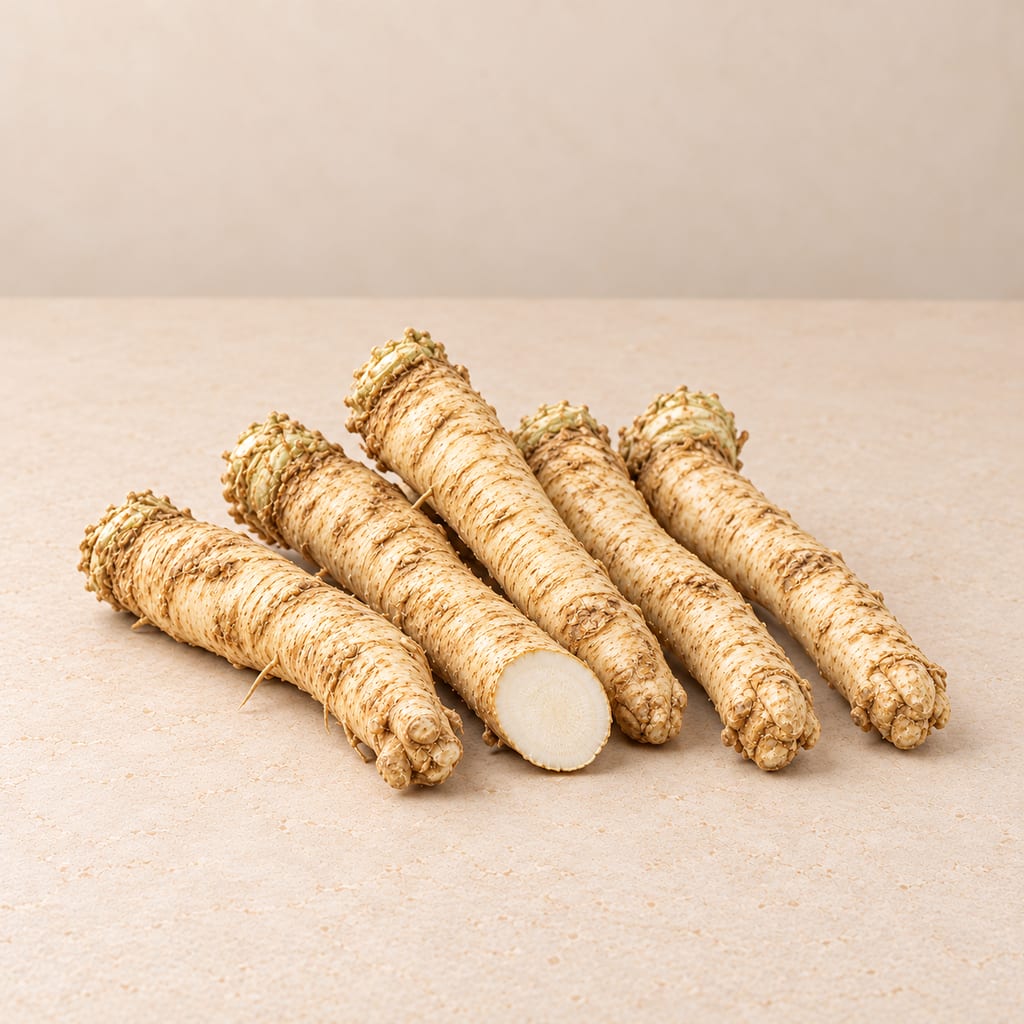
Horseradish root
Horseradish is the long white root of Armoracia rusticana, a perennial of the mustard family. Grated, it releases a sharp, nose-clearing heat that vinegar fixes in the sauce.
 FermenteaWhere food goes to change
Spices and aromatics
Yaupon is the caffeinated leaf of the southeastern North American holly Ilex vomitoria, dried and sometimes roasted for infusions. Its identity and cultural history differ from other hollies.
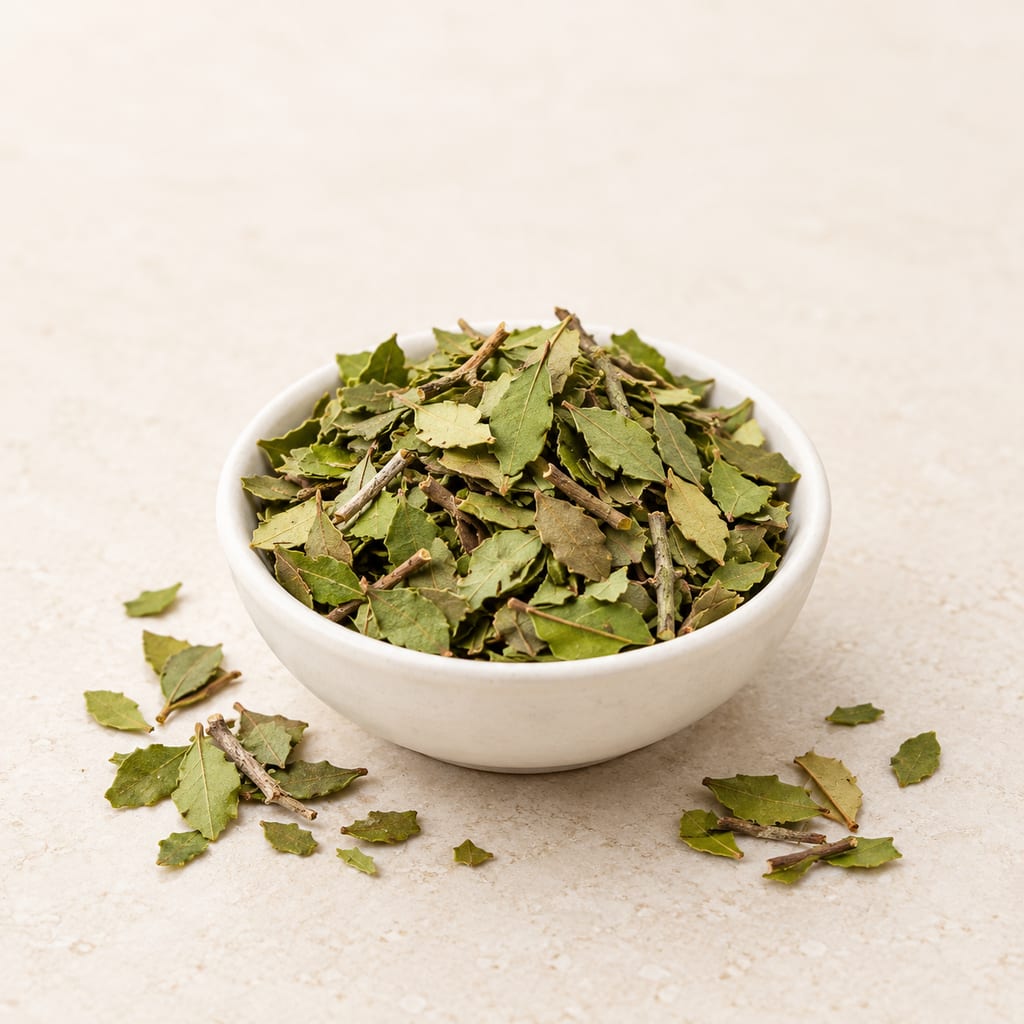
Yaupon is the leaf of Ilex vomitoria Aiton, an evergreen holly in the family Aquifoliaceae. The plant grows as a many-branched shrub or small tree. Its leathery leaves are arranged alternately on the stems, oval to elliptical, with shallow teeth along the edge; the upper surface is glossy dark green and the underside paler. A mature plant can reach several metres, and older branches carry pale grey bark. On female plants, small translucent red fruits may persist through winter. The leaves, rather than the fruit, are the culinary material used for infusion. In dried commercial form they appear whole, cut or broken, often with a few fine stems; colour ranges from green and olive to brown according to leaf maturity and processing.
Yaupon is sometimes called yaupon holly, cassena, cassina or cassine. Its botanical name distinguishes it from other caffeine-bearing hollies such as South American yerba mate, Ilex paraguariensis, and guayusa, Ilex guayusa. All are related members of Ilex, but they are different species with distinct growing ranges and food histories. Yaupon is also not Camellia sinensis, the plant used for black, green, white and oolong tea. “Tea” on a yaupon package describes the infused drink, not the botanical identity. Its small, leathery leaf and naturally present caffeine are more useful identification points than its common name alone.
The USDA Natural Resources Conservation Service guide places yaupon in the Coastal Plain of the southeastern United States. It describes the species in coastal and inland settings including sandy hammocks, dunes, maritime forest, pine flatwoods, well-drained woodland, forested wetlands and the upper edges of brackish or salt marshes. The species tolerates a broad range from dry to fairly wet soils and can withstand salt spray; it is better adapted to warm climates than many evergreen hollies. Those notes explain why yaupon is encountered both in natural thickets and as an ornamental hedge, but they are not a harvest map and do not establish that every hedge or nursery plant is grown for food.
The shrub can form dense stands through root suckers, and it tolerates pruning and shearing. It is dioecious: male and female flowers are borne on separate plants, so fruit set depends on pollination. The USDA guide gives spring flowering and red fruit on female plants as identification features. These botanical traits matter to a forager because foliage, berries and similar holly species may be present together, while beverage use concerns identified leaves. Yaupon’s wide horticultural use can make a plant seem familiar, but familiarity is not a reliable species identification or permission to pick from someone else’s landscape.
Yaupon has a documented place in Native communities of the Southeast as a plant whose leaves and shoots were brewed into a caffeinated drink. The USDA plant guide records that the infusion known as black drink served social, ceremonial and medicinal purposes, and notes that trees were traded and probably transplanted and tended by Native people. Those broad older summaries are not a substitute for the knowledge of particular communities. Florida’s Division of Historical Resources discusses yaupon in the foodways of Native Floridians and names Apalachee, Creek, Seminole and Muskogee peoples in the context of a drink referred to as the white drink. It describes the term’s association with particular cultural practices and explains that the name black drink was later used by English colonists for the dark brew. The labels are historical descriptions from outside and inside different traditions; they do not make every community’s beverage, purpose or recipe identical.
Archaeology pushes evidence of Ilex drinks beyond the written colonial record, but it needs species-level care. At Cahokia, in present-day Illinois, residue analyses from beaker vessels dated about AD 1050–1250 identified a combination of chemical markers consistent with holly of the genus Ilex. The study argued that the drink’s plant material had been transported from farther south, beyond the known local range. It did not prove that every tested vessel contained yaupon: the authors say Ilex cassine cannot be excluded and that more than one species may have been used. The finds therefore establish early use of an Ilex beverage at Cahokia, not an unbroken, species-specific recipe or a precise first date for yaupon itself.
Historic accounts of southeastern black drink describe preparation from parched leaves and small twigs, followed by boiling or steeping in water; the PNAS study summarizes these accounts alongside the residue work. The Florida state history also preserves the name cassina, a term borrowed through Indigenous languages and Spanish colonial use. Such records document exchange and encounter as well as beverage making. They are written through colonial observers and later historians, so an ingredient page should report what a source says without turning an outsider’s description into a universal account of Native practice.
Yaupon’s leaves contain caffeine, a purine alkaloid that dissolves into water during brewing. Chemical profiling of Ilex species found caffeine and other purine alkaloids in Ilex vomitoria, supporting it as the botanical source of yaupon tea. The same study did not corroborate older reports of caffeine in Ilex cassine, which helps explain why the historic and archaeological distinction matters. A separate study of leaf stage and roasting found that the chemical profile varies with leaf age: in its samples, methylxanthines were highest in the youngest leaves and caffeine declined substantially as leaves aged. That paper’s result is evidence of variation, not a universal prediction for every plant or cup.
Roasting changes aroma and flavour chemistry as well as appearance. The 2026 leaf-processing study reports that roasting changed several compounds associated with flavour, while it did not measurably change caffeine in the tested leaves. The researchers describe roasting-related changes resembling those seen in roasted coffee and tea, but yaupon remains its own leaf material and the paper does not establish a standard roast for all commercial products. A pale green, unroasted style and darker roasted leaves should therefore be treated as different processing choices rather than different species. The colour of the dry leaf alone does not tell a reader how much caffeine a serving contains.
The ingredient is harvested foliage, usually sold dried so it can be stored and infused. The plant’s leaves are leathery and relatively small; cutting or breaking them exposes more surface to water, while larger pieces remain visually identifiable. Product forms vary by producer: whole dried leaves, coarse cut leaf, mixed leaf and fine stem fragments, and roasted or unroasted material all occur. These are not necessarily standardized grades. The leaf-age study demonstrates that harvest stage affects measured chemistry, and the USDA guide documents the evergreen shrub’s broad natural and planted distribution; neither source supports a single ideal harvest date or a universal drying specification.
Commercial descriptions provide examples rather than a reliable specification for the whole category. One Texas-grown product is sold unroasted as green yaupon and described as producing a pale yellow infusion with grassy and citrus-like notes; another product page illustrates dried leaves and twigs sold for brewing. These supplier statements show current forms and tasting language, but the adjectives are not guaranteed sensory traits, and a single origin does not represent all yaupon. A seller’s roasting label, cut size, harvest source and ingredient statement are more informative than a broad claim that yaupon always tastes a particular way. No botanical standard for “green,” “light roast” or “medium roast” was found in the sources reviewed.
Yaupon is used primarily as an infusion: dried leaves are brought into contact with hot water, then the drink is strained or poured away from the leaf. The liquid’s strength depends on choices such as the leaf-to-water ratio, leaf particle size, water temperature, contact time and whether the leaves have been roasted. Since this ingredient record is not a brewing formula, it gives no fixed dose or steeping time. Commercial suppliers offer their own instructions, and a cook should follow the directions on the food-grade product they have rather than treating a supplier’s method as a historic or universal standard.
A cup made from unroasted leaves may be light in colour and is described by one current seller in grassy, citrus-like terms; roasting may give a darker, toastier profile. These are useful starting descriptions, not a promise that all batches match. Yaupon can be served warm or chilled and used wherever a brewed leaf infusion is wanted, but sweeteners, milk or flavourings change the cup and should not be treated as inherent ingredients. Its caffeine distinguishes it from many caffeine-free herbal infusions. The comparison with yerba mate is botanical and chemical, not a guarantee of equal strength or interchangeable brewing directions.
The linked Black drink preparation records a historically important use of yaupon, but its cultural context belongs with that preparation and the cited historical sources. The ingredient page identifies the leaf and its variation; it does not turn a culturally specific ceremonial drink into a generic modern recipe. If the infusion is incorporated into a ferment, the recipe needs to explain its own ingredient amount, timing and safety controls. Yaupon’s presence in a drink does not by itself make the process a fermentation, nor does the leaf provide a documented preserving function.
Choose a product that clearly names Ilex vomitoria or yaupon leaves and is sold for food or infusion. Check whether it is whole or cut, roasted or unroasted, and whether the ingredients list includes anything besides yaupon. The scientific name helps distinguish it from another holly or from other plants that may be sold under an informal common name. For a purchased product, retain its label and follow its storage directions; the sources reviewed do not provide a validated storage duration or a universal moisture limit for home-dried leaves. Keep dry material closed and protected from dampness as ordinary dry-herb handling, but do not infer that this prevents all quality loss or contamination.
Wild harvesting requires reliable plant identification and a known clean site. The USDA guide describes the glossy, shallow-toothed leaves, pale undersides and red fruit of yaupon, but a short written description is not enough to identify an unfamiliar plant safely. Do not assume a cultivated hedge is untreated or intended for harvest. The plant is also used ornamentally and its fruit is a food source for wildlife. The ingredient material is leaf, not the red fruit. The source guide does not give a food-grade harvest protocol, pesticide rule or test for plants collected near roads, treated landscapes or contaminated ground; those gaps make a traceable food-grade product the more defensible choice when identification or site history is uncertain.
Yaupon is caffeinated. The amount reaching a cup varies with plant, leaf age, processing and brewing, and the studies reviewed do not establish a standard amount per serving for the products sold today. Readers who need to monitor caffeine should count yaupon as a caffeine-containing infusion and use the product’s own serving information where available; no medical or pregnancy guidance is inferred here. The available food and botanical sources do not establish a universally safe amount, an interaction profile, a decaffeinated form, or a medical benefit, so the page makes none of those claims.
The USDA plant guide warns that yaupon berries are poisonous and can cause nausea, vomiting and diarrhoea. Fruit is not the documented beverage ingredient; this page is about leaves. The warning supports a clear separation of leaf from fruit, not the conclusion that every plant part or every preparation is safe. Correct species identification, absence of spray or contamination, and food-grade handling matter. The guide is a general botanical source and does not provide a modern toxicological assessment of brewed leaves. No controlled dose range, full allergen assessment, safe-for-every-person claim, or storage-life study was located in the sources reviewed. Those are open safety gaps, not invitations to substitute guesses.
The USDA guide describes the species’ southeastern Coastal Plain range; Florida’s state history documents particular Native Floridian foodways. This broad row does not assign one practice to every community.
Vessels from Cahokia and surrounding sites carry Ilex residue markers; the study area is broader than the central city and the analysis cannot establish Ilex vomitoria specifically.
One current supplier describes its yaupon as single-origin Texas product; this is an example, not a complete map of modern production.
Horseradish is the long white root of Armoracia rusticana, a perennial of the mustard family. Grated, it releases a sharp, nose-clearing heat that vinegar fixes in the sauce.
No community contributions have been published for this entry yet.
Sign in to contribute. Published comments and photos are free to read.
USDA Natural Resources Conservation ServiceIdentity · Distribution · Cultivation · Traditional use · Safety
Yaupon (Ilex vomitoria Ait.): Plant GuideScientific name, holly family, leaf and fruit description, Southeastern Coastal Plain distribution and habitat
Guide documents caffeine in leaves and historic leaf-and-shoot decoctions, while noting historical uses and trade
The guide warns that berries are poisonous and may cause nausea, vomiting and diarrhea; it does not establish a serving dose or a modern assessment of brewed leaf safety.
Cited in: What yaupon is; Native range and habitat; A long history with careful limits; Infusion, flavour and use; Choosing and keeping yaupon; Safety and what remains unknown
Florida Department of State, Division of Historical ResourcesHistory · Cultural use · Names
The YauponDescribes yaupon leaf tea in Native Floridian foodways and names Apalachee, Creek, Seminole and Muskogee peoples in the north Florida context
Explains historical use of white drink and later English-language black drink; its account is used with community and source limits, not as a universal recipe.
Cited in: A long history with careful limits; Infusion, flavour and use
Proceedings of the National Academy of SciencesHistory · Archaeology · Identity
Ritual Black Drink consumption at CahokiaOrganic residues in Cahokia-area beakers dated about AD 1050–1250 contain biomarkers consistent with Ilex
The authors say Ilex vomitoria is suggested by historic records but Ilex cassine or a combination cannot be ruled out; the material establishes Ilex, not the exact species.
Cited in: A long history with careful limits
Journal of Agricultural and Food Chemistry (PubMed record)Chemistry · Identity
LC-MS Metabolomics and Chemotaxonomy of Caffeine-Containing Holly (Ilex L. spp.) and Related Taxa in the AquifoliaceaeChemical profiling detected purine alkaloids in Ilex vomitoria and supported it as the traditional botanical source of yaupon tea
The study did not corroborate older caffeine reports for Ilex cassine; it is not a serving-dose or clinical safety study.
Cited in: What yaupon is; Leaf chemistry and the cup; Infusion, flavour and use; Safety and what remains unknown
Applied Food ResearchChemistry · Processing
Leaf stage and roasting shape methylxanthine levels, chlorogenic acid, and overall metabolic profile of Ilex vomitoria leaf extractsIn this study leaf age was associated with large chemical-profile changes; methylxanthines were highest in the youngest leaves and caffeine decreased substantially with natural aging
Roasting changed several flavor-related metabolites but did not measurably affect caffeine in the tested samples; results do not set universal commercial standards.
Cited in: Leaf chemistry and the cup; Harvesting and forms sold; Safety and what remains unknown
Storehouse Tea CompanyModern product example · Image reference
American Yaupon OrganicProduct page describes one Texas-sourced leaf product and displays a photograph of dried yaupon leaves and small stems; used as an example of current sold form and as an image subject reference, not as a source for historical or safety claims.
Cited in: Harvesting and forms sold; Infusion, flavour and use; Choosing and keeping yaupon