
Beverages
A syrup is a beverage technology: sharbat, saft, cheong and shrub around the world
From 13th-century Andalusian sikanjabin to Madurai nannari, Senegalese bissap, Korean cheong, Trinidad mauby and Austrian 55 °Brix law: how the world turns roots, flowers and fruit into syrups for water.
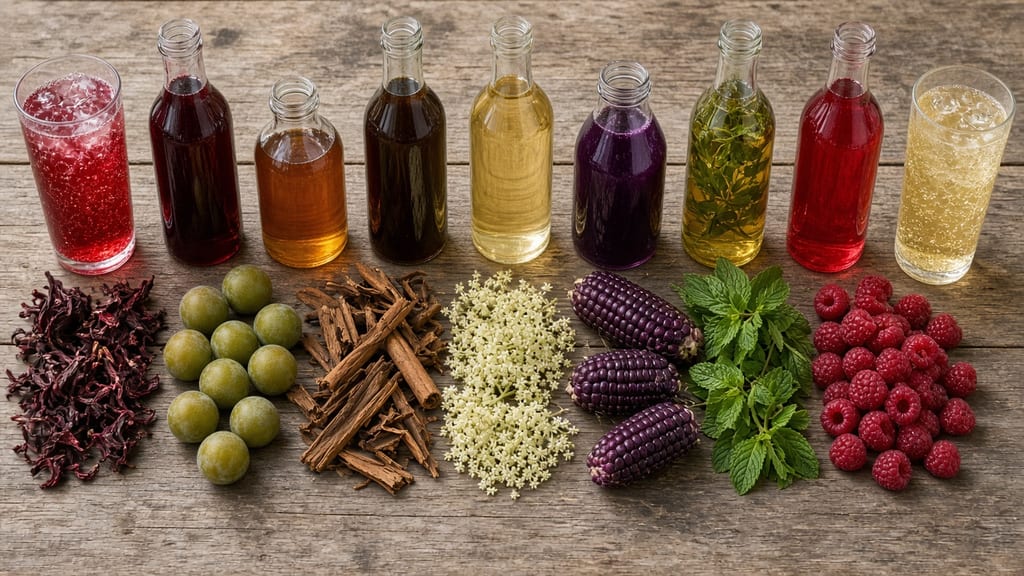
A bottle on every continent
Somewhere in almost every kitchen culture there is a bottle of something thick and sweet that is never drunk neat. You pour a little into a glass, fill it with water, and get a drink that tastes of a fruit, a flower, a root or a bark. In Madurai it is nannari, in Dakar it is sirop de bissap, in Vienna Himbeersirup, in Seoul maesil-cheong, in Port of Spain mauby, and in Tehran sekanjabin.
This feature walks around that map. The point is not that everyone likes sugar. It is that the syrup is a technology: a way to take a short harvest, or a plant that cannot be eaten, and turn it into a drink that lasts for months and costs almost nothing to serve. Each region solved the same three problems in its own way: how to get the flavour out, how to stop the bottle spoiling, and how much water to add at the end.
The recipes in this series follow those solutions in detail. Here we look at the patterns.
Al-Andalus, 13th century: a pharmacy you drink
One of the oldest written sets of syrup recipes comes from an anonymous cookbook compiled in Muslim Spain in the 13th century. In Charles Perry's translation it gives a whole run of them, each made the same way. Take a sour liquid, add sugar, cook until it takes the form of a syrup, keep until needed.
The pomegranate syrup takes a ratl of sour pomegranates and a ratl of sweet ones and adds their juice to two ratls of sugar. The lemon syrup takes a ratl of juice to as much sugar. The simple sikanjabin is a ratl of strong vinegar to two of sugar. To drink, one measure of syrup goes into three of hot water.
Every one of them comes with a medical claim. The sikanjabin calms jaundice and cuts the thirst; the pomegranate syrup lightens the body gently. These are the claims of humoral medicine and nobody should take them as advice. They do show why the syrup existed. It was a measured dose of a sour, cooling ingredient, stable enough to keep on a shelf, made into a drink on demand.
Cariadoc's Miscellany, which prints these translations, notes that sekanjabin is already mentioned in the tenth-century Fihrist of al-Nadim.
Iran: vinegar, mint and a bowl of lettuce
Sekanjabin is still made in Iran, and a current Iranian recipe calls it one of the oldest Iranian sharbats. The method has hardly moved: 400 g sugar and 250 ml water brought to the boil, 120 ml white or grape vinegar added, the mixture simmered for 20 to 30 minutes until a drop on a cold plate stretches a little. Mint goes in after the heat is off, because boiled mint turns bitter.
The same recipe names an older version, serkangabin, made with honey. And it gives two ways to serve it. One is the summer glass: two or three spoons of syrup in iced water with grated cucumber and mint, or in cold soda. The other is kahu sekanjabin, where crisp lettuce leaves are dipped straight into the thick syrup and eaten. A syrup that doubles as a salad dressing is a good reminder that sweet and sour is the point, not just sweet.
Iranian restaurants serve the drink cold. The 13th-century text served it hot. Somewhere in between, the medicine became a refreshment.
Turkey: a sherbet for visitors
In Isparta, in south-western Turkey, the provincial culture office describes loğusa şerbeti, the sherbet of a new mother. Two glasses of water and one and a half of sugar are boiled for about five minutes, sometimes with rose water, cloves and cinnamon, and coloured a rose red. It is cooled and served in plain glasses, on a tray, to visiting guests.
This is the syrup reduced to its simplest social form. It is not stored and not diluted; it is made the day it is needed and offered as a gesture. The recipe in our ginger and bark syrups page treats it as a spiced syrup, but its real job is hospitality.
Madurai: a root syrup sold door to door since 1906
Near the Meenakshi Sundareswarar Temple in Madurai, Tamil Nadu, a family business makes nannari syrup from the root of Hemidesmus indicus. The Hindu traces it to K Ondipulia Pillai, who began experimenting in 1906 and sold the syrup from door to door, telling buyers to mix two spoons into a glass of water with lime juice.
The factory method is a cold soak followed by a short boil. Roots from Palakkad in Kerala are soaked in fresh water for 12 hours, boiled for 15 minutes, and the extract is cooled and mixed with sugar syrup and citric acid. Sugarcane and fruit-juice sellers add it to their drinks, and the busy months run from February to July.
A Tamil home recipe from Samayam keeps the same logic at kitchen scale. Fifty grams of root are washed three times, dried and crushed with a hammer. The white core is pulled out and thrown away, because the fragrance is in the brown outer bark. The bark soaks in boiled water for five or six hours or overnight, is strained through muslin, and is boiled with 250 g of sugar. A little lemon juice goes in at the end. Three teaspoons make a glass.
Nannari shows a pattern that recurs across the map: the flavour is in a part of a plant nobody would eat, and the syrup is the only practical way to drink it.
Senegal: bissap and the eight-hour rule
The deep red drink of West Africa is made from the calyces of roselle, Hibiscus sabdariffa. In Senegal it is bissap, and the region around Kaolack is known for growing it. Seggfaye, a Senegalese food site, lists the ndogou, the meal that breaks the fast in Ramadan, among the moments it is served, along with ceremonies and every street corner in Dakar.
The most precise method we found is in a technical guide by GRET and the Institut de Technologie Alimentaire in Dakar, written for small producers. It asks for a cold maceration: 1 kg of calyces in 8 litres of water for six to eight hours. Hot extraction, it warns, pulls pectin out of the calyces and makes the drink cloudy.
Then comes the rule that makes the method interesting. The filtrate must become syrup within eight hours, because it starts to ferment. The guide's syrup is 60 % sugar and 40 % filtrate, boiled for one to three minutes to between 102 and 105 °C, which brings it to 65 to 70 °Brix, and skimmed. That is a professional standard: a cold extraction to protect colour and clarity, a deadline to stop fermentation, and a measured endpoint so the syrup keeps.
Seggfaye's own home recipe takes the opposite route: boil the water, steep 100 g of calyces for 15 minutes, sweeten while hot, flavour with mint, vanilla and orange-flower water, and chill. The professional guide and the family kitchen disagree on heat, and both are making bissap.
One flower, a dozen names
Roselle may be the most widely travelled syrup plant on the map. A Ghanaian food site lists the names its drink goes by: bissap, wonjo, foléré, dabileni, tsobo, zobo and sobolo in different parts of Africa, sorrel in the Caribbean and agua de Jamaica in Mexico. The PubMed Central study adds hibiscus tea, red sorrel, Sudan tea and karkadè.
In Ghana, Pulse's sobolo boils the calyces with pineapple peel and hwentia for 10 to 15 minutes, then stirs in blended pineapple and ginger and sugar once it has cooled. MyNewsGH adds prekese, the aromatic pod of Tetrapleura tetraptera, and says the drink keeps about a week in the refrigerator. Nigeria calls the same drink zobo.
These are drinks rather than syrups, made strong and diluted only with ice. The step from one to the other is just more sugar and a firm boil, the step the GRET guide takes.
Thailand and Japan: syrups that change colour
Some syrups are chosen for their colour as much as their taste. Thai nam dok anchan is made from butterfly pea flowers. Rachel Cooks Thai explains that the colour comes from anthocyanins: dark blue in a neutral solution, bright magenta once lime juice makes it acidic. Her butterfly pea lemonade is built on exactly that trick.
Japan has the red version. Kagome's recipe for aka-shiso juice boils 300 g of red perilla leaves in 2 litres of water for 15 minutes. The liquid is dark until 25 g of citric acid goes in with the sugar, and then it turns bright red. In both drinks the acid is not there to preserve anything. It is there to make the colour, and the sourness that comes with it.
Roselle belongs to the same family of colours. A study of roselle drinks in PubMed Central found pH between about 2.3 and 3.4 and notes that the red form of anthocyanin is stable at low pH. The same study stored pasteurised roselle blends for six months and lost 65 to 86 % of the anthocyanins at 28 °C, against 53 to 75 % at 4 °C. Cold keeps the colour, which is one more reason the hibiscus syrups in this series live in the refrigerator.
Korea and Japan: syrups made without a stove
East Asia has the slowest syrups on the map. Korean cheong is fruit packed into a jar with an equal weight of sugar and left until the sugar has pulled the juice out. Maesil-cheong, made from green plums, is the best known, and it carries a hazard: the stones of green plums contain cyanide compounds.
Korea's Ministry of Food and Drug Safety now publishes a method that deals with this step by step. Wash the plums three times and dry them, pick out the stems, and remove the stones, which cuts the cyanide compounds by 95 %. Pack 1 : 1 with sugar, leave at room temperature for three to four months, strain out the fruit, and mature the syrup for six months or more. Each of those steps lowers the cyanide compounds further.
In Wakayama, the Kishu Tanabe Ume Promotion Council has a shortcut. Freeze the ume first, for at least 24 hours, and layer them with rock sugar. As they thaw, fine cracks in the skin let the sugar in fast, and the syrup is ready in about seven days instead of a month. The council's own phrase is to extract quickly and suppress fermentation, and it adds vinegar, 200 ml per kilogram of fruit, when needed. The finished syrup is kept in the refrigerator, or heated to 80 °C or more for about 15 minutes for longer keeping.
Yuja-cheong, from the Korean citron, is the same idea with sliced peel, and a Korean news report puts the danger plainly: the most dangerous belief is that a sugared jar keeps forever at room temperature. If a jar foams, smells of alcohol or grows mould, the whole jar goes.
Poland: pine shoots in a jar
The cold sugar method turns up again in Poland, applied to something that is not fruit at all. Foragers pick young pine shoots, layer them with sugar in a jar and press them down. The Polish Ministry of Agriculture describes the jar standing for 7 to 14 days and being shaken often, then the syrup strained, the shoots pressed and the syrup stored in a cool place.
It is folk practice, and it carries a hazard of its own. Poland's State Forests note that every part of the yew except the red aril contains taxine, which harms the heart. Scots pine needles grow in pairs, stiff and sharp; yew needles are soft, up to 3 cm long, and arranged along the shoot like the teeth of a comb. Nobody should pick shoots they cannot identify.
The Caribbean: bark and bitterness
Mauby is brewed from the bark of small trees of the genus Colubrina, and it is very bitter. We Trini Food explains the names: maví or mabí in the Spanish-speaking Caribbean, mabi in the French-influenced islands, mauby in the English-speaking ones. On most islands the sweetened drink is left on the counter for a few days to ferment; in Trinidad and Tobago that is not common.
The Trinidadian approach is a syrup. Boil an ounce of bark with cinnamon, cloves, bay leaf and orange peel until the liquid is dark brown, strain it and keep the bitter concentrate in the refrigerator for up to two weeks. To serve, sweeten water and add concentrate to taste. Another method dissolves the sugar straight into the brew to make a thick concentrate that can be bottled and refrigerated.
Mauby is the clearest case of a syrup built around a flavour most people would not choose. The bitterness is the point, and the sugar makes it drinkable. Trinbago Recipes adds that anyone pregnant or taking medicines should check with a doctor before drinking bark drinks regularly.
Peru: purple corn
Chicha morada is made from purple maize boiled with pineapple peel, apple, cinnamon and cloves for about 45 minutes until the liquid is almost black and the kernels start to split. ADRA Peru's community cookbook gives the drink a history of about 3,000 years and links it to the religious festivals of pre-Inca cultures.
Sazón Perú adds the detail that matters for keeping. Unsweetened, without lime, the concentrate lasts five days in the refrigerator and can be frozen in ice-cube trays. Once sugar and lime go in, it should be drunk within a day or two, after which it begins to ferment. Chicha morada is not fermented and contains no alcohol, the site insists, and is not to be confused with chicha de jora, the maize beer.
So the Peruvian solution to keeping is not sugar at all: keep the concentrate plain and cold, and sweeten it only when you pour.
Central Europe: the law of 55 °Brix
In Austria the syrup has a legal definition. Chapter B 6 of the Austrian food codex says every syrup must reach at least 55 °Brix, measured with a refractometer, and herb syrups at least 45. A syrup meant for dilution carries an instruction such as 1 + 6, one part syrup to six of water, and colouring Himbeersirup and acidifying with citric, tartaric or malic acid are named as Austrian traditions.
The Czech Republic draws its line at 50 %. Its decree 248/2018 allows a drink concentrate with more than half its weight in natural sweeteners to be called sirup. Czech households make bezový sirup from elderflowers, and a recipe from Iva Hüttnerová, broadcast on Czech Radio, insists on one step: never rinse the flowers, because the aroma is in the pollen.
The Tyrolean chamber of agriculture explains why the old recipes were so sweet. They dissolved 2 kg of sugar in a litre of liquid; reduced-sugar versions mould in the bottle or ferment after opening. Its base recipe is 1 litre of juice and 1.3 kg of sugar, heated to 85 °C and filled hot, keeping about twelve months in the dark below 16 °C. Citric acid, it adds, does not preserve anything; it brightens the taste and the colour.
Central Europe also gave the syrup its machine. The steam juicer was invented in 1949 in Esslingen by Wilhelm Wagner and sold as Saftborn: water boils in the base, steam passes through a basket of fruit, and juice runs out of a hose. In the 1950s the design reached Finland, where Toivo Rautavaara gave it the name mehumaija.
Sweden: citronsaft
Swedish saft is the Nordic cousin. Receptfavoriter's citronsaft boils 1 litre of water with a litre of sugar and 40 g of citric acid, adds finely sliced lemons, and leaves them overnight in the refrigerator before straining. Diluted three to six times it is saft; diluted further it becomes citrondricka. The recipe mentions sodium benzoate for those who want it to keep longer, and the freezer for those who do not.
Victorian Britain and America
English-language cookbooks of the 1860s treat the syrup as a household recipe. Isabella Beeton's lemon syrup of 1861 boils 2 lb of loaf sugar in 2 pints of water for a quarter of an hour, then adds an ounce of powdered citric acid and essence of lemon. Two tablespoons go into a tumbler of cold water.
A year later in New York, Jerry Thomas's bartending manual boiled sugar syrup to the little crack, added a pint of lemon juice and boiled again to the pearl, the old sugar-boiler's stages, before bottling. His lemonade took a spoon of raspberry or strawberry syrup, and his book carried a whole manual for making cordials.
Beeton also had a soda that needs no siphon: lemon juice and sugar in cold water, with a teaspoon of carbonate of soda stirred in last, drunk while it fizzes. It is the same instinct as the soda fountain: a syrup is half a drink, and the bubbles are the other half.
New England: the shrub
The University of Maine's extension service traces the shrub to Colonial New England, where cider vinegar was easier to find than lemons and limes. Fruit and sugar are mashed together and left in the refrigerator for two or three days, then strained, and half to one part of vinegar is added to each part of syrup. It is the Andalusian sikanjabin again, arrived by a different road, with fruit in place of plain sugar syrup.
Four ways to make a syrup
Put all these bottles side by side and four methods appear. The first is the hot syrup: extract the flavour, add sugar and boil to a fixed point. Beeton, the Tyroleans, Thomas, nannari and the GRET bissap syrup all belong here, and the boil is what lets them keep.
The second is the cold extraction followed by a hot syrup. Bissap calyces and nannari bark both soak in water for hours before any sugar or heat, because heat would spoil the clarity or the aroma. The extract is then cooked quickly, before it ferments.
The third is the cold sugar method of Korea, Japan and Poland: no stove, only fruit or shoots in sugar and time. It is the slowest, and the one that most needs care, because a warm jar of fruit and sugar can ferment, and because some fruits, like green plums, need their stones removed.
The fourth is the sour syrup, where vinegar or a sour fruit does as much work as the sugar: sikanjabin, the shrub, the Andalusian pomegranate syrup.
Wherever the bottle comes from, the same questions decide how long it lasts: how much sugar is in it, whether it was heated, and whether it lives in the refrigerator. The recipes in this series answer them one by one. The fizzy water is your part.
Related
Pairs with
One plus six: how syrups and cordials keep
Sugar keeps, acid flavours, heat seals and cold protects the rest: how fruit syrups, flower cordials and lemon syrups are made and kept at home, from the Austrian 55 °Brix rule and a 1949 steam juicer to Victorian lemon syrup.
The strange shelf: rhododendron, plum stones, pine shoots and other unusual syrups
Rhododendron squash, cyanide in plum stones, pine shoots beside poisonous yew, mauby bark, distilled willow water, charcoal-smoked jallab and colour-changing drinks: unusual syrups and what makes each safe or not.
Community
No community contributions have been published for this entry yet.
Share what you made
Sign in to contribute. Published comments and photos are free to read.
Sources
David Friedman and Elizabeth Cook
Cariadoc's Miscellany: Drinks (with Charles Perry's translation of the Anonymous Andalusian Cookbook)Cited in: Al-Andalus, 13th century: a pharmacy you drink; Iran: vinegar, mint and a bowl of lettuce; New England: the shrub; Four ways to make a syrup
Menujat (Matin Rasouli, October 2026)
طرز تهیه شربت سکنجبین خانگی (Homemade sekanjabin syrup)Cited in: A bottle on every continent; Iran: vinegar, mint and a bowl of lettuce
T.C. Kültür ve Turizm Bakanlığı, Kültür Portalı
Loğusa Şerbeti - IspartaCited in: Turkey: a sherbet for visitors
The Hindu
Why sherbet-maker Ondippili is a 115-year-old success storyCited in: A bottle on every continent; Madurai: a root syrup sold door to door since 1906; Four ways to make a syrup
Samayam Tamil (Dhanalakshmi, 2023)
நன்னாரி சிரப் தயாரிப்பும் நன்மைகளும் (Homemade nannari syrup)Cited in: Madurai: a root syrup sold door to door since 1906; Four ways to make a syrup
GRET / ITA Dakar (Broutin and Sokona)
Préparer et vendre des boissons traditionnellesCited in: A bottle on every continent; Senegal: bissap and the eight-hour rule; One flower, a dozen names; Four ways to make a syrup
Pulse Ghana
DIY Recipes: How to make the perfect Bissap drink (Sobolo)Cited in: Senegal: bissap and the eight-hour rule; One flower, a dozen names
Rachel Cooks Thai
Butterfly Pea Lemonade (Nam Anchan Manao)Cited in: Thailand and Japan: syrups that change colour
식품의약품안전처 (Ministry of Food and Drug Safety, Korea)
매실청 담그기 (Making maesil-cheong safely)Cited in: A bottle on every continent; Korea and Japan: syrups made without a stove; Four ways to make a syrup
紀州田辺うめ振興協議会 (Kishu Tanabe Ume Promotion Council)
梅シロップの作り方 (How to make ume syrup)Cited in: Korea and Japan: syrups made without a stove; Four ways to make a syrup
Wikitree (October 2026)
'유자청' 설탕은 같은 무게로 담그세요, 술 냄새 나면 버립니다Cited in: Korea and Japan: syrups made without a stove
Ministerstwo Rolnictwa i Rozwoju Wsi, gov.pl
Syrop z pędów sosnyCited in: Poland: pine shoots in a jar; Four ways to make a syrup
PubMed Central (PMC3959965)
Influence of storage temperature and time on roselle beveragesCited in: One flower, a dozen names; Thailand and Japan: syrups that change colour
We Trini Food (Ros Singh)
Simple Mauby Recipe Using Mauby BarkCited in: A bottle on every continent; The Caribbean: bark and bitterness
Austrian Federal Ministry of Health, 2007, amended 2017
Österreichisches Lebensmittelbuch, Codexkapitel B 6 SirupeCited in: A bottle on every continent; Central Europe: the law of 55 °Brix
Bauernzeitung (Landwirtschaftskammer Tirol)
Sirupe aus Blüten, Kräutern und BeerenCited in: Central Europe: the law of 55 °Brix; Four ways to make a syrup
Ministerstvo zemědělství České republiky
Vyhláška č. 248/2018 Sb.Cited in: Central Europe: the law of 55 °Brix
Toprecepty.cz (June 2026)
Iva Hüttnerová prozradila recept na bezový sirupCited in: Central Europe: the law of 55 °Brix
Stadtmuseum im Gelben Haus Esslingen, museum-digital
Dampfentsafter SaftbornCited in: Central Europe: the law of 55 °Brix
Tekniikka&Talous, 17 September 2020
Mehumaijan isät ja äidit: malli tuli Suomeen SaksastaCited in: Central Europe: the law of 55 °Brix
Isabella Beeton; Internet Archive scan
The Book of Household Management (1861)Cited in: Victorian Britain and America; Four ways to make a syrup
Jerry Thomas; Internet Archive scan
How to Mix Drinks, or The Bon-Vivant's Companion (1862)Cited in: Victorian Britain and America; Four ways to make a syrup
Kate McCarty, University of Maine Cooperative Extension, 2025
Drinks from the GardenCited in: New England: the shrub; Four ways to make a syrup
University of Maine Cooperative Extension
Drinks from the Garden: resources (Fruit Shrub)Cited in: New England: the shrub
Gaps
- The tenth-century Fihrist mention of sekanjabin was not inspected directly.
- No measured Brix is given for home cheong, nannari or mauby concentrates.
- The 3,000-year history of chicha morada is ADRA Peru's statement; no archaeological source was read.
Updated 2026-11-24