
Beverages
One plus six: how syrups and cordials keep
Sugar keeps, acid flavours, heat seals and cold protects the rest: how fruit syrups, flower cordials and lemon syrups are made and kept at home, from the Austrian 55 °Brix rule and a 1949 steam juicer to Victorian lemon syrup.
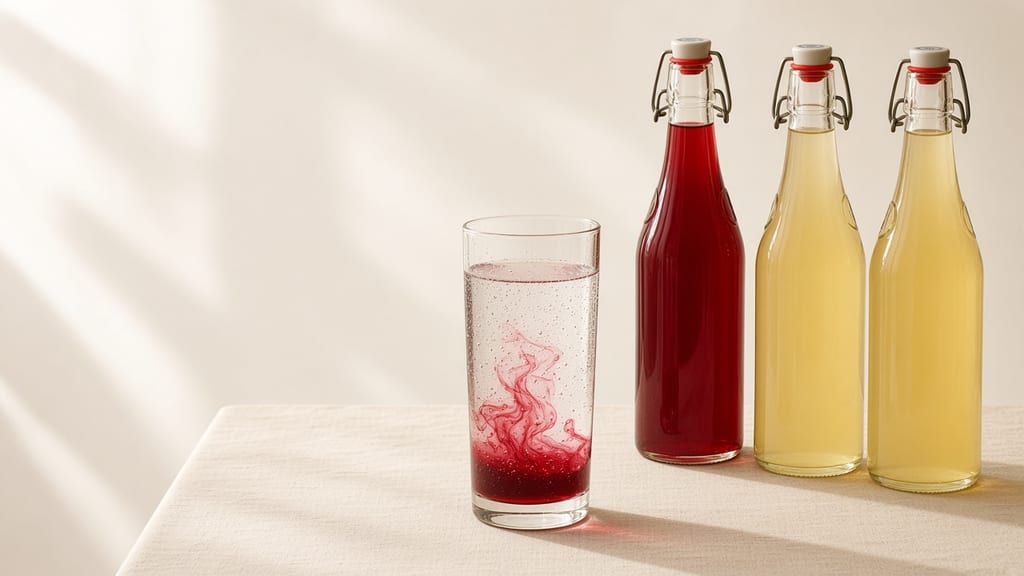
One plus six
An Austrian bottle of raspberry syrup carries two small numbers that explain the whole craft. One is the dilution, printed as 1 + 6: one part syrup to six parts water. The other is invisible. Under Austria's food codex every fruit syrup must reach at least 55 °Brix, which means that more than half of what is in the bottle is dissolved sugar.
Those two numbers belong together. A syrup is a drink made too strong to drink, so strong in sugar that moulds and yeasts cannot live in it, and then thinned in the glass. Everything a home syrup maker decides comes back to that pair: how much sugar the bottle can hold, what keeps it safe once you cut that sugar, and how far you stretch it with water, soda or sparkling water.
This article walks through the four levers a syrup maker has to work with. Sugar keeps. Acid flavours. Heat seals. Cold protects whatever the other three cannot. It also looks at the machines and habits that put juice in the pan, from a 1949 German steam juicer to a Victorian trick with lumps of sugar and a lemon. Three recipes in this series put the levers to work: a cooked berry syrup, an elderflower cordial, and a lemon syrup.
What the law calls a syrup
The Austrian codex chapter on syrups is five pages long and reads like a recipe card for an industry. A syrup is a thick product made from fruit juice, peel oils, herb extracts or other flavourings by adding sugar, water and other ingredients, drunk diluted or neat. Fruit syrups must contain at least 10% fruit. A syrup sold as traditional Austrian codex quality must contain 33%.
The chapter sorts syrups into four families. Fruit syrups get their flavour from juice. Orangeade and Zitronade get it from the oil in citrus peel, with juice optional. Herb syrups use plant extracts or distillates and may stop at 45 °Brix. Everything else, from nut and spice syrups to tea, coffee and chocolate, sits in a fourth group. The codex also records two Austrian habits: colouring orangeade and raspberry syrup, and sharpening syrups with tartaric, citric or malic acid.
The label rules are short. A syrup is named after its flavour, as in Himbeersirup or Pfefferminzsirup, raspberry or peppermint syrup. If it is meant to be diluted, the label gives the dilution, and if it needs special storage after opening, the label says so. A homemade bottle can follow both rules with a pen and a strip of tape.
Czech law draws the line in a different place. A drink concentrate may be called sirup only when natural sweeteners make up more than 50% of its weight. Both countries are saying the same thing in different units. A syrup earns its name through sugar.
Sugar does the keeping
Tyrolean farm advisers start their syrup courses with an old recipe that every household in the region knows. Two kilos of sugar go into one litre of water, for elderflower, lemon balm or almost anything else. That is about two thirds sugar by weight. The advisers explain why it worked: at that strength the liquid becomes useless to moulds and yeasts, which cannot live or multiply in it.
Then came the modern wish to eat less sugar. Households cut the old quantities, and the bottles started to fail. Moulds grew in the bottle. Opened bottles began to ferment if nobody drank them fast enough. The advisers' answer is a base recipe of 1.3 kg of sugar per litre of liquid. In water that works out at about 57% sugar, just over the legal 55 °Brix; in fresh fruit juice, which brings sugar of its own, it lands higher.
The cheapest way to know where a batch sits is a refractometer. The Tyrolean advisers point out that they are inexpensive in specialist shops. A few drops on the prism give the reading in °Brix, the same unit the codex uses.
American extension recipes show the same logic from the canning side. The National Center for Home Food Preservation's berry syrup takes 6¾ cups of sugar for about 4½ to 5 cups of juice. The centre warns that granular Splenda does not give the preserving properties of sugar. In those recipes the sugar is part of the safety margin.
Acid flavours but does not preserve
Many home cooks believe citric acid is what keeps a syrup. The Tyrolean advisers say plainly that citric acid cannot preserve a food. What it does is make a syrup taste brighter and, in berry syrups, keep the colour fresher by lowering the pH. Lemon juice or tartaric acid do the same job.
Isabella Beeton's 1861 lemon syrup shows how far acid can carry a flavour. It contains no fresh lemon at all. Two pounds of loaf sugar boil with two pints of water for a quarter of an hour, then an ounce of citric acid, pounded to powder and mixed with half a drachm of essence of lemon, goes into the cold syrup. Two tablespoons in a tumbler of cold water make, in her words, a very refreshing summer drink.
Acid matters for safety in one place: the canner. A boiling-water process only works for foods acidic enough to be safe at that temperature. Oregon State University Extension found that American elderberries are not consistently below pH 4.6, and that European elderberries are hard to tell apart from them. Its elderberry syrup therefore has to be refrigerated or frozen, not canned. Lemon juice sits at the other end. An Ask Extension expert describes it as a high-acid food that is safely water-bath canned.
Heat: three ways to close a bottle
There are three ways heat enters a syrup, and only one of them is a tested home process.
The first is boiling-water canning. Here a laboratory has worked out the time. The NCHFP berry syrup goes into half-pint or pint jars with half an inch of headspace and is processed for 10 minutes up to 1,000 feet, 15 minutes up to 6,000 feet and 20 minutes above that. It is limited to blueberries, cherries, grapes, red or black raspberries and strawberries. Clemson Extension's strawberry lemonade concentrate is heated to 88 °C without boiling and processed for 15 minutes. These recipes are fixed: change the fruit, the sugar or the jar and the time no longer applies.
Clemson Extension's small-batch berry syrup for blackberries, blueberries, raspberries or strawberries is another tested recipe. It takes 1¼ cups of juice, 1½ cups of sugar, ¼ cup of corn syrup and a tablespoon of bottled lemon juice, boils hard for one minute, goes into jars with a quarter inch of headspace and is processed for 10 minutes. It makes about two half-pints.
The second is the hot fill, the professional method the Tyrolean advisers teach. Fruit juice is heated to 85 °C, the sugar and citric acid dissolve in it, and the syrup goes into bottles at 85 °C. Each bottle is closed at once and laid on its side to cool, so that the hot syrup pasteurises the inside of the cap and the air bubble. Kept dark and below 16 °C, such syrups last about twelve months. It is an Austrian practice backed by high sugar, not a process tested by a home-canning authority, and this site records it as practice.
The third is no heat after bottling at all. Beeton bottled her lemon syrup cold. Czech cooks pour bezový sirup hot into sterilised bottles and keep it until the next season, but no laboratory has measured that shelf life. Without a tested process the safe home answer is the fourth lever.
One bush, two answers
Elderberries show how narrow a tested process can be. Oregon State gives a canned syrup for blue elderberries: 2½ cups of juice and 3½ cups of sugar, simmered for 3 minutes, poured into half-pint jars with half an inch of headspace and processed for 10, 15 or 20 minutes depending on altitude. It makes about four half-pints.
The same page says that syrup made the same way from American or European black elderberries must be refrigerated or frozen, with an inch of headspace in the freezer. The reason is acidity: those berries are not reliably below pH 4.6, and the European ones are hard to tell from the American. Many elderberry varieties also contain cyanogenic glycosides, so the berries are always cooked, and red elderberries are not used at all.
So two syrups that look the same in the glass, made by the same steps, belong on different shelves. That is the clearest argument for following a tested recipe to the letter, or keeping the bottle cold.
Cold protects what sugar cannot
A refrigerator changes the rules. Oregon State's elderflower syrup is made with equal volumes of sugar and water, roughly 46% sugar, well under the Austrian line. The flowers steep in the refrigerator for one to three days, and the strained syrup stays there and is used within a few weeks. Oregon State is blunt: the syrup cannot be safely consumed after storage at room temperature or after canning.
Freezing goes further. When a cook in Georgia asked Ask Extension how to can elderflower cordial because the bottles filled the freezer, the answer was that nobody had tested a canning process and that freezing is the safest way to keep it. BBC Food freezes elderflower cordial in plastic bottles with a couple of inches of space at the top and keeps it for a year. Swedish citronsaft goes into plastic boxes in the freezer and is scraped out a spoonful at a time.
Maine Extension gives the simplest rule for the quick syrups it suggests for homemade sodas. Store them in the refrigerator and use them within a month.
Getting the juice out
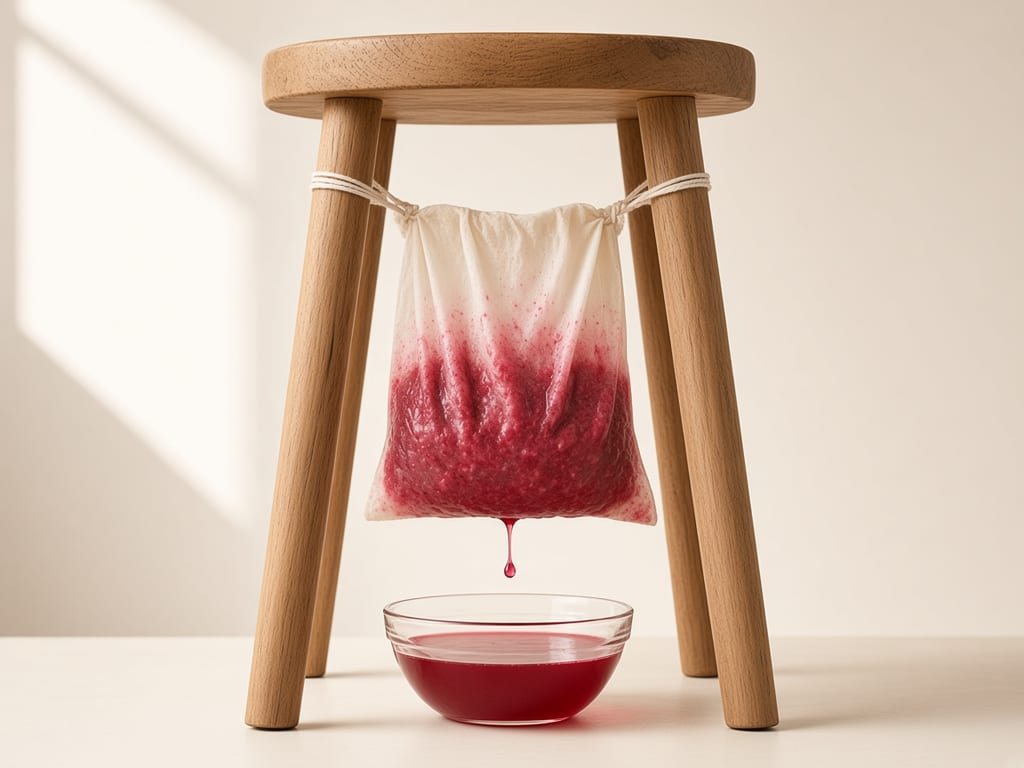
A fruit syrup is only as good as its juice, and the oldest way to get it needs a pan, a cloth and patience. The NCHFP instructions for jelly juice apply to syrups too. Put the fruit in a flat-bottomed pan. Berries and grapes need only enough water to stop them scorching; apples and other hard fruit take up to a cup per pound. Crush soft fruit to start the juice. Berries need 10 minutes or less to soften, hard fruit 20 to 25. Do not overcook, because long boiling destroys pectin, flavour and colour.
Then pour everything into a damp jelly bag and hang it up to drain. The clearest juice comes through without pressing or squeezing. If you use a fruit press, strain that juice again through a jelly bag. Clemson Extension adds that very juicy berries can be crushed and the juice extracted without heating at all.
The Tyrolean method uses enzymes. Crushed fruit is treated with them to open the cells, and the same enzymes break down pectin so the finished syrup does not set to a jelly in the bottle. For flavour, colour and nutrients the advisers rate cold pressing as the best way to get juice.
The steam juicer
Look in a German, Austrian or Finnish kitchen cupboard and you may find a stacked aluminium pot with a rubber hose and a clamp. It is a steam juicer, and a museum in Esslingen knows where it came from. The Stadtmuseum im Gelben Haus holds a Saftborn made by the Esslingen firm Wilhelm Wagner GmbH & Co. KG, which invented the device in 1949. Under the name Saftborn it became a best-seller.
The museum's description gives the principle. Water boils in the bottom pan. A tube carries the steam up into a basket of fruit, where the heat bursts the cell walls and frees the juice. The juice collects on the floor of the upper container and is drawn off through the clamped hose. Add sugar to the fruit basket and even sour fruit such as rhubarb gives a juice; the Saftborn also handled vegetable and herb juices.
In Finland the same pot is called a mehumaija. According to Tekniikka&Talous, the rural women's organisation Maa- ja kotitalousnaiset says it brought the forerunner of the mehumaija from Germany in the 1950s, after which Finnish industry began making berry juicers for home use. The name itself came from Toivo Rautavaara.
Not everyone loves it. The Tyrolean advisers call steam juicing a common practice that costs aroma and colour, because juicing at around 100 °C also destroys valuable components of the fruit. For a syrup made from good fruit they prefer a press. The museum notes that the device is still in many households today.
Steeping flowers and herbs
Flowers and leaves carry their flavour in oils and pollen rather than juice, so they are steeped, not pressed. The methods differ mainly in temperature and time.
Oregon State pours hot syrup over elderflower clusters and a sliced lemon and leaves them in the refrigerator for one to three days. The Tyrolean courses cool their syrup to about 50 °C first, add half a litre of herbs or blossoms per litre of water, and let them steep for about two days before straining and hot-filling. Maine Extension's herb syrups are fast: bring sugar and water to the boil, add one to two cups of mint, rosemary, thyme or basil, turn off the heat and steep for five minutes. The Czech bezový sirup steeps flowers and lemons in cooled citric-acid water at room temperature for about 24 hours before the sugar goes in.
Two rules hold for all of them. Do not wash elderflowers, because the scent sits in the pollen; Czech and Oregon sources agree on that, while BBC Food rinses gently. And strip off stems and leaves, which Oregon State says carry more toxins than the flowers.
What the Victorians did
The Victorian syrup maker worked without refractometers, but not without method. Jerry Thomas's How to Mix Drinks of 1862 includes a manual for making cordials and syrups. Its lemon syrup boils 2 lb of sugar to a stage it calls the little crack, adds a pint of settled, strained lemon juice and boils on to the pearl before skimming and bottling. Those sugar stages were the period's way of measuring strength by eye. Orange syrup follows the same method.
Beeton had another way of getting citrus into a drink. For her lemonade she rubbed lumps of loaf sugar over the skins of two lemons until they had soaked up all the oil, then dissolved them with the juice in boiling water. The same recipe appears, almost word for word, in Thomas's book a year later.
Her book also has a soda for people without a soda siphon. For a Summer Draught is the juice of one lemon in a tumbler of cold water, sweetened with pounded sugar. A small teaspoon of carbonate of soda goes in last, and you drink it while it is still fizzing.
The preservative question
Around 1920, the Tyrolean advisers write, a product called Einsiedehilfe came onto the market and made home preserving much easier. It works chemically, usually through sodium benzoate (E211) or potassium sorbate (E202). The advisers leave the choice to each household.
The choice is still on the table. The Swedish citronsaft recipe suggests sodium benzoate for an extra-long-keeping syrup. This series leaves preservatives out and uses the levers above instead: enough sugar plus a tested process, or the refrigerator and freezer.
Diluting for the glass
The 1 + 6 on the Austrian label is only one convention. Beeton's lemon syrup asks for two tablespoons to a tumbler of water. Clemson mixes one part strawberry lemonade concentrate to three parts water, tonic water or ginger ale. Swedish citronsaft is diluted three to six times, and diluted further it becomes citrondricka. Maine Extension's homemade soda is a few tablespoons in an 8-ounce glass of sparkling water.
Czech households pour bezový sirup into water with ice and a slice of lemon. BBC Food tops elderflower cordial with sparkling water, or with sparkling wine.
A little arithmetic shows why the numbers vary. A syrup at 55% sugar diluted 1 + 6 gives a drink at about 8% sugar. A thinner syrup, such as Oregon State's elderflower at about 46%, needs less water for the same sweetness. The right dilution is the one you like, so start strong and add water.
Fizzy water is where the craft pays off. A spoon of raspberry syrup, a few thin slices of lemon and a glass of cold sparkling water make a fruit soda in a minute. Jerry Thomas did the same in 1862, adding a tablespoon of raspberry or strawberry syrup to his lemonade.
Shrubs, the sour cousin
Maine Extension describes a related drink. A shrub is a syrup made with vinegar, traditionally equal parts fruit, sugar and vinegar, which began in colonial New England when cider vinegar was easier to get than lemons or limes. Some people find that much vinegar harsh; Maine's writer uses half as much vinegar as fruit syrup. Like syrups, shrubs are concentrated and are diluted with sparkling water or ginger beer, and they keep in the refrigerator for a month.
The safety short list
Follow a tested recipe exactly if you want jars on a shelf. The NCHFP berry syrup, the Clemson berry syrup and the strawberry lemonade concentrate all have processing times. Plain lemonade concentrate does not: an Ask Extension expert who checked found that recipes shared as safe had never been validated.
Cook elderberries, never use red elderberries, and refrigerate or freeze any elderberry syrup. Keep low-sugar syrups, flower cordials and quick herb syrups cold. Do not replace sugar with a sweetener in a canned syrup.
Throw away any syrup that grows mould or starts to fizz by itself. Smell and taste cannot show that a syrup is safe.
Where to start
The three recipes in this series group fruits and flowers by method rather than by name. The cooked berry syrup takes raspberries, blackberries, blueberries, cherries, grapes and strawberries through the same crush, simmer, drip and can sequence, with elderberries as the refrigerated exception. The elderflower cordial uses a refrigerated steep, and the same method flavours mint, basil, thyme or lemon balm syrups. The lemon syrup page gives Beeton's 1861 recipe in full, then a tested canned strawberry lemonade concentrate and a refrigerated Swedish citronsaft.
Each page states its numbers and its sources. Whichever you make, the question is the one on the Austrian label: how much sugar is in the bottle, and what keeps it safe if the answer is less than half.
Related
Pairs with
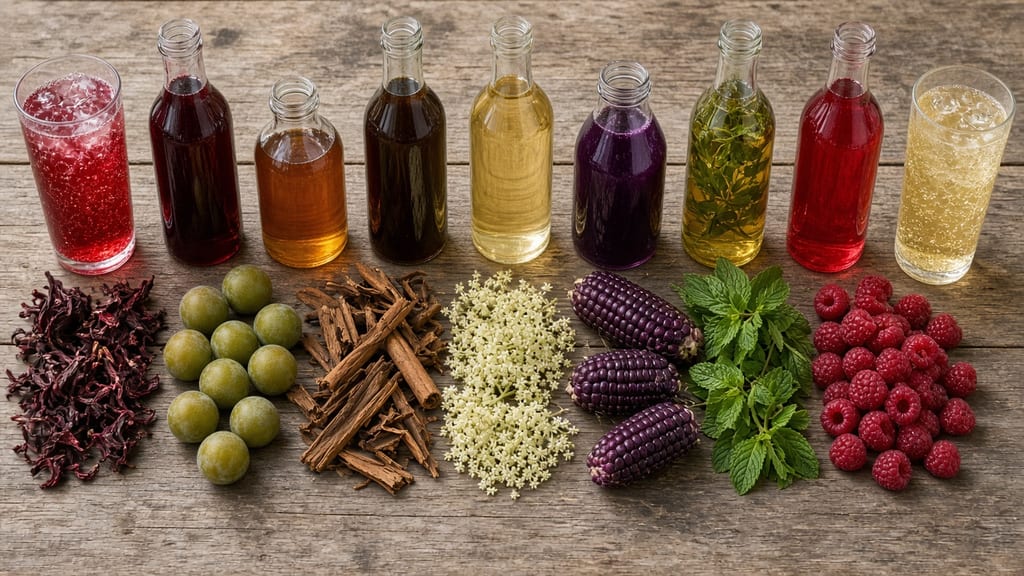
A syrup is a beverage technology: sharbat, saft, cheong and shrub around the world
From 13th-century Andalusian sikanjabin to Madurai nannari, Senegalese bissap, Korean cheong, Trinidad mauby and Austrian 55 °Brix law: how the world turns roots, flowers and fruit into syrups for water.
Discussed in this article
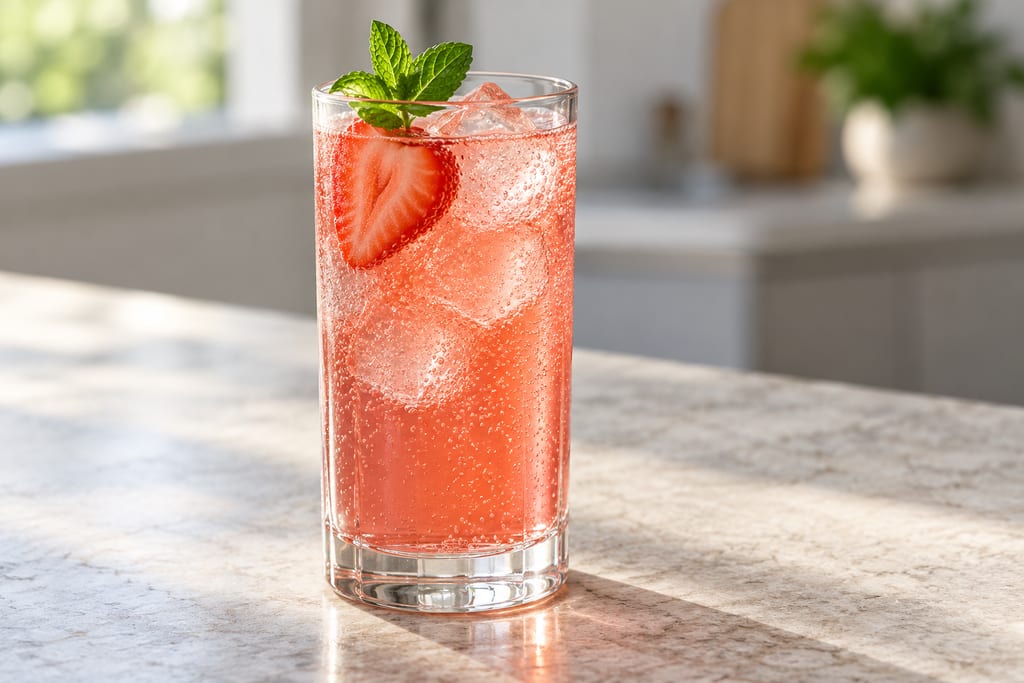
Carbonated cordial, shrub or juice
A cold finished drink charged with carbon dioxide in a home carbonator that accepts liquids other than water. Carbonating is not fermentation and does not preserve the drink.
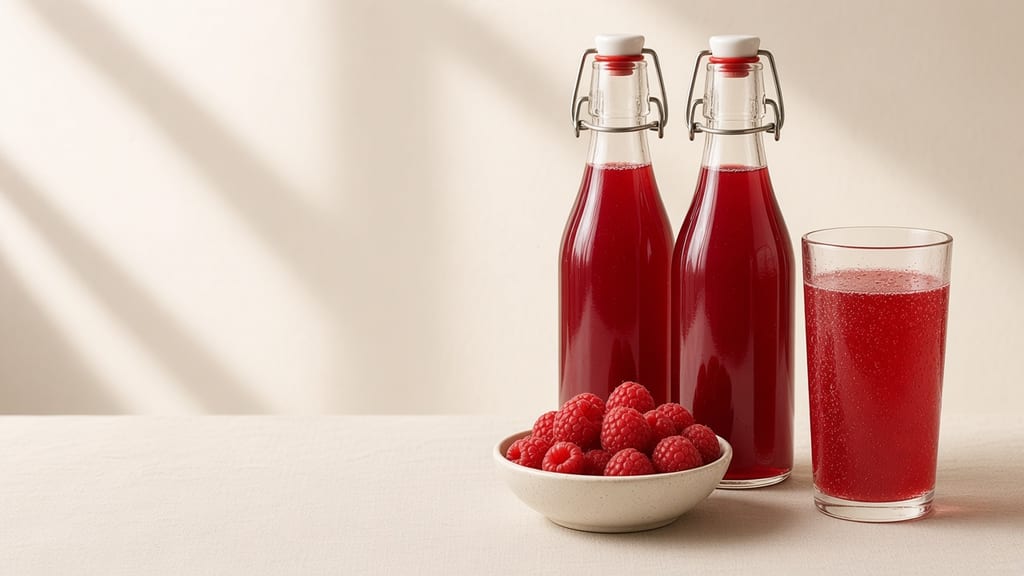
Cooked berry and fruit syrup
Clear fruit syrup from cooked, dripped berry juice boiled with sugar and canned in a water bath; one tested method for raspberry, strawberry, blueberry, cherry, grape and blackberry.
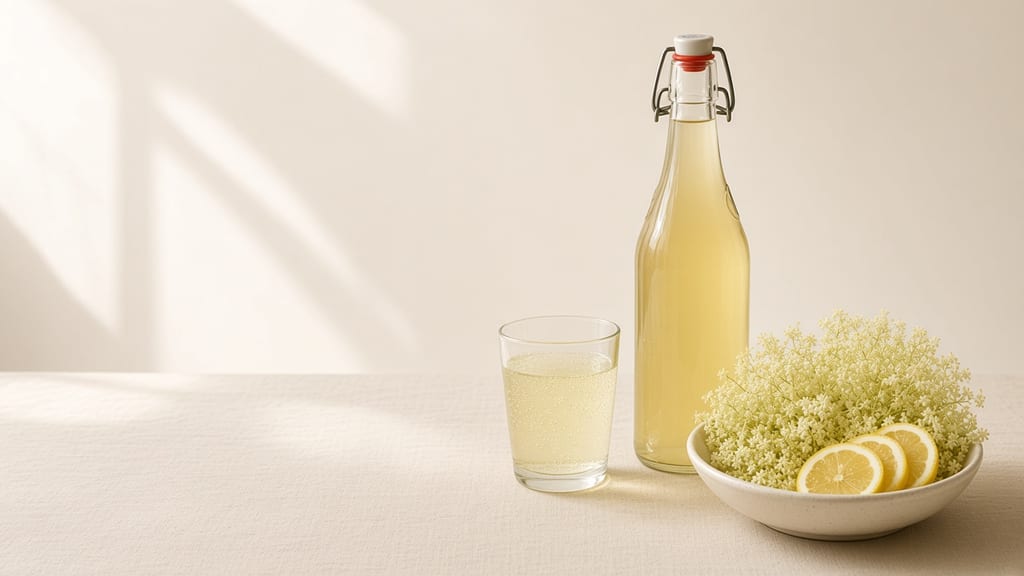
Elderflower cordial and herb syrups
Elderflower heads steeped for one to three days in a lemony sugar syrup, strained and kept cold; the same infusion method flavours syrups with mint, basil, thyme and other herbs.
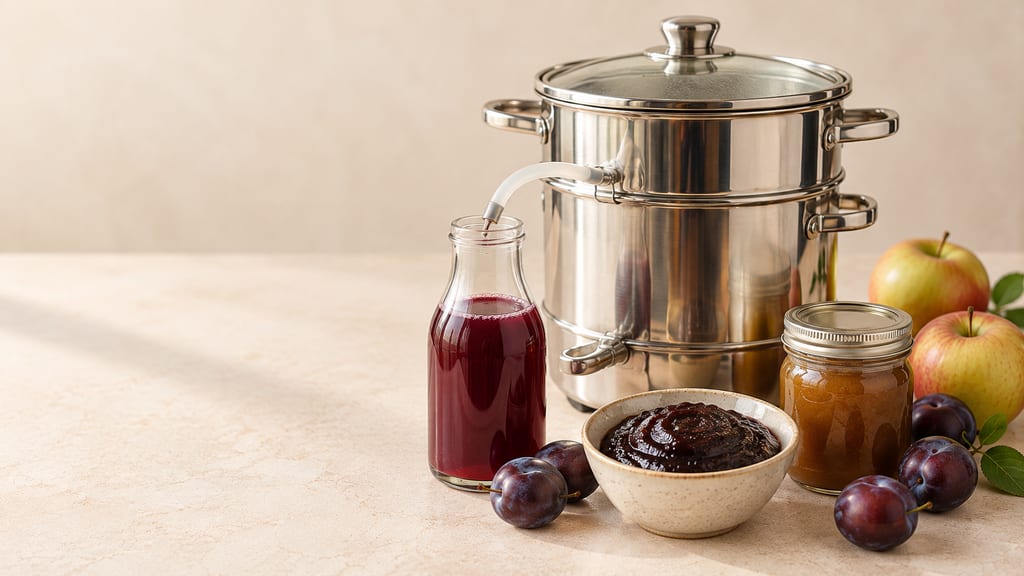
Fruit extraction and concentration: juice, butters, pastes and syrups
Fruit becomes juice, butter, paste or syrup in two moves: get the liquid out, then drive the water off. Steam juicers, slow cookers, microwaves and freezers each do one of those moves well, and none does both.
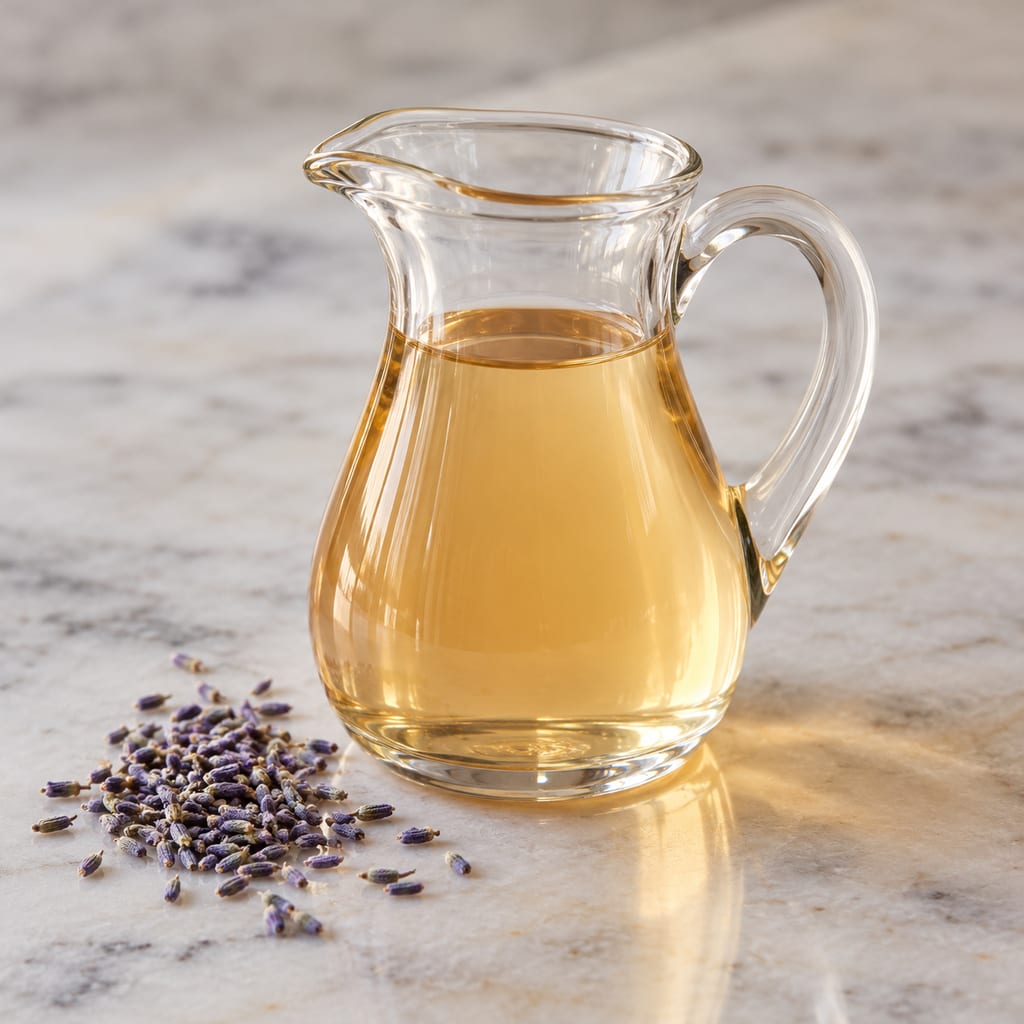
Herb, flower and fruit cordial syrups
Sugar syrups flavoured by holding botanicals, sugar and water in sealed bags in a 135°F (57°C) water bath for an hour, then cooling and refrigerating; several can share one bath.
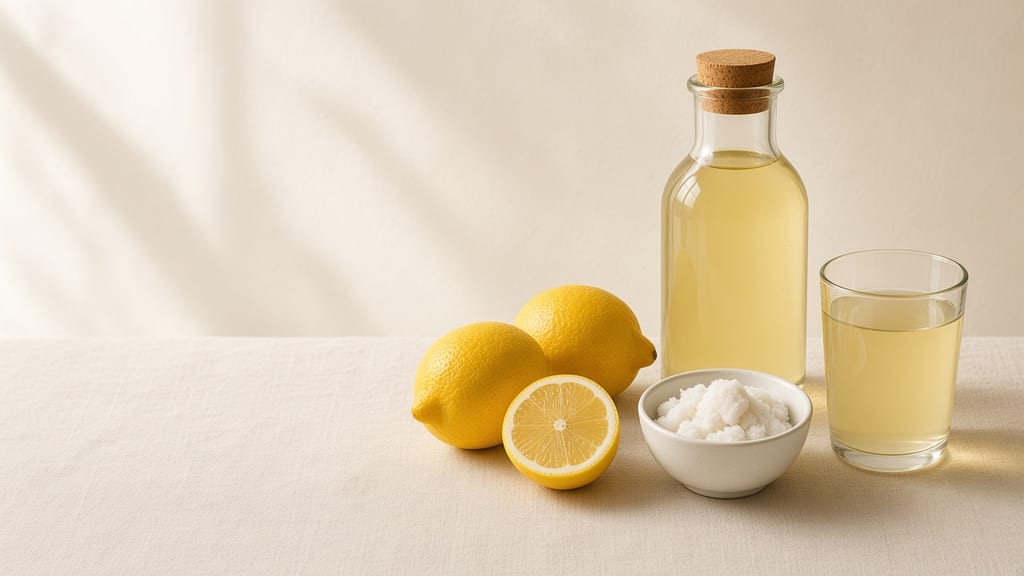
Lemon syrup and citrus cordials
A lemon concentrate for diluting with water or soda: Isabella Beeton's 1861 citric-acid lemon syrup in full, then a tested canned strawberry lemonade concentrate and a refrigerated Swedish-style lemon syrup.
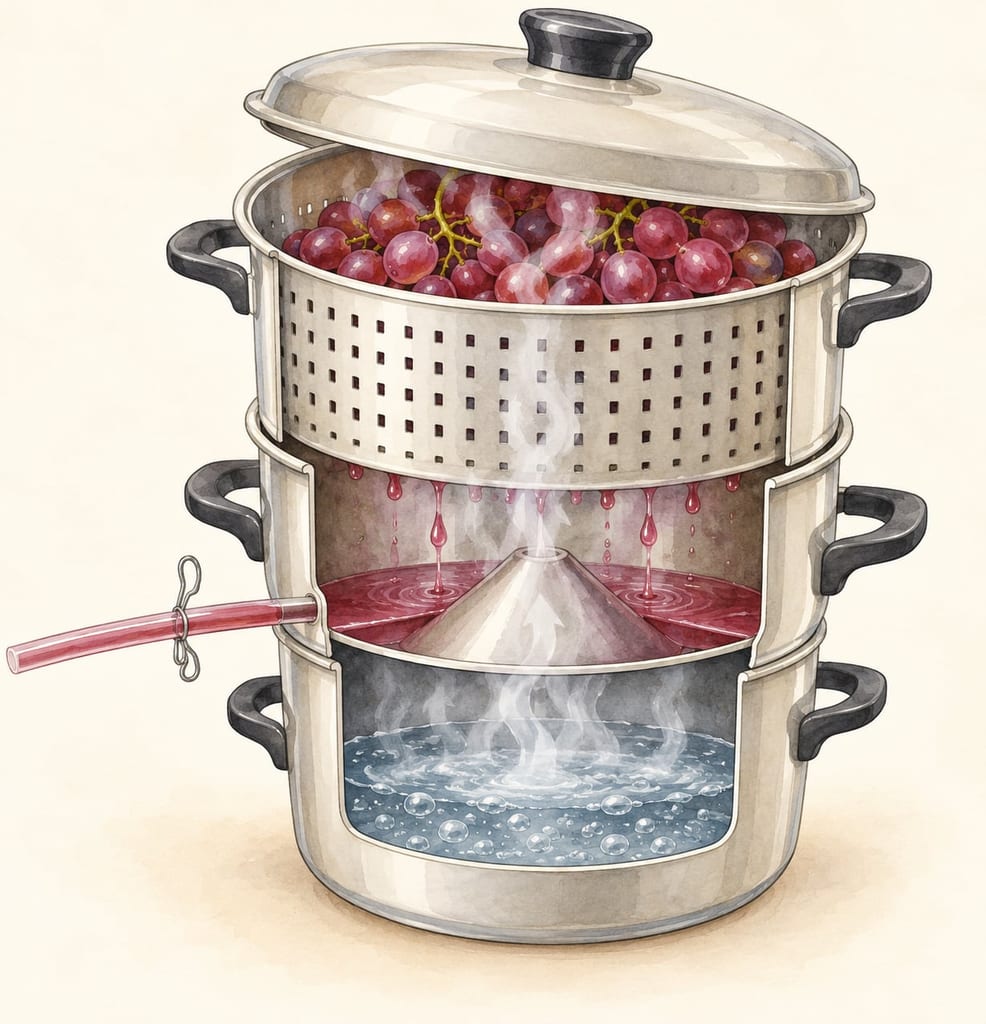
Steam juicer
A steam juicer stacks a water pan, juice collector and perforated fruit basket so steam releases juice that drains through an outlet hose. It extracts juice; it does not itself concentrate or preserve it.
Community
No community contributions have been published for this entry yet.
Share what you made
Sign in to contribute. Published comments and photos are free to read.
Sources
Austrian Federal Ministry of Health, 2007, amended 2017
Österreichisches Lebensmittelbuch, Codexkapitel B 6 SirupeCited in: One plus six; What the law calls a syrup; Sugar does the keeping; Diluting for the glass; Where to start
Ministerstvo zemědělství České republiky
Vyhláška č. 248/2018 Sb., o požadavcích na nápoje, kvasný ocet a droždíCited in: What the law calls a syrup
Bauernzeitung, Landwirtschaftskammer Tirol
Sirupe aus Blüten, Kräutern und BeerenCited in: One plus six; Sugar does the keeping; Acid flavours but does not preserve; Heat: three ways to close a bottle; Getting the juice out; The steam juicer; Steeping flowers and herbs; The preservative question; The safety short list
National Center for Home Food Preservation, University of Georgia
Berry SyrupCited in: Sugar does the keeping; Heat: three ways to close a bottle; The safety short list; Where to start
National Center for Home Food Preservation, University of Georgia
Extracting Juice for JellyCited in: Getting the juice out
Clemson Cooperative Extension Home & Garden Information Center
Fruit Syrups & Honeys (HGIC 3165)Cited in: Heat: three ways to close a bottle; Getting the juice out; The safety short list
Clemson Cooperative Extension Home & Garden Information Center, 16 May 2024
Strawberry LemonadeCited in: Heat: three ways to close a bottle; Diluting for the glass; The safety short list; Where to start
Oregon State University Extension Service
Play it safe when preserving elderberries (EM 9446)Cited in: Acid flavours but does not preserve; One bush, two answers; Cold protects what sugar cannot; Steeping flowers and herbs; Diluting for the glass; The safety short list; Where to start
Ask Extension, 30 May 2025
Preserving elderflower cordial (#902990)Cited in: Cold protects what sugar cannot
Ask Extension, May to June 2026
Canning Lemonade Concentrate (#932767)Cited in: Acid flavours but does not preserve; The safety short list
University of Maine Cooperative Extension, Kate McCarty, 15 May 2025
Drinks from the Garden: Using Fresh Fruit, Vegetables and Herbs in DrinksCited in: Cold protects what sugar cannot; Steeping flowers and herbs; Diluting for the glass; Shrubs, the sour cousin; The safety short list
Stadtmuseum im Gelben Haus Esslingen, via museum-digital
Dampfentsafter SaftbornCited in: The steam juicer
Tekniikka&Talous, Kari Kortelainen, 17 September 2020
Mehumaijan isät ja äidit: malli tuli Suomeen SaksastaCited in: The steam juicer
Isabella Beeton; London: S.O. Beeton, 1861; Internet Archive
The Book of Household ManagementCited in: Acid flavours but does not preserve; Heat: three ways to close a bottle; What the Victorians did; Diluting for the glass; Where to start
Jerry Thomas and Christian Schultz; New York: Dick & Fitzgerald, 1862; Internet Archive
How to Mix Drinks, or The Bon-Vivant's Companion, with A Manual for the Manufacture of CordialsCited in: What the Victorians did; Diluting for the glass
Toprecepty.cz, Vilém Besser, 8 June 2026
Iva Hüttnerová prozradila recept na bezový sirupCited in: Heat: three ways to close a bottle; Steeping flowers and herbs; Diluting for the glass
BBC Food, Lotte Duncan
Elderflower cordialCited in: Cold protects what sugar cannot; Steeping flowers and herbs; Diluting for the glass
Receptfavoriter.se, Henrik Mattsson, 2009, updated 2023
CitronsaftCited in: Cold protects what sugar cannot; The preservative question; Diluting for the glass; Where to start
Gaps
- No source gives a measured °Brix or pH for the homemade elderflower or Swedish lemon syrups.
- The twelve-month shelf life of Tyrolean hot-filled syrups is the advisers' figure; no home-canning authority has tested it.
- Tekniikka&Talous does not name the German model the Finnish organisation imported.
- Per-litre sugar percentages and the 1 + 6 dilution strength are this article's arithmetic from the source quantities.
Updated 2026-11-24