
Beverages
The strange shelf: rhododendron, plum stones, pine shoots and other unusual syrups
Rhododendron squash, cyanide in plum stones, pine shoots beside poisonous yew, mauby bark, distilled willow water, charcoal-smoked jallab and colour-changing drinks: unusual syrups and what makes each safe or not.
The strange shelf
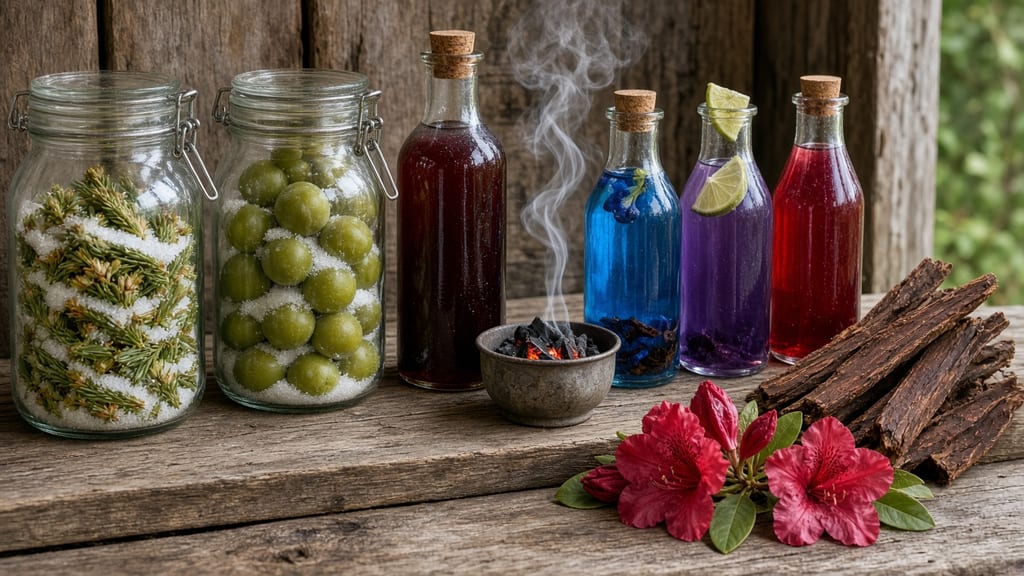
Most syrups on this site are made from fruit you can buy in a shop: berries, lemons, ginger, rose hips. This article is about the others. They come from flowers that can poison you, fruit stones that hold cyanide compounds, pine shoots that must not be mistaken for the poisonous yew, a Caribbean tree bark, willow catkins distilled in a home still, a molasses syrup smoked over hot charcoal, and two drinks that change colour in the glass.
Each one is a real drink with its own country and season, and each one carries a different lesson about what makes a syrup safe. Some of the lessons are about the plant itself, some about the method, and one is about the kitchen air. Where this site gives a recipe for one of them, it says so and links to it. Where it does not, it explains why.
Burans: the rhododendron squash of the Himalaya
In the hills of Garhwal, in the Indian state of Uttarakhand, the red flowers of the tree rhododendron, Rhododendron arboreum, known locally as burans, are made into juice and squash. A peer-reviewed study of flower collection in Garhwal describes the flowers as deep red or pale pink, blooming from January to March, with a sweet and sour taste. Squash, jam, jelly and chutney are made from them, and the juice is drunk as a cold drink in the hot summer.
The study recorded how the squash is made in local processing units. Workers grade the flowers and separate the stamens from the petals. The petals are washed in tap water, ground into small pieces, and boiled in water for an hour. The slurry is left to cool at room temperature and filtered through linen cloth: this is the pure juice. For squash, about 2 kg of sugar is boiled in a litre of water, a litre of the pure juice is added with about 10 g of citric acid for each 2 kg of sugar, and the mixture is boiled again for 30 minutes, cooled, filtered through linen and bottled. Small amounts of sodium benzoate and vanilla or kewra are added for keeping and aroma.
The numbers in the study show how much this matters to the hills. A kilo of flowers is about 400 flowers. Collection peaks between the second week of February and the first week of April, an adult picks about 4 kg a day, and a kilo of fresh flowers gives about 1.7 litres of pure juice. The study counted more than 87 villages and many NGOs and government food processing centres in five hill districts working with the flowers, and in its market survey a 750 ml bottle of squash sold for 100 rupees to retailers and 150 rupees to customers. About 30 per cent of households in the villages studied took part in collecting and trading the flowers, gathering 25 to 350 kg a year and earning 6,000 to 37,000 rupees, which the authors compare with per capita incomes in the hill districts as low as 8,352 rupees a year. Collectors sell to the processors at about 200 rupees for 2 kg of flowers, and the squash units are mostly near towns, run by NGOs and small entrepreneurs who sell through local shops and trade fairs.
The study is about yield and income; it does not discuss toxicity. That is the strange part. Across the border in Nepal, where rhododendron is the national flower, a 2025 case report described a 58-year-old man who ate four fresh white rhododendron flowers, identified from his photographs as Rhododendron decorum, on a visit to Kalinchowk at 3,842 metres. Two hours later he had dizziness, headache, nausea and vomiting. His blood pressure was 80/50 and his pulse 52. He was treated in Dolakha district hospital with intravenous fluids, had passing problems with balance and speech the next day, and went home well on the third day.
The authors explain the cause. Rhododendrons contain grayanotoxins, found in the leaves, petals and nectar, which act on the sodium channels of nerve and heart cells. Poisoning is known from rhododendron honey and, more rarely, from dried flowers and herbal preparations. Not every species is toxic, and only a laboratory can confirm the toxin. In Nepal, the same report notes, the flowers are used to flavour sweet drinks and eaten with salt and chilli.
So burans squash sits on the strange shelf for a simple reason. It is a commercial product of the Garhwal hills, made from one species by processors who know it, and the only safety evidence read for this article is a case of poisoning from a related flower. The case report's authors call for public awareness about eating rhododendron products and for training health workers to recognise the poisoning. This site does not give a home method for any rhododendron drink.
Plum stones and the Korean six months
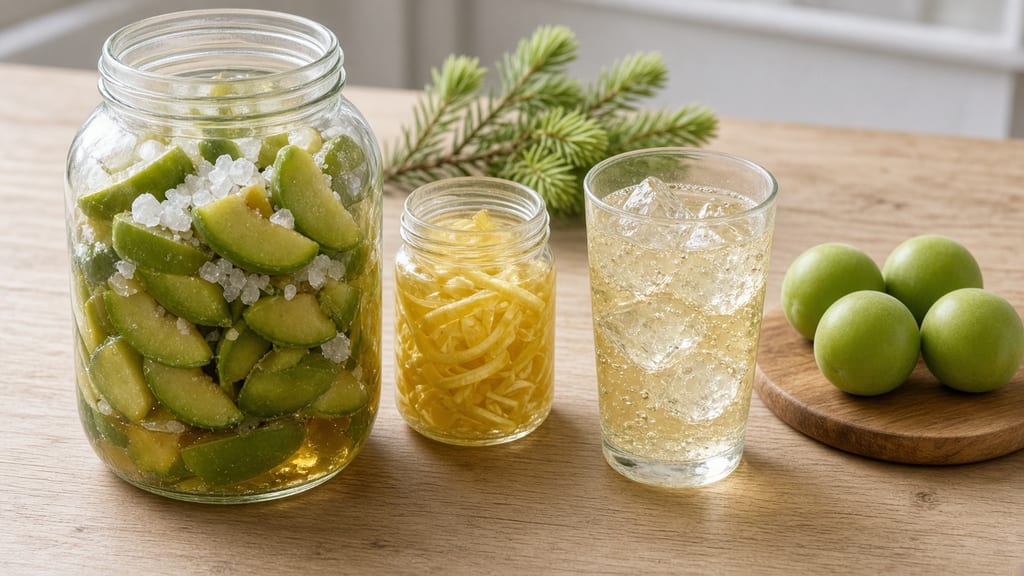
Maesil-cheong, the Korean green plum syrup, and Japanese ume syrup are made by burying raw green plums in sugar until the sugar draws the juice out. Green plums and their stones contain cyanide compounds. Korea's Ministry of Food and Drug Safety publishes a short guide on how to make maesil-cheong safely, and every step in it has a number attached.
Wash the plums at least three times under running water and dry them completely, because water left on them can cause mould. Take out the stems with a needle or toothpick. Remove the stones with a pitter: the Ministry says that removing them cuts the cyanide compounds of green or yellow plums by most of the way, 95 per cent. Use fruit and sugar one to one, with sugar on top. Using oligosaccharide syrup instead of sugar cuts the compounds by 14 per cent. Let it mature at room temperature, stirring as the sugar dissolves, generally for three to four months. Strain out the fruit, which cuts the compounds by 22 per cent as the syrup goes on maturing, and keep the strained syrup in a sterilised container for six months or more, which cuts them by another 13 per cent.
In Japan the Kishu Tanabe Ume Promotion Council in Wakayama works the other way round, against time. It recommends freezing the washed ume for at least 24 hours, which makes fine cracks in the skin, then layering them with rock sugar. The syrup is ready in about seven days, the fruit comes out, and the syrup goes into the refrigerator. The Council's point is to extract quickly and stop the syrup fermenting: 200 cc of vinegar per kilo of ume helps, cutting the sugar leads to mould, and for long storage the syrup is heated at 80 degrees or more for about 15 minutes.
The Council also notes that the colour of the syrup depends on the variety: Gojiro ume give an almost clear syrup, Nanko a slightly red one and Beni Nanko a redder one. It serves the syrup one part to four parts water or unsweetened soda.
The Korean guide also asks for the container to be sterilised with steam or boiling water and dried, because otherwise unwanted microbes can grow. The two approaches are not the same, and this site's recipe follows the Korean safety steps for the stones. Its cold sugar syrup page gives both methods side by side.
Pine shoots in a jar, and the yew
In spring, Polish households make syrop z pędów sosny, pine shoot syrup, from the soft new tips of pine branches. The Polish Ministry of Agriculture's page on it gives the bare method: young shoots with their scales removed are layered with sugar in a jar and pressed down lightly. The jar stands for 7 to 14 days and is shaken often. Then the syrup is strained, the shoots pressed, and the syrup jarred and kept in a cool place. The shoots sit raw in sugar for one to two weeks. No food safety authority read for this series gives a tested method for this kind of maceration, so this site records it as folk practice, and the cold sugar page keeps the strained syrup in the refrigerator.
The bigger danger is picking the wrong tree. Poland's State Forests describe Scots pine needles as growing in pairs on short shoots, 3 to 8 cm long, stiff, finely serrated and sharp; Swiss stone pine has them in fives. Yew needles are arranged like the teeth of a comb along green shoots, pointed but soft, dark on top and paler underneath, and up to 3 cm long. Every part of the yew except the red flesh around the seed contains taxine, which harms the heart, and the State Forests say a poisoned person must go to hospital at once.
The Polish method uses only the young shoots of spring, with their brown scales taken off; the State Forests pages describe the mature needles, which is what you check on the branch. Count the needles in each bundle before you pick. Two or five together from one point means pine. Single flat needles in a comb means yew, and that branch must not go anywhere near a jar.
Mauby: a bitter bark from the Caribbean
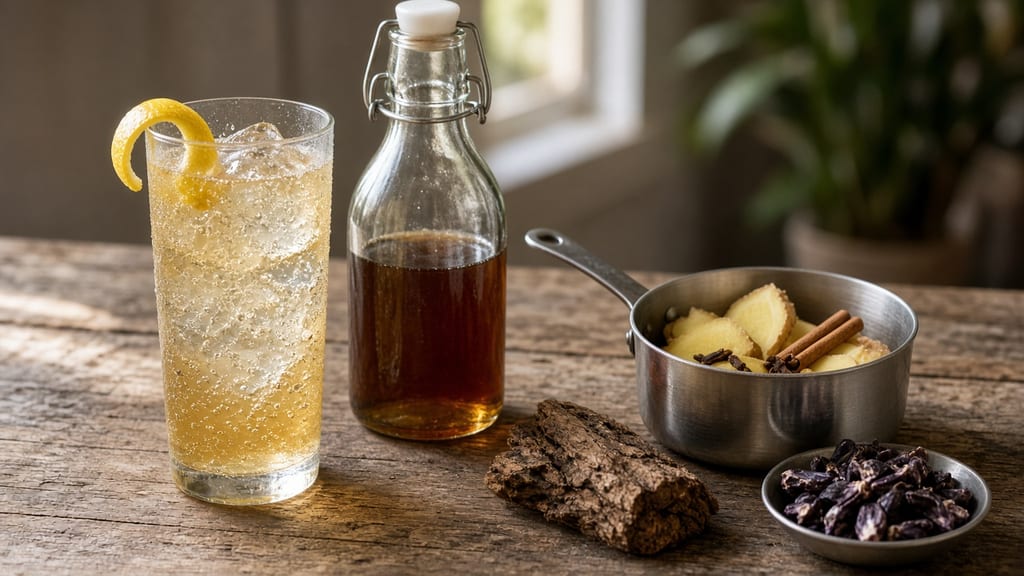
Mauby is a drink made from tree bark. We Trini Food, a Trinidadian recipe site, gives the trees as soldierwood, Colubrina elliptica, or greenheart, Colubrina arborescens, and the names as mauby in the English-speaking Caribbean, mabi in the French-influenced islands, and mavi or mabi in the Spanish-speaking ones. The bark is very bitter and needs plenty of sugar. It is boiled with spices such as aniseed, cloves, star anise, bay leaf and cinnamon, left to steep, strained, and sweetened.
What makes it strange is the next step. We Trini Food says that on most islands the drink is left on the countertop for a few days to ferment, while in Trinidad and Tobago fermenting is not common. Trinbago Recipes, another Trinidadian site, notes that some people leave sweetened mauby at room temperature for 12 to 24 hours so that it froths and ferments slightly, but keeps its own recipe in the refrigerator: the strained concentrate for up to two weeks and the finished drink for up to four days. It also advises people who are pregnant or taking medicines to check with a doctor before drinking bark drinks regularly.
This site keeps those two drinks apart. The boiled, sweetened and refrigerated concentrate is a syrup and belongs with the root and bark syrups. A sweet drink left on a counter to ferment is a different product, with different risks, and no tested method for it was found.
Willow-blossom water: bidmeshk from Urmia
In Iran, one of the most fragrant sharbats starts with willow catkins. The tree is bidmeshk, the musk willow, Salix aegyptiaca, and its flowers are distilled into a scented water, araq-e bidmeshk, which is then stirred into a sugar syrup.
A herbal distillate company in Urmia, Zarrin Giah, describes how the water is made there. Part of the harvest of catkins goes to local markets, and people distil them at home with a traditional still called a ney ghazan, a pot with a reed. Making bidmeshk water in the first days of spring has become an old custom in Urmia. The catkins are picked and sold at the end of the Persian month of Esfand and the start of Farvardin, around the Persian new year in March, before other crops have started to grow. The company's own figures, for Sanandaj in 2018, are 800 trees to the hectare, about 10 kg of fresh catkins from a five-year-old tree, about 8 tonnes a hectare, and about 10,000 toman a kilo paid by local traders. Herbal distilleries and herb sellers buy the catkins.
The same page lists what good bidmeshk water should be like. It should smell strong and pleasant, a sign that it is concentrated; anything else suggests it is old or contaminated. It should be completely clear. It should be kept in glass, preferably coloured, away from sunlight and heat, so the scent does not fade, and in a tightly closed bottle, or the scent slowly escapes.
The sharbat itself is simple. Digikala Mag, a Persian magazine, gives 1 cup of bidmeshk water, 1 cup of water and 3 cups of sugar. The sugar and water are heated until the syrup is as thick as you like, the syrup is left to cool, and the bidmeshk water is stirred in at the end. To serve, add a glass of water for every two spoons of syrup. A version with rose water uses a third as much rose water as bidmeshk water, boiled briefly; boiling it for more than 10 minutes, the magazine says, drives off the rose scent. That syrup is cooled, put into a clean, dry glass jar, and kept in the refrigerator.
The lesson here is about the scent, which lives in the distillate. It goes in after the heat, and it is protected from light and air. Digikala sells bottled bidmeshk water and rose water alongside its recipe; distilling at home is a separate craft and is not covered on this site.
Smoke in the jar: jallab
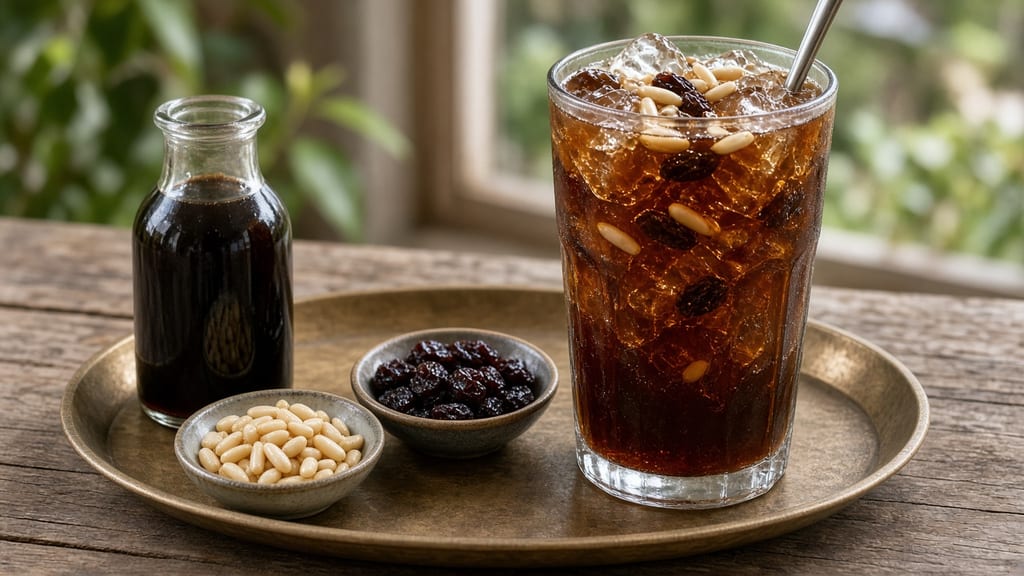
Jallab is the Levant's Ramadan drink: a dark syrup of grape and date molasses with rose water, poured over crushed ice and topped with pine nuts and raisins. The strange part is the smoke. In Hanakoleah's Syrian-style recipe, the cook turns off the heat under the finished syrup, lights a small piece of charcoal on the burner until it glows red, sets it in a small metal cup inside the pan above the syrup, not in it, drops two tears of mastic on the coal, and closes the lid for 10 minutes as soon as smoke rises.
Other cooks smoke the container instead. Al-Wasfa al-Arabiya smokes the glass jar or bottle by putting a cinnamon stick on a lit coal, and says frankincense, luban dhakar, can be used instead. Teb21 burns the ends of two cinnamon sticks, puts them in the jug with the molasses and closes it to trap the smoky flavour.
The danger here is in the air. The Scottish Fire and Rescue Service says lit charcoal in an enclosed space can lead to a build-up of carbon monoxide, which can be fatal, and that lit charcoal should only be used in a well-ventilated, open area. The NHS describes carbon monoxide as colourless and without smell, with symptoms such as headache, dizziness, nausea, weakness, tiredness and confusion, and says anyone who suspects poisoning should go outside and get medical advice, calling 999 if someone is struggling to breathe, confused or unconscious.
This site's jallab recipe makes the smoking optional and does it outdoors only. The syrup itself keeps, according to Hanakoleah, for a month in a closed bottle in the refrigerator. Hanakoleah also adds the rose water only after the syrup has rested five minutes off the heat, because heat drives off its scent, the same rule as for bidmeshk water. In Egypt, the recipe notes, jallab is often made with black treacle in place of grape molasses.
Drinks that change colour: butterfly pea and red shiso
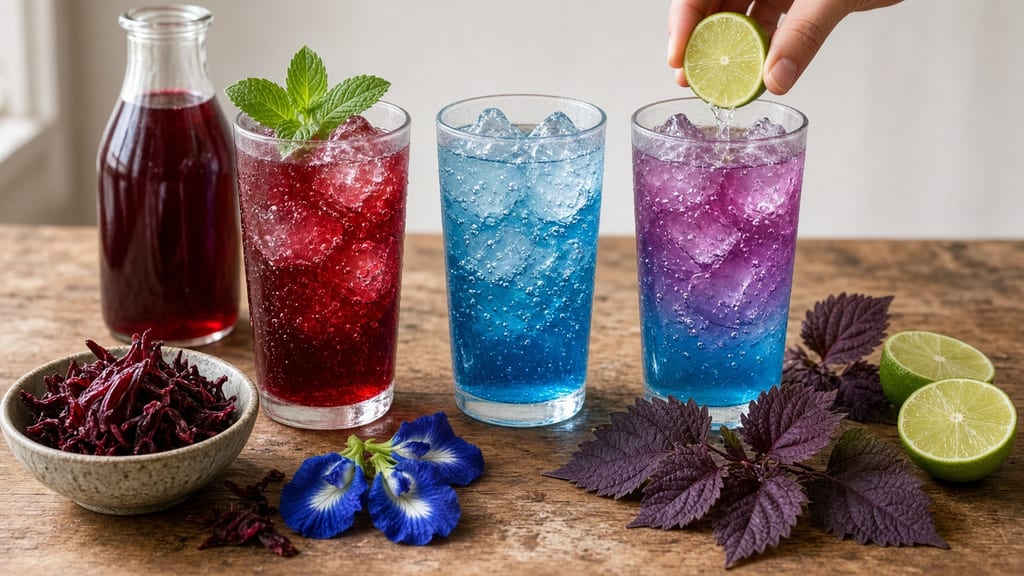
Two drinks on the shelf are strange to look at. In Thailand, the blue flowers of the butterfly pea, anchan, make nam anchan. The Thai Department of Health's nutrition recipe uses 10 g of dried flowers, 200 g of water and 8 g of sugar, boiled for three minutes, strained through cloth and cooled, with 10 g of lime juice added at the end. The blue drink turns purple when the lime goes in.
Rachel Cooks Thai explains why: the colour comes from anthocyanins, which change with pH. In a neutral liquid the extract is dark blue, and in an acid one it moves towards bright magenta. Pim's kitchen, a Thai recipe site, makes a strong extract by steeping 60 washed double flowers, about 50 g, in a cup of very hot water, and a separate sugar syrup from 200 g of sugar boiled with water just until it dissolves. It then turns the effect into a glass: a third of a cup of sugar syrup, 4 tablespoons of strong flower extract, a tablespoon and a half of lime juice and half a cup of boiled cooled water over small ice cubes.
In Japan, red shiso leaves do something similar. Kagome's recipe boils 300 g of red shiso leaves in 2 litres of water for 15 minutes and removes them, leaving a dark liquid. At least 500 g of sugar and 25 g of citric acid go in, and the moment the acid is added the liquid turns bright red. Kagome says that with 250 g or more of sugar per litre the juice keeps about six months in the refrigerator.
The colour change is chemistry: it shows how much acid is in the glass. The Thai recipe is a drink made fresh, and Kagome keeps its shiso juice in the refrigerator.
What the strange shelf has in common
Set side by side, these drinks fall into a few groups. Burans and yew are about the plant: some flowers and some needles are poisonous, and the risk is in the plant itself before any sugar goes in. Plum stones are about a known compound that a national regulator has measured and given steps for. Raw pine shoots in sugar and fermented mauby are about methods that people use but that no food safety authority read for this series has tested, so this site records them and does not recommend them. Jallab smoke is about the room you make it in. Bidmeshk water and shiso are about care with scent and acid.
For everything on this site that is made at home, the storage rule from the University of Maine Cooperative Extension applies: homemade flavoured syrup is labelled, dated and kept in a sterilised jar in the refrigerator for up to a month, unless a tested source for that syrup gives something else, as Kagome does for its high-sugar shiso juice.
Where to find the recipes
Maesil-cheong, ume syrup, yuja-cheong and pine shoot syrup are on the cold sugar syrups page, with the Korean plum stone steps and the pine and yew identification. Mauby concentrate is on the root and bark syrups page. Butterfly pea and red shiso are on the hibiscus and colour-changing syrups page. Jallab, with outdoor smoking, has its own page. The world feature on syrups as a beverage technology covers sharbat, saft and cheong in more depth. Burans squash and home-distilled bidmeshk water have no recipe pages here.
Related
Pairs with
A syrup is a beverage technology: sharbat, saft, cheong and shrub around the world
From 13th-century Andalusian sikanjabin to Madurai nannari, Senegalese bissap, Korean cheong, Trinidad mauby and Austrian 55 °Brix law: how the world turns roots, flowers and fruit into syrups for water.
Discussed in this article
Cold sugar syrups: maesil, ume, yuja and pine shoots
Syrups made without heat by packing fruit or shoots in sugar: Korean maesil-cheong with the ministry's stone-removal steps, frozen Japanese ume syrup, yuja-cheong and Polish pine-shoot syrup.
Ginger, root and bark syrups
Boiled syrups from hard ingredients: a refrigerated ginger syrup, Trinidad mauby from tree bark, Tamil nannari root syrup, Peruvian purple-corn concentrate and a Turkish spiced sherbet.
Hibiscus and colour-changing syrups
Senegalese bissap syrup from a cold soak, with Ghanaian sobolo, Thai butterfly pea that turns from blue to magenta and Japanese red shiso juice that flashes ruby.
Jallab: smoked grape and date molasses syrup
The Levant's Ramadan syrup: grape and date molasses blended into a sugar syrup in 5 minutes, smoked with mastic or cinnamon, finished with rose water and served over ice with pine nuts and raisins.
Community
No community contributions have been published for this entry yet.
Share what you made
Sign in to contribute. Published comments and photos are free to read.
Sources
PubMed Central (peer-reviewed study, Garhwal Himalaya)
Extraction of Rhododendron arboreum Smith flowers from the forest for the livelihood and rural income in Garhwal Himalaya, IndiaCited in: Burans: the rhododendron squash of the Himalaya; Where to find the recipes
PubMed Central (case report, 2025)
Grayanotoxin poisoning following fresh rhododendron flower ingestion: a rare case report from rural NepalCited in: The strange shelf; Burans: the rhododendron squash of the Himalaya
식품의약품안전처 (Ministry of Food and Drug Safety, Korea), 26 May 2026
매실청 담그기 (Making maesil-cheong safely), card newsCited in: The strange shelf; Plum stones and the Korean six months; What the strange shelf has in common; Where to find the recipes
紀州田辺うめ振興協議会 (Kishu Tanabe Ume Promotion Council, Wakayama)
梅シロップの作り方 (How to make ume syrup)Cited in: Plum stones and the Korean six months
Ministerstwo Rolnictwa i Rozwoju Wsi (Polish Ministry of Agriculture)
Syrop z pędów sosnyCited in: Pine shoots in a jar, and the yew; Where to find the recipes
Lasy Państwowe (State Forests, Poland)
Sosna zwyczajna (Scots pine)Cited in: Pine shoots in a jar, and the yew
Lasy Państwowe (State Forests, Poland)
Cis pospolity (yew)Cited in: The strange shelf; Pine shoots in a jar, and the yew
We Trini Food (Ros Singh)
Simple Mauby Recipe Using Mauby BarkCited in: The strange shelf; Mauby: a bitter bark from the Caribbean
Trinbago Recipes (October 2026)
MaubyCited in: Mauby: a bitter bark from the Caribbean; Where to find the recipes
Zarrin Giah Urum Pardis, Urmia
تهیه عرق بیدمشک به روش سنتی (Making bidmeshk distillate the traditional way)Cited in: The strange shelf; Willow-blossom water: bidmeshk from Urmia; Where to find the recipes
Digikala Mag
طرز تهیه شربت بیدمشک خانگی به روش سنتی (Homemade bidmeshk sharbat)Cited in: Willow-blossom water: bidmeshk from Urmia
Hanakoleah, Syrian kitchen section, by Marwa Mohamed
طريقة عمل الجلاب السوري بالصنوبر والزبيب (Syrian jallab with pine nuts and raisins)Cited in: The strange shelf; Smoke in the jar: jallab; Where to find the recipes
Al-Wasfa al-Arabiya (arabianrecipe.com)
طريقة عمل الجلاب (How to make jallab)Cited in: Smoke in the jar: jallab
กรมอนามัย (Department of Health, Ministry of Public Health, Thailand)
น้ำดอกอัญชัน (Butterfly pea flower drink)Cited in: Drinks that change colour: butterfly pea and red shiso; Where to find the recipes
ครัวบ้านพิม, Pim's kitchen (16 October 2009)
Sweet Lemon Violet (น้ำดอกอัญชัน)Cited in: Drinks that change colour: butterfly pea and red shiso
Rachel Cooks Thai
Butterfly Pea Lemonade (Nam Anchan Manao)Cited in: The strange shelf; Drinks that change colour: butterfly pea and red shiso
Kagome VEGEDAY (July 2017)
赤しそジュース (Red shiso juice)Cited in: Drinks that change colour: butterfly pea and red shiso; What the strange shelf has in common; Where to find the recipes
University of Maine Cooperative Extension
Drinks from the GardenCited in: What the strange shelf has in common
Gaps
- No grayanotoxin data for Rhododendron arboreum squash was found.
- No tested method was found for raw pine shoots macerated in sugar or countertop-fermented mauby.
- Home distillation of bidmeshk water is described from one Urmia company page.
Updated 2026-11-24