
Fungi intake
Edible mushrooms around the world
Mushrooms can be a meal, a broth's flavour, a forest harvest or an indoor crop. This survey follows edible fungi across East Asia, Africa, the Americas and desert regions, their kitchen roles and how harvests are kept.
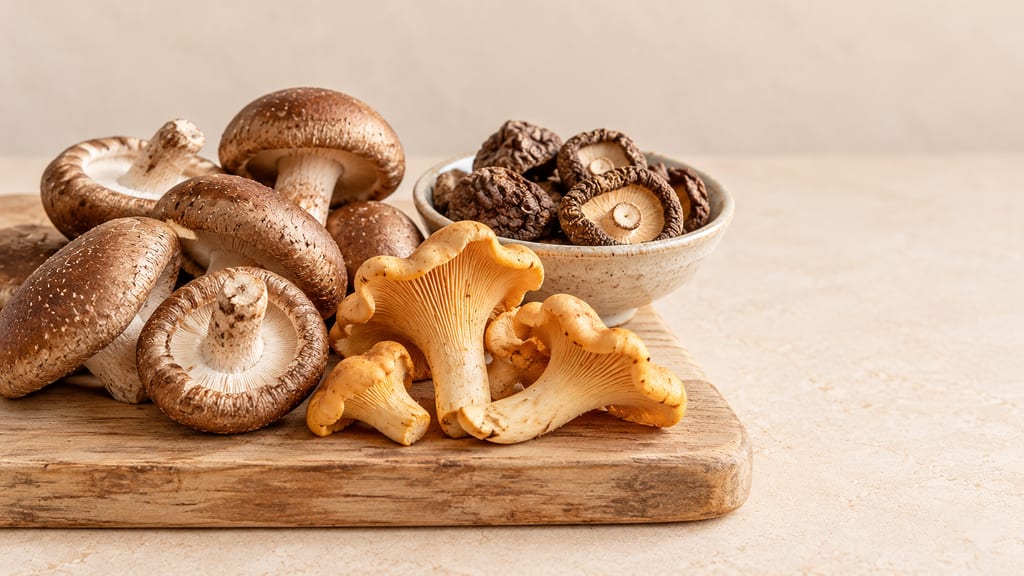
Fresh shiitake, golden chanterelles and dried shiitake: a few of the mushrooms the world cooks with.
Introduction
A mushroom can be the centre of a meal, the flavour behind a broth, a seasonal forest harvest or a crop grown indoors. Looking beyond the familiar button mushroom reveals a food world shaped by trees, termites, rain, trade and the people who know what to do with each harvest.
A food with many histories
There is no single mushroom cuisine. In Oaxaca, a small gathering may fill tortillas while a larger one goes into a maize-thickened mole. In the Pakaraima Mountains of Guyana, Patamona cooks steam mushrooms in leaf parcels. In Japan, dried shiitake can supply the savoury foundation of a dish without becoming its most visible ingredient. Desert truffles enter couscous and meat dishes in the northern Algerian Sahara. These are different ways of valuing fungi: for substance, texture, aroma, seasonality and the work of gathering them.
The history reaches beyond written recipes, but its earliest traces require care. Microscopic remains preserved in dental calculus from El Mirón Cave in northern Spain include fungal spores interpreted as possible evidence of bolete consumption during the Magdalenian. That is a tantalising glimpse of food otherwise unlikely to survive. It does not identify a modern recipe, establish an exact mushroom species or prove where mushroom eating began. A soft fruiting body generally leaves a less durable archaeological record than a bone or a charred seed.
Living food traditions preserve another kind of history. Names carry observations about habitat, season, resemblance and use; people teach them while walking, collecting, selling and cooking. Such knowledge is specific to communities. A country can contain several fungal cuisines, and neighbouring communities may appreciate different species. Treating an entire continent as enthusiastic or fearful about mushrooms conceals much of what there is to learn.
The fungus behind the mushroom
The mushroom we buy is usually a fruiting body: a structure through which a fungus produces and disperses spores. Much of the organism lives elsewhere as a network of fine filaments, or hyphae, collectively called mycelium. Understanding how that network obtains food helps explain why some mushrooms arrive reliably from farms and others follow the fortunes of a forest.
Decomposers obtain nutrients from organic material such as dead wood or prepared plant residues. Shiitake and many oyster mushrooms belong to this broad ecological group. Mycorrhizal fungi live in association with plant roots, exchanging resources with their hosts. Familiar examples include porcini, matsutake and many truffles. Other fungi parasitise plants or other fungi. These relationships overlap in complicated ways, so they are useful explanations of food supply rather than a shortcut for identifying specimens.
Button mushroom cultivation shows how much work can sit behind an ordinary punnet. Agaricus bisporus grows in a deliberately prepared substrate. Composting changes the starting materials; subsequent conditioning and pasteurisation prepare the substrate for the crop. Growers introduce spawn, allow the mycelium to colonise it, then apply a casing layer and manage conditions that encourage fruiting. Compost preparation, the growth of mycelium and the appearance of mushrooms are separate stages. The finished crop is not simply something that happens when scraps are left damp.
The relationship with trees makes truffle production a different undertaking. Growers establish a fungus on suitable roots and manage a living orchard. Finding fungal DNA in soil, maintaining a colonised tree and harvesting a truffle are distinct achievements. For the Italian white truffle, Tuber magnatum, orchard harvests in France reported in 2021 overturned the absolute claim that cultivation was impossible. The harvests were small and followed years of work; they did not make this fungus equivalent to a routine indoor mushroom crop.
Termite mushrooms add a third kind of cultivation. Fungus-growing termites maintain Termitomyces in their nests, using gathered plant material in an association that supports the colony. People harvest the mushrooms that this relationship produces. Their food source therefore depends on the termites and their habitat, as well as the fungus. The human collector is entering an agricultural system maintained by another animal.
East Asia: markets, cultivation and the flavour of a broth
East Asian mushroom foodways combine intensive cultivation with detailed knowledge of wild harvests. These two supplies should not be treated as stages on a simple ladder from primitive gathering to modern farming. A cultivated mushroom offers predictable availability; a forest mushroom may carry a seasonal taste, local name and market value that cultivation does not replace.
In Pu’er Prefecture in southwestern Yunnan, fieldwork joined market surveys with collection in surrounding habitats. The researchers visited eleven markets and recorded 101 market species. About three quarters were ectomycorrhizal: fungi associated with plant roots. Specimens were examined morphologically and with DNA evidence, then deposited in a herbarium. This connects the food on a stall to biological material that other researchers can revisit. It also makes the forest part of the food system visible. Market diversity depends partly on living trees beyond the market boundary.
Sellers travel from collecting areas to street stalls and mobile markets. Knowledge of when and where mushrooms appear has economic consequences: it affects what reaches a buyer and whose labour makes that sale possible. These observations belong to the communities and markets studied in Pu’er; they should not become a claim that every part of China gathers, trades or cooks fungi in the same way.
Shiitake, Lentinula edodes, demonstrates a different connection between growing, preserving and cooking. Fresh mushrooms and dried mushrooms are not merely two interchangeable packages. Drying changes the ingredient, and rehydration makes both the mushroom and its liquid available to a cook. Fresh shiitake can be grilled, fried or simmered; dried shiitake contributes a more concentrated foundation to stocks and braises. In Japanese Buddhist temple cooking, shiitake stock has a recognised place among the ingredients used to build a broth without meat.
A regional dish makes that contribution tangible. Houchou from Ōita is made with long, hand-stretched wheat noodles and a dipping broth. Dried shiitake and dried small fish contribute to the stock, with accompaniments such as sesame, ginger, Japanese leek and kabosu citrus. Mushrooms work here as part of a composition: their flavour supports the noodles and condiments. The dish is associated with hospitality and celebrations, including Bon festivities, rather than merely being a vehicle for a mushroom garnish.
The science of dried shiitake is more interesting than the claim that drying concentrates everything. Guanylate, a nucleotide associated with umami, can be generated through enzyme action on RNA. Drying conditions and subsequent preparation influence the result. Experiments comparing drying treatments have measured differences in guanylate extraction, texture and rehydration. Removing water, changing tissue and allowing enzymes to act are different processes. None requires us to describe a dried shiitake as fermented.
Across monsoon markets and mountain supply routes
In Luang Prabang, Laos, vendors sold mushrooms alongside a wide range of wild plant foods. Some Russula collections could not be assigned securely to named species even after DNA work. The sellers' familiarity with a food and the researcher's ability to attach a published scientific name were advancing on different tracks. That is a reason to preserve both the local record and the unresolved identification.
One detail brings the market into the kitchen: sour Antidesma acidum leaves were sold alongside Russula mushrooms for preparing their dishes. A stall could therefore offer a culinary relationship as well as an ingredient. Wild-collected fungi and cultivated supplies meet in these markets. The presence of both does not mean that everything on display came from the same habitat or was gathered in the same way.
In the western Himalayas, research in Azad Jammu and Kashmir documented mushroom collecting, preservation and selling as linked sources of household food and income. Morels were among the valued traded fungi. Here a mushroom's journey can extend beyond its gathering season and beyond the household that found it. The economic account should remain attached to the surveyed area, while broad historical morel names require their own taxonomic scrutiny.
Names that travel, species that differ
A mushroom's presence in a country does not establish that people eat it there. A food-use record is different again from a toxicological assessment. Brazil makes the distinction concrete. A major audit published in 2024 separated occurrence, identification and consumption evidence. Of its 409 edible or conditionally edible entries, 86 had the strongest local occurrence evidence, based on molecular data or Brazilian nomenclatural types. Within that group, 52 had clear evidence of consumption in Brazil. The larger figure describes a research category; it does not establish hundreds of equally well-documented Brazilian food traditions.
Food names travel more easily than biological identities. Button, cremini and portobello are market forms of Agaricus bisporus, not three separate species. In other cases, a familiar name covers several distinct fungi. “Oyster mushroom,” “wood ear,” “porcini” and “matsutake” need the context of a species, place or supply chain before they can support precise research claims.
Wood ears provide a well-studied example. Asian Auricularia heimuer was formerly treated as the same species as European A. auricula-judae. Morphological and molecular work separates them. A worldwide revision of Auricularia also revealed that several apparently widespread forms conceal multiple species. An old name can remain useful for finding a paper while being unsuitable as its final biological identification. Renaming a record without retaining the original name would lose part of the route back to the evidence.
Cultivated East Asian enoki presents a related case. An integrated taxonomic study distinguished Flammulina filiformis from European F. velutipes, a name widely used in older cultivation and genome literature. The practical consequence for a reader is modest but important: findings should follow the organism actually studied. A name printed on an older experiment does not automatically make the experiment wrong; it may need a careful cross-reference.
Regional truffles show why familiar European words should not swallow other traditions. Oregon's culinary truffles include the winter white Tuber oregonense, spring white T. gibbosum, black Leucangium carthusianum and brown Kalapuya brunnea. They are associated with Pacific Northwest forests, including Douglas-fir stands, and have their own aromas and seasons. Their value does not depend on being substitutes for an Italian or French species. For these aromatic foods, maturity and handling affect culinary quality; a famous name alone cannot supply it.
The same care belongs in a European pantry. Fresh porcini, dried porcini and a prepared mushroom preserve serve different purposes. Broad historical references to Boletus edulis can include a wider species concept than a modern taxonomic treatment. A cook may reasonably buy a product under its established culinary name, while a research account still needs to record what that name meant in its particular source.
African forests, termites and household preferences
Africa contains several mushroom food systems, connected to different habitats. Miombo woodlands support tree-associated mushrooms as well as termite fungi; rainforests also offer many fungi growing on dead wood. Desert truffles belong to another ecology again. Combining these into a single African mushroom list can reveal breadth, but it cannot explain how a particular household chooses dinner.
Neighbouring groups in Tshopo Province in the Democratic Republic of the Congo recognise and value different fungal foods. Among the foods especially appreciated by participants in local fieldwork were wood-decaying fungi such as Schizophyllum commune, Auricularia species and Lentinus squarrosulus. Pleurotus tuber-regium stood out for its multiple uses. Its sclerotium, a compact mass of fungal tissue, reminds us that the edible part of a fungus need not be a cap and stalk.
Some collectors in the Tshopo study deliberately felled trees to encourage wood-decaying fungi. This is an uncomfortable but useful detail: a forest food is not automatically harvested without ecological cost. Cultivating locally appreciated decomposers was proposed as a way to reduce that pressure. The appropriate crop would need to match local preferences, not simply whichever commercial mushroom was easiest for an outside project to supply.
Tree-associated fungi in Tshopo rainforest habitats were less used than their availability might suggest. Distance mattered. Fungi growing on dead wood near villages and cleared areas could be more accessible than those in older forest. Short fruiting seasons could further limit the usefulness of a species. Biological abundance, practical access and cultural preference are different things; all three help determine whether a potential food becomes an everyday one.
The enormous Termitomyces titanicus illustrates a more conspicuous harvest. It grows in association with miombo and particular fungus-growing termites; its substantial flesh and strong flavour contribute to its appeal. Yet its size is only one part of the story. Protecting a termite mushroom resource means considering the colony and surrounding land, not merely the fruiting bodies carried to market. A food-development project that ignored those relationships could damage the system that supplied its ingredient.
The Americas: maize, forest parcels and local knowledge
In the Mixteca Alta of Oaxaca, mushrooms belong to a wider body of knowledge about rain, woodland and work. Among households participating in local fieldwork, preparation choices changed with the amount gathered. Small quantities could be roasted and put into quesadillas or empanadas; more abundant harvests could become soup or amarillito, a mole thickened with ground maize and seasoned with ingredients including chilli and hoja santa. Participants described keeping mushroom kinds separate because their flavours and cooking times differed.
This is a cuisine organised around distinctions, not an indiscriminate mixture of forest produce. Selected fungi were dried, and a valued dried mushroom was sent to migrants in the United States. Preservation helped a food travel with a community. Local names and habits continued to matter after the ingredient had left the place where it grew.
Mexico's huitlacoche shows another way of eating a fungus. Ustilago maydis infects maize and produces the swollen galls used in dishes such as quesadillas, soups and tamales. The food includes the transformed host tissue; it is not an ordinary mushroom fruiting body. Its place in a kitchen differs from the crop disease perspective of a maize grower. Neither description permits a general leap from this particular food to other smuts or mould-damaged grain.
Further south, fieldwork with Patamona people in Guyana documented mushrooms steamed in parcels made from selected forest leaves. The wrapping serves as a cooking vessel, holding the mushrooms together near a fire. Species were also added to tuma, a pepperpot eaten with cassava bread. These accounts give texture to a food tradition that would disappear inside a Latin name alone: there is a vessel, a hearth, a preferred preparation and a meal around it.
Mushrooms eaten by Patamona participants differed from some of those sampled by visiting researchers. Researchers' self-experiments are not the same as an established local food tradition or a safety study. Some mushrooms valued elsewhere were not chosen by the people interviewed. A refusal to eat a fungus can express culinary judgement and inherited categories, not a lack of knowledge.
Brazil offers a further reminder that Amazonian fungal foodways are diverse. Sanöma knowledge of wood-growing mushrooms forms one part of a much wider history of Indigenous fungal foods. Tropical fungi such as Auricularia, Lentinus, Favolus and Pleurotus broaden a culinary picture too often centred on European forest species. Their histories deserve community-specific accounts, with the identity and preparation evidence attached to each food rather than borrowed from a related mushroom.
Desert harvests and southern histories
Desert truffles upset the expectation that mushroom foods always belong to damp woodland. In the northern Algerian Sahara, interviews with truffle hunters in Ouargla and Ghardaïa documented Terfezia and Tirmania foods, local preferences and a close attention to rain and associated plants. Truffles were prepared with couscous and meat or in porridge. Much of the gathering supplied households, although surplus could also be sold.
These are substantial ingredients in meals, not simply aromatic shavings placed on a restaurant plate. Their cultural and economic place depends on uncertain seasonal abundance. People also valued these truffles for medicinal uses, but a belief or practice does not demonstrate treatment efficacy. The culinary record can stand on its own without turning a valued seasonal food into a remedy.
Australian histories require similar precision about both people and fungal parts. Recorded Aboriginal foods include the underground sclerotium of Laccocephalum mylittae, often called native bread, and the fleshy structures of Cyttaria gunnii associated with southern beech. Early European observers often supplied too little detail to identify the fungus securely, and their interpretations could distort what they witnessed. The surviving written record therefore gives examples, not a complete measure of Aboriginal fungal knowledge or a single Australian practice.
In Aotearoa New Zealand, wood ears connect local gathering to international trade. Hakeka was eaten and dried for export to China in the late nineteenth and early twentieth centuries. Chew Chong helped organise the trade known as Taranaki wool. Here drying did more than bridge a short season: it made a light, transportable product that linked Māori collectors with distant consumers. Older botanical names in such histories still need checking against modern work; the trade history is not dependent on pretending that every historical specimen has been reidentified.
Different jobs in the kitchen
“Mushroom” is a useful shopping category but a poor prediction of eating quality. The following groups describe culinary roles among documented food fungi. They are not identification categories or permission to eat an unfamiliar specimen.
Culinary role: A substantial cooked ingredient. Examples: Button mushrooms, oyster mushrooms, lion's mane. What the distinction explains: The body of the fungus contributes texture and volume to the dish.
Culinary role: Broth and concentrated flavour. Examples: Dried shiitake, dried porcini. What the distinction explains: Drying and extraction can make the cooking liquid as valuable as the solid ingredient.
Culinary role: Elastic or gelatinous texture. Examples: Wood ears, snow fungus. What the distinction explains: Texture can be the principal attraction; a mild flavour is not a culinary defect.
Culinary role: Aroma used as seasoning. Examples: Named culinary truffles, matsutake. What the distinction explains: Identity, maturity and handling matter to the aroma that reaches the plate.
Culinary role: Fungal transformation of a plant. Examples: Huitlacoche; water-bamboo associated with Ustilago esculenta. What the distinction explains: The food includes altered host tissue rather than a conventional mushroom alone.
Culinary role: Compact fungal tissue. Examples: Sclerotia of Pleurotus tuber-regium and native bread. What the distinction explains: A food record may concern a different part of the organism from its fruiting body.
These distinctions also explain why one mushroom is not an automatic substitute for another. Replacing wood ear with a soft cap changes the bite of a dish. Replacing a dried ingredient with fresh changes the relationship between solids and liquid. Replacing an aromatic truffle with an unrelated mushroom changes the dish's seasoning. The useful question is what the particular ingredient contributes, not whether both products can be filed under fungi.
Keeping a harvest: fermentation is one route among several
Mushroom preservation begins with a perishable ingredient. Drying removes water; freezing changes the physical state of that water; acid pickling introduces acid; pressure canning uses a specified thermal process. Fermentation involves microorganisms changing the food. Salt may participate in several of these methods, but a salted mushroom is not necessarily a fermented mushroom.
Controlled experiments with button mushrooms show what a genuine lactic fermentation can involve. Researchers compared two strains of Lactiplantibacillus plantarum, including one isolated from spontaneously fermented mushrooms. Their process used blanched mushrooms, added sucrose and salt, a measured starter inoculum, a controlled fermentation period and refrigerated maturation. The bacteria differed in sugar use and acid production. The mushrooms contained several sugars and organic acids, and lactic acid became dominant in the fermented product.
That finding explains why starter choice and the available food for bacteria matter. It does not validate any jar assembled from mushrooms and a spoonful of salt. The tested ingredient, pretreatment, formulation, inoculum and storage conditions belong together. A pleasing sour taste, bubbles or a single home acidity reading cannot establish that an altered procedure controls every relevant hazard. The research also does not make every resulting food probiotic: a health benefit needs evidence for the organism, product and use in question.
A preservation method may apply to a narrowly defined ingredient. One established whole-or-sliced pressure-canning procedure applies to domestic mushrooms and expressly excludes wild mushrooms. A recipe's scope is part of its safety information. Neither an ethnographic account of a salted harvest nor the success of a laboratory ferment fills a gap in a different canning process. Species-specific preservation methods deserve their own full accounts.
Fungi also preserve and transform other foods. Selected koji cultures, cheese-ripening moulds, brewing yeasts and tempeh fungi belong to this wider food world, as does manufactured fungal biomass. Here the fungus is a working culture or the food being grown, rather than a harvested mushroom being preserved. Strain identity and the controlled process are essential. The existence of a food-grade mould does not justify cultivating an environmental mould found in a kitchen.
Nutrition, medicine and the limits of an edible label
Mushrooms contribute to meals through nutrients as well as flavour, but comparisons need a consistent basis. Fresh mushrooms contain substantial water. A protein percentage measured in dried material cannot be compared directly with the same weight of a fresh food. Species, growing conditions and processing also affect composition. Calling mushrooms a meat substitute may describe how a cook uses their texture or savoury flavour; it does not establish nutritional equivalence.
Vitamin D is a useful example of a real property that becomes misleading when flattened into a slogan. Ultraviolet exposure can convert fungal ergosterol into vitamin D₂. Human studies have tested UV-treated mushroom products, but their outcomes depend on the product and participants. A 2011 trial in healthy adults found improved vitamin D status with an enhanced mushroom preparation. In a separate 2014 trial involving overweight or obese prediabetic adults, cooked UV-treated mushrooms produced modest or no increases in the measured vitamin D markers relative to positive vitamin-D₃ control groups. Cooking had reduced the mushrooms' vitamin D₂ content; the controls also received more vitamin D₃ than their supplement labels stated. The result cannot isolate population differences from the different products and delivered doses. “Contains mushrooms” therefore tells us little about a dish's vitamin D contribution without information about the ingredient actually used.
Medicinal evidence needs an even sharper distinction between food, extract and treatment. Traditional uses record cultural practice. Laboratory tests can reveal compounds and mechanisms. Clinical studies ask different questions about specified preparations and health outcomes. Evidence for a mushroom-derived product used alongside cancer treatment cannot be transferred to a bowl of mushroom soup or an unrelated supplement. A specified extract, its dose and its clinical use belong together; mushroom foods are not established cancer treatments.
Finally, an edible name does not erase handling and preparation hazards. A 2023 Montana outbreak linked to morels involved 51 illnesses and two deaths. The implicated morels were cultivated and commercially supplied; preparation included raw or incompletely cooked use. Investigators did not identify the causative agent. The event is a reason to retain the distinction between a species with a food history and a food safely prepared in a particular meal. It is not evidence for a universal cooking time that the investigation did not establish.
Wild mushrooms require identification by a suitably qualified local expert. A food name or photograph cannot establish the identity or edibility of a specimen. The most useful next step for a cook is to choose a known food ingredient with reliable provenance, then follow a preparation appropriate to that particular mushroom. For a reader, the reward is broader: each familiar cap, dried ear or underground truffle leads back to a specific relationship between fungi, landscape and people.
Related
Discussed in this article
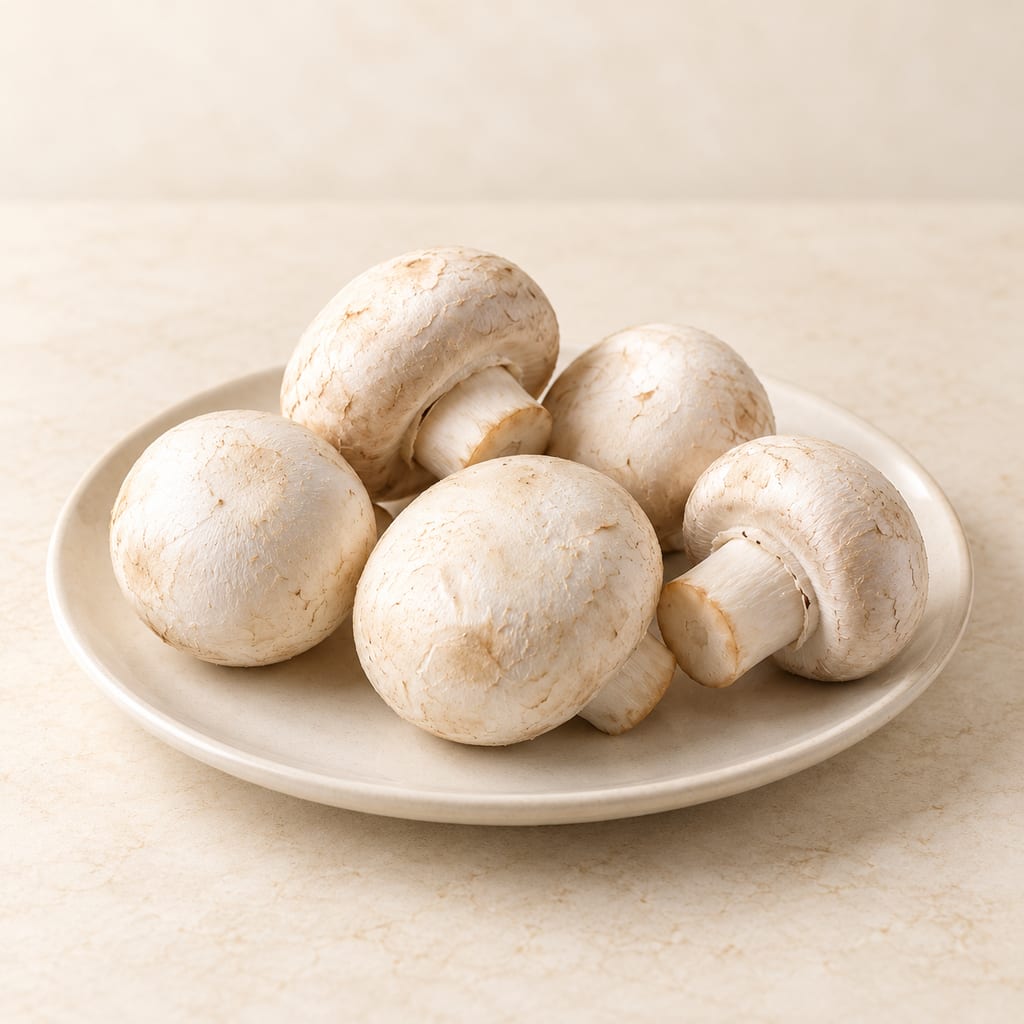
Mushrooms
Mushrooms are the edible fruiting bodies of fungi, cultivated or gathered, and each species has its own texture, aroma and handling needs. Fresh, dried and roasted forms differ in water and in flavour compounds.
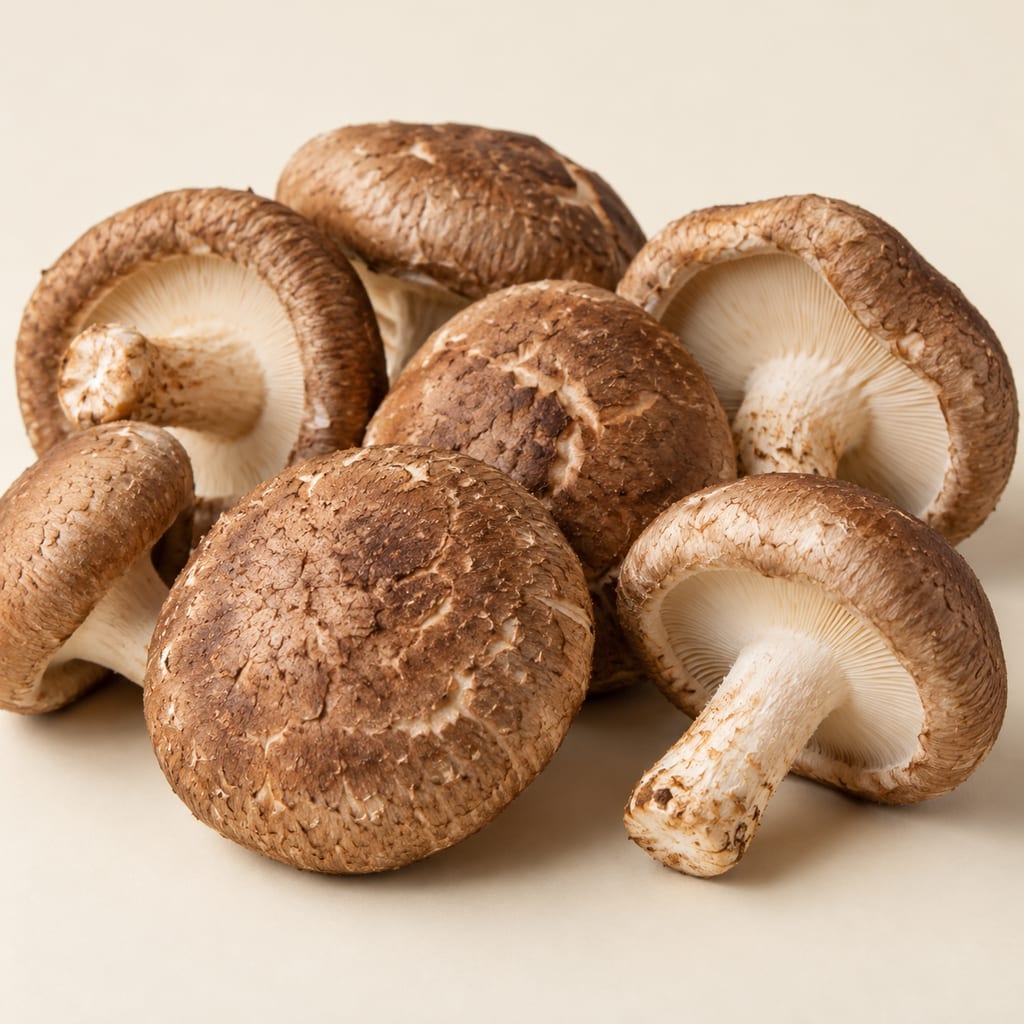
Shiitake
Shiitake, Lentinula edodes, is a wood-rotting mushroom cultivated in East Asia for centuries on logs and sawdust, and dried for storage and stock.
Community
No community contributions have been published for this entry yet.
Share what you made
Sign in to contribute. Published comments and photos are free to read.
Sources
Robert C. Power et al.; Journal of Archaeological Science / Elsevier
Microremains from El Mirón Cave human dental calculus suggest a mixed plant–animal subsistence economy during the Magdalenian in Northern IberiaCited in: Introduction; A food with many histories
Eric Boa; FAO
Wild edible fungi: a global overview of their use and importance to peopleCited in: The fungus behind the mushroom; Nutrition, medicine and the limits of an edible label
Eric Boa; FAO
Wild edible fungi: a global overview of their use and importance to peopleCited in: Nutrition, medicine and the limits of an edible label
Mariana P. Drewinski et al.; IMA Fungus / Springer Nature
Over 400 food resources from Brazil: evidence-based records of wild edible mushroomsCited in: Names that travel, species that differ; The Americas: maize, forest parcels and local knowledge
David M. Beyer; Penn State Extension
Basic Procedures for Agaricus Mushroom GrowingCited in: The fungus behind the mushroom
INRAE
Controlled production of white truffles Made in France: a global firstCited in: The fungus behind the mushroom
Gudeta W. Sileshi, Donatha D. Tibuhwa and Alec Mlambo; CABI Agriculture and Bioscience / Springer Nature
Underutilized wild edible fungi and their undervalued ecosystem services in AfricaCited in: The fungus behind the mushroom; African forests, termites and household preferences
Rui Wang et al.; Journal of Ethnobiology and Ethnomedicine / Springer Nature
Ethnomycological study on wild mushrooms in Pu’er Prefecture, Southwest Yunnan, ChinaCited in: East Asia: markets, cultivation and the flavour of a broth
Ministry of Agriculture, Forestry and Fisheries, Japan; MAFF
The Washoku Way: Japan’s Nuanced Approach to FoodCited in: East Asia: markets, cultivation and the flavour of a broth
Ministry of Agriculture, Forestry and Fisheries, Japan; MAFF, Our Regional Cuisines
Houchou (Thin udon noodles dipped in dipping sauce)Cited in: Introduction; A food with many histories; East Asia: markets, cultivation and the flavour of a broth
Umami Information Center
MushroomsCited in: East Asia: markets, cultivation and the flavour of a broth; Different jobs in the kitchen
Daisuke Kurata et al.; Food Science and Technology Research / Japanese Society for Food Science and Technology
Quality Evaluation of Shiitake Mushrooms Dried by Vacuum Microwave TreatmentCited in: East Asia: markets, cultivation and the flavour of a broth; Different jobs in the kitchen; Keeping a harvest: fermentation is one route among several
Fang Wu et al.; Journal of Fungi / MDPI
Global Diversity and Updated Phylogeny of Auricularia (Auriculariales, Basidiomycota)Cited in: Names that travel, species that differ
Pan Meng Wang et al.; Mycological Progress / Springer Nature
Phylogeny and species delimitation of Flammulina: taxonomic status of winter mushroom in East Asia and a new European species identified using an integrated approachCited in: Names that travel, species that differ
Alicia Christiansen and Tiffany Hopkins; Oregon State University Extension
Oregon Native Edible TrufflesCited in: Names that travel, species that differ; Different jobs in the kitchen
Journal of Ethnobiology and Ethnomedicine / Springer Nature
Uses and importance of wild fungi: traditional knowledge from the Tshopo province in the Democratic Republic of the CongoCited in: African forests, termites and household preferences
Journal of Ethnobiology and Ethnomedicine
Wild edible ectomycorrhizal fungi: an underutilized food resource from the rainforests of Tshopo province (Democratic Republic of the Congo)Cited in: African forests, termites and household preferences
Edible Fungi of Tropical Africa; Meise Botanic Garden
Termitomyces titanicusCited in: African forests, termites and household preferences
Faustino Hernández Santiago et al.; Journal of Ethnobiology and Ethnomedicine / Springer Nature
Traditional knowledge and use of wild mushrooms by Mixtecs or Ñuu savi, the people of the rain, from Southeastern MexicoCited in: Introduction; A food with many histories; The Americas: maize, forest parcels and local knowledge
Secretaría de Agricultura y Desarrollo Rural; Government of Mexico
Algo raro y suculento es el huitlacocheCited in: The Americas: maize, forest parcels and local knowledge
INIFAP; Government of Mexico / Instituto Nacional de Investigaciones Forestales, Agrícolas y Pecuarias
Huitlacoche para una alimentación saludableCited in: The Americas: maize, forest parcels and local knowledge; Different jobs in the kitchen
Terry W. Henkel, M. Catherine Aime, Mimi Chin and Christopher Andrew; Mycologist / Cambridge University Press
Edible mushrooms from GuyanaCited in: Introduction; A food with many histories; The Americas: maize, forest parcels and local knowledge
Lyès Bradai et al.; Journal of Ethnopharmacology / Elsevier
Ethnomycological survey of traditional usage and indigenous knowledge on desert truffles among the native Sahara Desert people of AlgeriaCited in: Introduction; A food with many histories; Desert harvests and southern histories
Heino Lepp; Australian National Botanic Gardens and Australian National Herbarium
Aboriginal use of fungiCited in: Desert harvests and southern histories; Different jobs in the kitchen
Ewa Jabłońska-Ryś, Aneta Sławińska, Katarzyna Skrzypczak and Karolina Goral; Foods / MDPI
Dynamics of Changes in pH and the Contents of Free Sugars, Organic Acids and LAB in Button Mushrooms during Controlled Lactic FermentationCited in: Keeping a harvest: fermentation is one route among several
National Center for Home Food Preservation; University of Georgia / USDA guidance
Mushrooms – Whole or SlicedCited in: Keeping a harvest: fermentation is one route among several
Paul Urbain et al.; European Journal of Clinical Nutrition / Nature
Bioavailability of vitamin D2 from UV-B-irradiated button mushrooms in healthy adults deficient in serum 25-hydroxyvitamin D: a randomized controlled trialCited in: Nutrition, medicine and the limits of an edible label
A. Mehrotra et al.; European Journal of Clinical Nutrition / Nature
Bioavailability of vitamin D2 from enriched mushrooms in prediabetic adults: a randomized controlled trialCited in: Nutrition, medicine and the limits of an edible label
PDQ Integrative, Alternative, and Complementary Therapies Editorial Board; National Cancer Institute
Medicinal Mushrooms (PDQ®)–Health Professional VersionCited in: Nutrition, medicine and the limits of an edible label
CDC and investigating public-health teams; Morbidity and Mortality Weekly Report / CDC
Outbreak Linked to Morel Mushroom Exposure — Montana, 2023Cited in: Nutrition, medicine and the limits of an edible label
Łukasz Łuczaj et al.; Journal of Ethnobiology and Ethnomedicine / Springer Nature
Wild food plants and fungi sold in the markets of Luang Prabang, Lao PDRCited in: Across monsoon markets and mountain supply routes
Tariq Saiff Ullah et al.; Journal of Ethnobiology and Ethnomedicine / Springer Nature
Diversity and ethnomycological importance of mushrooms from Western Himalayas, KashmirCited in: Across monsoon markets and mountain supply routes
Gaps
- The names of disputed morels, tropical wood ears and some historical broad names remain unresolved.
Updated 2026-10-27