
Home equipment crafts
Cream four ways: clotted, cultured, churned and clarified
Cream can be scalded into clotted cream, soured by bacteria, churned into butter and buttermilk, or boiled down to ghee. Each is a different change, and each asks something different of the equipment.
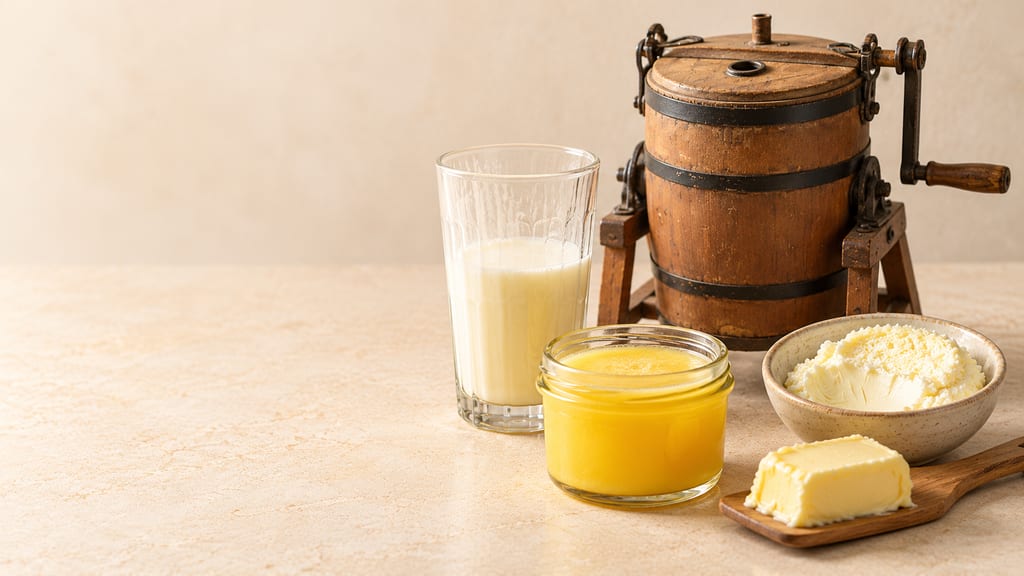
Cream, butter, buttermilk and clarified butter: one jug of cream, separated and cultured into four foods.
Four changes that can start from one jug of cream
The same carton of cream can end as four quite different foods. Scald it gently in a wide, open dish, then chill it, and a thick crust sets over a dense layer of thickened cream: clotted cream. Leave it with lactic acid bacteria and it sours and thickens: cultured cream. Agitate it hard and the fat gathers into grains of butter, leaving buttermilk behind. Boil the butter until its water has gone and its milk solids have browned, and the result is ghee.
Each is a different kind of change. Clotting is heat and surface; culturing is microbial acidification; churning is mechanical separation; clarifying is evaporation. The four can follow one another, with cultured cream churned into butter and that butter cooked into ghee, but none is a quicker version of another, and an appliance that suits one may be useless for the next. Makers publish methods for two of these stages: churning in a stand mixer, and culturing cream in a bread proofer before churning. The oven, water-bath and slow-cooker routes have not been tried and need measuring.
What cream is made of
Charles O'Connor's 1995 training manual Rural Dairy Technology, published by the International Livestock Research Institute, describes cream as a mass of microscopic fat globules floating in milk, each wrapped in a thin membrane that acts as the emulsifier. The membrane protects the fat from enzymes and keeps the globules from merging into butter grains. Milk and cream are oil-in-water emulsions: water is the continuous phase, with fat dispersed through it as droplets. Butter is the reverse, a water-in-oil emulsion in which tiny droplets of water sit in continuous fat. The manual gives typical butter as about 80 percent fat, 16 percent moisture, 2 percent salt and 2 percent milk solids other than fat. United States law, in a definition dating from an Act of 4 March 1923, requires butter to be made exclusively from milk or cream, or both, and to contain "not less than 80 per centum by weight of milk fat".
Milk fat is partly solid and partly liquid at room temperature. About 98 percent of it is triglycerides, built partly from short-chain fatty acids such as butyric acid, which the manual notes is specific to the milk fat of ruminants. Carotene in the fat gives butter its natural yellow. That mixture of solid and liquid fat is what churning depends on, and it is why the temperature of the cream decides how churning goes.
Cornish clotted cream: a crust formed in the heat
Clotted cream is the most precisely defined of the four, because one regional version is protected by law. Cornish Clotted Cream is a protected designation of origin, first registered in the European Union on 1 October 1998 and carried into the United Kingdom's own register on 31 December 2020. Its specification, submitted by the Cornish Clotted Cream Producers through Cornwall County Council, describes "heat-treated high butterfat cows' milk cream" with a nutty flavour, a mixture of thick and thin consistency, a texture from granular to smooth, and a colour from cream to golden yellow. It is spread rather than poured.
The method in the specification is short. Milk is warmed to separate the cream, which must contain at least 55 percent butterfat. The cream is "scalded to 70 to 80 °C" (70–80 °C), not allowed to boil, for at least one hour, and a thick crust forms during that time. The product is then cooled to no more than 5 °C, and as it cools the crust hardens and the cream beneath thickens. Only milk produced in Cornwall may be used.
The same document records a long regional production history, written as the producers' case for their product. It says clotted cream has been made in Cornwall for many generations and is noted in seventeenth-century literature, and that it served to extend the life of a perishable, fat-rich milk from small herds, especially in spring and summer. It reports a claim by "some historians" that Phoenician tin traders brought the idea around 300 BC, a story the specification passes on without standing behind it. Its later details are more specific: visitors to Cornwall "at the turn of the century" took a taste for the cream home, distribution to London followed, and one member of the applicant group had made it on the same site since 1890. The producers credit Cornwall's long grass-growing season for milk averaging 4.33 percent butterfat, against 4.1 percent for England and Wales, and the grass's carotene for the colour. The cream is eaten with scones and jam in a cream tea, or on fruit and desserts; the specification adds that it once accompanied vegetables and was part of the Cornish miner's diet.
What the process asks of equipment is unusual. The crust forms on the exposed surface of hot, undisturbed cream, so the process needs a wide open vessel rather than a deep covered one, and a long hold below boiling followed by a cold finish. A low oven and a shallow dish is the closer starting point for a home version, with less supervision than a pan on the hob, though it is untested. A water-jacketed open dish, warmed from below by a slow cooker or a circulator bath, is a second option; it would heat the cream from underneath while the surface loses heat to the air, which may form a different crust. A sealed bag is a poor match for both, because it removes the open surface altogether.
Anyone trying either route should measure the cream itself, since the specification's 70–80 °C is a cream temperature and an oven dial says nothing about the dish. The hold of at least an hour, the cooling to 5 °C or below and the cream's fat content belong in the record. The specification's cream has at least 55 percent butterfat, and it says nothing about how cream with less fat behaves. A home result is clotted cream in the Cornish style. The protected name belongs to cream made in Cornwall to the specification.
Churning: turning the emulsion inside out
O'Connor's manual explains churning through air, membrane and fat. Cream is agitated vigorously at a temperature at which its fat is partly solid and partly liquid. Air beaten in forms bubbles, and the cream swells into whipped cream. Material from the fat-globule membranes spreads over the surfaces of the bubbles, partly stripping the globules of their protective layer, and liquid fat seeps out and coats them, so that they stick to the bubbles. Free fat then destabilises the foam and it collapses. The partly stripped globules, cemented together by free fat, appear as butter grains, which grow quickly and separate sharply from the liquid buttermilk. About half of the membrane material ends up in the buttermilk. The rest of buttermaking is removing the buttermilk, kneading the grains into one mass and adjusting water and salt.
KitchenAid's published method for its stand mixer follows that path. Four cups of heavy whipping cream go into the bowl with the wire whisk. The mixer starts on its slowest setting and is raised gradually to the fastest, and the cream passes through three stages: soft peaks, stiff peaks, and the separation of butter solids from buttermilk. At that point the mixer stops and the buttermilk is poured off and can be kept for other uses. The butter is pressed with a spatula in a fine sieve over a bowl, then washed: a quarter cup of ice-cold water goes in, the butter is whipped again for about ten seconds, the cloudy water is poured off, and the wash is repeated until the water stays clear. A flat beater mixes in any flavourings. The whisking takes around ten minutes and the whole job about thirty. A pouring shield keeps the splashes in the bowl. A suitable food processor can do the same churning job, and Brød & Taylor's cultured-butter method churns the cream in a mixer, a food processor or a jar.
Temperature decides how churning goes. O'Connor's manual says cream that is too cool churns slowly into small grains that are hard to handle, while cream that is too warm leaves much of the fat in the buttermilk and gives a spongy butter of poor quality. It recommends churning cream at 10–12 °C in the hot season and 14–17 °C in the cold season, with the churn no more than half full, and stopping when the grains are the size of small wheat grains. KitchenAid's tip points the other way for a different goal: cream left out for 10 or 15 minutes before whipping may separate sooner. Faster separation and the best fat recovery are not the same target, and a probe in the cream at the start of churning shows which one a batch is aimed at.
Washing and working finish the job. The manual washes the grains with water only until it runs clear, two or three changes, colder than the churning temperature in the cold season. It salts butter, when salt is wanted, at 16 g per kg and works it until it seems dry and solid but not greasy. Working spreads the brine into many tiny droplets. With 2 percent salt and 16 percent moisture, the manual calculates, the water droplets hold a 12.5 percent salt solution, and microbes trapped in small droplets have less to live on. Washing, it adds, does little to reduce bacterial counts. KitchenAid's own storage advice for its fresh butter is not to leave it at room temperature for more than four hours and to keep it in an airtight container in the fridge for two to four weeks, because "any milk remaining in the butter will cause it to spoil sooner".
Buttermilk is three different liquids
The liquid poured off sweet cream in the mixer is sweet-cream buttermilk: the water, lactose, protein and membrane material of a cream that was never soured. Lei and colleagues, in a 2025 comparison of commercial butters, define sweet-cream butter as butter made from pasteurised cream without fermentation, and its buttermilk is the same unfermented liquid.
Buttermilk from sour milk or cultured cream is a different product. O'Connor lists what remains after sour whole milk is churned: casein, whey proteins, milk salts, lactic acid, lactose, the fat that was not recovered, and fat-globule membrane material. It is drunk as it is, used to inoculate fresh milk so that acid develops, and used for cheese.
The third liquid, sold as cultured buttermilk in the United States, is not a by-product of churning at all. The federal standard for cultured milk covers cream, milk, partially skimmed milk or skim milk cultured with characterizing microbial organisms, and allows the name "cultured buttermilk" for one made with lactic acid-producing organisms together with ingredients such as butterfat flakes, an aroma-producing culture, salt or a little citric acid. Home cheesemaking suppliers sell buttermilk cultures; Jim Wallace's quark recipe for New England Cheesemaking Supply lists one among its culture options. A recipe that simply says buttermilk could mean any of the three, and they differ in acid and in flavour.
Ethiopia's chain: ergo, kibe, arerra and ayib
Butter from soured milk, and a cheese from what remains, describe a whole household dairy system in Ethiopia. Two reviews published in 2024, one by Assen and Abegaz and one by Karssa and colleagues, name its products: ergo, spontaneously fermented milk; kibe or qibe, traditional butter; arerra, the defatted sour buttermilk left after churning; ayib, a cottage cheese made from that buttermilk; and niter kibe, the clarified butter. Assen and Abegaz report that about 40 percent of the country's milk is processed into butter.
The process is a chain. Karssa and colleagues describe milk collected in a clay pot and kept in a warm place, around 30 °C, for 24 to 48 hours to sour on its own, then churned by gradually shaking the pot until the fat separates. A 2023 survey in North Shoa by Diriba, Eshetu and Hailu found farmers keeping milk two to seven days to sour, smoking their vessels with wood of Olea africana, known as ejersa, and churning mainly in clay pots. O'Connor's 1995 manual adds the numbers behind traditional churning of sour whole milk: churning between 15 and 26 °C, with the best results at 15–17 °C. In trials at the International Livestock Centre for Africa, the traditional method recovered 67 percent of the fat as butter at 18 °C and 44 percent at 25 °C, and a wooden agitator fitted inside the clay pot halved churning time and raised recovery to 76 percent at 18 °C. Milk with at least 0.6 percent lactic acid churned more easily than fresh milk.
O'Connor's 1993 cheesemaking manual gives ayib as a recipe. Buttermilk from churning sour whole milk, or skimmed milk, is heated gradually to about 50 °C until a distinct curd mass forms. Higher temperatures, 65 °C, may be used and give a longer-keeping cheese "because of the destruction of harmful bacteria"; above 65 °C the cheese may taste cooked. The curd cools for about an hour, is separated from the whey by ladling or straining through a sieve or fine cloth, and is mixed to break up pockets of whey. It is not pressed. The manual suggests about one gram of salt per 100 g of cheese while noting that ayib is not salted in Ethiopia, and gives a shelf life of no more than about two days at around 30 °C and about seven days at 4 °C. About one kilogram of ayib comes from about nine litres of buttermilk. Karssa's review says ayib is eaten fresh, as a condiment or with hot spices, salt and herbs such as koserete and tikure azmude, Nigella sativa.
The same review sets out why the heating temperature matters. In studies it cites, E. coli O157:H7 survived 50–60 °C in heat-defatted buttermilk during ayib making, while cooking the buttermilk at 70 °C inhibited it completely; Salmonella Typhimurium survived the 50 °C cooking and was destroyed at 60 and 70 °C. The review concludes that spontaneous fermentation without heat treatment does not guarantee safety. A kitchen version made from the buttermilk of pasteurised, cultured cream starts from a different raw material, and a water-jacketed pot could hold it at a measured temperature. That route is untested, and the yield and texture of ayib made that way are unknown. The order matters: start from an established cultured-milk procedure and its buttermilk before adapting the heating to a home bath, rather than substituting arbitrary warm raw milk.
Culturing cream before it is churned
Cultured butter is butter churned from cream that lactic acid bacteria have fermented first. Lei and colleagues name the usual starters as lactococci: Lactococcus lactis subspecies cremoris, lactis and diacetylactis. During fermentation the bacteria release enzymes that break proteins into peptides and amino acids and split fats into free fatty acids. In their comparison, cultured butters had higher acid values and more free amino acids than sweet-cream butters, and their aroma was dominated by ketones, lactones and medium-chain free fatty acids, where sweet-cream butters showed more aldehydes, esters and short-chain fatty acids. Electronic sensory analysis scored the cultured butters higher for umami, bitterness and sourness.
A laboratory method makes the stages plain. Kataria and Singh, in a 2025 study of ghee using milk from the National Dairy Research Institute's southern station in Bengaluru, separated cream with a centrifuge, inoculated it with a 2 percent starter of a diacetylactis lactococcus, incubated it at 30 ± 5 °C for 22 hours, and only then churned it in an electric blender. O'Connor adds a reason for souring beyond flavour: the acid serum in butter made from ripened cream or sour milk may control the growth of acid-sensitive organisms.
Culturing and churning want opposite conditions. The culture stage keeps the cream warm and still for many hours, 22 of them at 30 ± 5 °C in the laboratory process; O'Connor's cream churns best cold, at 10–17 °C. Cultured cream has to be cooled between the two stages, which is one more reason to treat them as separate steps with separate equipment.
The warm stage needs an incubator that runs at the cream culture's own temperature, which is lower than yogurt's. The University of Alaska Fairbanks yogurt guide incubates thermophilic yogurt bacteria at 43 °C, and Miele's steam-oven recipe warns that yogurt cannot be made above 45 °C. Lactococci work cooler. Wallace's quark sets as the milk falls from 30 °C to 20–22 °C, and his cultured mascarpone sets a milk-and-cream mixture with a crème fraîche culture at 20–23 °C for 10 to 12 hours. For butter itself, the proofer maker Brød & Taylor shows a home method: cream is ripened with a culture at a mild, controlled temperature in the company's bread proofer, then churned in a mixer, food processor or jar. Culturing and churning stay separate stages in that method. A water bath that can be set cool enough could take the proofer's place, though that has not been tried; many standard yogurt-only machines run too warm for this particular method. Whatever holds the cream, a probe in the cream is a better guide than the dial. The article Fermentation cabinets describes the proofer as a culture station, and the article One bath, many small jars describes jars of cream held in a circulator bath.
Ghee and clarified butterfat: driving out the water
Ghee, butter oil and dry butterfat are, in O'Connor's words, almost entirely butterfat with practically no water or milk solids-not-fat. His manual describes ghee as made in eastern tropical countries, usually from buffalo milk, with an identical product called samn in Sudan, and notes that the Maasai in Kenya make ghee from sour milk. Ghee keeps better than butter in a hot climate, because its low water and solids content inhibits bacterial growth. Much of its characteristic flavour, the manual says, comes from the burned milk solids left in it. Butter oil, also called anhydrous milk fat, is a different, refined product, made by centrifuging melted butter or separating fat from high-fat cream.
The manual's method is simple. Accumulated butter is put in an iron pan and its water boiled off at a steady rate. Overheating burns the curd and spoils the flavour. A scum forms on the surface and is lifted off with a perforated ladle. When the water has gone, the casein begins to char, and that marks the end; the ghee is poured into an earthenware jar. Much of the water and solids can be removed first by melting the butter in hot water at 80 °C and separating the fat layer, which then contains about 1.5 percent moisture and needs only a final heating to drive off the rest. The manual credits ghee made this way with keeping about six months at ambient temperature.
Kataria and Singh's 2025 study shows how the route to the butter changes the ghee. They compared three Indian processes: the curd-butter method, in which whole milk is cultured to curd and the curd churned, which they describe as the method most often referred to in Ayurvedic literature; the cream-butter method, churning unfermented cream; and fermented cream-butter, churning cultured cream. Each butter was heated in a stainless steel pan over a direct flame until it reached 120 °C and its moisture fell below 0.5 percent, then cooled and filtered. The processing made no difference to the 26 fatty acids they measured. It did change the aroma: ghee from the two fermented routes held more acids, alcohols, lactones, ketones, heat-breakdown products, 5-hydroxymethylfurfural and maltol. Souring before churning shows up in the ghee's flavour, not in its fat.
Ethiopia's niter kibe is ghee of its own kind. Karssa's review calls it spiced butter, and Assen and Abegaz describe it as used for culinary, social and therapeutic purposes and served with coffee and tea to honoured guests and on holidays.
A slow cooker or an open multicooker could, untested, supply the gentle heat for melting butter and rendering other fats, leaving the finish to a separate stage. Moisture removal and storage have to be worked out explicitly for such a route. The finish is another matter. Ghee is finished by evaporation and browning, and a covered crock is built to keep moisture in: Oregon State University's fruit-butter guide has to tell cooks to keep a slow cooker's lid ajar "so the moisture can evaporate". Whether a slow cooker can bring butterfat to the 120 °C used in the laboratory study is unmeasured. A sealed low-temperature bag in a water bath cannot evaporate anything; it keeps the water in and cannot be assumed to give ghee's dried, toasted character. The likely split, still untested, is to melt and settle with gentle heat and to finish in an open pan, where the bubbling and the colour of the solids can be watched.
One cream, a chain of appliances
Put together, the stages make a proposed workflow, proofer to mixer to buttermilk, that nobody has yet published as one method. Pasteurised cream is cultured in a proofer or another incubator held at the culture's own temperature, chilled, and churned in a stand mixer. The butter is washed, salted if wanted and worked. The sour buttermilk is drunk, baked with, or heated at a measured temperature for an ayib-style curd. Some of the butter goes on to an open pan to become ghee. A share of the cream can leave the chain at the start for a clotting dish instead. Each appliance does the stage it is suited to, and none of them makes another stage faster.
The record worth keeping is specific to each stage: the cream's fat content; the culture, its dose and the temperature measured in the cream over time; the cream temperature at the start of churning and the churning time; butter weight, buttermilk volume, number of washes and salt weight; for ghee, the endpoint used and the colour of the solids. O'Connor's manual gives a way to check a churn's efficiency: with butter at 80 percent fat, 1 kg of butter needs the fat from 19.38 litres of milk at 4 percent fat. Storage limits stay with the methods that state them: KitchenAid's two to four weeks in the fridge for its fresh sweet-cream butter, O'Connor's figures for ayib and for ghee made his way, and none at all for a home clotted cream.
Related
Discussed in this article
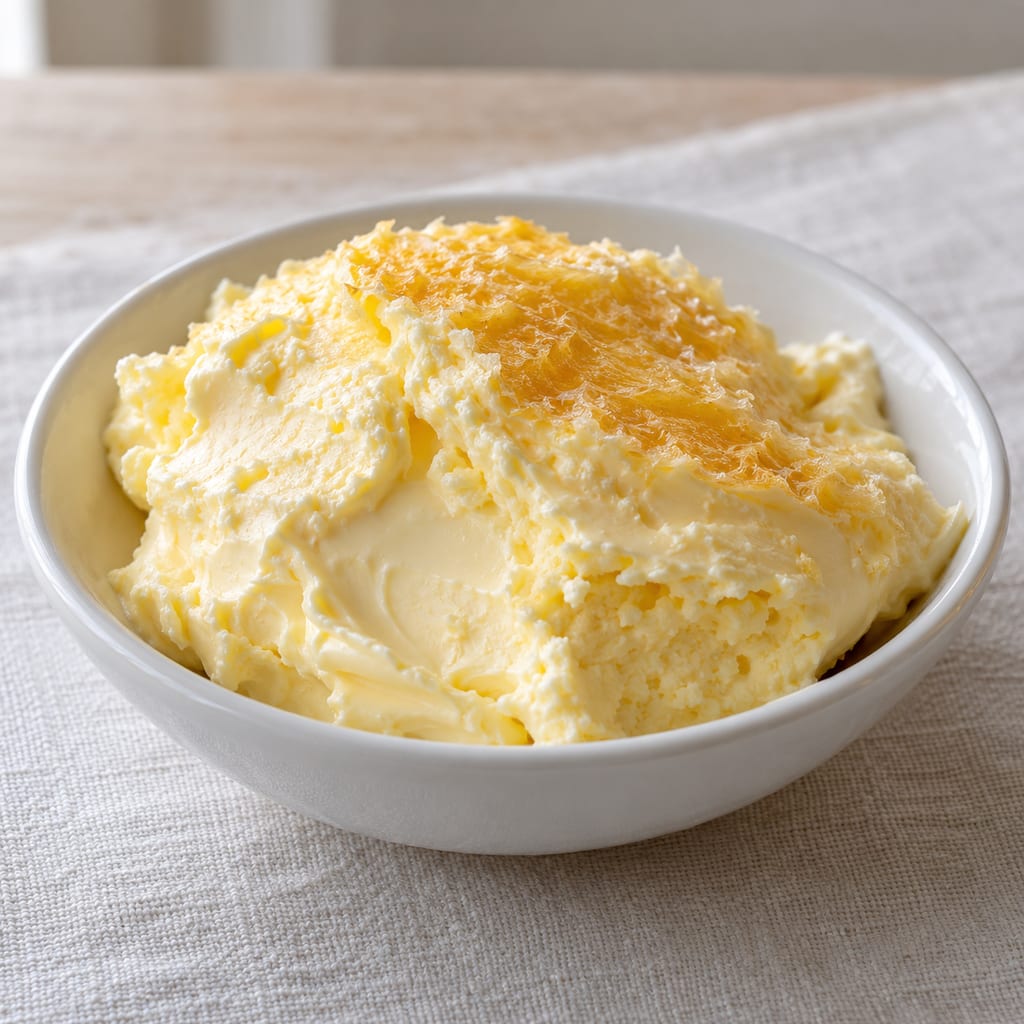
Clotted cream (Cornish style)
High-fat cream scalded below boiling for at least an hour until a thick crust forms, then cooled hard so the crust sets and the cream beneath thickens.
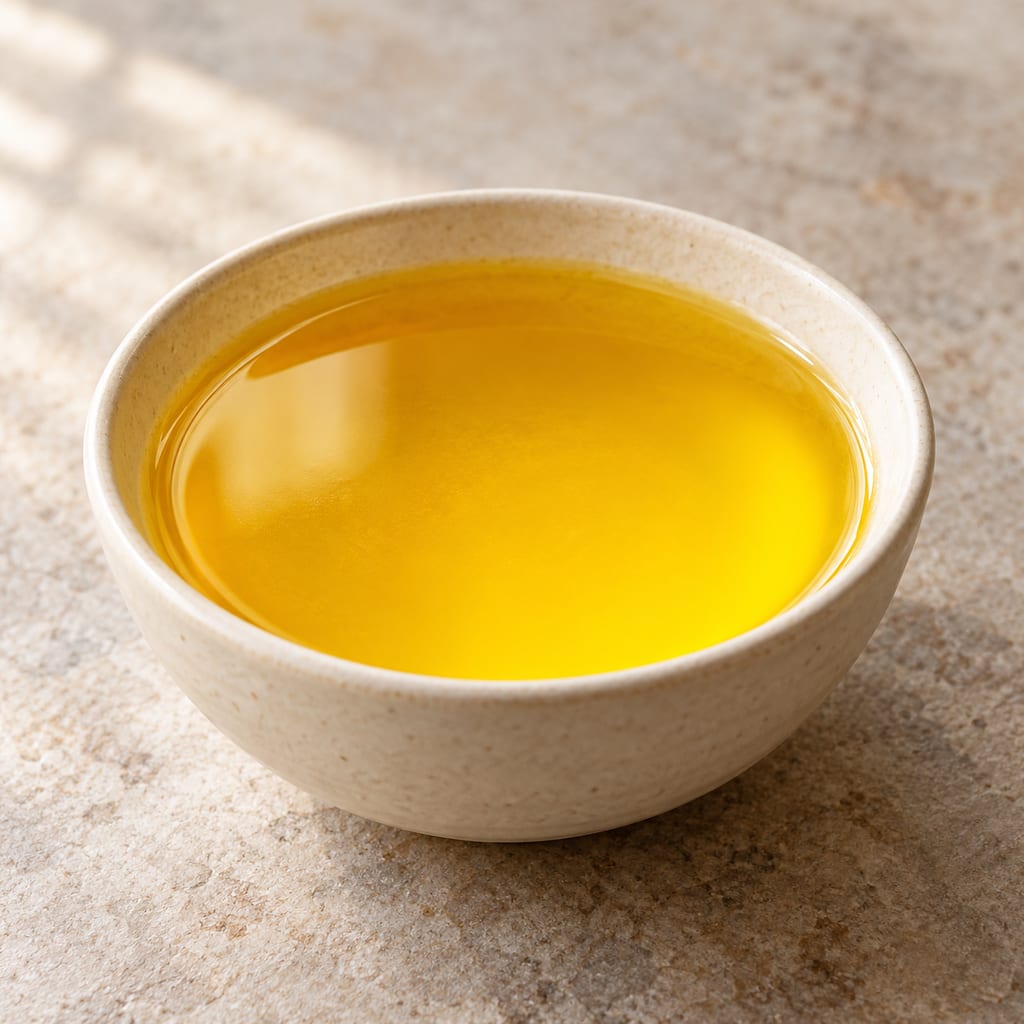
Ghee, clarified butter and rendered fats
Butter heated until most water leaves and the milk solids separate, giving a fat that keeps far longer than butter. Rendering applies the same heat to animal tissue to make lard and tallow.
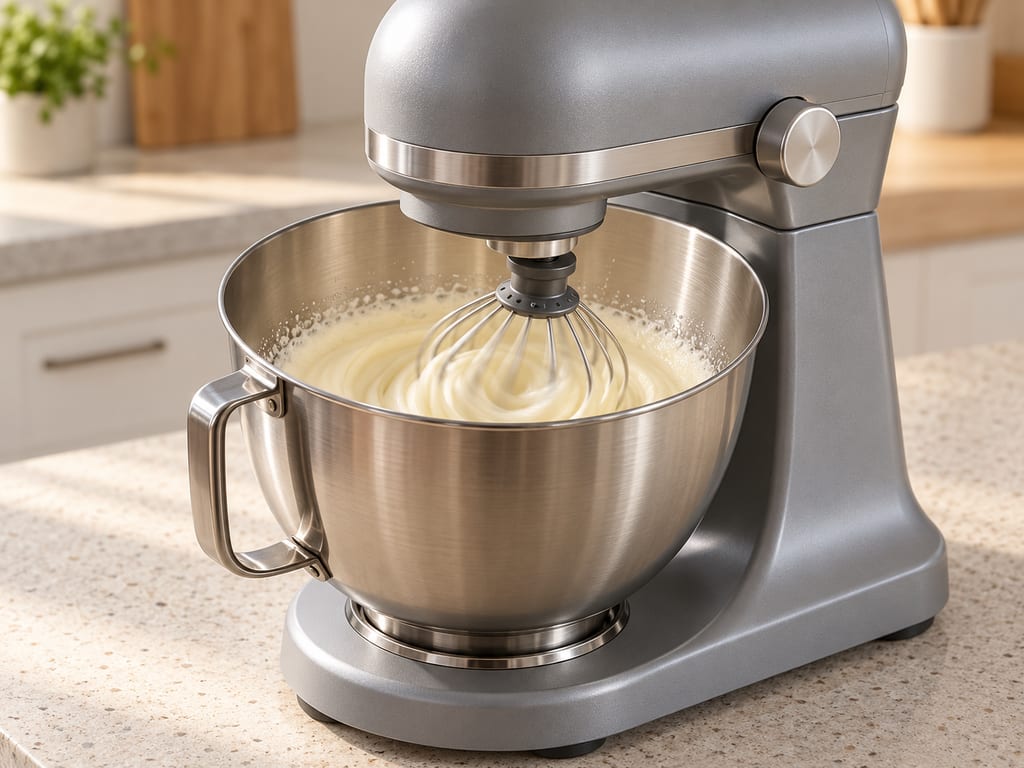
Stand mixer
A stand mixer is a powered mixing machine built around a stationary base, a supported bowl and a driven beater or other tool. It can stir, beat, whip and knead; particular models may also accept separate accessories for other jobs.
Community
No community contributions have been published for this entry yet.
Share what you made
Sign in to contribute. Published comments and photos are free to read.
Sources
KitchenAid US (09 October 2025)
How to make butter in a KitchenAid® stand mixerCited in: Four changes that can start from one jug of cream; Churning: turning the emulsion inside out; Buttermilk is three different liquids; One cream, a chain of appliances
Department for Environment, Food and Rural Affairs (Defra) / GOV.UK protected food and drink names register
Cornish Clotted Cream product specification (with GOV.UK register entry 'Cornish Clotted Cream')Cited in: Four changes that can start from one jug of cream; Cornish clotted cream: a crust formed in the heat; One cream, a chain of appliances
New England Cheesemaking Supply Company
Mascarpone Cheese Making RecipeCited in: Culturing cream before it is churned
New England Cheesemaking Supply Company
Quark Cheese Making RecipeCited in: Buttermilk is three different liquids; Culturing cream before it is churned
University of Alaska Fairbanks Cooperative Extension (UC Cooperative Extension republication, reviewed November 2015)
Making Yogurt at HomeCited in: Culturing cream before it is churned
International Livestock Centre for Africa (ILCA), Addis Ababa, 1993
Traditional cheesemaking manualCited in: Ethiopia's chain: ergo, kibe, arerra and ayib; One cream, a chain of appliances
International Livestock Research Institute (ILRI), Addis Ababa, January 1995
Rural dairy technology (ILRI Training Manual 1)Cited in: Four changes that can start from one jug of cream; What cream is made of; Churning: turning the emulsion inside out; Buttermilk is three different liquids; Ethiopia's chain: ergo, kibe, arerra and ayib; Culturing cream before it is churned; Ghee and clarified butterfat: driving out the water; One cream, a chain of appliances
Food Chemistry: X 27 (2025), doi:10.1016/j.fochx.2025.102489 (PMC12131252)
Effect of processing methods on fatty acid composition and flavour profile of clarified butter (ghee) obtained from Deoni and Holstein Friesian cow breedsCited in: Culturing cream before it is churned; Ghee and clarified butterfat: driving out the water; One cream, a chain of appliances
Food Chemistry: X (2025), doi:10.1016/j.fochx.2025.103334 (PMC12719179)
Evaluation of flavor quality of commercial butter: A systematic comparison of sweet cream and cultured butterCited in: Buttermilk is three different liquids; Culturing cream before it is churned
Food Science & Nutrition 12(10): 6990–7003 (2024), doi:10.1002/fsn3.4372 (PMC11521749)
Insights on the microbiology of Ethiopian fermented milk products: A reviewCited in: Ethiopia's chain: ergo, kibe, arerra and ayib
Heliyon 10(21): e40089 (2024), doi:10.1016/j.heliyon.2024.e40089 (PMC11566870)
Review on quality attributes of milk and commonly produced dairy products in EthiopiaCited in: Ethiopia's chain: ergo, kibe, arerra and ayib; Ghee and clarified butterfat: driving out the water
Heliyon 9(6): e17510 (2023), doi:10.1016/j.heliyon.2023.e17510 (PMC10320282)
Production practice, microbial quality and consumer acceptability test of traditionally produced butter in North Shoa Zone, Oromia Regional State, EthiopiaCited in: Ethiopia's chain: ergo, kibe, arerra and ayib
Legal Information Institute, Cornell Law School
21 U.S. Code § 321a – "Butter" definedCited in: What cream is made of
U.S. Government Publishing Office, govinfo
21 CFR 131.112 Cultured milk (2023 edition)Cited in: Buttermilk is three different liquids
Oregon State University Extension Service (revised October 2025)
Fruit butters (SP 50-304)Cited in: Ghee and clarified butterfat: driving out the water
Brød & Taylor
Cultured Butter RecipeCited in: Four changes that can start from one jug of cream; Churning: turning the emulsion inside out; Culturing cream before it is churned; One cream, a chain of appliances
Gaps
- A laboratory study cultured cream at 30 ± 5 °C for 22 hours; the proofer method gives only a mild temperature.
- Whether clotted cream was made in Cornwall before the seventeenth century, and the Phoenician story, are unproven.
- The cooking temperature that reliably kills pathogens in home-made ayib from pasteurised buttermilk has not been established.
Updated 2026-10-27