
Preservation catalogue
Dry in a fraction of a second: how factories take the water out of milk and mash
A milk droplet meets air at 150–300 °C and is dry within a fraction of a second. How tunnels, belts, drums and spray towers remove water, what the heat does to food, and what dry actually means.
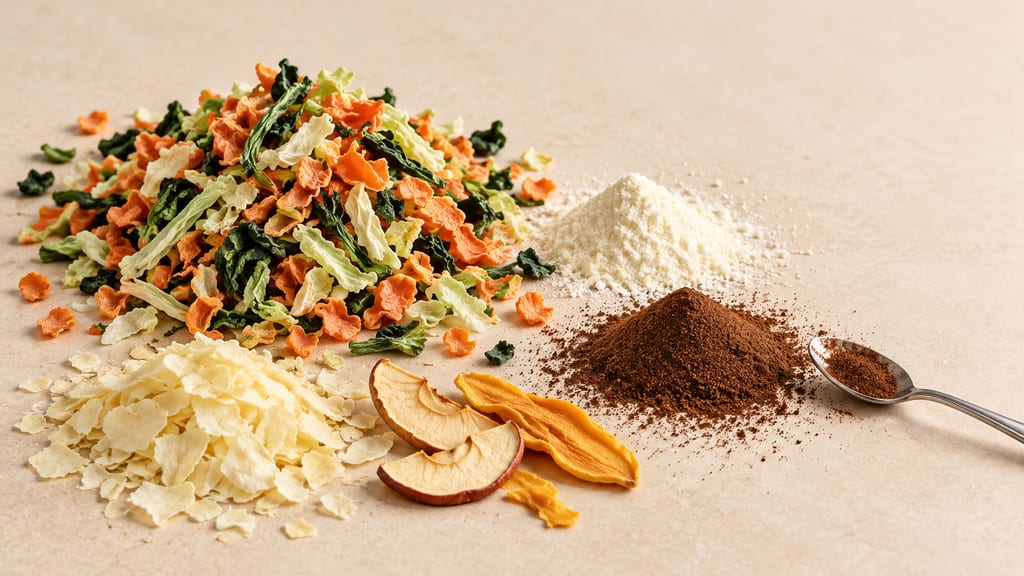
Dried vegetable flakes, instant coffee powder and milk powder: three foods dried by different machines.
A droplet in a tower of hot air
Concentrated milk is pumped through an atomising nozzle into a tall chamber, and the air waiting there has been filtered and heated to 150–300 °C. Each droplet is dry within a fraction of a second: the water leaves in between 1/100 and 1/10 of a second, and what falls out is a powder of tiny, nearly spherical particles. This is spray drying, and it is the most common way to make milk powder.
The air is hotter than any home oven, yet the milk does not scorch. A particle never gets warmer than 65–75 °C. The water leaving a droplet carries heat away with it, so a particle that still holds water stays far cooler than the air around it, and the finished powder cools quickly once it is dry.
The tower is the middle of a longer line. The milk is first concentrated by evaporation under vacuum at 45–75 °C, to 40–50% dry matter. The powder from the tower goes on to a fluid-bed dryer for its final drying, and what reaches the bag holds about 4% water. Milk is not the only liquid that suits the method. Any pumpable stream that carries solids can be sprayed, and the standard textbook example is the whey solids recovered from cheese whey.
Quoted temperatures for the incoming air are not uniform. The Swiss range is wide, and other published sources give narrower or higher figures, so a number such as 150–300 °C describes a family of machines rather than one setting.
What drying takes away
Micro-organisms cannot grow without water, but the amount of water in a food is a poor guide to whether they can. What counts is water activity, a scale that describes how freely the water in a food is available to them. Most foods sit above 0.95. Fresh meat, fish and raw vegetables are about 0.99, and raw fruit about 0.98.
Each group of organisms has a floor. Most gram-negative bacteria stop growing below 0.97, most gram-positive bacteria below 0.90, most yeasts below 0.88 and most moulds below 0.80. The most drought-tolerant moulds and yeasts keep growing down to about 0.60. Dried fruit measures 0.60–0.65, and biscuits and chocolate fall below 0.60, so a dried food is dried to a number on this scale, not to a texture that feels dry.
Two cautions follow. Water content alone predicts nothing: salami, at 0.82, and cooked beef, at about 0.98, both hold about 60% water. And lowering water activity stops organisms multiplying without killing those already present, while most moulds need more water to produce mycotoxins than to grow at all. The thresholds also differ a little between sources and shift with the substance that binds the water, so the figures above mark the region where growth ends, not one exact line.
Trays, belts and a bed of air
Solid pieces such as sliced fruit and diced vegetables are dried in heated air, and the machines differ mainly in how the food travels through it. In a tunnel dryer, trays or racks stacked on carts are pulled through a long tunnel while heated air is blown across them. Donald Mercer of the University of Guelph, who wrote an introduction to drying fruits and vegetables, notes that the design needs much more labour than a belt dryer and is not as common as it once was.
A continuous belt dryer replaces the carts with a mesh conveyor. The air can run against the direction of the belt, along with it or across it, and each of these layouts has its own diagram in the textbook.
A fluidised-bed dryer drops the belt altogether. Heated air blown up through the chamber floor holds the pieces in suspension, so each one is surrounded by moving air. The air flow is reduced as the particles lose water and become lighter.
Drums, flakes and a cooked edge
Some foods are better dried as a thin film than as pieces or droplets. A drum dryer is a set of metal drums heated by steam or hot water. The feed sits in the nip between the rollers, dries on the hot surface as the drum turns, and a doctor blade scrapes the dried sheet off. Mashed potato is the textbook example, and it leaves the machine as the flakes sold for instant mashed potato.
Milk can be dried the same way. Concentrate at 45–50% dry matter is spread over rollers heated to as much as 145 °C and reaches 4% water in under 3 seconds. The milk touches a surface at up to 145 °C, where a spray-dried particle never passes 65–75 °C, and the product shows it. Drum-dried milk comes out as flat flakes with denatured proteins, lower solubility in water and more Maillard browning, the same browning reaction that colours bread crust. Spray drying gives spherical particles and rapid cooling instead.
The choice of machine therefore decides more than the shape of the product. It decides how cooked the food tastes and how easily it dissolves again.
When the heat goes wrong
Hotter and faster is not always better. Mercer describes mango slices dried at 80 °C that run into trouble removing their moisture: the cells at the surface collapse into a hard, dry layer, and the water behind it cannot escape. This is case hardening. The slice feels dry while its centre is still wet. After packing, the trapped moisture moves outward and condenses, and it can support mould.
Other costs are quieter. Removing too much water, or using too high a temperature, can leave a product brittle. Starch can gelatinise at about 60 °C, which changes how a dried product thickens later, so some products have to be dried with their starch left intact. For protecting vitamins, Mercer gives a temperature of 50–55 °C for fruits and vegetables and just over 40 °C for sensitive herbs.
Other dryers, and what to ask of dried food
Mercer's list of dryer types is longer than the ones above. It also names freeze, vacuum, flash, plate, rotary and solar dryers. A freeze dryer works differently from all of the machines here: it removes ice as vapour under reduced pressure instead of evaporating liquid water.
For a reader, two questions are worth asking of any dried food. How was the water removed, since that decides whether it is a flake, a powder or a chewy piece, and how cooked it tastes? And how far was it dried, since that decides how well it keeps? Drying alone is not a dependable kill step, and a dried food that takes up water again can grow what it could not grow while dry.
Related
Discussed in this article
Dry milk
Dry milk is a family of dairy ingredients made by removing most water from milk or cream. The name includes distinct whole, partly skimmed and nonfat powders; fat level, heat treatment and particle form determine handling and use.
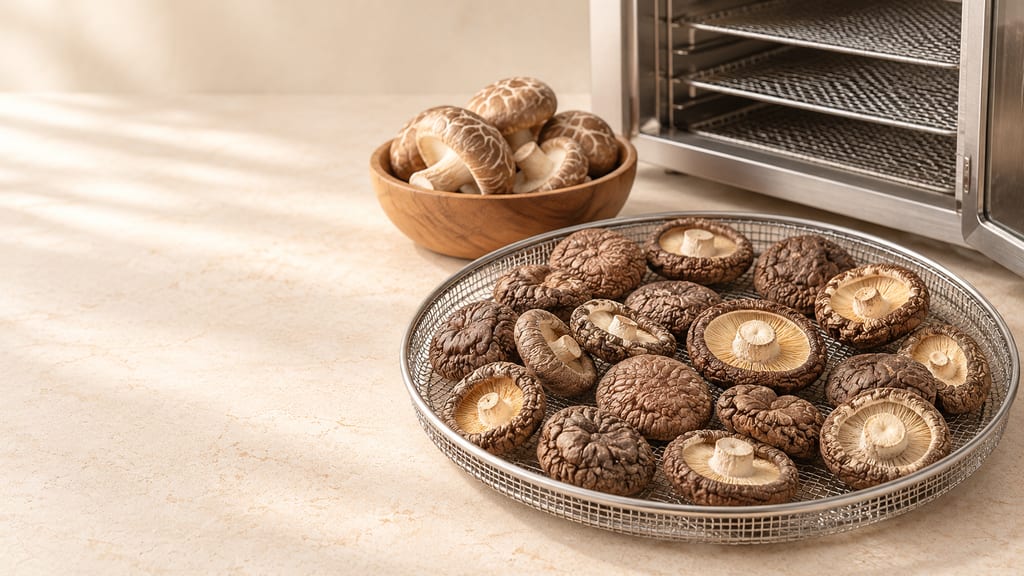
The dryer that dries its own air
A heat-pump dryer wrings the water out of the air it recirculates and reuses the heat. Drying shiitake took 0.85 kWh per kilogram against 6.67 for hot air, at a price in shrinkage. Here is how it works and how far the results carry.
Community
No community contributions have been published for this entry yet.
Share what you made
Sign in to contribute. Published comments and photos are free to read.
Sources
Agroscope, Switzerland
Concentrates and dried products with milk componentsCited in: A droplet in a tower of hot air; Drums, flakes and a cooked edge
University of Guelph
An Introduction to the Dehydration and Drying of Fruits and Vegetables (Donald G. Mercer, 2014)Cited in: A droplet in a tower of hot air; Trays, belts and a bed of air; Drums, flakes and a cooked edge; When the heat goes wrong; Other dryers, and what to ask of dried food
Government of Manitoba
Water Content and Water Activity: Two Factors That Affect Food SafetyCited in: What drying takes away; Other dryers, and what to ask of dried food
Gaps
- No temperatures or times from a source read in full for tunnel, belt or fluidised-bed dryers.
- Spray-dryer air temperatures differ between sources, and no peer-reviewed spray-drying paper was read.
- Freeze drying and vacuum drying as industrial dryers have no source read in full here.
Updated 2026-10-29