
Techniques
The dryer that dries its own air
A heat-pump dryer wrings the water out of the air it recirculates and reuses the heat. Drying shiitake took 0.85 kWh per kilogram against 6.67 for hot air, at a price in shrinkage. Here is how it works and how far the results carry.
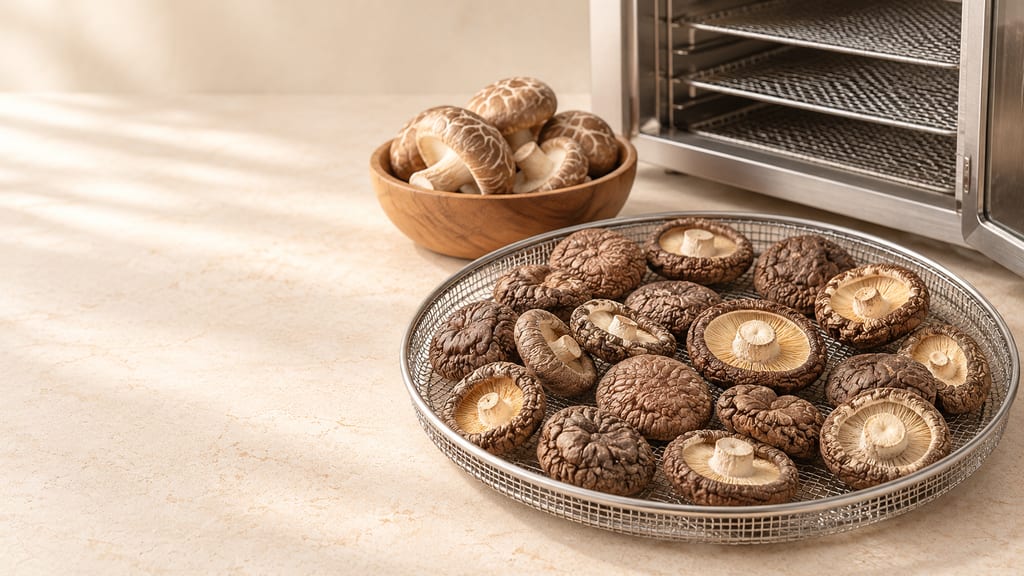
Dried shiitake caps, the mushroom in the three-way comparison of hot-air, freeze and heat-pump drying.
Eight to one
In a 2023 comparison, drying a kilogram of fresh shiitake in a hot-air dryer took 6.67 kilowatt-hours of energy. Freeze drying the same mushroom took 2.65. A heat-pump dehumidifier took 0.85. A kilowatt-hour is what a 1 kW heater uses in an hour, so the heat-pump machine did the same job on nearly an eighth of the energy the hot-air machine needed.
The mushrooms that came out were not identical, and that is where the story gets interesting. Heat-pump drying shrank the caps and broke them up more than hot air did, while holding on to more protein and polysaccharide. This article follows that trade-off back to its cause, which is the way the machine handles air, and then outward: to other mushroom tests, to apple slices and industrial salted cod, and to a Norwegian project that dried stockfish indoors in under a month instead of about four months outdoors.
How a dryer can reuse its own heat
Every dryer has two jobs. It has to supply the heat that turns liquid water in the food into vapour, and it has to take that vapour away so the air around the food can keep absorbing more. A hot-air dryer heats air, passes it over the food and lets it carry the moisture off. The heat goes with it.
A heat-pump dryer keeps the air in a closed or semi-closed loop and treats the vapour as something to be extracted. Warm, humid air leaves the drying chamber and meets a cold coil, the evaporator. Refrigerant inside the coil absorbs heat from the air and turns from liquid to gas. The air cools to its dew point, the temperature at which it can no longer hold all its water, and the moisture condenses and is drained away. The compressor then raises the pressure of the refrigerant, and the heat released in that step reheats the same air, which goes back into the chamber dry and warm. The principle is the reverse Carnot cycle: a small amount of electricity moves a larger amount of heat from a cool place to a warm one.
Because the loop recycles its heat and its air, it can run cooler than a conventional dryer. Single heat-pump systems dry fruit and vegetables at roughly 30–60 °C, a range given for those crops in general rather than for mushrooms in particular, and the low temperature limits oxidation. Closed circulation also helps the product keep much of its original flavour. Systems built in series go a step further by recovering heat from the exhaust air, cooling and dehumidifying it over an evaporator and returning the heat through a condenser. What defines the method is control of the air's humidity as well as its temperature.
Three ways to dry a shiitake
Liu Qin and colleagues compared three treatments of fresh shiitake fruiting bodies: hot-air drying, vacuum freeze drying and heat-pump dehumidifier drying. Vacuum freeze drying freezes the food and removes the ice as vapour under reduced pressure. It is the slow, energy-hungry benchmark, and the 2.65 kWh per kilogram it used sits between the other two.
On the physical measures, the heat-pump mushrooms looked like the freeze-dried ones. Their shrinkage was 36.30 percent and their degree of fragmentation 56.21 percent. Both were close to the freeze-dried figures and significantly higher than the hot-air figures. The same grouping held for nutrients: the heat-pump samples kept 249.87 g of protein and 82.57 g of polysaccharide per kilogram, close to freeze drying and significantly higher than hot air.
After rehydration, the heat-pump mushrooms had a texture between the rehydrated hot-air and freeze-dried samples. Their rehydrated microstructure showed no significant difference from fresh mushroom. The authors called heat-pump drying a promising technology for large-scale shiitake drying.
For a cook, the result reads as a bargain with one cost. If the aim is a dried mushroom that keeps its nutrients at a low energy bill, the heat pump did well. If the aim is whole, unbroken slices, a shrinkage rate above a third and fragmentation above half are a real penalty. The test covered one species on one set of machines, and its drying temperatures, air speeds and end points are not published in its abstract, so it cannot be turned into a schedule.
What other mushroom tests found
A Korean test at the Korea Food Research Institute dried shiitake in a heat-pump hot-air dryer and in an electric-heater dryer. The heat pump used 22.8 kWh against 28.9 kWh for the heater, though the batch size is not given, so the figure cannot be set beside the per-kilogram numbers above. The heat-pump mushrooms held more total polyphenol, 290.55 ppm against 192.99 ppm. The two dryers did not differ in rehydration rate, browning or colour. Drying at 45 °C in the heat-pump dryer was the more energy-efficient setting.
A solar-assisted heat-pump dryer took mushrooms from 13.24 down to 0.07 g of water per gram of dry matter with air at 45 and 55 °C. The heat-pump configuration needed between 220 and 250 minutes. Its coefficient of performance, the heat delivered per unit of electricity, ran from 2.1 to 3.1. That machine also had a solar collector, so it is not a pure dehumidifier.
Shiitake can also be dried on a changing schedule. One study used four stages at 35, 45, 55 and 65 °C and found the best combination at 2.4, 3.3, 5.6 and 2.6 hours, 13.9 hours in all. Its composite quality score of 0.837 was 49 percent higher than constant drying at 65 °C. The time spent at 55 °C mattered most for rehydration, and the time at 35 °C mattered most for the heat pump's own efficiency. A separate solar-assisted system that switched between open, closed and semi-open air circulation used 37.96 percent less energy than a closed heat-pump system.
Apples, and a salted-cod simulation
The pattern holds beyond mushrooms. In a comparison of apple slices, drying took 50 minutes on trays, 90 minutes with a heat pump, 270 minutes by freeze drying and 20 minutes by microwave. The heat pump had the lowest energy consumption and the highest moisture-extraction rates, meaning the most water removed for each unit of energy. The microwave and freeze-dried slices were of better quality than the tray and heat-pump slices. Fast, cheap and gentle did not come together.
At industrial scale, Norwegian researchers simulated a batch tunnel drier holding 40 tonnes of clipfish, which is salted cod, with a 250 kW heat pump running on ammonia. The model gave 195.5 kWh per tonne for the heat pump and 973.8 kWh per tonne for a hot-air system. These are simulated figures for a salted product on a very large machine. They do not transfer to stockfish, which is not salted, or to a kitchen, and they are per tonne where the shiitake figures are per kilogram.
Stockfish indoors
Stockfish is cod dried in the open air on racks, and the traditional cycle takes about four months because it depends on the weather. A Norwegian research project set out to take the weather out of it. The idea came from Nordahl Anthonisen of Athena Seafoods in Bergen. John-Erik Haugen led the process development at Nofima's laboratory in Ås, in an EU-funded project with other European companies and institutes.
The raw material was fresh, headed and gutted cod, and the indoor process took under one month. Staff at the Italian company Il Ceppo assessed the appearance and smell of the fish, and blind consumer tests in Italy compared indoor and outdoor stockfish in traditional dishes. Haugen said the initial tests indicated the pilot product was of high quality. A patent application was filed, and provisional cost calculations suggested the method could be economically viable. The results were described as initial, and industrial scale-up was still a goal when the project was reported in 2015.
This is research on drying cod indoors under controlled conditions. The published description does not say which machine did the drying, how warm or humid the room was, or whether a heat pump was involved. Heat pumps are a natural fit for controlling a room's air, but that is an inference, not a finding, and it would be wrong to read the project as proof that heat-pump cabinets are in use for stockfish. Nor is it a household recipe: a fan, a thermostat and a timer do not reproduce a controlled process.
What it means in a kitchen
Every figure above comes from research or industrial equipment. No data were found for a household dehumidifier or heat-pump cabinet, and the settings behind the shiitake result are not given, so a home machine may give very different numbers. What the studies do show is the shape of the choice. In the shiitake test a heat pump used far less energy than hot air and kept more protein and polysaccharide, and it shrank and broke the mushrooms more than hot air did.
Drying lowers the water available to microbes, but none of these studies measured how long the dried product keeps or whether a given moisture level is safe for a given package and temperature. The look, smell or crispness of a dried food does not settle that question.
Related
Read more
Dry in a fraction of a second: how factories take the water out of milk and mash
A milk droplet meets air at 150–300 °C and is dry within a fraction of a second. How tunnels, belts, drums and spray towers remove water, what the heat does to food, and what dry actually means.
The shiitake that changes its smell in the dryer
A fresh shiitake is about 90 percent water. As it dries, its smell moves from earth to garlic to sauté to burnt. A 2025 study tried changing the heat during the run to steer that chemistry.
Discussed in this article
A shiitake dried in an hour: what microwaves and vacuum do to a mushroom
Hot air takes most of a day to dry a shiitake. Microwaves under vacuum can finish in an hour or less, and the same settings can scorch the mushroom. What the laboratory studies show about speed, texture and flavour.
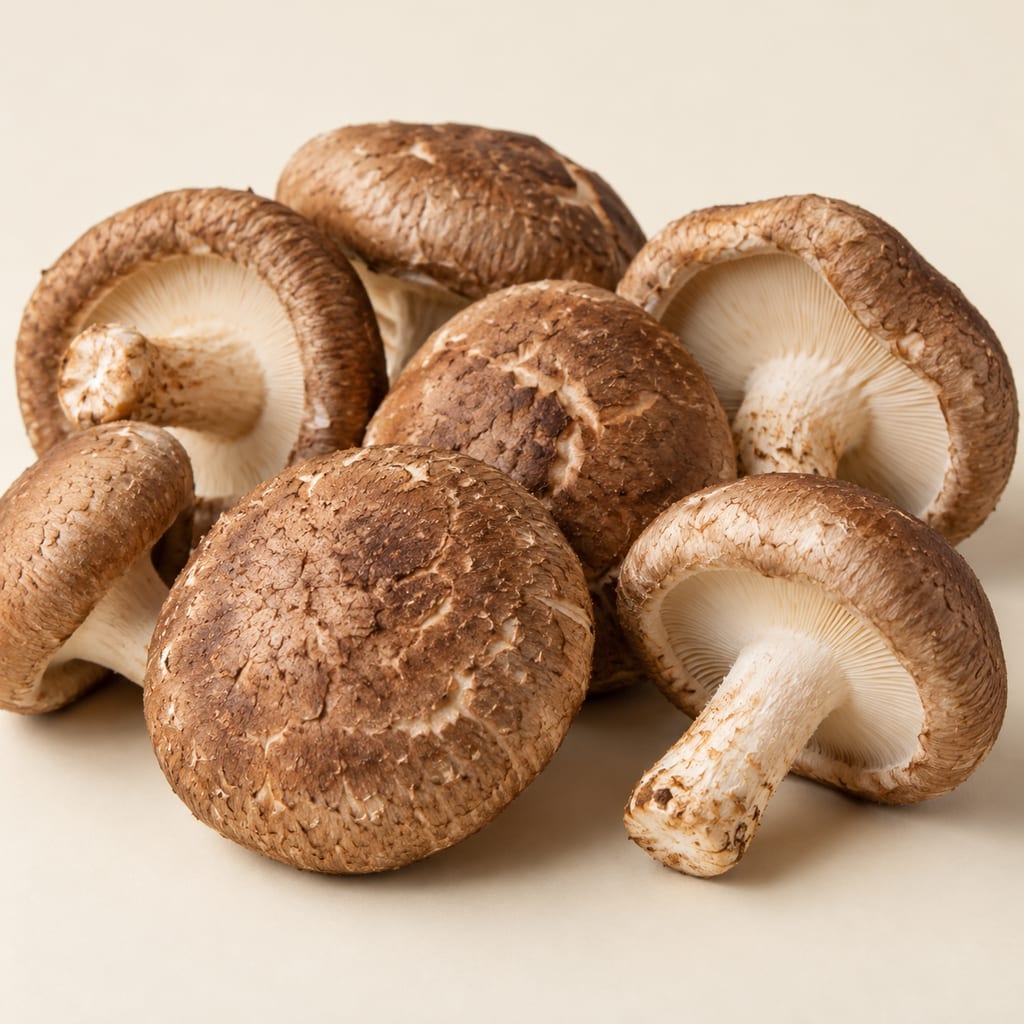
Shiitake
Shiitake, Lentinula edodes, is a wood-rotting mushroom cultivated in East Asia for centuries on logs and sawdust, and dried for storage and stock.
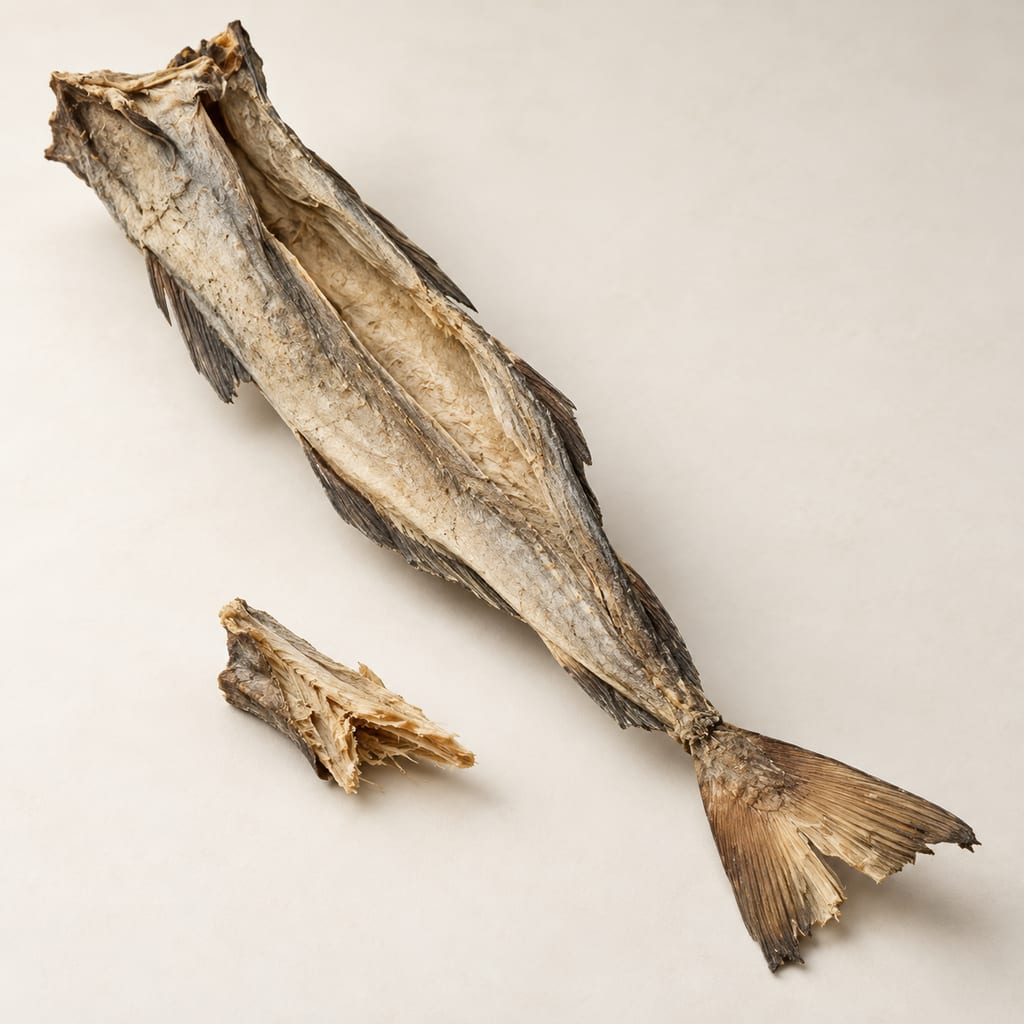
Stockfish
Cod hung on open racks in cold northern air until most of its water has gone, leaving a hard, light, unsalted fish that keeps and travels and must be soaked for days before cooking.
Community
No community contributions have been published for this entry yet.
Share what you made
Sign in to contribute. Published comments and photos are free to read.
Sources
Foods, 2025
Heat Pump Technology in the Field of Fruit and Vegetable Drying: A ReviewCited in: How a dryer can reuse its own heat; What it means in a kitchen
Northern Horticulture (Beifang Yuanyi), 2023, (11): 98-106; authors LIU Qin, HU Su-juan, NIU Sen-yuan, CUI Xiao, KONG Wei-li, ZHANG Yu-ting
Effects of Different Drying Methods on the Quality, Texture and Microstructure of Shiitake MushroomCited in: Eight to one; Three ways to dry a shiitake; What it means in a kitchen
Journal of the Korean Society for Geothermal and Hydrothermal Energy 11(4): 22-27, 2015; Shin Eun-Jeong and Lee Ho-Joon, Korea Food Research Institute
Drying Quality Characteristics of Shiitake Mushroom by Heat Pump Hot-air DryerCited in: What other mushroom tests found
Energy Conversion and Management 72 (2013): 171-178; Sevik S., Aktas M., Dogan H., Kocak S.
Mushroom drying with solar assisted heat pump systemCited in: What other mushroom tests found
Renewable Energy 198 (2022): 1267-1278; Zhang L.Z., Jiang L., Xu Z.C., Zhang X.J., Fan Y.B., Adnouni M., Zhang C.B.
Optimization of a variable-temperature heat pump drying process of shiitake mushrooms using response surface methodologyCited in: What other mushroom tests found
Renewable Energy 164 (2021): 1290-1305; Xu B., Wang D., Li Z., Chen Z.
Drying and dynamic performance of well-adapted solar assisted heat pump drying systemCited in: What other mushroom tests found
Journal of Thermal Science and Technology (Isi Bilimi ve Tekniki Dergisi) 35(1), 2015; Baysal T., Ozbalta N., Gokbulut S., Capara B., Tastan O., Gurlek G.
Investigation of effects of various drying methods on the quality characteristics of apple slices and energy efficiencyCited in: Apples, and a salted-cod simulation
6th Nordic Drying Conference, Copenhagen, 5-7 June 2013; Bantle M., Eikevik T.M., Claussen C., Andresen T.; NTNU and SINTEF
Dynamic process simulation of industrial heat pump drying of clipfishCited in: Apples, and a salted-cod simulation
Nofima, published 23 June 2015, updated 12 August 2022
Indoor production of stockfishCited in: Stockfish indoors
Gaps
- The drying temperatures, air speeds, loading and end-point moisture of the shiitake comparison are not published in its abstract.
- No data on household heat-pump or dehumidifier cabinets were found, and no storage-life or microbial-safety result for the dried food.
- Whether the Norwegian indoor stockfish process uses a heat pump is not stated.
Updated 2026-10-29