
Techniques
A shiitake dried in an hour: what microwaves and vacuum do to a mushroom
Hot air takes most of a day to dry a shiitake. Microwaves under vacuum can finish in an hour or less, and the same settings can scorch the mushroom. What the laboratory studies show about speed, texture and flavour.
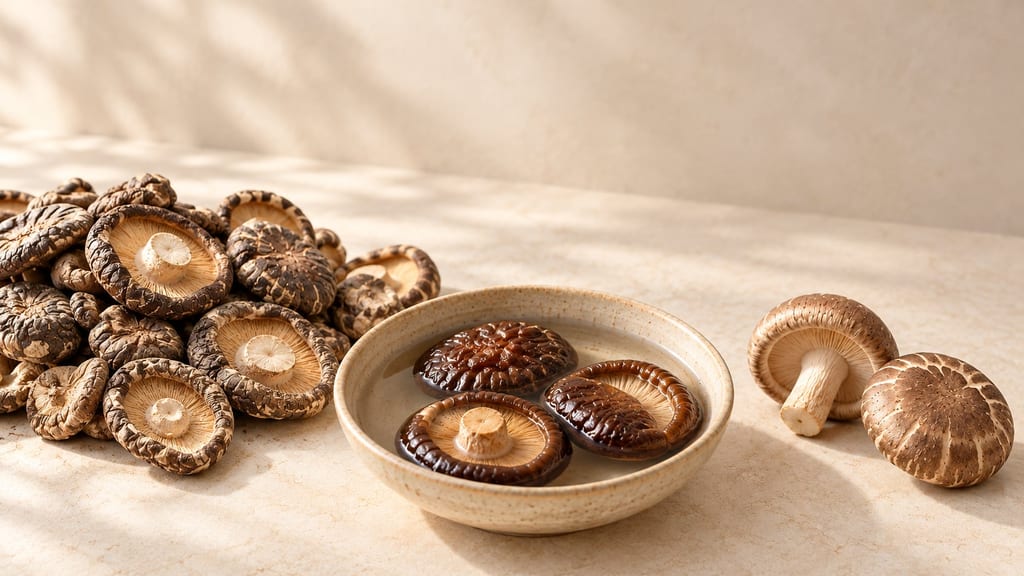
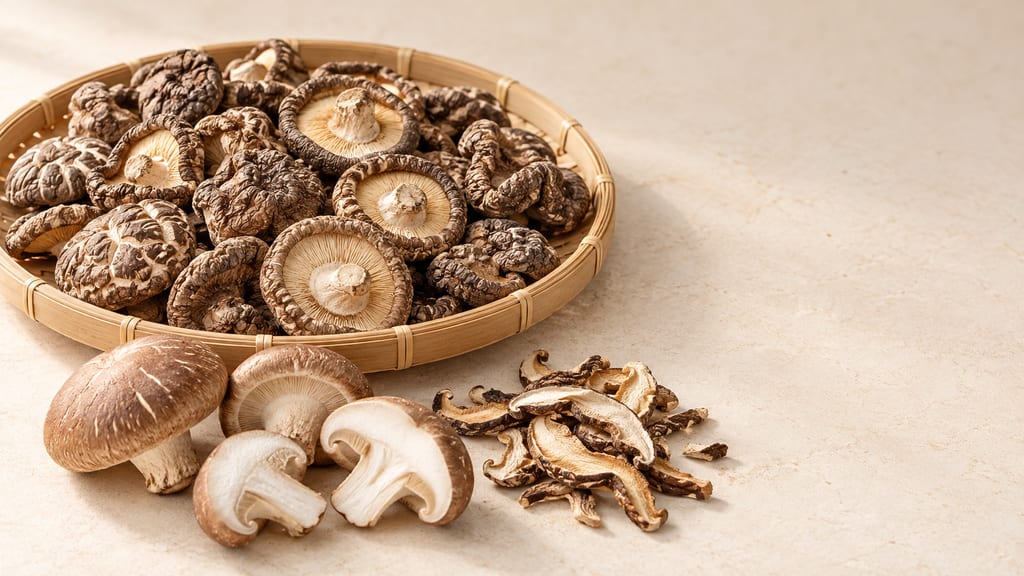
Dried shiitake, the form in which most of the crop is sold, beside a soaked cap that has taken its water back.
Nine-tenths water
A fresh shiitake is more than nine-tenths water. The samples in one Japanese laboratory started at 91.5% moisture, and the job was to bring them down to 13% without cooking, scorching or wrecking them. In ordinary hot-air drying that takes most of a day: the published figures the researchers compared against run from 14 to 20 hours. At Iwate University, shiitake placed in a chamber with the air pumped out and the microwaves switched on reached 13% in between 0.2 and 1.1 hours, from about 12 minutes to just over an hour, depending on the pressure and the power.
That comparison has two caveats. The hot-air figures come from earlier work and from market-bought dried mushrooms, not from the same run. The fastest settings are also not the ones that gave the best mushrooms. The trade-off is how much of the speed can be had before the mushroom pays for it.
A mushroom that lives on dry
Shiitake is one of the few mushrooms that is mostly sold dry. Cultivation in China is thought to have begun around 1000–1100 CE, in the Sung dynasty; the tale of farmers beating logs to coax mushrooms out of them belongs to Chinese folklore rather than to record. Early Japanese records have the Emperor Chuai praising the mushroom in 199 CE, and the mushroom is recorded as introduced to Japan in the 15th century, where growers inoculated logs with spawn.
Drying is more than a way to keep the crop. Shiitake gains flavour as it dries, which makes it an excellent export: a dried crop can be shipped across oceans and soaked at the other end. The trade grew large. By 1953 the export volume had risen to 1,500,000 kilograms, and world cultivated output stood at 234,436 tonnes in 1984. By the early 2000s Japan was supplying two-thirds of the world's needs from as many as 170,000 farmers, with Hong Kong the major market.
A product sold dry is judged dry. Does the cap keep its colour? Does it swell back when soaked, or stay leathery? Does it still taste of shiitake once it is cooked? Every drying method is tested against those questions, and they are the measures in the studies that follow.
Why vacuum and microwaves belong together
Water leaves a food by evaporating, and how hot the food must get depends on the air pressure around it. At sea-level pressure water boils at 100 °C. At 20 kPa, about a fifth of an atmosphere, it boils at roughly 60 °C, and at 10 kPa at roughly 46 °C. A vacuum chamber lets water escape from a mushroom at temperatures well below those of boiling at normal pressure.
Vacuum alone has a catch: with the air gone, almost nothing is left to carry heat to the food. Microwaves fill the gap. They are absorbed mainly by water, so they warm the wet interior of the mushroom directly instead of waiting for heat to creep in from the surface. Researchers at the University of Hohenheim in Germany, working on button mushrooms, found that the combination moved heat and moisture quickly and dried the food at low temperature.
The Iwate measurements show how directly pressure sets temperature. The core of the shiitake settled at about 40 °C at 3 kPa, 50 °C at 10 kPa and 60 °C at 20 kPa: the lower the pressure, the cooler the mushroom.
The method also changes the shape of the tissue. Heated from inside under vacuum, the mushroom builds up vapour pressure within its cells. In the Hohenheim button mushrooms the cells were partly expanded and puffed by it, and the dried slices had an open, puffed texture that the researchers thought would suit a snack.
Three ways to dry the same shiitake
At Anhui Agricultural University in Hefei, China, a team put three methods side by side on fresh shiitake: hot-air drying, freeze drying, and a three-stage microwave vacuum freeze-drying process they call TS-MVFD. The name points to microwave, vacuum and freezing steps. What the three stages are, and at what power and pressure they run, has not been published in any material available here.
The clock favoured the combined process. To bring the mushrooms below 13% moisture took 5 hours with TS-MVFD, 8 hours with hot air and 14 hours with freeze drying, the slowest of the three. TS-MVFD finished in just over a third of the time of freeze drying.
Speed did not cost the mushrooms their ability to take water back. After 120 minutes of soaking, rehydration reached 7.1 for TS-MVFD, 6.0 for freeze-dried shiitake and 4.4 for hot-air dried, on the study's own scale. The TS-MVFD rehydration coefficient was 91.40%. Under the microscope the hot-air mushrooms showed severe collapse of their cell walls. The TS-MVFD tissue looked like the freeze-dried tissue, with slightly larger micropores.
On composition the combined process held its ground. Its cap colour, total sugar (60.21 g per 100 g), crude polysaccharide (7.41 g per 100 g) and free amino acids (3.44 g per 100 g) did not differ significantly from the freeze-dried samples. And when tasters judged the mushrooms after rehydration and cooking, they scored the flavour and taste of TS-MVFD significantly better than both hot-air and freeze-dried shiitake. Freeze drying is the usual yardstick for structure. In this comparison, the combined process matched it and won on taste.
The settings decide
A microwave-vacuum dryer is not one machine setting but a grid of them. The Iwate team tried three pressures, 3, 10 and 20 kPa, and three microwave powers, 25, 50 and 75 W for each gram of dry matter, drying three samples totalling 50 g to 13% moisture each time.
Pressure shaped how the mushroom looked and felt. At 3 and 10 kPa the dried shiitake stayed yellow and bright. At 20 kPa it came out dark, and at the higher powers it burned. Every vacuum-microwave sample differed from fresh in colour by at least 10 units on the standard colour-difference scale, and the 20 kPa samples by at least 20. Lower pressure also gave softer mushrooms that took up water better, a difference between 3 and 20 kPa that was statistically significant.
Flavour pulled the other way, or seemed to. The researchers measured guanylic acid, a flavour nucleotide the mushroom makes from its own RNA with the help of an enzyme. Hot-air dried market shiitake held 142.02 ± 7.27 mg per 100 g of dry matter. No vacuum-microwave condition differed significantly from that, although the values tended to be highest at 20 kPa, the hottest and most damaging setting for colour.
A panel of six picked 3 kPa and 25 W per gram as the best condition, the lowest pressure and the lowest power of the grid. Six tasters is a small panel, but the choice agrees with the colour and texture results: the gentlest conditions gave the best-looking and best-rehydrating mushroom.
Hot air first, then a burst of microwaves
Microwave-vacuum drying does not have to run from start to finish. At Hohenheim, Argyropoulos, Heindl and Müller used it as a middle step on button mushrooms, Agaricus bisporus, which they sliced 5 mm thick from a starting moisture of 94.1% and dipped for 5 minutes in a solution of 0.25% potassium metabisulfite and 0.1% citric acid.
Their combined route began with hot air, which took the slices down to 45% moisture. Then came a 10-minute microwave burst under vacuum at about 60 mbar, with the power stepped down from full to half to a fifth of its maximum and lower as the slices dried. A long finish followed on plates heated to 75 °C under vacuum for 170 minutes. For comparison, plain hot air at 60 °C and 0.9 metres per second took about 250 minutes to bring the slices to equilibrium at 0.065 g of water per gram of dry matter. The hot-air phase that opens the combined route has no stated length, so the two totals cannot be compared.
Freeze drying, with its pre-freezing at −25 °C for 24 hours, set the standard for quality, and the combined route landed in between. Colour change from fresh, on the same colour-difference scale as the Iwate work, was 24.26 for hot air, 17.05 for the combined route and 6.75 for freeze drying. Apparent density fell from 0.88 g per cubic centimetre for hot air to 0.59 for the combined route and 0.23 for freeze drying, and porosity rose from 36.6% to 57.4% and 83.4%. Rehydration ratios across the three methods spanned 3.16 to 7.87.
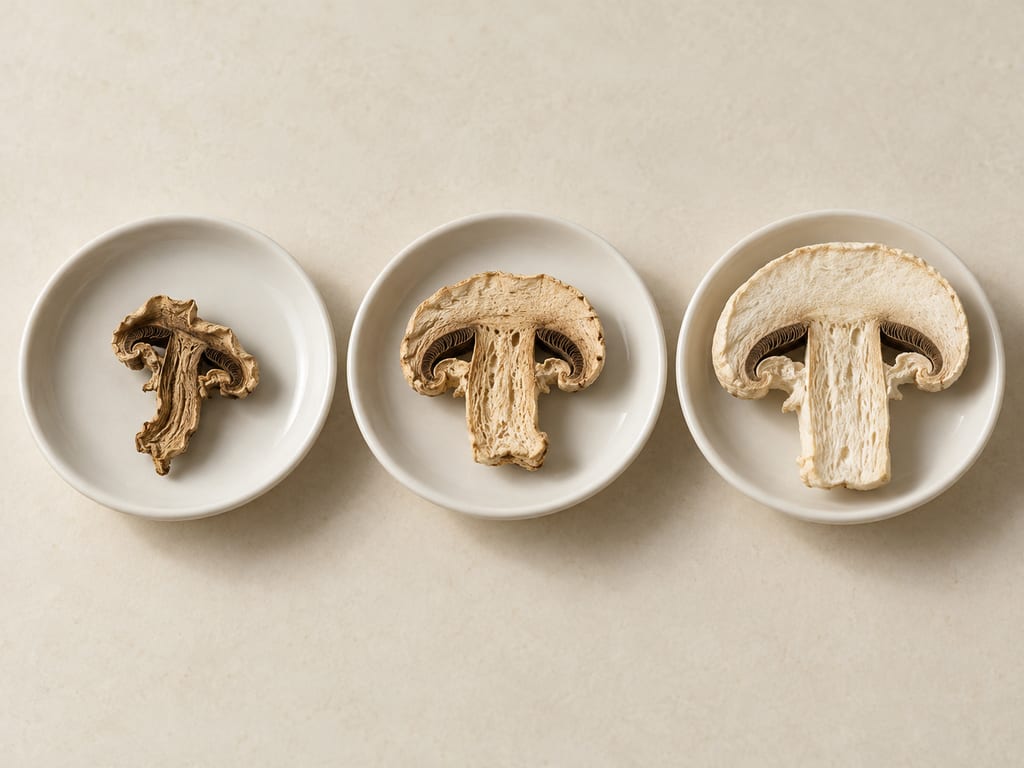
The earlier conference paper from the same group reached the same ranking in words: freeze-dried mushrooms were the lightest in colour, the softest and the best at taking up water, hot-air and combined samples were significantly darker, and the combined slices were more porous than the hot-air ones. The microwave step, then, buys texture and some colour, but it does not turn a hot-air mushroom into a freeze-dried one.
What a laboratory result does not tell you
The settings that worked in one machine do not carry over to another. The Iwate powers are written per gram of dry matter, so they scale with the load; the Hohenheim powers were written as fractions of a dryer's maximum. The two Hohenheim papers even describe the final power step and the dryer's rating differently, so the exact schedule is uncertain. The three-stage process that won the Anhui comparison cannot be reproduced at all from what is published. And all of this work was done on shiitake or button mushrooms in a laboratory; none of it describes a method for a home kitchen.
Drying also says nothing by itself about safety. Microwave heating is uneven, and the 20 kPa samples that burned show how close to the edge the process can run. None of the studies tested whether the combined processes kill microorganisms, or how long the product keeps, so none of the results can be read as a sterilising step or a shelf-life promise.
What the studies do show is that the old trade-off in drying, between speed, structure and flavour, has some give in it. Under vacuum, microwaves can dry a shiitake in an hour or less, and with the gentlest settings tested the mushroom stays bright and takes water back readily. The price is control: lower the pressure, hold the power down, and the same machine that dries the mushroom in minutes is also the one that can burn it.
Related
Read more
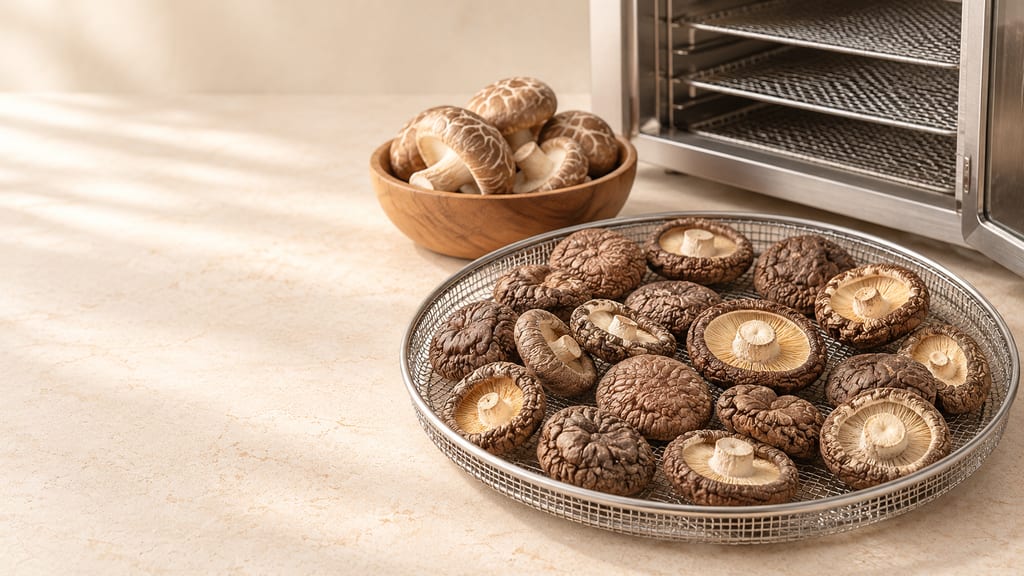
The dryer that dries its own air
A heat-pump dryer wrings the water out of the air it recirculates and reuses the heat. Drying shiitake took 0.85 kWh per kilogram against 6.67 for hot air, at a price in shrinkage. Here is how it works and how far the results carry.
Discussed in this article
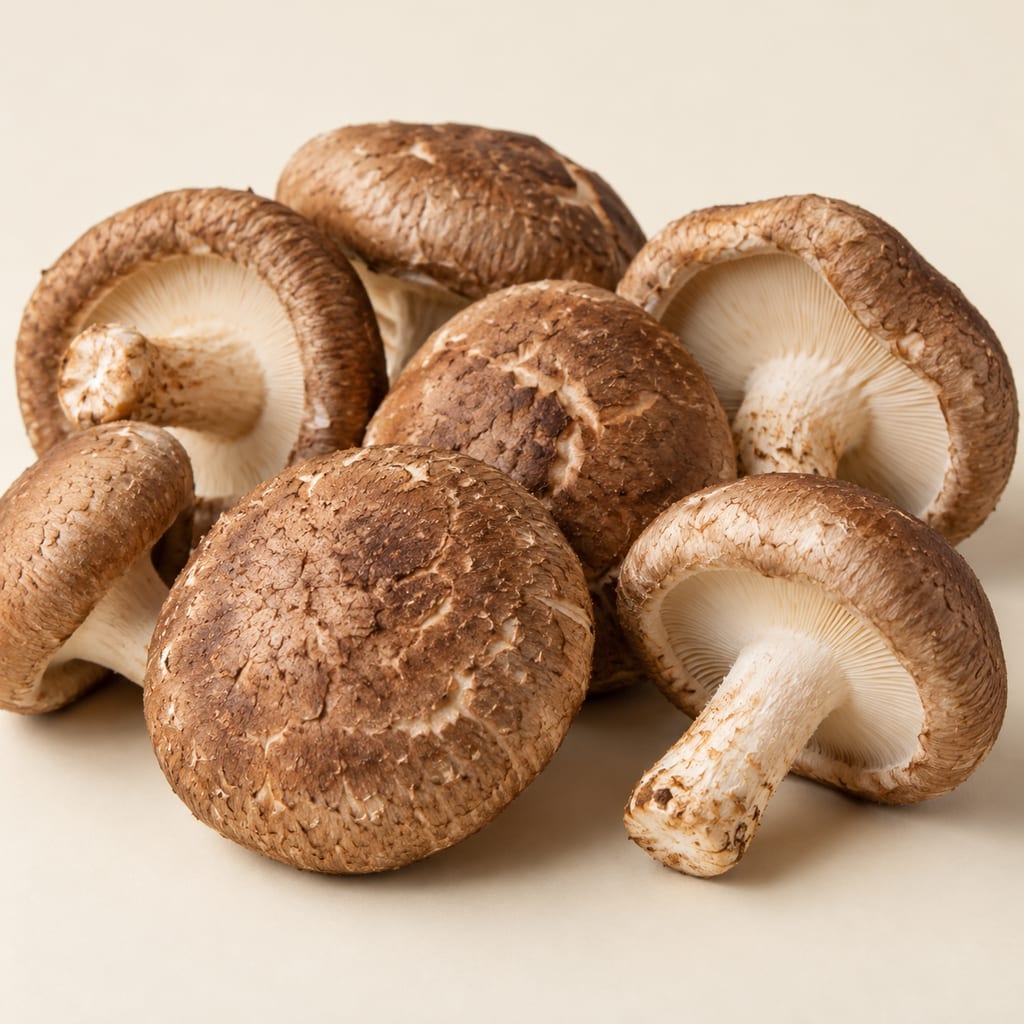
Shiitake
Shiitake, Lentinula edodes, is a wood-rotting mushroom cultivated in East Asia for centuries on logs and sawdust, and dried for storage and stock.
The shiitake that changes its smell in the dryer
A fresh shiitake is about 90 percent water. As it dries, its smell moves from earth to garlic to sauté to burnt. A 2025 study tried changing the heat during the run to steer that chemistry.
Community
No community contributions have been published for this entry yet.
Share what you made
Sign in to contribute. Published comments and photos are free to read.
Sources
Food Science (Shipin Kexue) 41(11): 150–156, 2020
Effects of Drying Methods on the Quality Characteristics and Microstructure of Shiitake Mushrooms (Lentinus edodes)Cited in: Three ways to dry the same shiitake; What a laboratory result does not tell you
Food Science and Technology Research 26(3): 339–350, 2020
Quality Evaluation of Shiitake Mushrooms Dried by Vacuum Microwave TreatmentCited in: Nine-tenths water; Why vacuum and microwaves belong together; The settings decide; What a laboratory result does not tell you
International Journal of Food Science and Technology 46(2): 333–342, 2011
Assessment of convection, hot-air combined with microwave-vacuum and freeze-drying methods for mushrooms with regard to product qualityCited in: Hot air first, then a burst of microwaves; What a laboratory result does not tell you
Tropentag 2008, University of Hohenheim
Evaluation of processing parameters for hot-air drying to obtain high quality dried mushrooms in the Mediterranean regionCited in: Why vacuum and microwaves belong together; Hot air first, then a burst of microwaves; What a laboratory result does not tell you
The Mycologist 17(1), Royal Botanic Gardens, Kew, 2003
Useful fungi of the world: the Shii-take, Shimeji, Enoki-take, and Nameko mushroomsCited in: A mushroom that lives on dry
Gaps
- The power, vacuum level and stage times of the three-stage process that won the 2020 comparison are unknown, as are the colour and composition values for the freeze-dried and hot-air samples it was measured against.
- No study read here measured storage life or whether a combined microwave process kills microorganisms.
Updated 2026-10-29