
Techniques
The shiitake that changes its smell in the dryer
A fresh shiitake is about 90 percent water. As it dries, its smell moves from earth to garlic to sauté to burnt. A 2025 study tried changing the heat during the run to steer that chemistry.
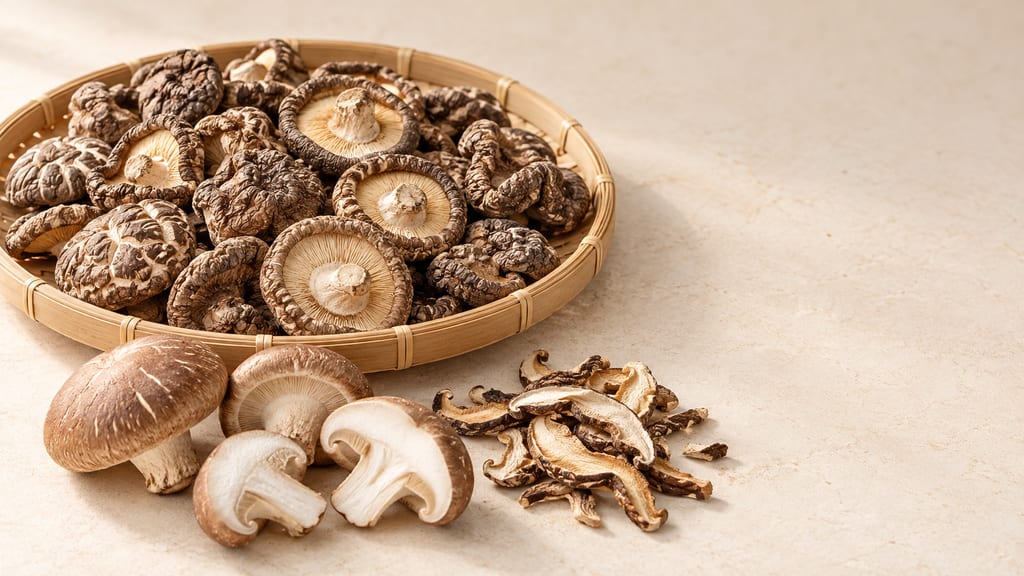
Dried shiitake caps, the end point of a drying run whose temperature history shapes the aroma they carry.
Three hours at 60 °C
Cut a shiitake into cubes about 6 mm on a side, put them in a dryer set to 60 °C, and the water goes fast. The fresh mushroom is 90.19 percent water. After 3 hours it holds 7.62 percent, and after 12 hours 3.50 percent. In 2020 a group at Dalian Polytechnic University in China ran exactly this experiment, but the water was not what they were watching. They were tracking the smell.
The smell did not hold still. Fresh shiitake gave a fresh-mushroom flavour and an earthy smell. Early in the run, garlic and rotten-egg notes came up. Midway the profile moved to a sautéed-mushroom smell, and late in the run it shifted from sauté toward burnt. The researchers split the run into an early stage of under 2 hours, a middle stage of 2 to 3.5 hours and a late stage after 3.5 hours, and identified 62 volatile compounds across the three. They measured those in relative terms, not as concentrations.
The late, burnt notes were put down to Maillard browning and caramelisation, the heat reactions between sugars and amino acids, and of sugars alone, that brown any food. The early garlic and sulfur notes are a different matter. They lead to a compound called lenthionine.
One temperature, three different smells. If a dried shiitake's aroma is built along the way, then what the dryer does in hour one and what it does in hour four are separate choices, and a fixed setting makes the same choice for both.
Lenthionine, and an argument about it
Lenthionine is a cyclic sulfur compound. Shimane Prefecture's forestry pages describe the sequence plainly: during drying, an enzyme acts on a precursor called lentinic acid, and lenthionine is the result. One laboratory study found none in fresh samples.
A 2010 paper in the Journal of Wood Science added a temperature to that picture. Lentinic acid rose significantly when mushrooms were dried at 40 °C for up to 4 hours, a rise put down to moderate heating, and the paper proposed lentinic acid as a marker for picking strains with a strong smell.
What happens to lenthionine itself is where the accounts split. The same 2010 paper found only a small amount after drying, whatever the temperature or time, and a weak characteristic smell. Lenthionine rose when the dried mushroom was rehydrated in a pH 8.0 buffer. The Dalian paper found lenthionine only in the early stage of drying, yet its discussion describes cyclic sulfur compounds, lenthionine among them, as increasing with drying time.
The accounts do not agree. Different strains, slice sizes and drying set-ups could explain the gap, but that is a guess, and neither direction can be called settled.
The flavour is not finished when the dryer stops
Drying is not the last step in making the flavour. Japanese food scientists measured six dried shiitake samples after rehydration and heating: five common log-grown varieties and one sawdust-bed sample from China. They tracked free amino acids, lentinic acids and the nucleotides, among them 5′-GMP, a compound linked to umami. The Chinese sawdust-bed sample had significantly more lentinic acid and RNA than the others.
Shimane's pages make the same point from the kitchen side: guanylic acid, the umami compound, increases when the mushroom is cooked. The rise of lenthionine on rehydration in the 2010 paper points the same way. The soak and the pot appear to be part of the process.
So any claim about drying and flavour is a claim about a starting point. The dried mushroom holds precursors, and part of the taste arrives later.
Timing the heat to two enzymes
Machine drying of shiitake in Shimane Prefecture starts at about 40 °C and climbs to 65 °C over more than ten hours, taking the mushroom from about 85 percent water to about 9 percent. A rising schedule is not new. What a team of researchers from several Chinese institutions published in the Journal of Food Science in January 2025 is a schedule built around the mushroom's own chemistry. The team included Zhenbin Liu, Jia Luo and Bimal Chitrakar, and worked from institutions including Shaanxi University of Science and Technology in Xi'an and Hebei Agricultural University in Baoding.
They call it program temperature-controlled drying, or PTCD. The drying temperature is changed during the run in step with changes in the activity of two enzymes: γ-glutamyl transpeptidase and cysteine sulfoxide lyase. Their names point to the sulfur chemistry described above. Hot-air drying of mushrooms is typically done at a constant temperature, and the staged approach has been scarcely studied.
The team compared two programmes, labelled ST_75 and ST_150, with constant-temperature drying. Both significantly enhanced the umami and aroma profiles and the sulfur compounds, with higher levels of glutamic acid and 5′-GMP, two compounds linked to umami. ST_150 samples reached a rehydration capacity of 515.17 percent and a shrinkage of 12.43 percent, with better texture and colour retention. Ergothioneine, ergosterol and purines were also better preserved, and ergosterol in the ST_150 group reached 9,953.22 micrograms per gram.
How much better is not something the available figures can say. The constant-temperature baseline and its results, the set points and length of each stage, and the numbers behind the aroma and umami gains are all missing. Without the baseline beside them, 515.17 and 12.43 show the level reached, not the size of the improvement. The labels ST_75 and ST_150 hint at two settings, but that is a guess.
The work is on shiitake only, and it tested quality, not storage life or microbial safety. A better smell or colour says nothing about either.
What a cook can take from this
A dryer's dial is not a flavour setting. Over one run the same mushroom smells of earth, garlic, sauté and then burnt, and the heat that suits one stage may not suit the next. A 2025 study gives good reason to think that changing the heat can improve rehydration, shrinkage and aroma, and no way yet to copy it, because its schedule is not in hand. The only schedule described here is Shimane's ramp from about 40 °C to 65 °C, and that is a description of one prefecture's machines, not a validated method for anyone else's.
Three things would settle the matter: the full schedule and the constant-temperature figures, a clear answer on whether lenthionine itself rises or falls during drying, and a comparison of the dried mushroom with the soaked and cooked one.
Related
Read more
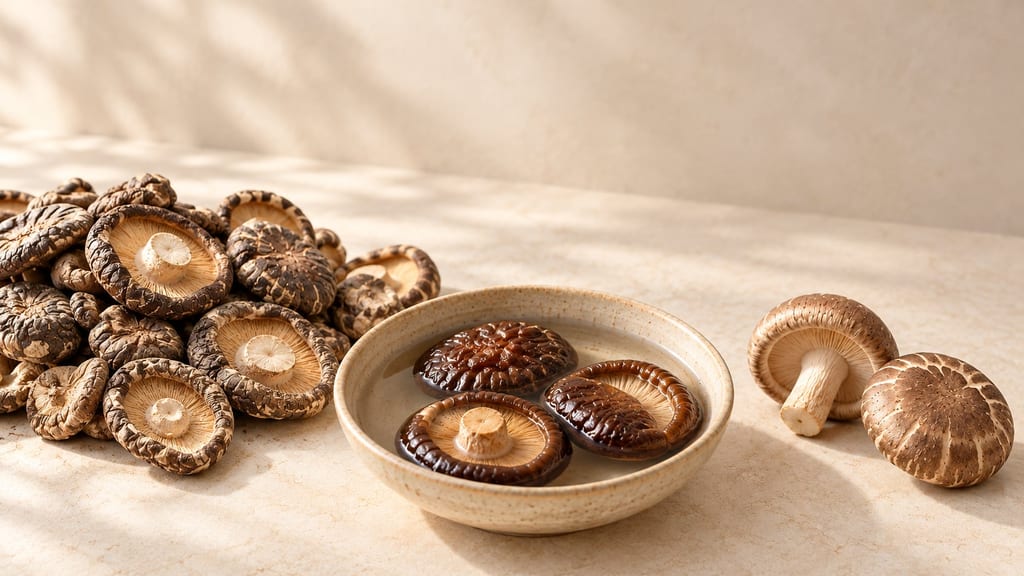
A shiitake dried in an hour: what microwaves and vacuum do to a mushroom
Hot air takes most of a day to dry a shiitake. Microwaves under vacuum can finish in an hour or less, and the same settings can scorch the mushroom. What the laboratory studies show about speed, texture and flavour.
Discussed in this article
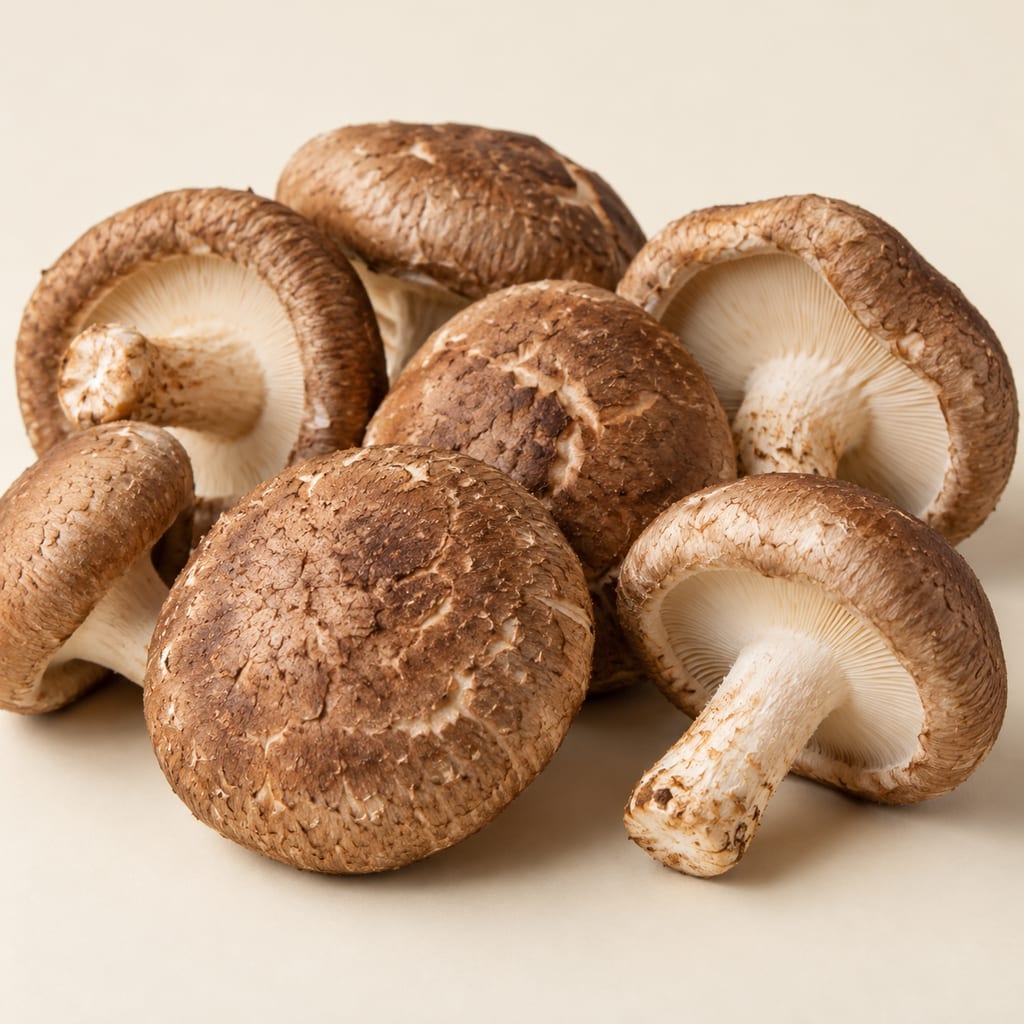
Shiitake
Shiitake, Lentinula edodes, is a wood-rotting mushroom cultivated in East Asia for centuries on logs and sawdust, and dried for storage and stock.
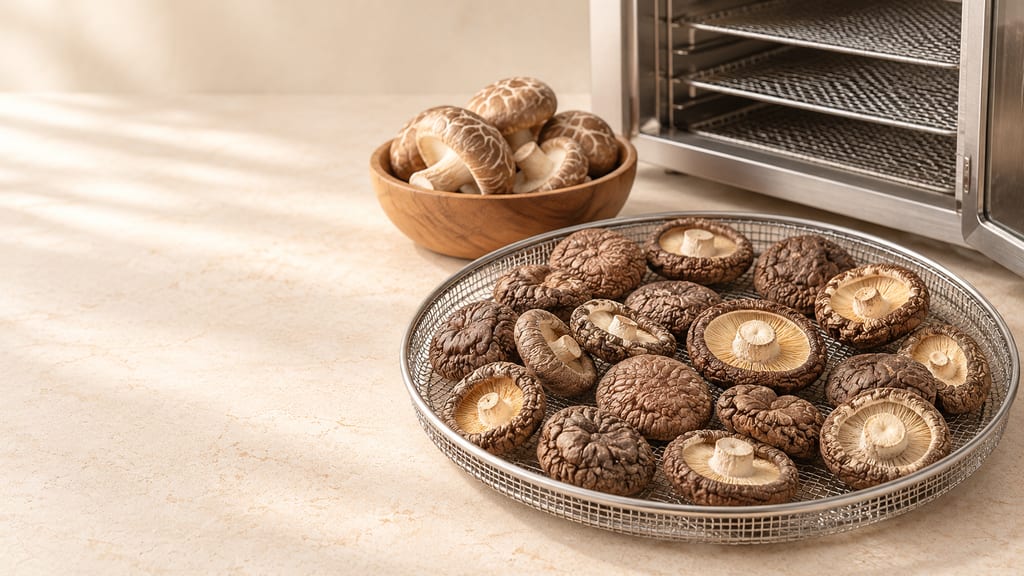
The dryer that dries its own air
A heat-pump dryer wrings the water out of the air it recirculates and reuses the heat. Drying shiitake took 0.85 kWh per kilogram against 6.67 for hot air, at a price in shrinkage. Here is how it works and how far the results carry.
Community
No community contributions have been published for this entry yet.
Share what you made
Sign in to contribute. Published comments and photos are free to read.
Sources
Journal of Food Science 2025; 90(1): e17616
Program temperature-controlled drying: An effective way to improve the quality of hot-air dried shiitake mushroomsCited in: Timing the heat to two enzymes; What a cook can take from this
Foods 2020; 9(4): 444
Changes in Aroma Profile of Shiitake Mushroom (Lentinus edodes) during Different Stages of Hot Air DryingCited in: Three hours at 60 °C; Lenthionine, and an argument about it; What a cook can take from this
Journal of Wood Science 2010; 56: 477-482
The smell and odorous components of dried shiitake mushroom, Lentinula edodes VCited in: Lenthionine, and an argument about it; The flavour is not finished when the dryer stops; What a cook can take from this
Shimane Prefecture
Shimane Prefecture forestry pages on the aroma and taste of shiitake (香りと味の秘密)Cited in: Lenthionine, and an argument about it; The flavour is not finished when the dryer stops; Timing the heat to two enzymes; What a cook can take from this
Nippon Shokuhin Kagaku Kogaku Kaishi 2000; 47(5): 347-354
The Behavior of Different Varieties of Dried Shiitake Mushrooms (Lentinus edodes (Berk.) SING.) in RehydrationCited in: The flavour is not finished when the dryer stops
Gaps
- Temperatures, stage durations and endpoints for ST_75 and ST_150, the constant-temperature baseline and numeric aroma results are not established.
- Accounts disagree on whether lenthionine survives drying.
- No account of traditional sun or fire drying of hoshi-shiitake is known.
Updated 2026-10-29