
African fermentation intake
Rwanda's milk bars and the culture of ikivuguto
In Kigali people sit down to drink milk out of respect for the cow. A look at Rwanda's milk bars, the wooden pots of ikivuguto, aged butter and a 17th-century royal decree about milk.
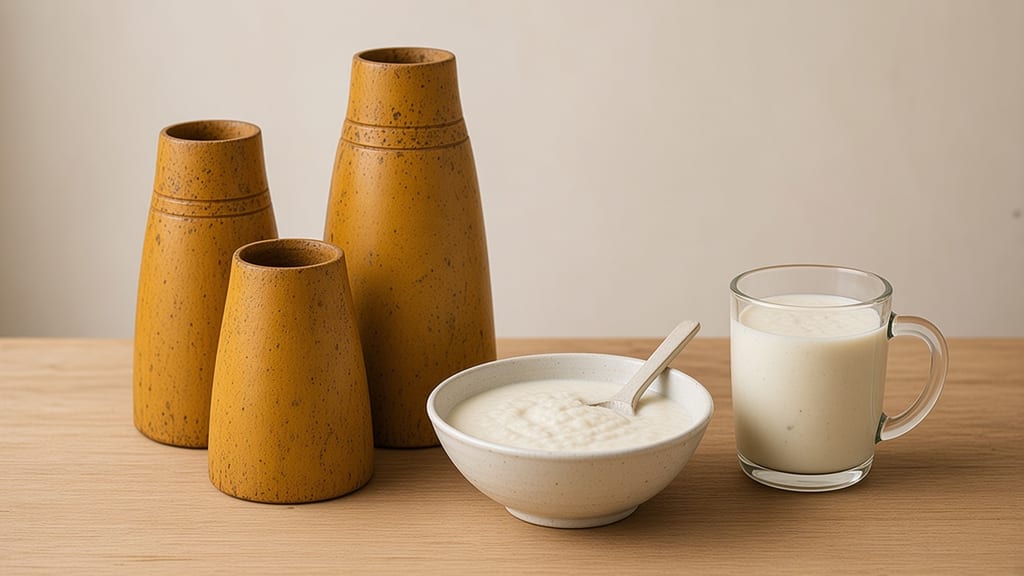
A glass the size of a stein
On a street in Nyamirambo, a busy part of Kigali, customers stand outside Moses Sansiman's milk bar with heavy glass mugs in their hands. Inside, Sansiman wears a lab coat. He draws cold whole milk from a large steel tank through a tap on one end. The milk is pasteurised. He is 52 and has run the shop, called Milk Zone, for five years.
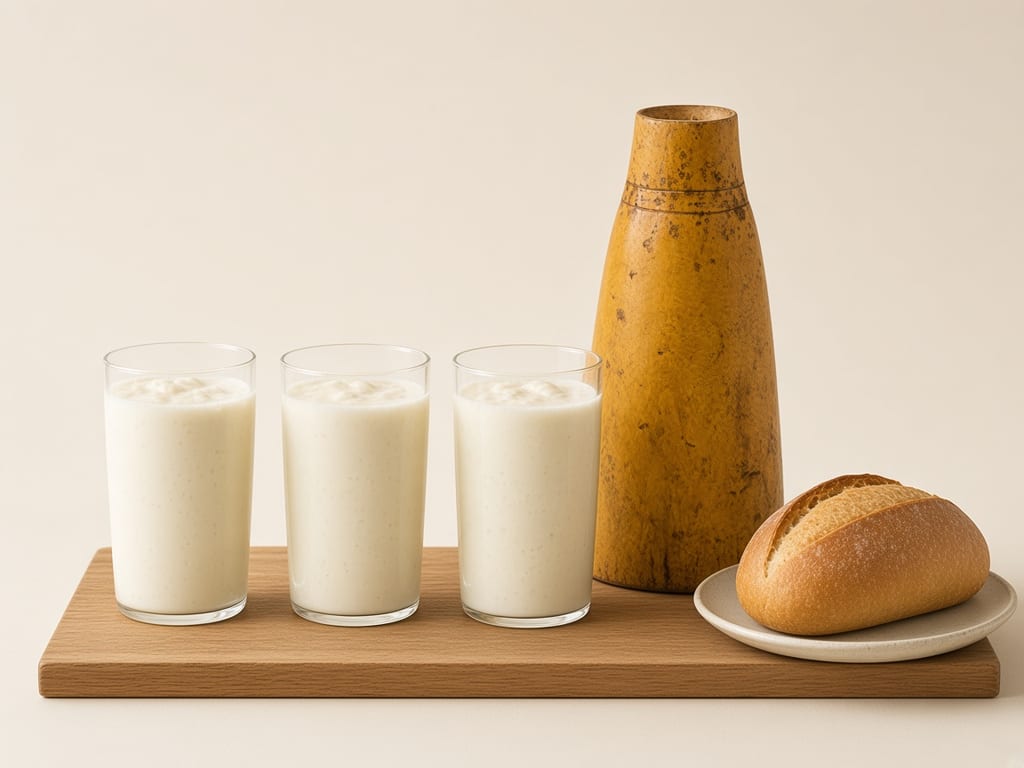
"I like to keep it simple," he told the NPR reporter Fatma Tanis in 2026. Other milk bars in the city sell hot milk with a spoon of honey, fermented milk or flavoured milk. Sansiman sticks to plain cold milk. The glass he set down for Tanis was the size of an Oktoberfest stein. She found the milk creamy and very fresh, with a faint floral smell.
His regulars are particular. They drink milk at the bar or fresh from a cow, never from a carton at the grocery store. "I can't drink milk in a box. No way," said JP Sagahutu, who drinks about four 8-ounce glasses a day. He looked for an English word for milk and settled on a French one. "I don't know the wording in English, but it's something sacré," he said.
The Rwandan custom is to sit down when drinking milk, out of respect for cows. Gilles Bertrand Niyomwungeri, at the same bar, put the habit in family terms. "I don't think I ever saw my grandfather drink anything other than milk," he said.
Milk bars are a fixture of daily life in Kigali. In NPR's account, they grew from a plain need. Over the last decade many Rwandans moved from the countryside to the city and lost the cows that had stood outside the door. The bar replaced the cow. To understand why a city would build a network of bars for milk, you have to start with the cow.
A country that counted in cows
"A very long time ago, there was no currency. To see if someone is rich, they were counting cows. If you have 10 cows, it means you are rich," Sagahutu said. A greeting is older than any bar. To wish someone well in Kinyarwanda, you say "may you have a cow", kajirinka.
A 2013 review of Rwandan dairy by E. Karenzi and colleagues makes the same point in academic terms. Cattle served as a symbol of political power and as the mainstay of the old economy. Cows run through language, ceremony, speeches, customs and taboos, and the review says their symbolic value goes beyond their price. The same review is frank about the other side. Milk was once the privilege of a few rich families, and cows played what the authors call a somewhat divisive role in Rwandan society.
The Japanese researcher Masahiro Hirata, of Obihiro University of Agriculture and Veterinary Medicine, surveyed nine farming households across Rwanda in March 2018 for a study of how they handle milk. Every household kept between one and eight dairy cattle. They kept cattle for milk, for meat at ceremonies, for bridewealth, for cash and for manure. They did not use them for ploughing or for carrying loads, because cattle are respected and treated well. Goats and sheep lived on some of the same farms, and nobody milked them.
Hirata also recorded who does what. Milking is men's work. Twice a day, between 5 and 7 in the morning and 4 and 6 in the afternoon, the calf suckles for about a minute and is led aside. A man squats on the cow's left with a container between his knees and milks for about three minutes. Children and young men stand on the other side and stroke the cow with a leafy branch, which keeps the calf off the udder and the flies off the cow. Then the calf finishes what is left.
Long horns and royal herds
Rwanda's local cattle belong to the Ankole group of East Africa. Hirata lists Bashi, Watsui and Inyambo among the breeds. A 2017 survey of indigenous cattle by C. D'A. Hirwa and colleagues names five local types, Inyambo, Inkuku, Inkoromaijo, Inkungu and Bashi. Inyambo is the most popular of them.
Breeders once chose these cattle for coat colour and horn shape. Hirwa's team describes a shift in breeding goals away from those looks and toward fast growth and other productive traits.
Local Ankole cows give little milk by modern standards. Hirata puts them at about 1–5 L a day. Crosses with Holstein cattle, brought in to raise yields, give about 5–10 L. That gap between the old cow and the new one is the start of the modern milk economy, and of the bar in Nyamirambo.
The pots and the gourd
In a Rwandan farmhouse, milk moves through a series of vessels, each with its own name. Hirata described the sequence in two households of the southwest. Fresh raw milk goes first into an inkongoro, a cylindrical wooden pot about 30 cm tall and 10 cm across, carved from one piece of wood and covered with an umutemeri, a woven grass lid. Once the milk has cooled, it is poured into an icyansi, a larger wooden pot about 40 cm high and 18 cm across.
Karenzi's review adds where the pot stands. The icyansi is kept at room temperature in a warm, clean spot in the house called the uruhimbi, under a straw lid or a lid cut from a calabash. The vessel is never sealed airtight.
Then the milk waits. Morning milk is half-soured by evening and has a new name, umubanji. Nobody drinks umubanji. After about two days it sets into a thick gel. That gel is ikivuguto, also written kivuguto. Men and women, children and adults all drink it. It often splits into curd and whey in the pot, so before serving it is stirred with an umutozo, a wooden stick about 40 cm long.
Nothing is added to start the souring in the classic method. Bacteria that live in the wooden pots, and in the air of a house with cattle, do the work. Karenzi's review notes that some households add a little ikivuguto from the last batch to new milk, and that others boil the milk first, cool it and leave it for 24–36 hours to set.
In parts of the east the pots get special treatment. Karenzi describes smoke from two plants, a grass and a shrub called Combretum molle. The grass stems are stripped, dried in the sun and kept in bundles in the house for more than six months, where kitchen smoke stains them red. They are then burned in a small clay pot with one large and one small opening, and a vessel is held mouth-down over the small opening to catch the smoke. Between rounds of smoke, the inside of the vessel is wiped with a cloth of tree bark. Milk set in a smoked pot smells and tastes of smoke, and the review says Rwandans and their neighbours prize that taste. Hirata saw smoked vessels in all seven households he visited in the northeast, where a small ceramic smoker called an igicunga holds the burning grass.
Two hours on the floor
Ikivuguto is also the raw material for butter. For churning, the soured milk goes into an igisabo, a round gourd about 45 cm tall and 40 cm across. A plug of banana leaf seals the spout. The churner rocks the gourd back and forth on the ground, and its round body does much of the work. In the southwest, Hirata timed churning at about two hours. In the northeast it took thirty minutes to an hour.
When the butter has come, the churner tips the gourd and pours out the liquid. That liquid is amacunda, buttermilk. Cold water goes in to bring out the butter, which is washed again in fresh cold water and sometimes soaked for a day. Children and women drink amacunda. When there is some, it is always drunk with meals, but Hirata's informants said men are not allowed to drink it.
The farm households Hirata visited make no cheese. Hirata argues that the reason lies near the equator. Day length hardly changes, so cattle breed all year, and a household with a few cows can milk one of them in any season. In the dry lands of West Asia, sheep and goats give milk only from January to September, so people turn buttermilk into sun-dried cheese for the months without milk. Rwandan households never needed to, and so they drink their milk in its soured forms.
Butter that ages for flavour
Fresh butter, Hirata found, is not food in the southwest. People call it amavuta y'inka amaresanyo, "still fresh oil of cow". They rub it on hair and skin, or on bruises to ease pain during massage. Butter for eating needs time.
The fresh butter is rolled into a ball, an isoro, and packed into an intsimbo, a storage gourd about 25 cm tall, or into an unglazed pot called an urwabya. Every week the ball comes out and is pressed and slapped between the hands to drive out water. After two to five weeks of this, the butter is left in the gourd for about two months. It comes out dark yellow, and its smell fills the house. This is amavuta y'inka akuze, "aged oil of cow". Kept in a cool part of the house, its gourd set in an igiseke basket of woven banana leaf against mice, it keeps for about a year.
In the northeast, cooks do something else. They heat fresh butter for several minutes to drive off water and milk solids. The result is a butter oil, brown and liquid while hot, solid at room temperature. It carries the same name as aged butter, amavuta y'inka akuze. One household, among those that had sheltered in Uganda during the war, told Hirata that the method came from Uganda. Hirata reads the shared name as a clue to what Rwandans value in butter. They judge it by the strength of its flavour more than by how long it keeps.
Karenzi's review describes a similar division. Some butter is heated with perfumed plants for use as body cream. Other butter is kept for half a year or a full year until it becomes a solid yellow cooking fat, sometimes seasoned with onion or garlic.
Why the butter stays butter
Rwanda sits almost on the equator, but most of it is high ground. Hirata notes that most of the east lies above 1,000 m and most of the west above 1,500 m. Kigali, at about 1,500 m, averages about 22 °C in every month of the year. The old houses of grass and mud let air through, and inside them it can feel almost chilly.
That climate, Hirata argues, explains why the southwest never took the last step that herders in hot countries take. In West Asia and South Asia, butter is always boiled down into butter oil, which is more than 99% fat and keeps far longer than butter, which still holds about a fifth of its weight in water. In the cool highlands of Rwanda, as in Tibet and Central Asia, butter itself was the end of the line. A cool house kept it well enough.
Hirata also points out how unusual the Rwandan view of butter is. Aged butter and butter oil share one name because both bring strong flavour to a plate of boiled food. He found that way of sorting butter by strength of flavour confirmed only in Rwanda and Uganda. The inland highlands near the equator, he concludes, built a milk culture of their own.
A plate of iburunge
Aged butter has one job above all. Cooks mix it into boiled cassava and beans, and the dish made that way has its own name, iburunge. Boiling is the everyday way to cook in rural Rwanda. Cassava, pumpkin, sweet potato, beans and plantain go into the pot. They come out plain, and salt or a spoon of strong butter gives them taste.
Ikivuguto almost always comes to the table with these meals. Hirata's informants said that when food was scarce they often ate only ikivuguto and sweet potato, or ikivuguto with cassava and kidney beans. They also ate it with mutsima, a stiff porridge of sorghum flour and hot water. Hirata argues that the pairing made sense. The meals are heavy in starch. The fresh, creamy sour milk suits them and adds good protein and minerals.
Hirata also notes that the old pattern was changing in 2018. Since about 2012, milk collection centres have opened in villages. Farmers now sell most of their milk for cash, keep less for the family and make ikivuguto and butter less often.
King Mibambwe's decree
Rwanda's government has tied its milk policy to a story from the 17th century. A 2018 report by the Rwanda Governance Board traces the practice of giving cows back to King Mibambwe Gisanura, who died in 1660. He decreed, in the report's words, that "no Rwandan child was ever to lack daily milk while others had plenty of it". Since then, the report says, Rwandans have given cattle to one another, or milk to those in need.
In 2006 the government revived the practice as Girinka, the "one cow per poor family" programme. A family that receives a cow later passes on a calf to the next family on the list, and the report says the two are then bound in a lifelong friendship. By 2016, the governance board counted more than 297,060 families with a Girinka cow, against a target of 350,000 by the end of 2017. The Ministry of Agriculture reported 451,612 cows distributed by the end of June 2022.
Karenzi's review places Girinka next to a school programme called "One cup of milk per child", funded by the European Union for children in nursery and primary schools. It also records how small consumption was in the mid-2000s. In 2005, Rwanda produced an estimated 178,598 tonnes of milk. People drank on average 13 L a year, and three quarters of that was drunk in the countryside. The ministry's report for 2022–23 puts national milk production at 1,061,301 tonnes.
From the farm gate to the kiosk
More cows meant more milk to move, and the state wrote rules for moving it. A ministerial order of 10 February 2016, published in the Official Gazette on 15 February, governs how milk is collected, carried and sold. Milk must pass through a milk collection centre, where it is tested at reception. The order defines a milk kiosk as any premises that meets its requirements and sells milk. To run one, the owner applies in writing for a licence from the sector authority where the kiosk stands.
The order also lists the kit. A kiosk needs stainless-steel saucepans, basins, buckets and milk cans, and a refrigerator. Milk for sale must meet set values for density, acidity and fat. Fermented milk and ghee sold in kiosks must meet the standards of the Rwanda Standards Board.
Factories came before the bars. Karenzi's review lists five dairy companies in the early 2010s, Inyange Industries, Nyanza Dairy, Eastern Savannah, Rubilizi Dairy and Masaka Farms, plus about 20 small cheese units, most of them in the Western Province. An earlier estimate it cites put national processing capacity at 188,000 L a day, with only 3.3% of it in use.
The collection centres now carry a large share of the milk. In 2022–23, according to the ministry, they collected 91,791,675 L, up from 85,223,665 L the year before. The ministry put their use at 53.9% of installed capacity.
The informal trade still matters. Chika Ezeanya-Esiobu and Vedaste Ndungutse surveyed ikivuguto makers and sellers for a 2019 study. Of the processors and sellers they interviewed, 87% were women. Their paper describes commercial ikivuguto made by adding a starter culture at 2–3% to milk that has been pasteurised and cooled.
What the microscope found
The pot that gives ikivuguto its taste can also give it germs. Karenzi's review says the lactic bacteria in traditional ikivuguto live alongside harmful ones, and that the mix depends on the hygiene of the person who makes it.
The researchers F. D. Nzabuheraheza and A. N. Nyiramugwera tested that risk in the north. In April 2013 they bought five samples of traditionally fermented milk from retailers in Kinigi Sector, Musanze District. The average total count was 7.21×10^7 colony-forming units per millilitre. Of the coliforms they identified, 66.7% were Escherichia coli. They also found Staphylococcus aureus. They concluded that the milk was not safe and did not meet Rwandan standards, and they recommended pasteurised milk and a pure starter culture.
Karenzi's own laboratory work points the same way. From samples of ikivuguto from the north and south of the country, the team isolated the bacteria that sour it, Lactococcus lactis and two species of Leuconostoc. Milk fermented with these strains set in about 8 hours at 30 °C. The best mix, two Leuconostoc strains with Lactococcus lactis, kept its flavour for 35 days in cold storage. Karenzi's review compares ikivuguto with Swedish filmjölk, another mild milk soured by Lactococcus and Leuconostoc, and says Central Africans living in Europe often choose filmjölk over yogurt.
The industrial route keeps the bacteria and changes the start. The milk is pasteurised, and a known culture replaces the microbes of the wooden pot.
Too much of a good thing
Rwanda's health minister now worries about a different problem. He says heavy milk drinking has become one of the new health problems that come with city life. "In [Rwandan] society, they think milk is everything," Dr Sabin Nsanzimana told NPR. Asked how much milk he recommends a day, he picked up a 16-ounce water bottle. "I mean, I would say maybe half of this," he said. That is about a cup.
He admits the message is hard to deliver. "If I go to my own family and start to talk about [how] too much milk is not good or how water is important, they will start to think that I probably went into the wrong medicine," he said.
Back in Nyamirambo, the customers at Milk Zone sit with their mugs. The milk in the tank is pasteurised and cold. The custom of sitting down to drink it, out of respect for the cow, came from the farm.
Related
Discussed in this article

Iburunge with ikivuguto
Iburunge is boiled cassava and kidney beans dressed with strong butter, the Rwandan farm meal Hirata recorded. This home plate uses butter oil and comes with a cold cup of ikivuguto.
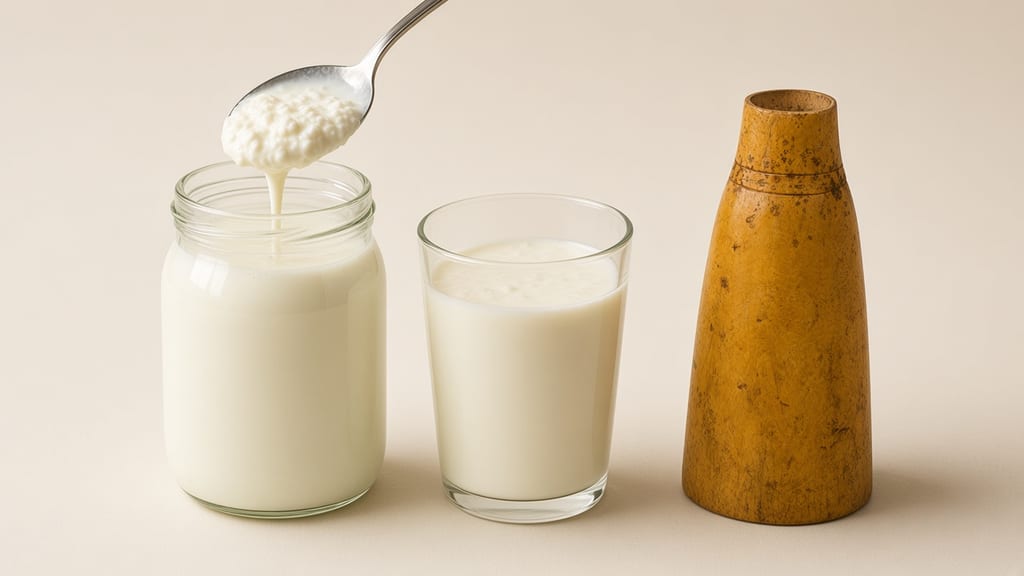
Ikivuguto at home
Ikivuguto is Rwanda's thick soured milk. This home version sets pasteurised whole milk with cultured buttermilk overnight at about 21 °C, then chills it for a mild, spoonable drink.
Community
No community contributions have been published for this entry yet.
Share what you made
Sign in to contribute. Published comments and photos are free to read.
Sources
NPR, Fatma Tanis, 27 August 2026
How much milk is too much milk?Cited in: A glass the size of a stein; A country that counted in cows; Too much of a good thing
Masahiro Hirata, Milk Science 67(3), 2018
Milk Processing System in RwandaCited in: A country that counted in cows; Long horns and royal herds; The pots and the gourd; Two hours on the floor; Butter that ages for flavour; Why the butter stays butter; A plate of iburunge
Karenzi E. et al., Biotechnologie, Agronomie, Société et Environnement 17(2), 2013
Kivuguto traditional fermented milk and the dairy industry in Rwanda. A reviewCited in: A country that counted in cows; The pots and the gourd; Two hours on the floor; Butter that ages for flavour; King Mibambwe's decree; From the farm gate to the kiosk; What the microscope found
Karenzi E. et al., Sciences & Technologie C 36, 2012
Fermentation of kivuguto, a Rwandese traditional milk: selection of microbes for a starter cultureCited in: What the microscope found
Nzabuheraheza F. D. and Nyiramugwera A. N., African Journal of Food, Agriculture, Nutrition and Development 16(2), 2016
Microbiological analysis of traditionally fermented milk sold in Kinigi sector of Musanze district in RwandaCited in: What the microscope found
Hirwa C. D'A. et al., International Journal of Livestock Production 8(7), 2017
Management and phenotypic features of indigenous cattle in RwandaCited in: Long horns and royal herds
Rwanda Governance Board, 2018
Assessing Girinka Programme (2006–2016): Citizen perspectivesCited in: King Mibambwe's decree
Ministry of Agriculture and Animal Resources, Rwanda, 2023
Annual report 2022–2023Cited in: King Mibambwe's decree; From the farm gate to the kiosk
Official Gazette of the Republic of Rwanda nº 07 of 15/02/2016
Ministerial Order N° 001/11.30 of 10/02/2016 regulating the collection, transportation and selling of milkCited in: From the farm gate to the kiosk
Ezeanya-Esiobu C. and Ndungutse V., IK: Other Ways of Knowing 5, 2019
Rural women economic empowerment, indigenous fermented milk production, and the challenges of modernityCited in: From the farm gate to the kiosk
Gaps
No unresolved gaps are listed.
Updated 2026-10-30