
Techniques
Vinegar for a truffle that will not wait
Desert truffles spoil within hours or days. Some Bahraini Bedouin pickle them in vinegar and salt, a practice with one line of evidence and no safety data. Here is what a safe acidified pickle needs, and what is missing.
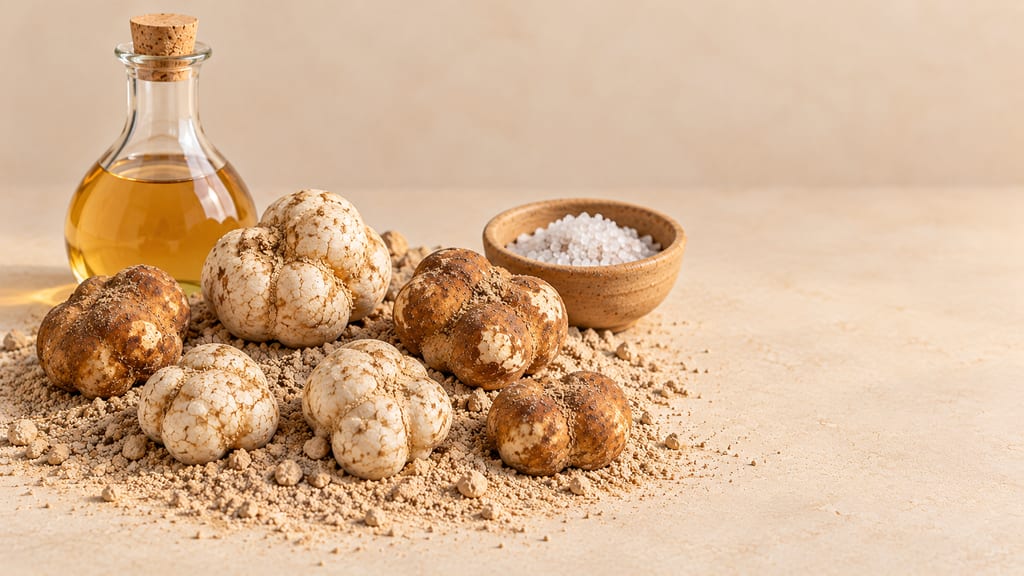
Desert truffles, coarse salt and vinegar: the three things the Bahrain pickle names.
A fruit that does not wait
A desert truffle dug up in spring and left in the sun is losing a race. A botanist's account of the genus says ripe truffles spoil within hours once they are exposed. A survey of Algerian truffle hunters, repeating an older study, puts the loss at within a week of harvest, worst in sunlight or heat. The two figures have not been reconciled, but they agree on the shape of the problem: whatever is done with these truffles has to be done fast.
The truffles in question are Terfezia and Tirmania. They grow underground in calcareous, high-pH desert soil, mostly in partnership with rock-rose plants of the genus Helianthemum, and they fruit in spring. The season is short and shifts from place to place. In Saudi Arabia it runs from about 25 January to 10 March, roughly six weeks. In Algeria the fruit bodies appear from early February to mid-April, and 65 per cent of the hunters surveyed start gathering between mid-February and March. In eastern Anatolia, 68.3 per cent of the gatherers interviewed work between early March and late April.
What hunters do about the clock is best documented in Algeria. In March and April 2014, researchers interviewed 60 truffle hunters, 30 each in Ghardaia and Ouargla. Very few keep truffles beyond the season, and for those who do the usual method is sun drying. To hold a catch for days, hunters bury it in sand in the shade, for up to three weeks, or cover it with green desert plants, for up to two weeks. Others cut truffles into strips and dry them, or steam or boil them and freeze them. Across the 60, 54.7 per cent covered fresh truffles with desert plants, 33.3 per cent kept them in the shade under salt, and 12 per cent did nothing at all. Those durations are the times hunters work to. Nobody has tested them as limits of safety.
Names, markets and kitchens
The truffle has as many names as the countries that eat it. It is terfez or terfas in Morocco, Libya and Egypt, and kama, kamma or faqa across the Arabian Peninsula and the eastern Mediterranean. In Saudi Arabia the common word is fage, with white zubaidi and black khulas as the kinds a market seller names. Zubaidi is also the name given to the white Tirmania nivea. Saudi hunters look for the truffles near rock rose, which they call raqrooq.
Prices show how much people want a fruit that lasts a few weeks. In Saudi Arabia a kilogram sold for SR 700–1,200 in the 2021 season. In Doha's Omani Souq in early March a kilogram goes for 300–500 QR, and one writer reports prices as high as 3,000 QR. In Algerian local markets the price swings with the year's rainfall: Tirmania nivea at USD 6.31–32.81 a kilogram, Terfezia arenaria at USD 7.57–33.44 and Terfezia claveryi at up to USD 37.86. About a quarter of the Algerian hunters, 26.7 per cent, sell their surplus.
In the kitchen the treatment is plain. Saudi cooks roast truffles on coals with salt, or boil them until tender and add salt with ghee or goat butter. Algerian cooks serve them with couscous and meat, or in porridge. In good seasons truffles are also dried and ground into a powder for flatbread, although drying does not keep the aroma. Salt turns up in nearly every one of these routes: on the coals, in the pot, over the shaded store. Vinegar appears in none of these accounts.
What the Bahrain survey recorded
The vinegar pickle has one documented source. In 2007 Qaher Mandeel and Abdul Ameer Al-Laith, of the biology department at the University of Bahrain, published a study of how native Bahraini and non-Bahraini people use the desert truffle. Its main finding on preservation is about cold. Chilling cleaned truffles, at 45.6 per cent of respondents, is the main method for short periods, and freezing, at 30.4 per cent, is used for prolonged preservation.
Then comes one sentence about vinegar: some Bedouin preserve cleaned truffles by pickling them in vinegar and salt at 3 to 6 per cent. The line leaves most of what a cook or a food-safety scientist would want to know unstated. It does not say whether the 3 to 6 per cent is the strength of the vinegar, the salt in the brine or the two together. It does not say how many respondents pickle, which truffle species they use, how the truffles are cleaned, how much liquid goes with them, how long they sit or how long they keep.
A later survey of Algerian hunters repeats the 3 to 6 per cent phrase and cites the Bahrain work. That is one claim told twice, not two confirmations.
Cold turns up elsewhere too. In eastern Anatolia, 93.0 per cent of the gatherers interviewed keep truffles in refrigerators. Chilling and freezing, with the Bahrain and Anatolian figures, are the subject of another Fermentea story, "Five days or two: the cold chain that keeps a mushroom fresh". This one stays with the jar.
What the acid has to do
Pickling in vinegar is not fermentation. In a lactic pickle, bacteria make the acid over days. Here the acid arrives with the vinegar, and nothing has to grow for the food to become acidic. On paper that makes the method simple. What makes it hard is the word "enough".
Food safety has a number for enough. The spores of Clostridium botulinum, the bacterium behind botulism, cannot germinate at a pH of 4.6 or below, so 4.6 is the limit that acid-food rules are built on. A low-acid food with acid added counts as an acidified food only if it settles at a pH of 4.6 or lower with a water activity above 0.85. Water activity is a measure of how much water is free for microbes to use. The United States federal rule for acidified foods uses the same two numbers.
The word that matters is "settles". A jar of truffles in vinegar has two parts, the liquid and the solid pieces, and they often differ in acidity. The pH that counts is the equilibrium pH, measured at least 24 hours after packing. For a product with distinct solid and liquid parts, the whole jar is blended into a paste before testing. Any shortcut in preparation can lower the ratio of acid to the low-acid food, and then the product may not be sufficiently acidified. The acidity of the liquid in the pot says little about the middle of a truffle a day later.
A mushroom is ordinarily counted as a low-acid food, so this is the test a pickled truffle would have to pass. No one has published a pH for desert truffle flesh, or measured how truffle pieces change the acidity of a vinegar brine they sit in.
Why "3 to 6 per cent" settles nothing
Vinegar strength is only one input, and a study of vinegar-preserved sea fennel shows how the others move the result. Croatian researchers packed unfermented sea fennel leaves in liquids made from vinegar at 5, 6 and 9 per cent acetic acid, diluted at 1:5, 1:4 and 1:5 by volume, each with 1 per cent salt and 1.5 per cent sugar. After pasteurising at 95 °C for 10 minutes and eight weeks at room temperature, the three liquids measured pH 3.55, 3.64 and 3.49. Their titratable acidity, the total acid present, was 1.62, 1.65 and 2.48 g per 100 mL. The strongest liquid carried about half as much acid again as the weakest, yet its pH was almost the same.
The limits matter as much as the numbers. Only the liquid was measured: no microbes were counted and the leaves' own pH was not tested. Sea fennel is not a truffle. What the sea fennel work does establish is that vinegar strength and dilution together set the result, and that one measure of acidity does not stand in for another. What any truffle brine reaches is still unmeasured.
A tested formula for mushrooms does exist, in the United States home-preservation literature: whole marinated mushrooms in 5 per cent white vinegar with oil and lemon juice, processed in a boiling-water canner for a time set by altitude. It differs from the Bahrain description on every point that matters here. It is not a vinegar-and-salt brine, it includes a heat process, and it says nothing about truffles. What it shows is what a tested recipe looks like: a stated vinegar strength, stated proportions and a stated process. The Bahrain line has, at best, the first.
The one laboratory trial
In 2022 researchers at Iranian universities in Mamaghan and Tabriz ran the only laboratory trial found that stores desert truffles in vinegar. They treated Terfezia claveryi with ultraviolet-C light for 0, 10 or 20 minutes, then kept the truffles at 4 °C for 160 days in brine of 7, 10, 13 or 16 per cent salt or in 5 per cent vinegar, sampling every 40 days. They measured weight loss, firmness, phenolic compounds, vitamin C and microbial load. Ten minutes of UV-C gave the firmest tissue and the least weight loss, the longer dose caused skin damage, and irradiated truffles had the lowest microbial growth. The authors judged 10 minutes of UV-C followed by vinegar immersion and cold storage the most effective combination over the 160 days.
It is a useful experiment, and it is not a safety test. It leaves open the parts a pickle depends on: no pH, acidity, microbial count or taste result is on record for it, and it is not known how the salt brines compared with the vinegar. The vinegar was plain 5 per cent, not the vinegar-and-salt mixture of the Bahrain line. And every jar stood at 4 °C, so cold was part of the method. The 160 days is the length of an experiment on irradiated truffles in a refrigerator. It is not a shelf life for anyone's jar.
A Kuwaiti cook who blanches and freezes truffles says they keep one to two years, depending on the variety, and that freezing may slightly affect flavour. That describes freezing, not pickling, and it is one person's untested practice.
What a reader can take from it
Vinegar and salt preserve food when there is enough acid, well mixed through the food, settling at or below pH 4.6. Some people in Bahrain have used that principle on desert truffles, but the method is not documented.
The ways of holding desert truffles that come with numbers are cold ones: the chilling and freezing in Bahrain, the refrigerators in Anatolia and the 4 °C jars of the Iranian trial. Salt appears in several traditions, as a cover in the Algerian shaded store and as a brine in that trial. Vinegar and salt together, at a stated strength and ratio, held for a stated time, with a measured pH, appear nowhere.
So treat the Bahraini pickle as an observation about what people do, not as a method to copy. A truffle that smells and looks sound after weeks in a jar is not thereby safe, and no duration in this story is a tested safe storage time. What would settle the question is ordinary work: the equilibrium pH of truffle and brine measured after 24 hours and again later, microbial tests alongside it, and a full account of who pickles in Bahrain, with what and for how long.
Related
Discussed in this article
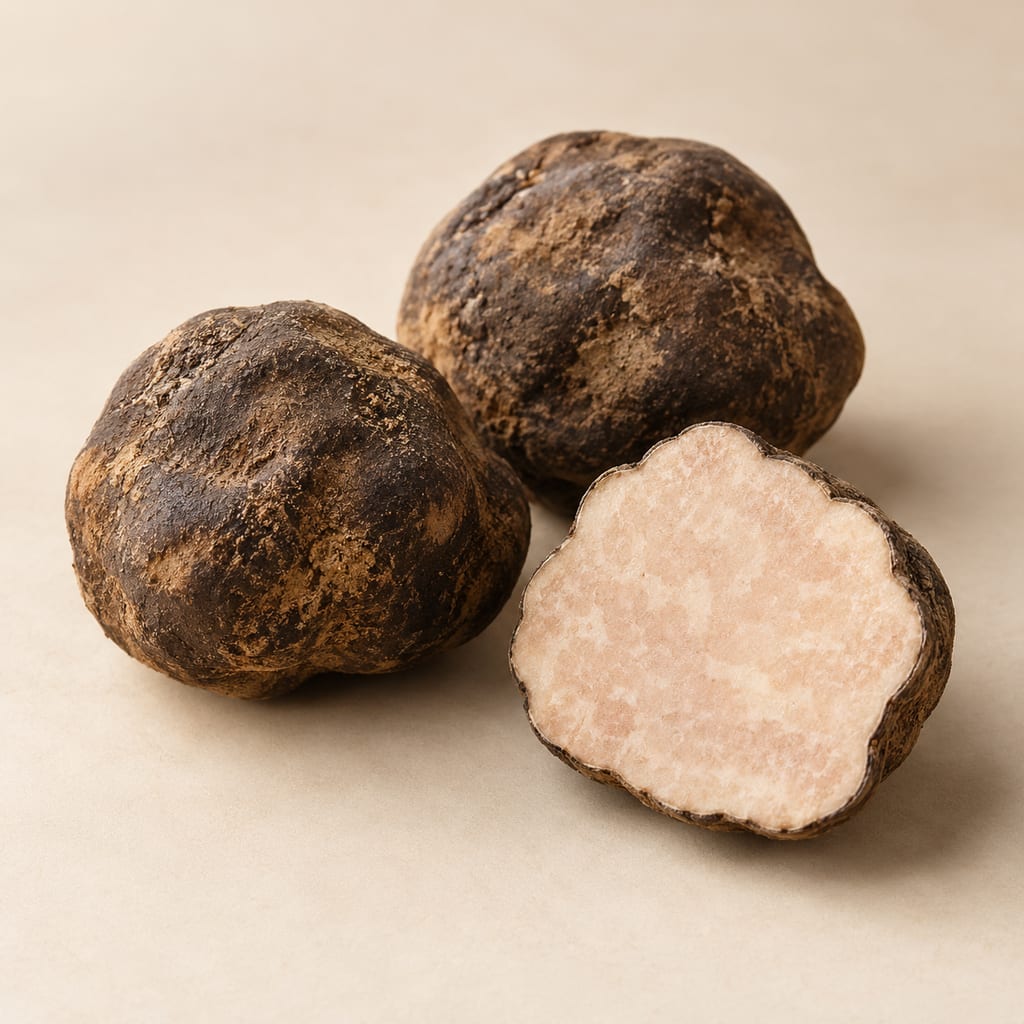
Desert truffle
Desert truffle, Terfezia claveryi, is an underground fungus of dry Spanish and Moroccan ground that is gathered and sold seasonally, under names such as terfass, in local markets.
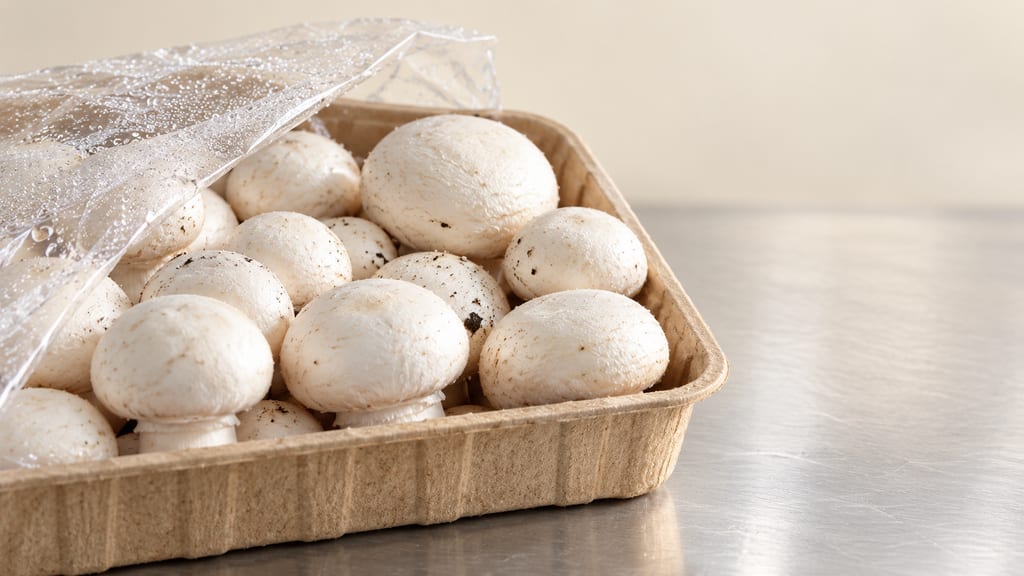
Five days or two: the cold chain that keeps a mushroom fresh
A picked mushroom keeps breathing and growing. A fridge 3 °C warmer than it should be can cut its life from a week to two days, and the cold that saves a button mushroom ruins a straw mushroom.
Community
No community contributions have been published for this entry yet.
Share what you made
Sign in to contribute. Published comments and photos are free to read.
Sources
Journal of Ethnopharmacology 2007; 110(1): 118-29; Qaher A. Mandeel and Abdul Ameer A. Al-Laith
Ethnomycological aspects of the desert truffle among native Bahraini and non-Bahraini peoples of the Kingdom of BahrainCited in: What the Bahrain survey recorded; Why "3 to 6 per cent" settles nothing; What a reader can take from it
Journal of Ethnopharmacology 2015; 162: 31-38; Bradai L, Neffar S, Amrani K, Bissati S, Chenchouni H
Ethnomycological survey of traditional usage and indigenous knowledge on desert truffles among the native Sahara Desert people of AlgeriaCited in: A fruit that does not wait; Names, markets and kitchens; What the Bahrain survey recorded; What a reader can take from it
Gazi University Journal of Science 2017; 30(4): 57-70; Akyüz M
Ethnomycological study of Eastern Anatolian trufflesCited in: A fruit that does not wait; What the Bahrain survey recorded; What a reader can take from it
Arab News, 11 February 2021; Tashkandi H
Jewels in the sand: Everything to know about Saudi truffle seasonCited in: A fruit that does not wait; Names, markets and kitchens
Kuwait Times, 7 May 2026; Omar F
Truffle season stretches into summerCited in: The one laboratory trial
Mushroom the Journal; Merenkov R
Desert truffles: from the souq to my kitchenCited in: Names, markets and kitchens; The one laboratory trial
Tom Volk's Fungus of the Month, University of Wisconsin-La Crosse, January 2007; Shavit E, Volk T
Desert Truffles (Terfezia and Tirmania)Cited in: A fruit that does not wait; Names, markets and kitchens
Journal of Food Science and Technology (Iran) 2022; 19(125): 183-194; Daei B, Azadmard-Damirchi S, Javadi A, Torbati MA
Effect of UV-C irradiation and storage at the different concentration of brine and vinegar on the quality and shelf life of desert truffle (Terfezia claveryi)Cited in: The one laboratory trial; What a reader can take from it
University of Florida IFAS Extension, revised August 2024; Ahn S, Krug M
Food Acidity (FSHN20-2, EDIS FS325)Cited in: What the acid has to do; What a reader can take from it
Code of Federal Regulations, Legal Information Institute, Cornell Law School
21 CFR 114.3 Definitions (acidified foods)Cited in: What the acid has to do
National Center for Home Food Preservation, University of Georgia
Marinated whole mushroomsCited in: Why "3 to 6 per cent" settles nothing
Foods 2023; 12(20): 3812; Radman S et al.
Vinegar-Preserved Sea FennelCited in: Why "3 to 6 per cent" settles nothing
Gaps
- The pH, acidity and microbial safety of desert truffles held in vinegar and salt have not been measured.
- Quoted spoilage times for fresh desert truffles range from hours to a week.
Updated 2026-10-29