
Preservation catalogue
Five days or two: the cold chain that keeps a mushroom fresh
A picked mushroom keeps breathing and growing. A fridge 3 °C warmer than it should be can cut its life from a week to two days, and the cold that saves a button mushroom ruins a straw mushroom.
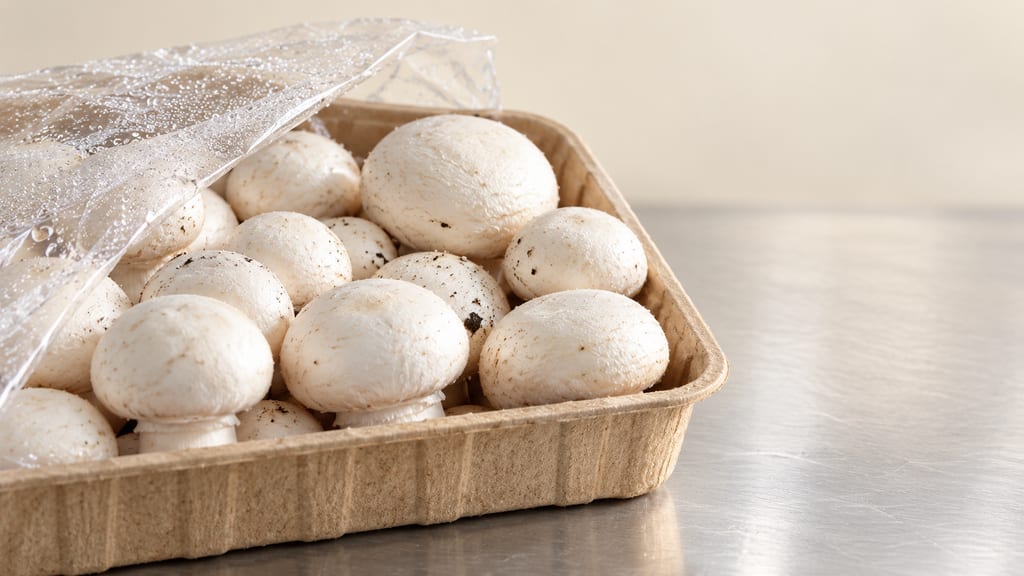
Button mushrooms keep five to seven days at 1.5 °C, and two at 4.5 °C.
A crop that is still alive
In a mushroom house, white button mushrooms are cut while their caps are still round and the thin membrane under each cap, the partial veil, is whole. That is the mark of a mushroom ready to sell: harvesters choose it by maturity, not by size, and they leave enough stalk to trim cleanly without cutting into the veil.
The moment it leaves the bed, the mushroom starts to spend itself. It has no root to feed it any more, but it keeps breathing, burning its own reserves and giving off heat and carbon dioxide. At 20 °C a kilogram of button mushrooms gives off 132 to 158 millilitres of carbon dioxide an hour. At 0 °C the same kilogram gives off 14 to 22. The warm kilogram breathes six to eleven times as hard: the difference between a crop that idles and one that races through its own shelf life.
It also keeps growing. A picked mushroom carries on with the development it started on the bed: the stalk lengthens, the cap bends upward, the veil tears and the dark gills show. Every one of those changes lowers its grade, and every one of them runs faster in the warm. Fresh mushroom keeping is therefore a contest with time and temperature, and the first hour after picking counts for more than the last day in the fridge.
That is what prompt cooling means. The heat the mushroom carries in from the growing room, and the heat it makes itself, has to come out quickly, and the cold has to hold from the packing shed to the shop. This story follows that chain for the button mushroom, where the figures are best known, and then for two mushrooms where the rules change: the tropical straw mushroom, which cold can damage, and the desert truffle, which households in the Gulf and in eastern Turkey keep in their own refrigerators.
Five days or two
The best-known reference figures for button mushrooms are in the produce fact sheet of the postharvest centre at the University of California, Davis. The best storage temperature it gives is 0–1.5 °C. At 1.5 °C the mushrooms typically keep for five to seven days. At 4.5 °C, 3 °C warmer and still a respectable fridge temperature, they keep for two.
A difference of 3 °C is the whole argument of this article. A domestic refrigerator door, a delivery van with a slow cooling unit or a shop counter that is chilled but not cold enough can each take most of a mushroom's life away without anyone seeing it happen. The product looks the same on day one. The loss shows later, as browned stalks, open caps and a slimy surface.
There is a floor too. Mushrooms freeze at about −0.6 °C, and freezing injury shows as a water-soaked look that turns into extreme softening. Good cold storage keeps the product just above that point and holds it there.
Humidity matters almost as much as temperature. The fact sheet asks for 95–98% relative humidity, because a mushroom has almost no protection against drying. As it loses water it loses its gloss, the stalk and gills blacken and the cap curls. Mushrooms are usually packed in cartons under a perforated overwrap, which keeps the air around them moist while still letting them breathe.
Pulling the field heat out
For the button mushroom the fact sheet is direct: rapid forced-air cooling soon after harvest is strongly recommended. In forced-air cooling, fans pull cold air through the stacked cartons rather than letting the cold soak in slowly from the outside of a pallet. The difference is in the middle of the stack, where a carton in still air can stay warm for hours.
A precooling trial at Shandong University of Technology measured what that early cold buys. Button mushrooms were precooled for six hours at 2, 6, 10 or 14 °C and then stored at 3 °C, and the researchers sampled them on days three, six and nine. After precooling at 2 °C the mushrooms still had a whiteness score above 80 on day nine, which the authors judged acceptable. The groups precooled at 6 °C and 10 °C had lost their commercial value by then. The colder start also slowed the loss of firmness and the rise in the activity of polyphenol oxidase and peroxidase, enzymes involved in browning.
The cold has to survive the journey as well. The fact sheet advises loading trucks so that cooling air can circulate through the middle of the load, and notes that mushrooms arrive in better shape in trailers with air suspension, because the caps bruise easily. A bruise turns into a brown patch. Mushrooms also pick up strong smells: carried or stored beside onions, they take on the onion.
Changing the air around them
Once the mushrooms are cold, the next lever is the air in the package. Because they breathe, a sealed pack slowly loses oxygen and gains carbon dioxide, and some of that change helps. The fact sheet reports storage of about 12 to 15 days at 0 °C in an atmosphere of 3% oxygen and 10% carbon dioxide. Raising carbon dioxide to 10–15% in ordinary air reduces decay and slows the blackening of stalks and gills, and the benefit is largest when the store cannot be held below 5 °C. Short exposure to 20% carbon dioxide is safe only at 0–1 °C. Too much carbon dioxide causes its own injury, seen as blackening and pitting.
The fact sheet also gives the reason controlled and modified atmospheres are not common for mushrooms: poorly controlled atmospheres or the wrong packaging can strip the oxygen out quickly, and an airless, moist package is the kind of place where Clostridium botulinum can grow. A film that is too tight is a food-safety problem, not only a quality one.
Researchers keep testing films and coatings to find the balance. One study packed whole and sliced button mushrooms in a PVC wrap and two polyethylene films and stored them at 12 °C for seven days. The type of film did not change the whiteness of whole mushrooms, but a chitosan and calcium chloride coating did, and the tighter polyethylene film gave the lowest weight loss and slowed the opening of the caps. Its combination with a coating preserved the mushrooms best under those warm conditions.
A 2023 study tried biodegradable polylactic acid films at 4 °C and 90% relative humidity for 15 days. Unwrapped mushrooms lost 30.99% of their weight within three days. In the best of the new films the loss after 15 days was 6.78%. Ordinary polyethylene lost only 1.7%, but water condensed inside the bag, and wet mushrooms brown and spoil. The point of a good film is not to stop all exchange, but to let the right amount of water vapour and gas through.
When cold is the wrong answer
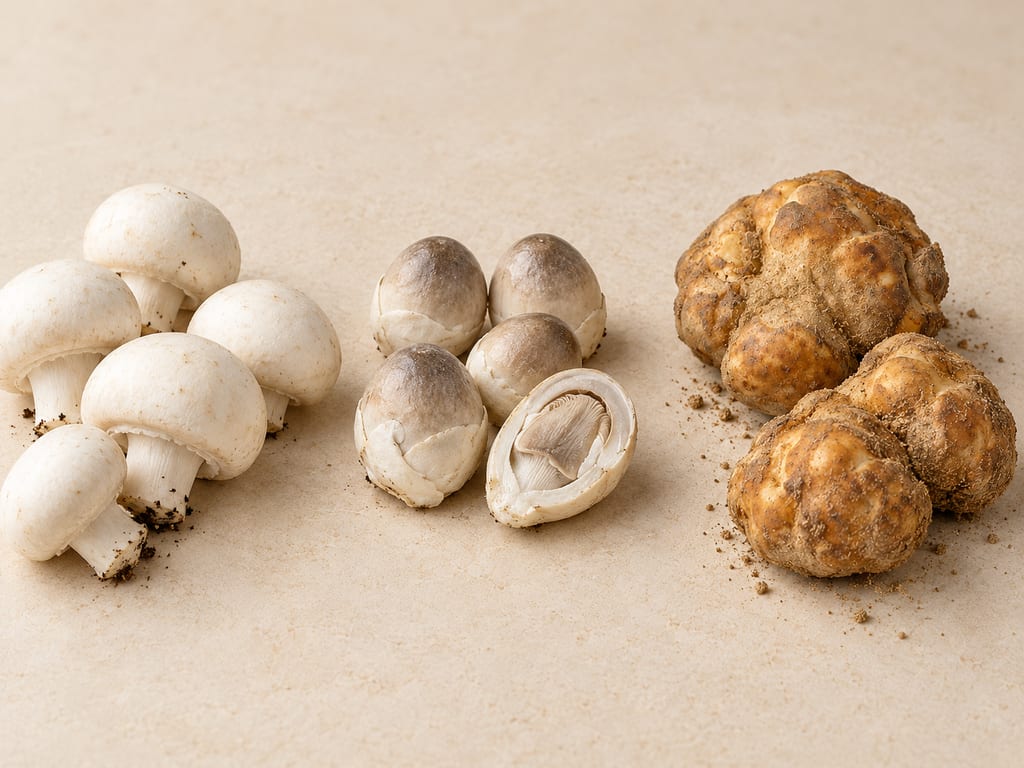
Everything above is about the button mushroom, a temperate crop grown in cool, dark houses. The straw mushroom, Volvariella volvacea, is a mushroom of warm climates, and it does not follow the same rules. It usually breaks down, or autolyses, at 0–5 °C: the cold that keeps a button mushroom fresh makes a straw mushroom soften and turn to liquid.
A 2020 study in Scientific Reports stored straw mushrooms at 4 °C and sampled them at 12, 24 and 60 hours. Weight loss, electrolyte leakage and malondialdehyde, a marker of damaged cell membranes, all rose. The team identified 2,063 proteins and found hundreds whose levels changed during storage, most of them falling, with the number rising as storage went on. Among the few that rose were proteins of the mitochondria's energy machinery, including subunits of ATP synthase and succinate dehydrogenase.
The lesson is simple: storage rules belong to a species. A mushroom from a warm climate can be harmed by a temperature that suits one from a cool climate, and a figure measured on button mushrooms should never be carried over to any other kind.
Truffles from the desert
The desert truffles of the Arabian Gulf and Anatolia are another food again. They grow underground in arid land after the winter rains, and they are gathered and sold in a short season. Families who collect or buy them keep them in the kitchen, and two ethnographic surveys record what they actually do.
In Bahrain, a survey by Mandeel and Al-Laith asked native Bahraini and non-Bahraini residents about the truffles they called zubaidi (Tirmania nivea) and ikhlasi (Terfezia claveryi). Chilling cleaned truffles was the main way Bahraini respondents kept them for short periods, named by 45.6%, while 30.4% froze them for longer. Non-Bahraini residents preferred freezing, at 51.4%. Some Bedouin preserved clean truffles by pickling them in 3–6% vinegar with salt. Respondents linked good seasons to early, heavy rain.
In eastern Anatolia, Akyüz interviewed 230 truffle gatherers about desert truffles that grow with rock-roses (Helianthemum species), among them Terfezia boudieri, the one most valued for sale. Most gatherers, 93.0%, kept their truffles in the refrigerator. The season ran mainly from early March to late April, and the usual dish was truffle fried with eggs, mentioned by 84.8%.
Neither survey measured how long a chilled truffle stays good or at what temperature. They record practice, the way people in two truffle regions use the household fridge, rather than a tested storage limit.
What the cold cannot promise
Cold storage keeps a fresh mushroom fresh for a while. It does not make a mushroom safe for a fixed number of days, and the storage lives in a fact sheet or a study are quality figures, measured under stated conditions, not safety deadlines. A cold mushroom can look and smell acceptable after the point where it should have been used.
The practical rules that follow from the evidence are short. Cool mushrooms as soon as they are picked or bought, and keep them as close to 0 °C as the fridge allows without freezing. Keep them moist but not wet, in packaging that breathes. Keep them away from strong smells and rough handling. Do not seal them airtight. And know the species before applying any of this: a straw mushroom wants none of the cold that keeps a button mushroom.
For the other species, the cooling delay, temperature and humidity that keep each one in a stated condition for a stated time are not established. For the desert truffle, gatherers have their own practice, and measurements have not yet caught up.
Related
Read more
Vinegar for a truffle that will not wait
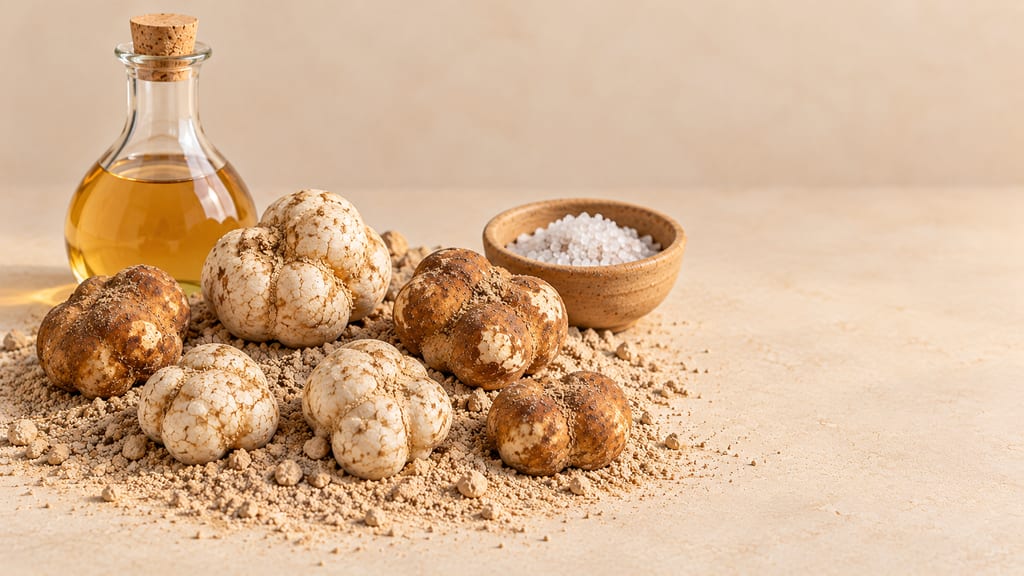
Desert truffles spoil within hours or days. Some Bahraini Bedouin pickle them in vinegar and salt, a practice with one line of evidence and no safety data. Here is what a safe acidified pickle needs, and what is missing.
Discussed in this article
Button mushroom
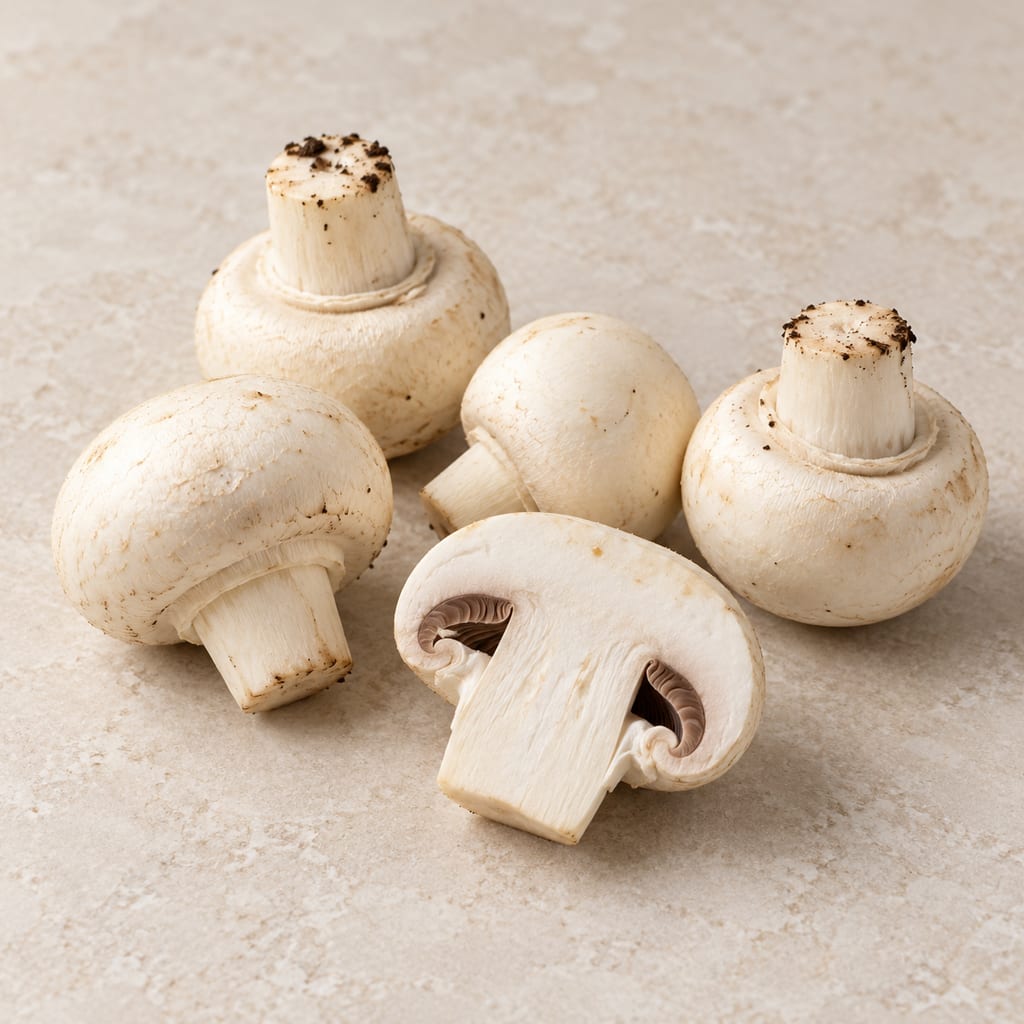
A cultivated form of Agaricus bisporus sold young as a button and at more mature stages as cremini or portobello, used fresh or preserved in everyday cooking.
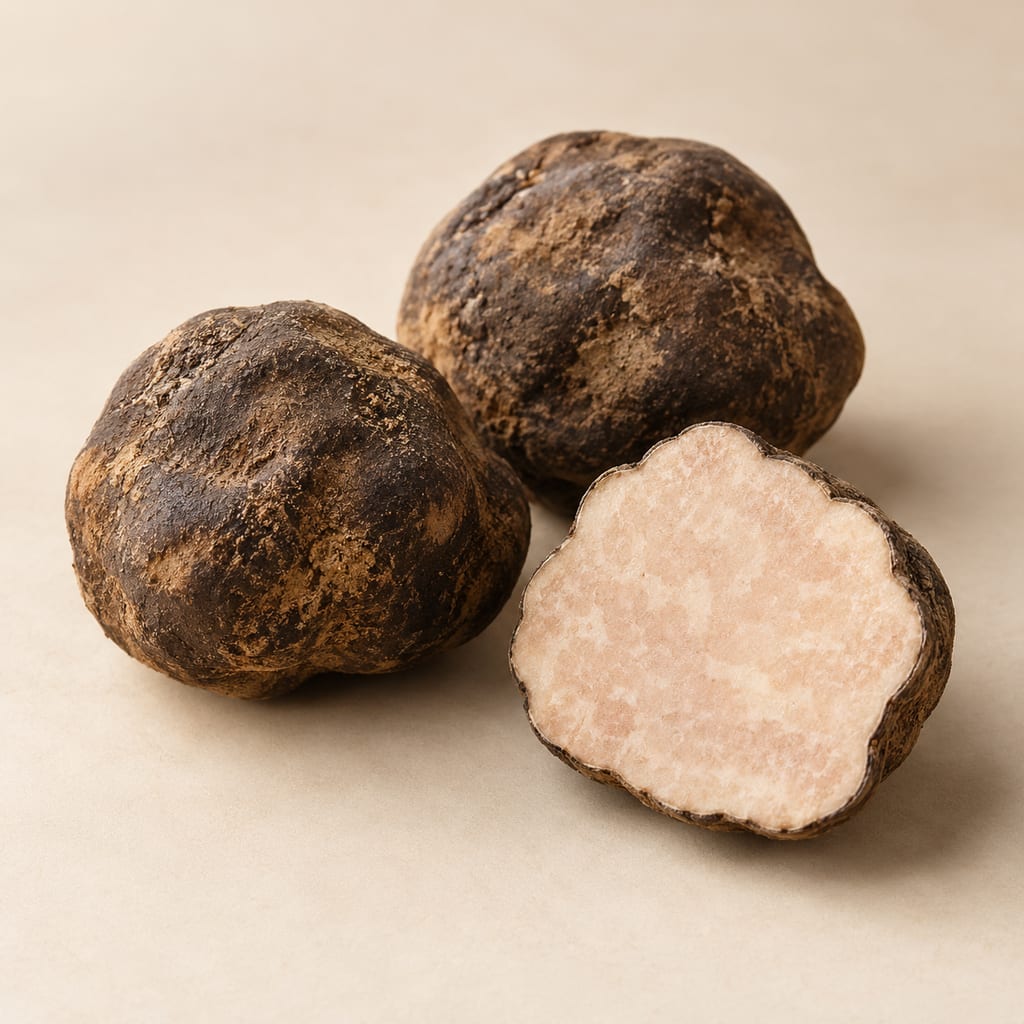
Desert truffle
Desert truffle, Terfezia claveryi, is an underground fungus of dry Spanish and Moroccan ground that is gathered and sold seasonally, under names such as terfass, in local markets.
Community
No community contributions have been published for this entry yet.
Share what you made
Sign in to contribute. Published comments and photos are free to read.
Sources
UC Davis Postharvest Research and Extension Center
Mushroom: recommendations for maintaining postharvest quality (Suslow and Cantwell, 2002)Cited in: A crop that is still alive; Five days or two; Pulling the field heat out; Changing the air around them; What the cold cannot promise
Scientific Reports
Differential proteomics study of postharvest Volvariella volvacea during storage at 4 °C (Zha et al., 2020)Cited in: When cold is the wrong answer; What the cold cannot promise
Journal of Ethnopharmacology
Ethnomycological aspects of the desert truffle among native Bahraini and non-Bahraini peoples of the Kingdom of Bahrain (Mandeel and Al-Laith, 2007)Cited in: Truffles from the desert; What the cold cannot promise
Gazi University Journal of Science
Ethnomycological aspects of traditional usage and indigenous knowledge about the arid-semi arid truffles consumed by the residents of the Eastern Anatolia region of Turkey (Akyüz, 2017)Cited in: Truffles from the desert; What the cold cannot promise
Journal of Food Science and Technology
Modified atmosphere packaging (MAP) and coating for improving preservation of whole and sliced Agaricus bisporus (Ban et al., 2014)Cited in: Changing the air around them
Foods
One-step synthesis of poly(L-lactic acid)-based soft films with gas permselectivity for white mushrooms (Agaricus bisporus) preservation (Sun et al., 2023)Cited in: Changing the air around them
International Journal of Agricultural and Biological Engineering
Effect of precooling temperature on physiological quality of cold stored Agaricus bisporus (Wang, Tan and Wang, 2014)Cited in: A crop that is still alive; Pulling the field heat out
Gaps
- No tested storage limit is established for desert truffles or straw mushrooms comparable to that for button mushrooms.
Updated 2026-10-29