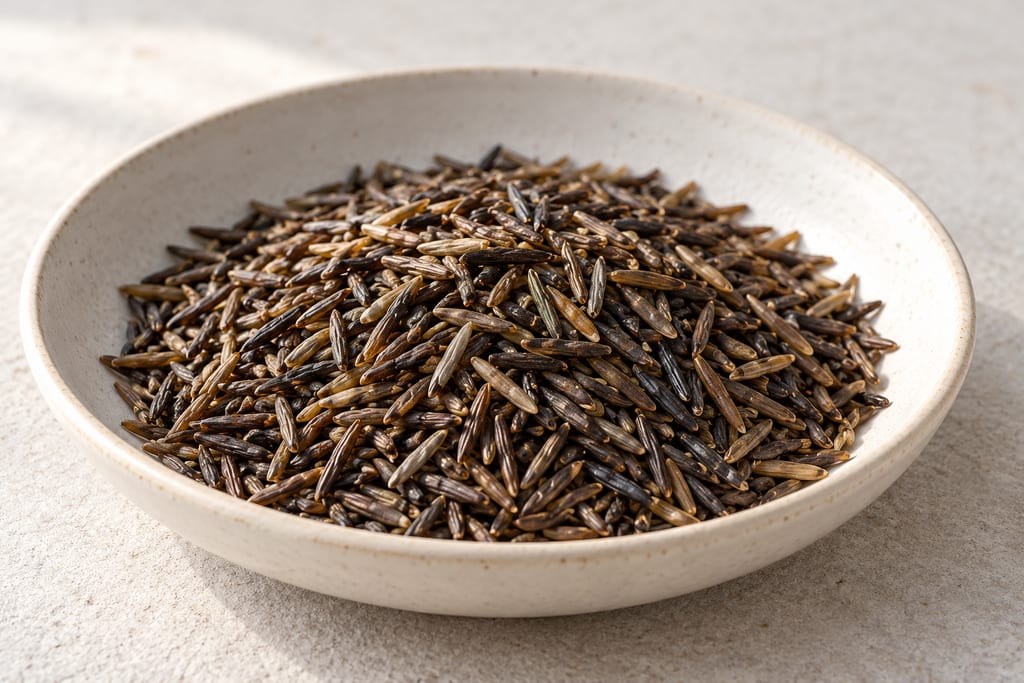
Parched wild rice (manoomin)
Harvested wild rice dried, parched over heat and hulled, a step that keeps the grain for storage in Ojibwe food systems and does more than cook it.
 FermenteaWhere food goes to change
Granulated maple sugar
Maple sugar is sap from maple trees boiled down until it granulates. Great Lakes Indigenous makers stored the concentrated sugar for later use and for exchange.
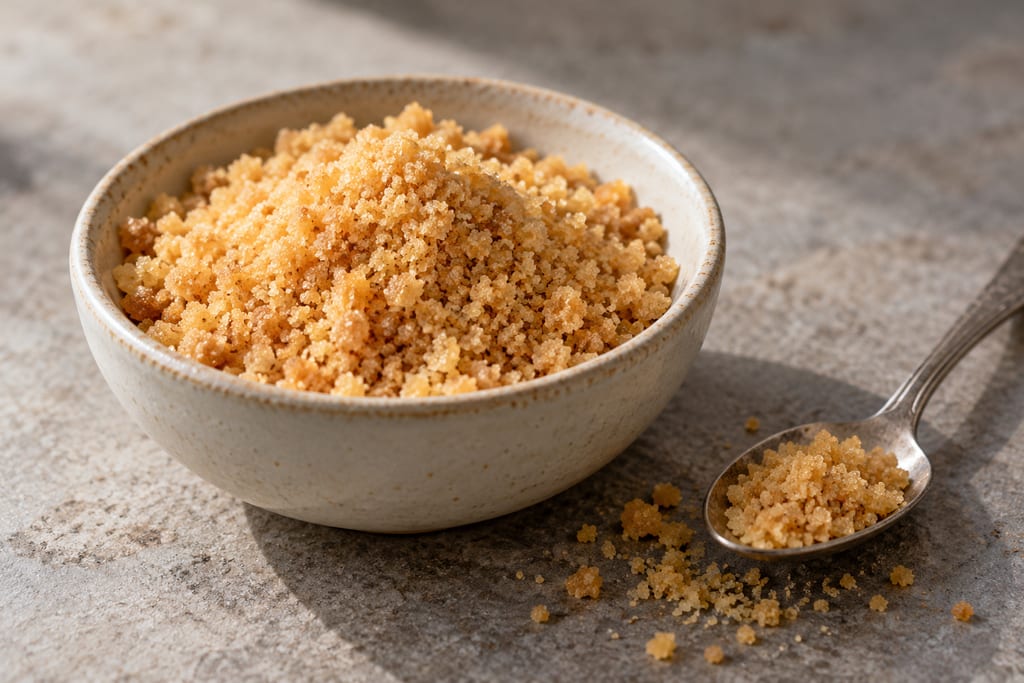
Maple sugar is a granulated sweetener made by boiling down the sap of maple trees. Boiling removes water from the sap, so that the sugar it contains becomes concentrated enough to solidify into granules. The result is a more durable sweetener than the sap, which spoils quickly and must be concentrated before it can be kept.
The Great Lakes manufacture is the clearest documented Indigenous example. It gives a solid sugar that could be stored for later use and traded, not only a sweet liquid used the same day.
Sap is mostly water with a small share of dissolved sugar. Heating drives off water as steam, so the sugar in what remains reaches a concentration at which it can crystallise. Continued boiling and stirring of the concentrate then produces the granular form.
The same principle applies to fruit juice concentrated into syrup, and many Old World farming societies used boiling in this way. What distinguishes maple sugar is that the product is granulated and stored as a dry sweetener.
The granulated form keeps well because its water content is low. The record notes that it was stored for later use and was also exchanged, which made it a trade good as well as a household supply. Its value came from the labour of concentrating the sap and from the sugar's durability.
The record gives no sap-to-sugar ratio, no boiling time, no temperature and no storage limit. Maple sap spoils quickly if it is not boiled or kept cold, and a sugar that has taken up moisture may clump or ferment. The page does not supply a home method.
Great Lakes maple-sugar manufacture is documented as an Indigenous practice in which concentrated, granulated sugar was stored and exchanged. Concentrating sap or juice by boiling is also found in many Old World farming societies.
The source gives the Great Lakes as the region of Indigenous maple-sugar manufacture; no locality is named.
Harvested wild rice dried, parched over heat and hulled, a step that keeps the grain for storage in Ojibwe food systems and does more than cook it.
No community contributions have been published for this entry yet.
Sign in to contribute. Published comments and photos are free to read.
Milwaukee Public MuseumMethod · History
Indigenous Great Lakes maple sugar (Milwaukee Public Museum)Great Lakes maple-sugar manufacture: concentrated, granulated sugar stored for later use and exchange.
Cited in: What it is; How the concentration works; Storage and exchange; Limits of the record