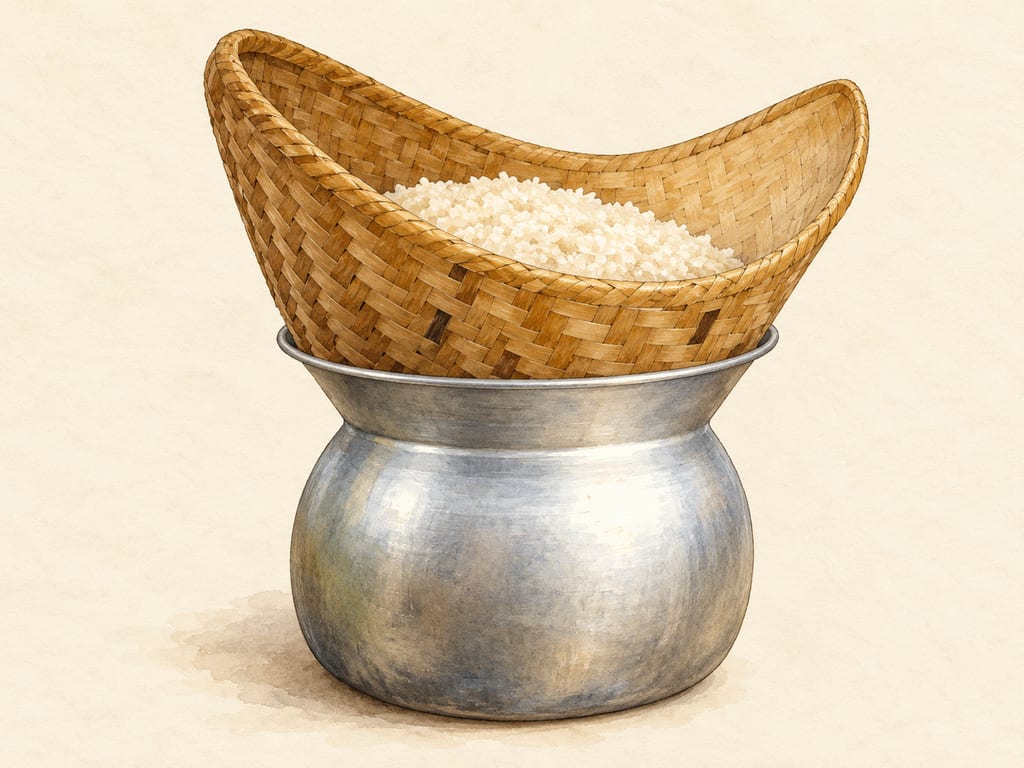
Huad
A woven upper basket used to steam Lao glutinous rice over a separate water pot. It holds the drained rice above the water; a different lidded basket, the katip khao, is used to carry and serve the cooked rice.
 FermenteaWhere food goes to change
Equipment · Bamboo, leaf and wraps
A cleaned bamboo internode holds compressed steamed tea leaves during the Luar miang fermentation practiced in north-western Laos.
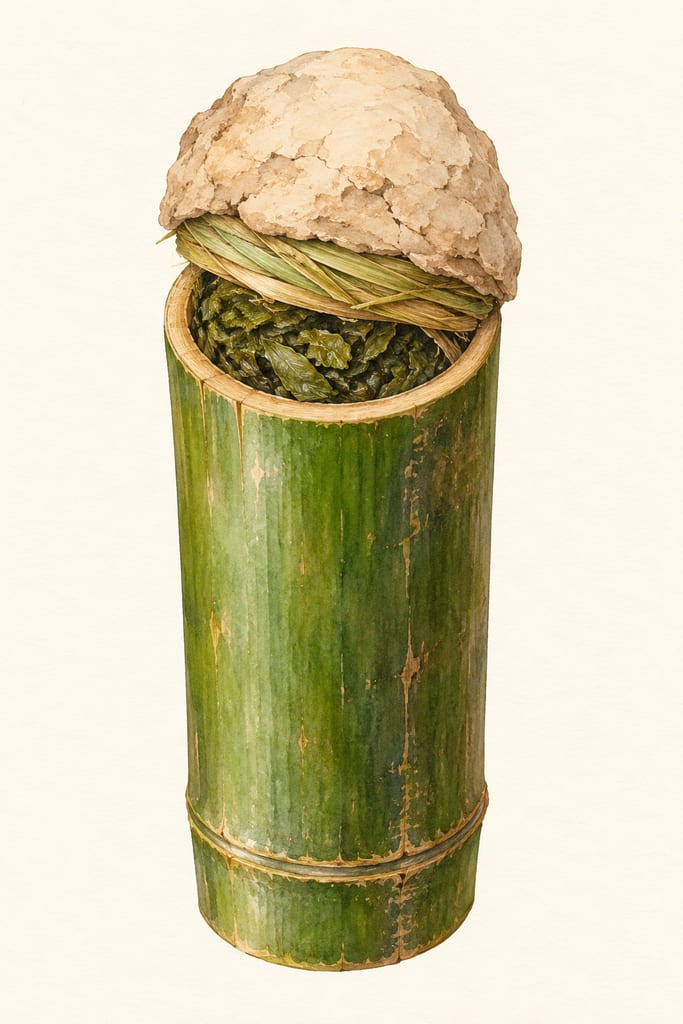
A Luar miang bamboo tube is a portable vessel made from a cleaned bamboo internode, used to hold compressed steamed Assam-tea leaves for underground fermentation. The tube is equipment; the soil cavity that receives it is a separate site-made structure. The 2024 study’s methods identify the bamboo as Dendrocalamus hamiltonii, but Figure 1 labels the tube Oxytenanthera parviflora. Because those parts of the paper disagree, this page treats it simply as a bamboo internode. The source gives neither a capacity nor external dimensions, so the tube should not be imagined as a standard-sized container.
The documented method begins by steaming bundled young tea leaves for 90 minutes and cooling them overnight. The leaves are then pressed tightly into a cleaned hollow bamboo section. A triple layer of broom grass closes the opening, and a clay layer 2–3 cm thick seals it. The sealed vessel is placed in a soil cavity and covered with soil. This sequence makes the tube part of a larger fermentation arrangement: the bamboo is carried to the site, while the cavity is dug where it stands and belongs to a separate build record. The paper’s Figure 1 gives a burial depth of 15–20 cm; its methods paragraph does not state a depth. That disagreement does not support a general depth specification.
The internode is a hollow vessel that keeps tightly packed leaves together; the grass and clay closure cap its open end before burial. Measurements of capacity, wall thickness, gas exchange and thermal behaviour are not established here, so the tube’s role can be described without assigning it a technical performance. During the five-week preparation, sampling at weeks 0, 1, 3 and 5 let researchers compare the leaves as fermentation progressed. Those observations concern the fermented tea and this particular method; they do not show that bamboo alone creates a specific flavour or guarantees a safe result.
The vessel is associated with Luar miang preparation documented at a production site in Saysathan district, Xayaboury province, Lao PDR. Miang belongs to a wider edible-tea tradition across northern Thailand and north-western Laos, but that regional history does not date this particular tube form. The method is described as traditional, yet its earliest attestation and wider distribution are not established. In the monitored preparation, the first-week sample contained detectable coliform bacteria, while later samples were below the detection limit. Those results apply to the studied samples and do not validate other tubes or batches.
A 2024 study documents this traditional Luar method at one production site but does not date the origin of the bamboo-tube practice.
The study detected coliform bacteria in a first-week sample; later non-detection in that study does not validate other batches or methods.
Hazard sourceThe study’s later below-detection results apply to its monitored preparation and do not establish safety for other batches.
The study reports no vessel capacity, dimensions, wall thickness, or measured thermal behaviour.
Source →Figure 1 labels the bamboo Oxytenanthera parviflora, while the methods paragraph says Dendrocalamus hamiltonii; the paper does not resolve the mismatch.
Source →The paper identifies a Luar miang production site in Saysathan district. It does not establish where the tube form originated.
A woven upper basket used to steam Lao glutinous rice over a separate water pot. It holds the drained rice above the water; a different lidded basket, the katip khao, is used to carry and serve the cooked rice.
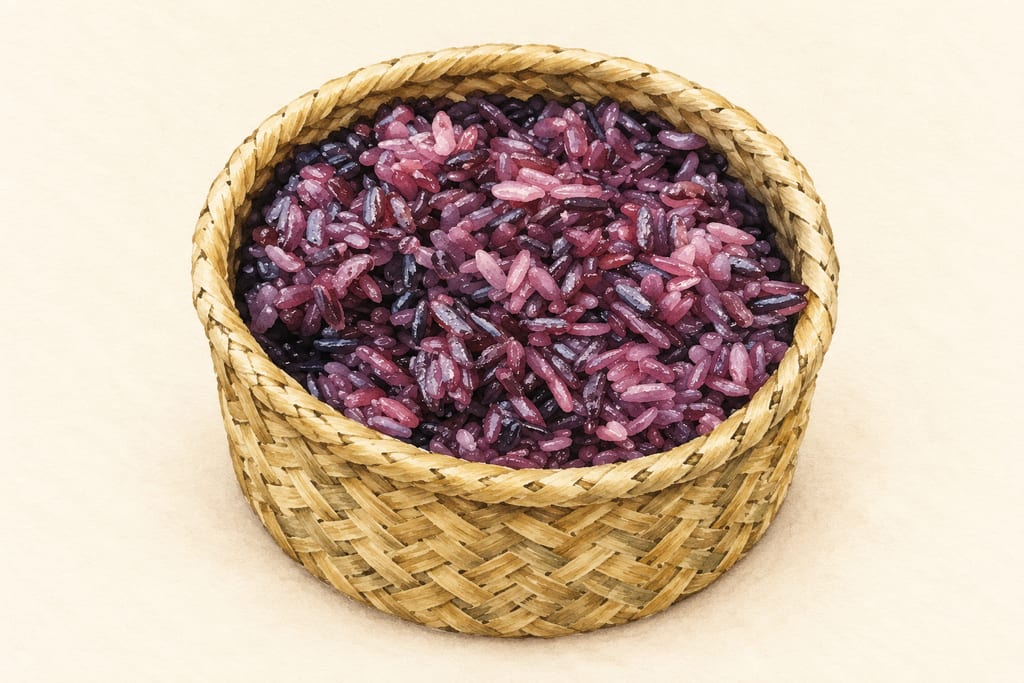
A lidded woven bamboo or rattan basket used in Laos to hold steamed sticky rice and keep it warm and soft for serving.
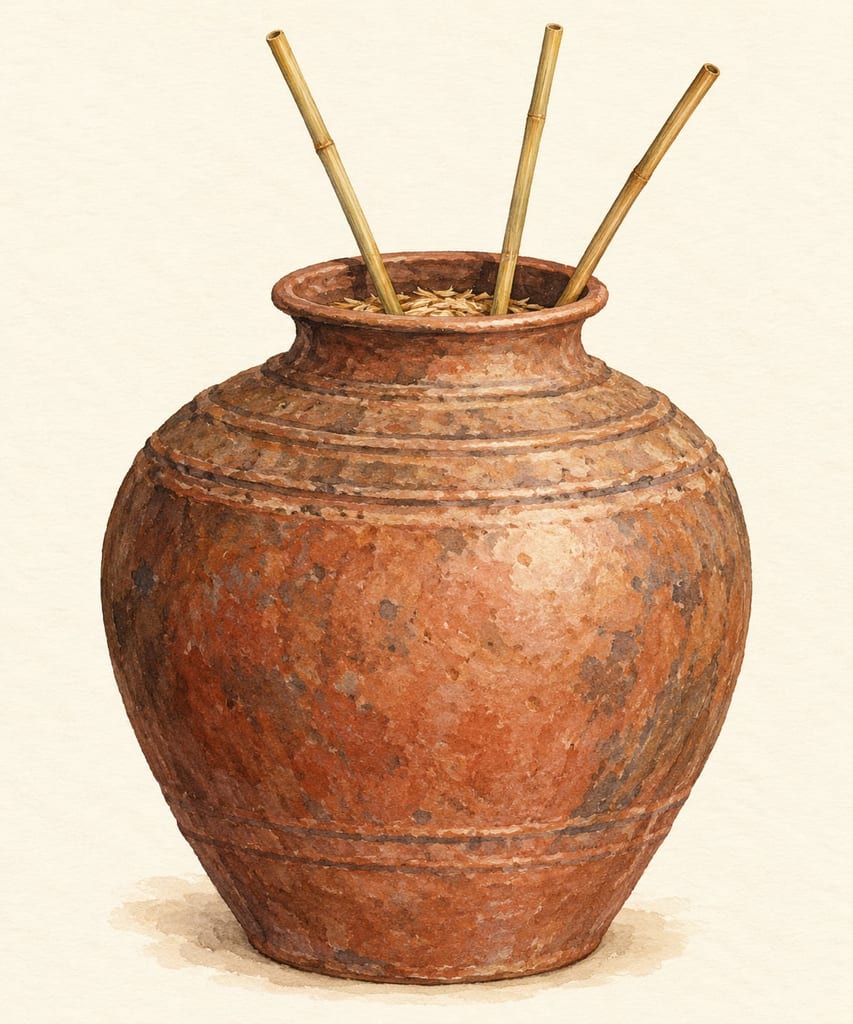
A large earthenware jar in which lao hai ferments and from which it is shared through long reeds. In northern Laos, documented communities include Kmhmu’, Hmong and Tai groups; the jar does both fermentation and table service.
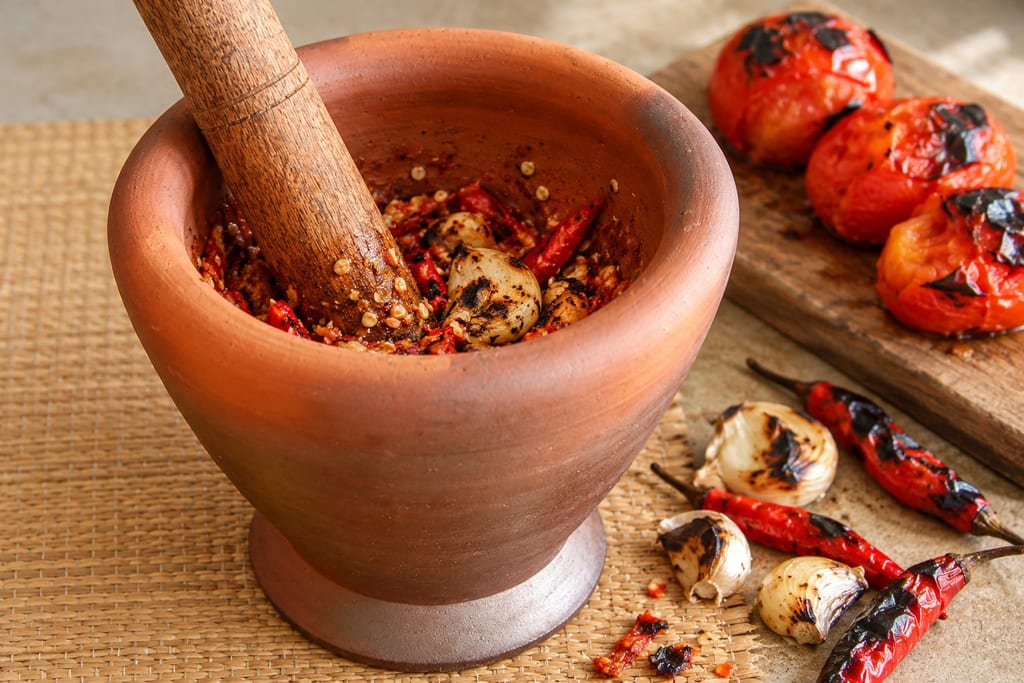
A mortar and pestle pairs a hollow bowl with a hand-held striker; Lao kitchens and Malay and Singaporean sambal traditions show how pounding shapes sauces and spice pastes.
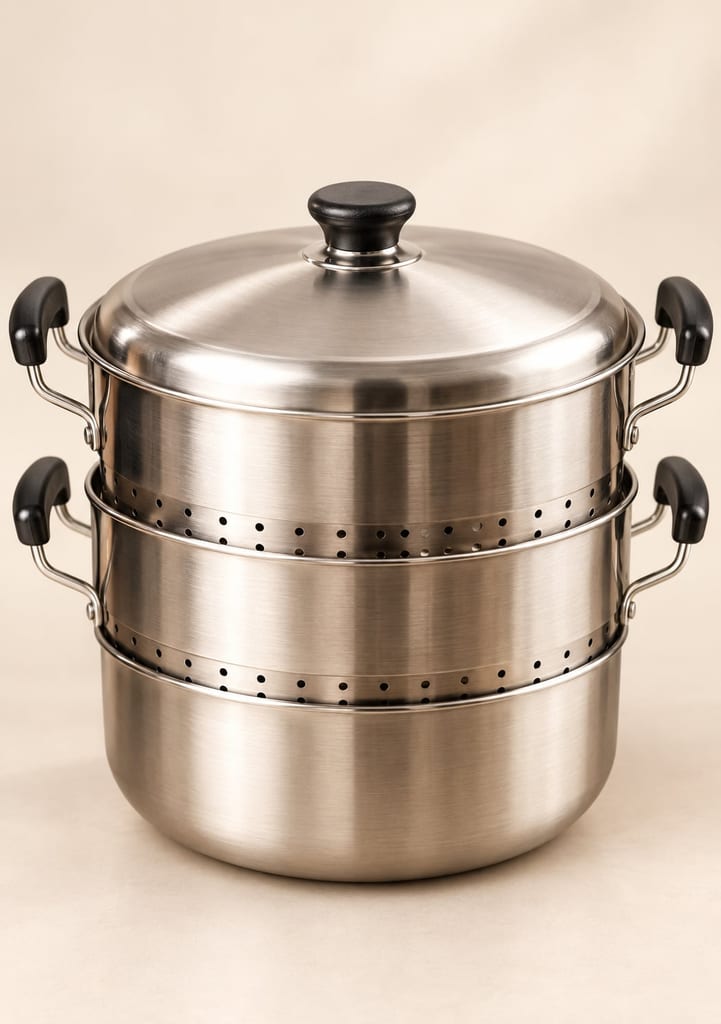
A steamer cooks food above heated water under a cover. The broad term includes improvised pot-and-rack setups, metal tiers and basket steamers; individual forms have different designs and uses.
No community contributions have been published for this entry yet.
Sign in to contribute. Published comments and photos are free to read.
Foods (MDPI)Description · Method · History · Safety
Microbial Population and Physicochemical Properties of Miang Fermented in Bamboo Tubes by the Luar Ethnic Group in Lao PDRDocuments a traditional Luar Miang method at a production site in Saysathan district, Xayaboury province, Lao PDR.
Methods section identifies cleaned Dendrocalamus hamiltonii internodes as vessels; Figure 1 instead captions Oxytenanthera parviflora and states a soil depth of 15–20 cm, while the methods paragraph gives no depth.
Documents tightly packed steamed leaves, a triple-layer broom-grass closure, a 2–3 cm clay seal, and burial in a soil cavity; the vessel capacity and dimensions are not given.
Reports an observed microbial and chemical course in one monitored preparation; the study does not establish a universal safety validation or date the practice's origin.
Cited in: A portable tube in a buried fermentation; How the vessel is closed and used; A documented place, with limits on what can be dated