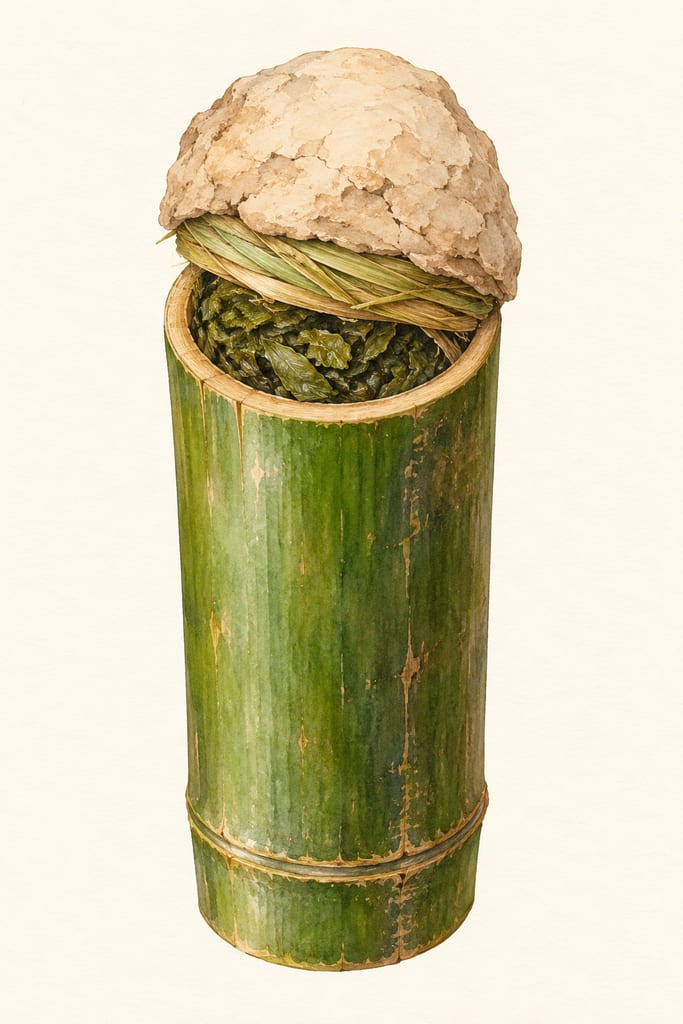
Buried bamboo tube (Luar miang)
A cleaned bamboo internode holds compressed steamed tea leaves during the Luar miang fermentation practiced in north-western Laos.
 FermenteaWhere food goes to change
Equipment · Jars, pots and crocks
ເຫຼົ້າໄຫ · communal straw-drinking jar · hai
A large earthenware jar in which lao hai ferments and from which it is shared through long reeds. In northern Laos, documented communities include Kmhmu’, Hmong and Tai groups; the jar does both fermentation and table service.
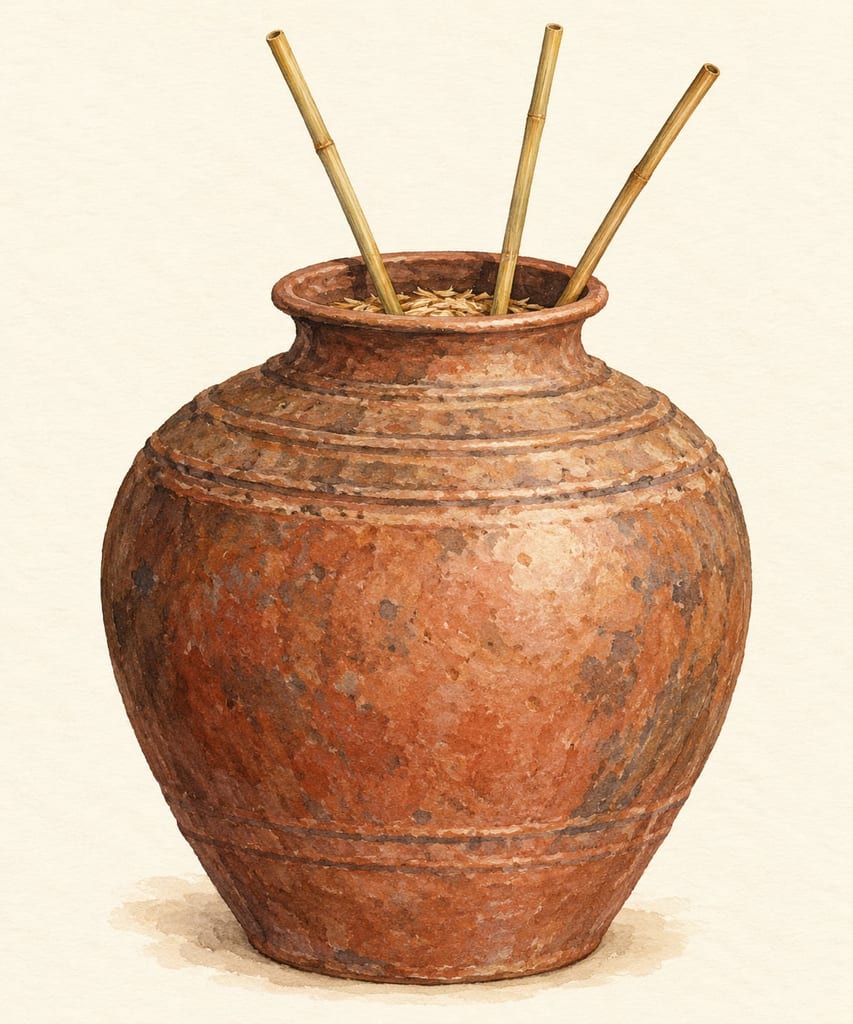
Lao hai is a rice wine whose name is often translated as “jar alcohol.” Here the jar is not just storage: the fermented grain sits in it, then the same vessel becomes the place from which the drink is drawn. A northern Laos guide describes cooked, soaked sticky rice mixed with rice husk or bran and a powdered starter. After several preliminary stages, the mash is transferred into large pottery jars for a further fermentation; the book reports seven to fourteen days before drinking and says a longer wait is also used as the beverage develops.
Those timings describe the method reported in that book, not a universal schedule for every household. The sources inspected do not specify the starter’s composition, a jar capacity, a controlled temperature, or a single end point for fermentation. The vessel should therefore be understood as a container in a local process rather than a standardized fermenter with a fixed size or specification.
At the table, drinkers use long reed straws directly from the jar. The account describes two people sipping at once; after they finish, water is added and the jar is passed to another pair. A stick may be used to mix the contents. This makes the vessel both the fermentation chamber and a shared serving vessel, with the rice solids and liquid remaining together as water draws more drink from the mash.
The same book notes that plastic tubing has sometimes replaced reeds. That is a documented change in serving practice, not proof that plastic is standard or that a specific tubing material is appropriate for every setting. It also cautions that some village water added to the jar may be untreated. That observation is context-specific; it is not a controlled water-safety assessment. Water used for drinking should be safe to drink.
The regional cookbook places lao hai among communal and special occasions for Kmhmu’, Hmong and Tai Dam, Tai Daeng and Tai Neua communities. It identifies one photograph as drinking in an upland Kmhmu’ village in Nalae District. The book’s account is specific to the settings it documents: it should not be taken to mean that every named community uses identical jars, starter, rice or service customs.
A separately licensed 2013 photograph shows a Brao woman adding rice husk to a jar of rice wine at home. Brao is not the Kmhmu’ identity named in the Nalae caption, so the image is presented as another Lao household example of the jar’s working role, not as a portrait of the same community or a single pan-Lao design.
The book calls for large pottery jars, and the inspected photograph shows a rounded earthenware vessel in use. Neither establishes a standard profile, wall thickness, clay source, glaze, firing practice, lid, capacity, or jar maker. No cited source here gives a cleaning, seasoning, repair or storage routine for the empty vessel. These are maker- and household-specific details and should not be filled in by borrowing instructions from another jar tradition.
The earliest inspected publication describing this vessel’s use is the 2010 book, and the Commons photograph is dated 2013. Neither gives an origin date for the Lao hai jar form. This equipment page also does not treat the archaeological Plain of Jars as evidence for the history of these functional fermentation vessels.
Dorothy Culloty’s 2010 regional cookbook documents large pottery jars for lao hai, including a caption locating its drinking photograph in an upland Kmhmu’ village in Nalae District. A separate 2013 Commons photograph shows a Brao woman adding rice husk to a fermenting lao hai jar at home. Neither source dates the jar form’s origin.
A caption identifies lao hai drinking in an upland Kmhmu’ village in Nalae District; it does not identify every lao hai jar as originating there.
The guide associates communal lao hai with Kmhmu’, Hmong and named Tai communities; the record does not imply a single shared vessel design.
A cleaned bamboo internode holds compressed steamed tea leaves during the Luar miang fermentation practiced in north-western Laos.
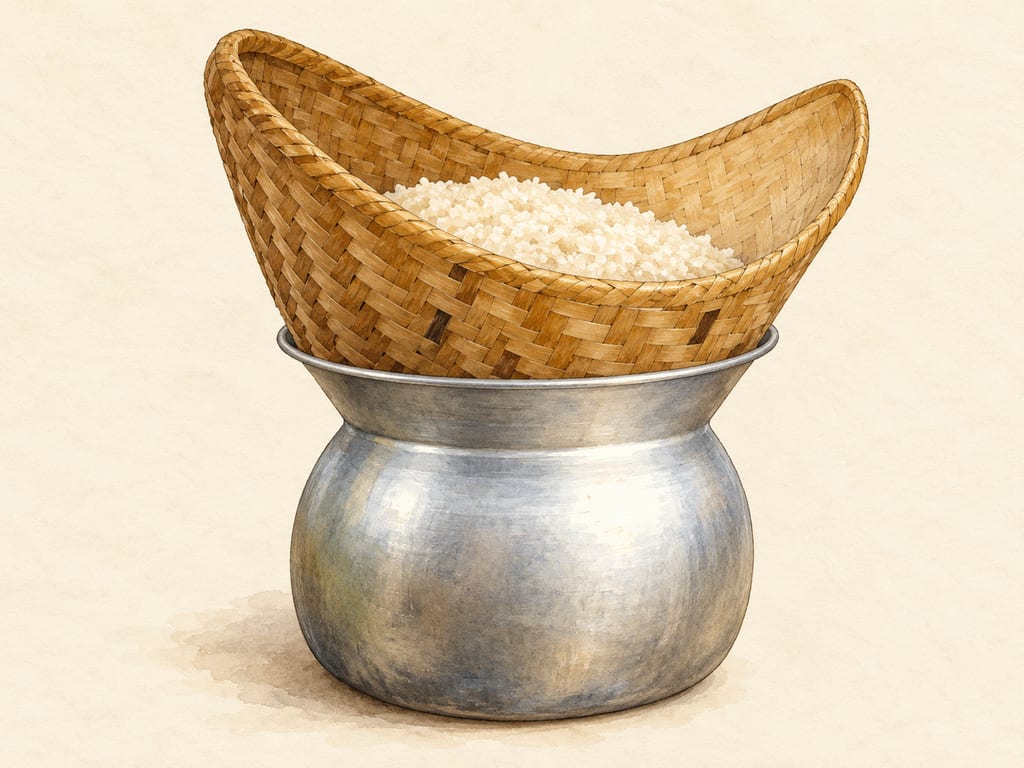
A woven upper basket used to steam Lao glutinous rice over a separate water pot. It holds the drained rice above the water; a different lidded basket, the katip khao, is used to carry and serve the cooked rice.
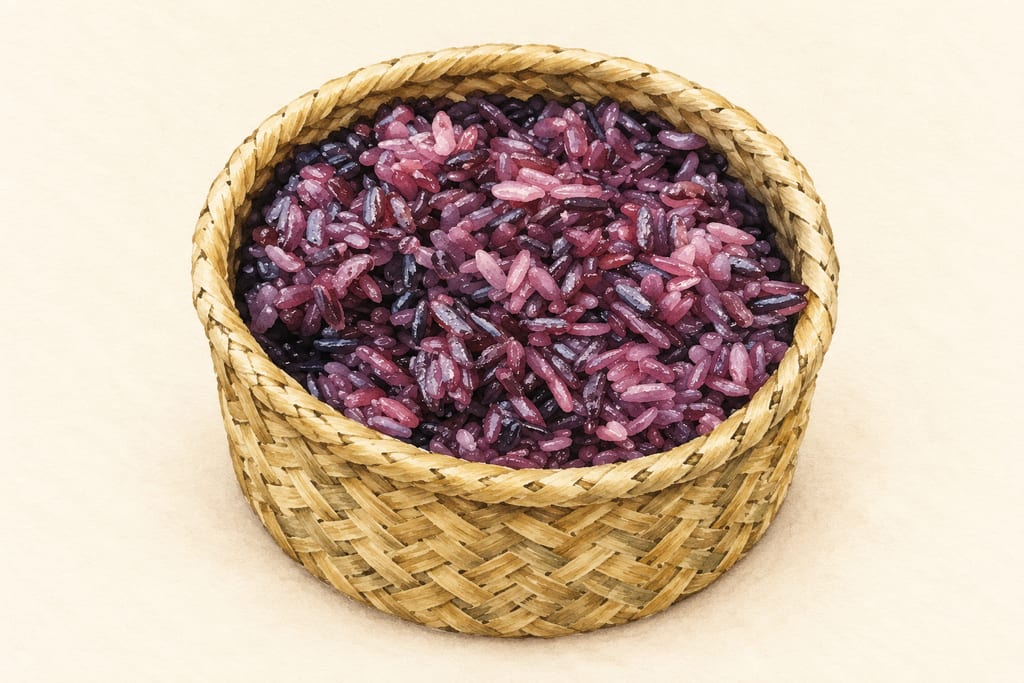
A lidded woven bamboo or rattan basket used in Laos to hold steamed sticky rice and keep it warm and soft for serving.
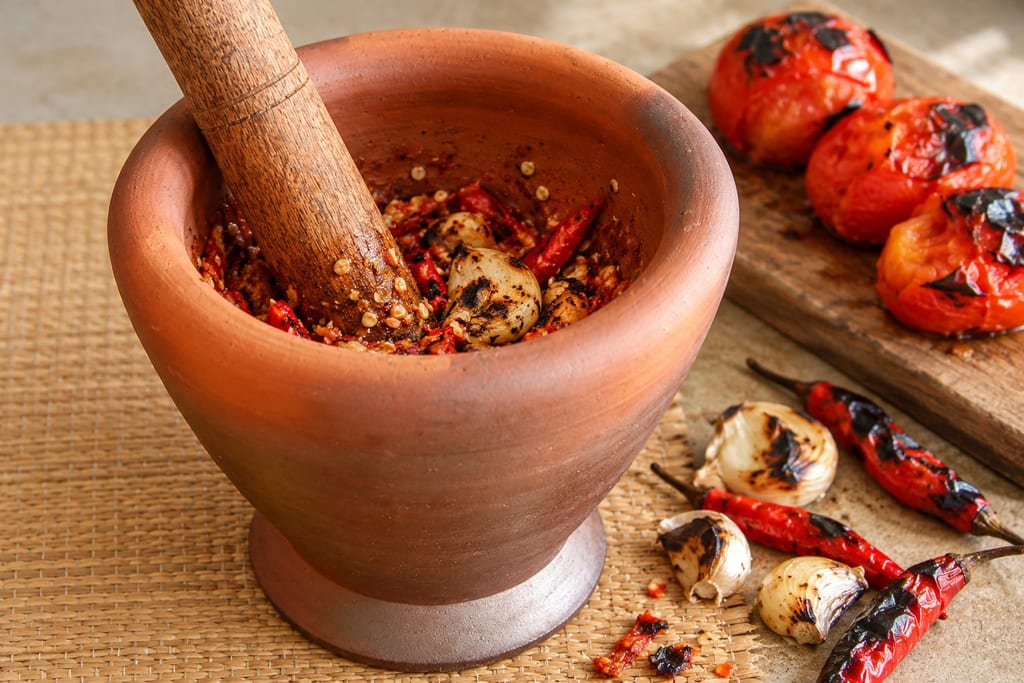
A mortar and pestle pairs a hollow bowl with a hand-held striker; Lao kitchens and Malay and Singaporean sambal traditions show how pounding shapes sauces and spice pastes.
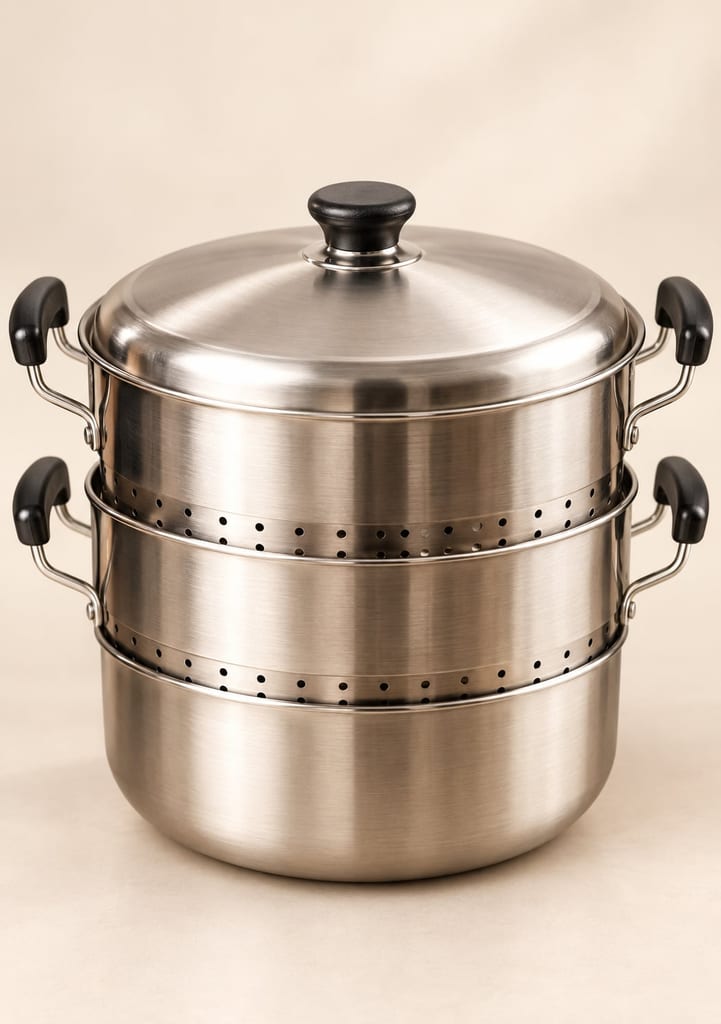
A steamer cooks food above heated water under a cover. The broad term includes improvised pot-and-rack setups, metal tiers and basket steamers; individual forms have different designs and uses.

Soft, spreadable Calabrian pork sausage made with a great deal of red chilli and fatty pork, stuffed into natural casings, sometimes smoked and matured while staying soft.

A way to add independent temperature logging to an existing food dehydrator without changing its built-in controls or protections. It is a monitoring method, not a rewiring plan.

Pleurotus cystidiosus is the abalone mushroom, a cultivated oyster-type fungus with dark brown caps that grows more slowly and is more demanding than other Pleurotus species.

A dark, balanced vinegar from Emilia-Romagna made by combining cooked or concentrated grape must with wine vinegar, then acetifying and refining it in wood under a protected specification.

A living dairy inoculum that starts controlled cream fermentation, developing acidity and aroma before sour cream or cultured butter is finished.

A small electric incubator holds jars at a selected temperature for yogurt and other documented warm food preparations. Controls, capacity and vessel arrangement vary by model.

Adygean salt is a seasoned table salt associated with Adygea and the wider North Caucasian culinary tradition. Salt is blended with garlic and a variable selection of herbs and spices; the exact mix depends on the named style and maker.

The African Caesar-group mushroom, Amanita masasiensis, is a wild ectomycorrhizal species of central and southern African woodlands, eaten locally. The genus contains deadly poisonous species, so identification needs care.
No community contributions have been published for this entry yet.
Sign in to contribute. Published comments and photos are free to read.
Galangal PressMethod · Form · Geography · Use
Food from Northern Laos: The Boat Landing CookbookThe 2010 book describes lao hai as a fermented sticky-rice beverage made with rice husk or bran and powdered starter. After several preparation stages, the mixture is transferred to large pottery jars for a further fermentation period; the text reports seven to fourteen days before drinking and says longer maturation is recommended.
The book says long reed straws are used to drink directly from the jar, that water is added as it is shared, and that some accounts include stirring with a stick. It names Kmhmu’, Hmong and Tai Dam, Tai Daeng and Tai Neua communities, and captions a photograph of lao hai drinking in an upland Kmhmu’ village in Nalae District. It cautions that some village water added during use may be untreated.
Cited in: One jar, two stages; Fermenting becomes serving; A northern Lao practice with more than one community; What the sources leave open
Wikimedia CommonsImage · Form · Use
Brao woman making rice wine in a jarThe page identifies this as a 2013 own-work photograph of a Brao woman adding rice husk mixed with rice that has begun fermenting to a traditional lao hai jar in her home. It is a specific Brao example, not a photograph of the Kmhmu’ community named in the book. The file is licensed CC BY-SA 3.0.
Cited in: A northern Lao practice with more than one community; What the sources leave open