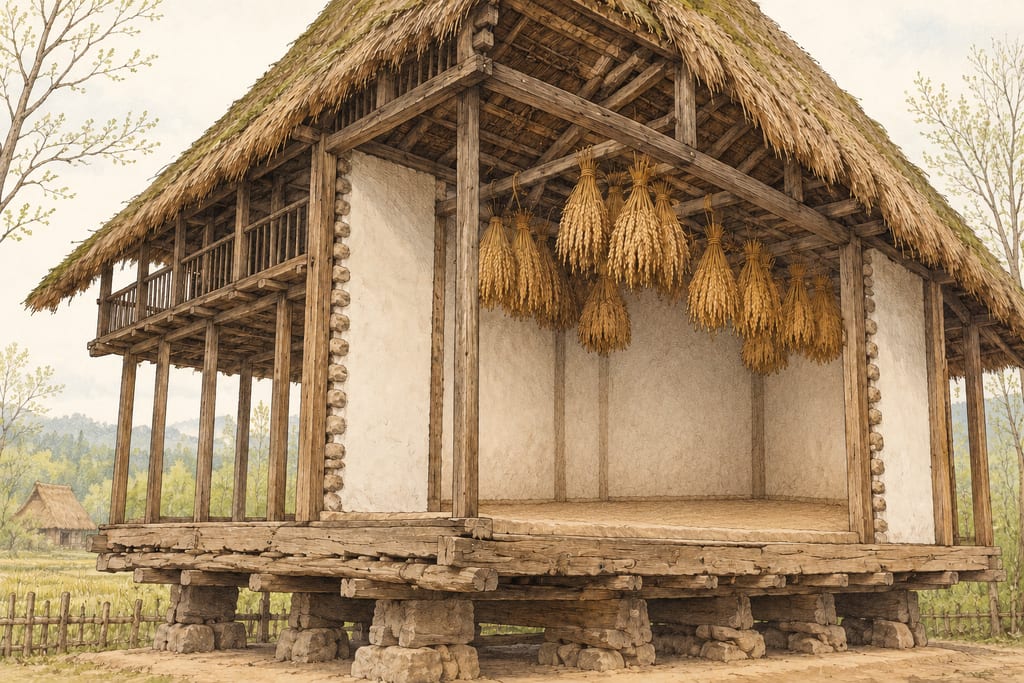
Bojkhāne
Bojkhāne names a rice-smoking room in some Gilan accounts. It was part of a flexible household room tradition, not a single standardized plan.
 FermenteaWhere food goes to change
Built structures · Smokehouses and smoke rooms
Dudkhāneh is a smokehouse term used in Gilan. A field report documents one fish-smoking workshop at Mobandan; its mud-plastered room and thatched roof are one local example, not a universal plan.
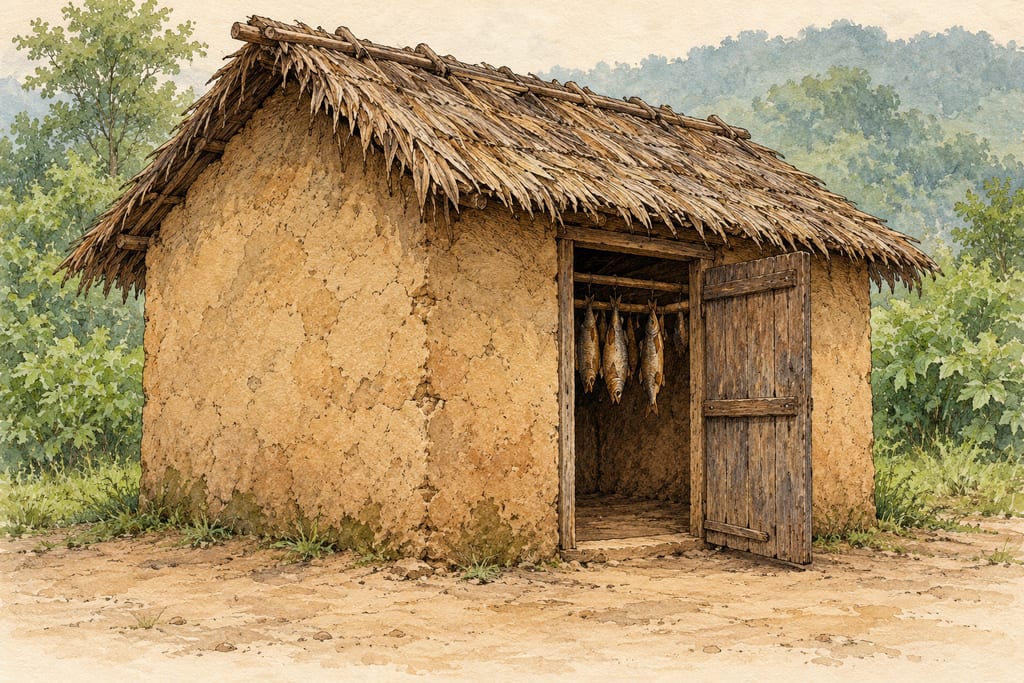
Dudkhāneh (دودخانه, literally a smokehouse) is a local name used for a smoke room or smokehouse. In Gilan, fish smoking belongs to the region’s wider preservation culture, but it should not be confused with the household rooms used to dry rice. Encyclopaedia Iranica notes both rice smoking and fish preservation in Gilan; the room arrangements differ by purpose and account.
The clearest building-specific account here is one family workshop visited in Mobandan, near Langarud. A 2022 field report records a dark, earthen-plastered smoke room with a roof covered in gāli, a plant thatch, and old wooden doors. That description records one place and one installation. It does not define every Gilan smokehouse or give a standard architectural plan.
The Mobandan workshop was more than a single smoking room. The report separates areas for fish preparation and brining, open-air drying, smoking, cold storage and packing. The sequence matters for understanding the building: fish were prepared and salted before they reached the smoke room, then dried in moving air before smoking. The chamber was one stage in a wider family workshop, not a household cooking room.
At this workshop fish hang on wooden rods inside the room and alder sawdust is the named smoke source. The report does not locate a firebox or specify airflow, chamber measurements, fuel quantities or an operating temperature. Those gaps prevent a reconstruction of the working interior from this account alone.
The term refers to smokehouses, not to one fixed structure. A 2021 study sampled seven fish smokehouses in northern Iran, but its published abstract reports energy and economic analysis rather than building design. It confirms that regional facilities are not represented by one photographed room; it cannot be used to fill in a shared floor plan or construction material list.
A 2025 Mehr News photograph from Gilan shows a contemporary smokehouse exterior clad in corrugated metal. Its visible modern panels are useful context for present-day adaptation, but they are not a substitute for the earthen plaster, plant-thatch roof and timber doors recorded at Mobandan. The two records document different examples, and this page keeps them distinct.
The Mobandan report does not establish when the dudkhāneh form began, how common that roof and wall combination was, or how the room was built. The regional study does not provide an architectural plan. No source consulted here supplies standard dimensions, a specific foundation, a firebox design, cleaning instructions, validated smoke-exposure limits or a food-safety endpoint. This is a descriptive record of a named regional structure and one reported workshop, not a construction or smoking guide.
A 2022 field report records one Mobandan family workshop and its separate preparation, drying, smoking and cold-storage spaces. Encyclopaedia Iranica describes smoke as a fish-preservation method in Gilan; a 2021 study sampled seven regional smokehouses. None establishes an earliest date or one standard form.
A build is made where it stands: moving it means building it again.
Country-level context for Gilan smoked-fish workshops.
Regional practice and facilities; no single shared building design is claimed.
One family workshop visited in a 2022 report, not a claim about every Gilan smokehouse.
Bojkhāne names a rice-smoking room in some Gilan accounts. It was part of a flexible household room tradition, not a single standardized plan.
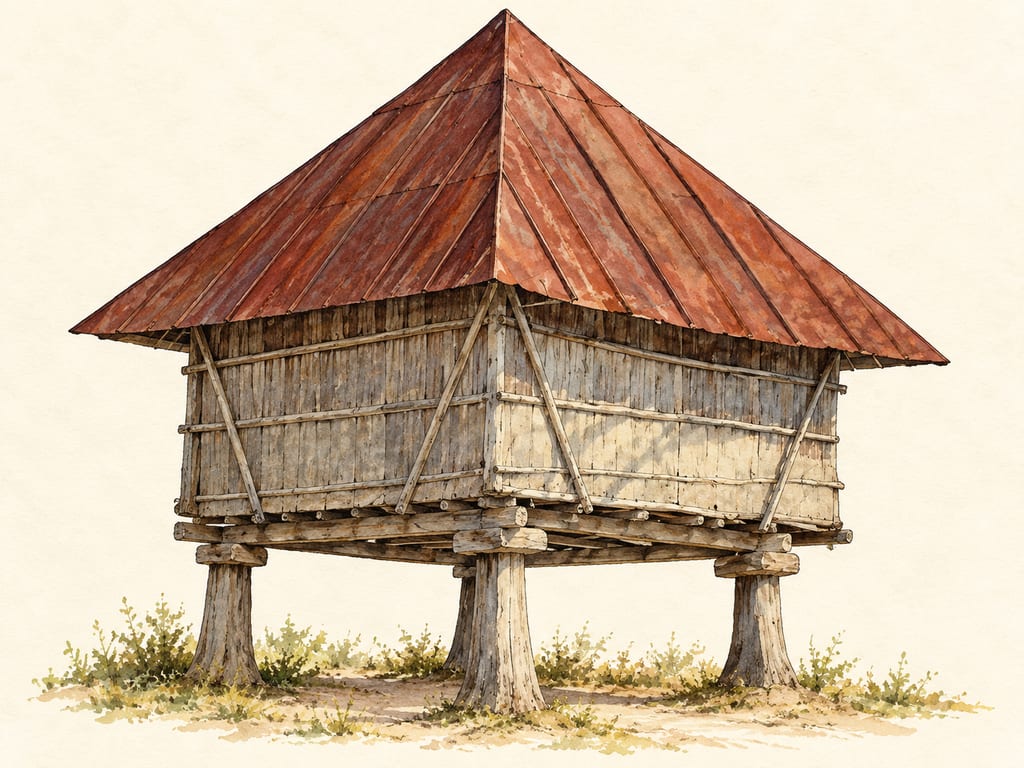
A kundej is a raised rice barn documented in central and eastern Gilan, Iran. Its regional forms store harvested sheaves above damp ground while ventilation helps dry them.
No community contributions have been published for this entry yet.
Sign in to contribute. Published comments and photos are free to read.
Maryam Varsho, Hamshahri OnlineField report · Architecture · Process · Geography
ببینید | سفر به دودخانهای که طعم ماهی دودیاش را چشیدهایدA 2022 report describes a family fish-smoking workshop at Mobandan near Langarud in Gilan.
The reporter distinguishes brining, drying, smoke-room, cold-storage and packing areas.
The reported smoke room has earthen plaster, a gāli-covered roof and old timber doors; the report names alder sawdust as the smoke source.
The report presents one observed workshop, not a universal plan, measured room design or validated process.
Cited in: What a dudkhāneh is; A workshop with several spaces; A regional practice with different building forms; What the evidence does not establish
Encyclopaedia IranicaRegional context · Preservation
GILĀN xxi. CookingSmoke is used in Gilan fisheries to preserve fish, while salting is described as more traditional.
Supports the regional context and distinction between smoked and salted fish; not a smokehouse building specification.
Cited in: What a dudkhāneh is
Environmental Science and Pollution Research, Springer NatureRegional production · Contemporary facilities
Evaluating the energy use, economic and environmental sustainability for smoked fish production from life cycle assessment point of view (case study: Guilan Province, Iran)The study collected production data from seven smokehouses in northern Iran through face-to-face questionnaires.
It analyzes regional smoked-fish production and energy inputs, not architectural form or a traditional construction standard.
Cited in: A regional practice with different building forms; What the evidence does not establish
Wikimedia Commons / Mehr News AgencyImage reference · Contemporary form
The tradition of smoking fish in Gilan 13 (Mehr, 2025).jpgThe 2025 photograph shows a contemporary local smokehouse exterior with corrugated metal panels; it is a different, modern example, not evidence for the older Mobandan materials.
Wikimedia Commons records the photograph as CC BY 4.0; attribute Saeed Nikpour and Mehr News Agency.
Cited in: A regional practice with different building forms
Encyclopaedia IranicaRegional context · Comparison
GILĀN xviii. Rural Production TechniquesSmoke has several uses in humid Gilan, including drying rice and preserving fish.
The article discusses rice smoke rooms as a separate household use; it does not identify those rice rooms as fish smokehouses.
Cited in: What a dudkhāneh is