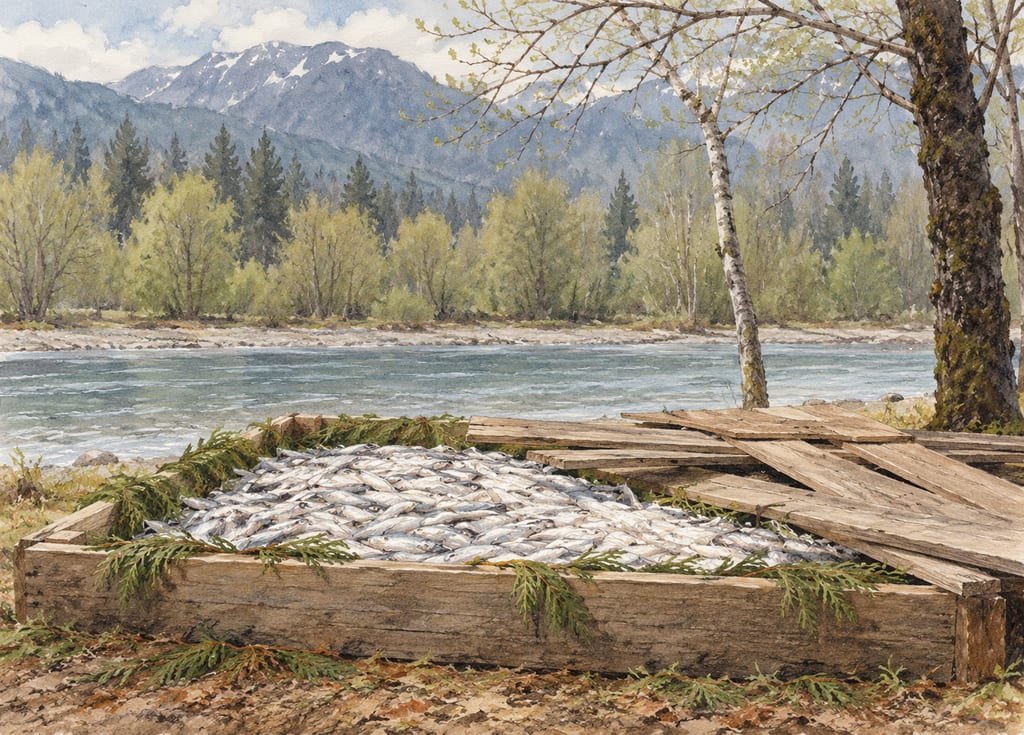
Nuxalk eulachon ripening bin
A 2022 study describes Nuxalk families using large, covered cedar-plank bins lined with western redcedar boughs to ripen eulachon beside the river. The later grease-rendering box is a separate structure.
 FermenteaWhere food goes to change
Equipment · Kettles, coppers and boilers
A separate cooking box heats ripened eulachon so grease rises for skimming. Nuxalk sources describe wooden or cedar sides, a metal bottom and, in one setup, a fire trench beneath the box.
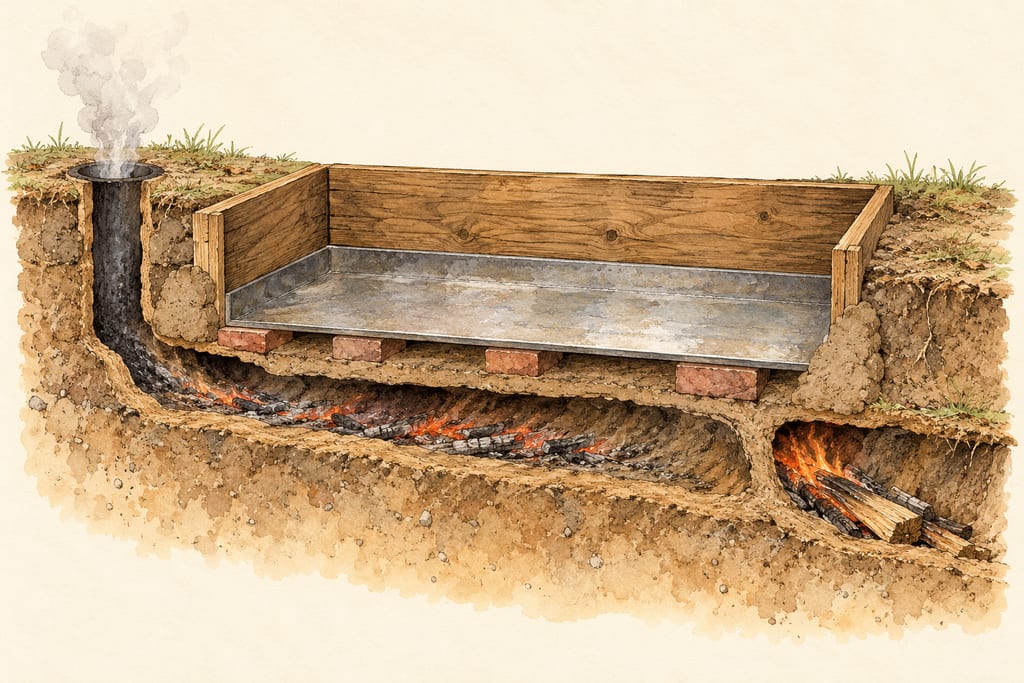
This box is the heat-rendering vessel in a Nuxalk eulachon-grease process. It is not the separate cedar-plank ripening bin, sometimes called the stink box. Kuhnlein and Chotiboriboon describe spring-caught eulachon ripening in that bin, then being moved to a second box with a metal floor. Water in the cooking box is brought to a gentle simmer; as the ripened fish is heated, rendered oil rises to the surface for skimming. The sequence separates ripening from cooking and grease extraction.
A Nuxalk community account calls the finished grease sluq’ and the fish sputc. It describes a cook box heated either by hot rocks or by a controlled fire beneath the metal bottom. These terms name the grease and fish; the sources do not supply a distinct Nuxalk-language name for the box itself.
A common documented form is a large rectangular wooden box with a metal bottom. Moody’s 2008 thesis reports that ten of fourteen interviewed cooks described common boxes as about four feet wide, eight feet long and three to four feet deep; all fourteen said the bottom was metal. These are interview-reported common dimensions, not a universal pattern or a precise measured specimen. The sources do not identify the metal alloy or consistently specify the cooking box’s wood species.
The thesis distinguishes the box from its support: the cooking box sat beside the ripening bin on bricks and clay, with clay around its wooden parts. Beneath it was a dirt trench for the fire, with a chimney at one end and access to the fire at the other. Those in-place hearth features are a separate build; they are not part of the movable box described by this equipment record.
The documented account concerns Nuxalk grease camps along the Bella Coola River in British Columbia. The thesis draws on interviews with fourteen cooks; the 2022 article describes the process while noting family-specific preferences. Neither source establishes a single standard for every family or for all Northwest Coast eulachon grease practices.
The 2022 study reports hundreds of litres of grease from one box in a family process, but that output is not the cooking box’s capacity. No source gives its water volume, an exact universal dimension, repair method, safe fire design or validated food-processing controls. The open-fire description is historical and descriptive, not a construction or home-processing guide. The sources do not date the box’s origin, so its first attestation remains unknown.
The sources document Nuxalk grease-making through interviews conducted in 2006, a 2008 thesis and later community and research accounts. They do not date the first use or origin of the separate cooking box.
The thesis describes a trench fire beneath the metal floor, with brick and clay around the wooden parts.
Hazard sourceThe sources describe heating water and skimming rendered grease from the cooking box.
Hazard sourceThis historical and community-based description is not a safe construction or food-processing procedure.
The grease yield reported from one box is not a measurement of the box's capacity; no water volume or vessel capacity is established.
Source →The 4 × 8 × 3–4 ft dimensions are a common form reported by 10 of 14 interviewed cooks, not a single measured standard for all boxes.
Source →The wooden cooking box is distinct from the in-place brick-and-clay support and fire trench described in the thesis; this page does not treat that hearth as part of the box.
Source →Sources describe a large fire-heated process but do not give validated construction or safe-use controls; this descriptive record is not a household procedure.
Source →The cited material places this documented process in Nuxalk community practice along the Bella Coola River; it does not claim exclusive use or a wider region.
A 2022 study describes Nuxalk families using large, covered cedar-plank bins lined with western redcedar boughs to ripen eulachon beside the river. The later grease-rendering box is a separate structure.
A probe thermometer measures the temperature of food at its sensing tip. It answers a different question from a kettle, oven or water-bath display, and from a pH meter.
A steam oven cooks with water vapour; a combi oven pairs steam with circulating dry heat. Their modes and temperature controls differ by model, so a documented yogurt programme cannot be assumed for every oven.
No community contributions have been published for this entry yet.
Sign in to contribute. Published comments and photos are free to read.
Frontiers in Sustainable Food SystemsProcess · Geography · Image attribution · History
Why and How to Strengthen Indigenous Peoples’ Food Systems With Examples From Two Unique Indigenous CommunitiesThe Nuxalk account describes eulachon caught in spring, ripened in a separate cedar-plank bin lined with redcedar boughs, then transferred to a second box with a metal floor over a fire; hot water is simmered and the rendered oil rises for skimming.
The article distinguishes ripening from heat rendering and states that process details vary by family.
Figure 4 is captioned “Skimming eulachon grease from the surface of the cooking bin, Nuxalk Nation”; the article is CC BY.
Cited in: A cooking box, after ripening; Place, practice and limits
University of British ColumbiaForm · Materials · Dimensions · Process · Geography
Eulachon past and presentBased on Nuxalk interviews conducted in 2006, the thesis describes a separate cooking box situated beside the stink box on bricks and clay; clay surrounds wooden parts, and a dirt trench below holds the fire with a chimney at one end and open fire access at the other.
Ten of fourteen interviewed cooks reported boxes commonly about 4 ft wide, 8 ft long and 3–4 ft deep; all fourteen said the bottom was metal. These are interview-reported common dimensions, not a universal specification.
The box is filled partly with water and heated before ripened eulachon are transferred; cooking and skimming follow. The thesis does not make a household-safe construction guide.
Cited in: Box and hearth are different things; Place, practice and limits
Nuxalk Territory: Weaving Stories and PlaceCommunity terminology · Process · Geography
Sluq’ (eulachon grease)The page describes sluq’ as eulachon grease and sputc as eulachon, and says large cedar boxes at sluq’ camps include a separate stink box and cook box.
It describes two cook-box heating options: hot rocks or a controlled fire under the metal bottom.
This page identifies the grease product name, not a distinct Nuxalk-language name for the rendering box.
Cited in: A cooking box, after ripening; Box and hearth are different things; Place, practice and limits