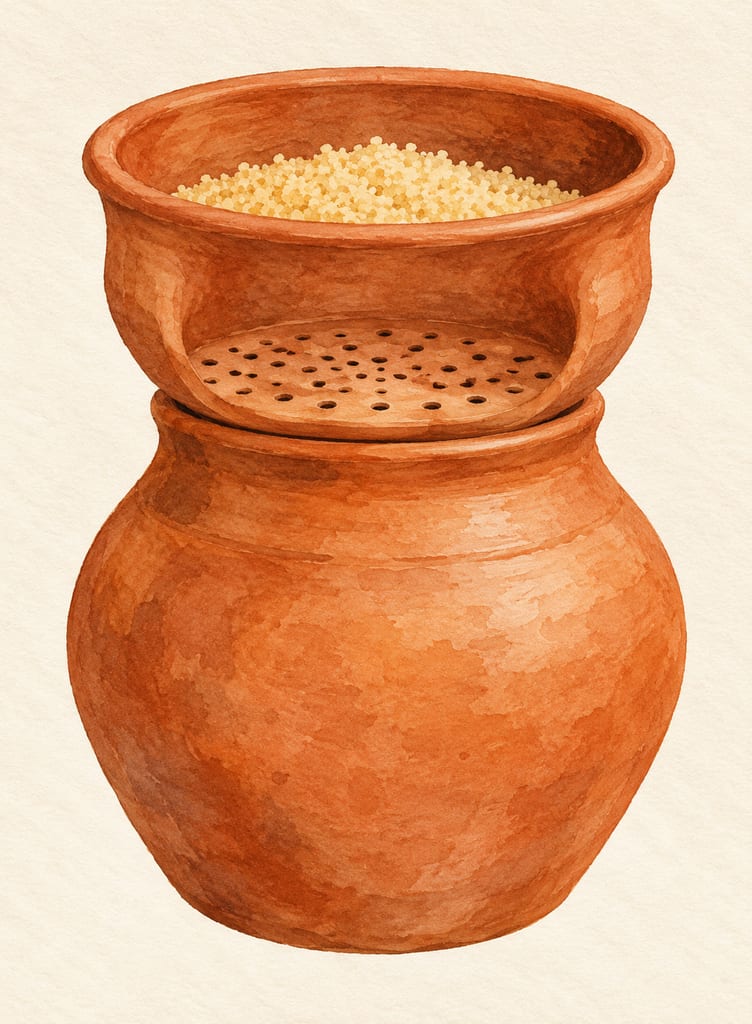
Couscous steamer
A two-part steamer for couscous: a perforated upper chamber sits over a lower pot that produces steam. Clay, basketry and metal forms are documented in different places and periods.
 FermenteaWhere food goes to change
Equipment · Jars, pots and crocks
Ezir is the earthenware jar used in northeastern Algeria to ripen Khliaa ezir, a cooked meat kept in olive oil and rendered fat. Its standard shape, capacity and construction are not documented.
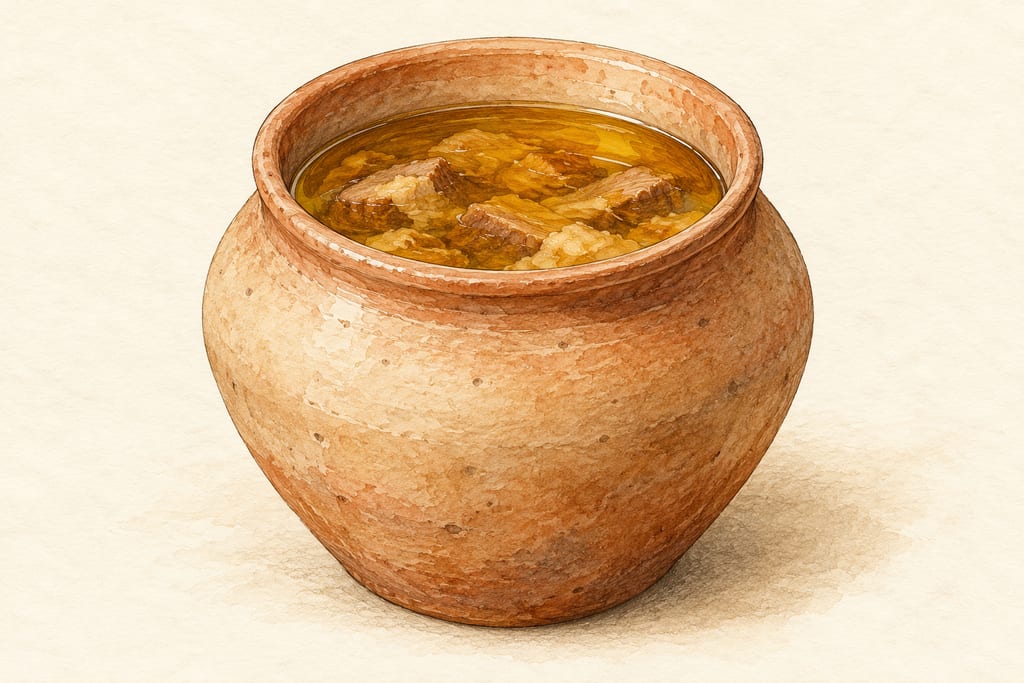
Ezir is the earthenware jar used to ripen and keep Khliaa ezir, a cooked meat preparation documented in northeastern Algeria. The word names the vessel as well as appearing in the product's name: the 2015 study describes meat placed in an earthenware jar called ezir after cooking. This makes the jar part of the preservation arrangement, rather than a cooking pot or a serving dish in the documented process.
The study is unusually specific about the vessel's job and unusually quiet about its appearance. It identifies earthenware, but does not show a named historical jar or report a standard profile, mouth, lid, handles, glaze, capacity or wall thickness. Ezir can therefore be described confidently as a material and use category, while its exact silhouette remains undocumented in the available study.
The field study reports households preparing Khliaa ezir in northeastern Algeria. Its documented process ends with cooked meat immersed in a mixture of olive oil and melted bovine fat and stored in the earthenware jar. For the equipment record, that sequence defines the ezir's role: it holds the prepared meat and covering fats during ripening and storage. The article does not attribute a particular curing effect to the pot's porosity, clay composition or surface finish, so none is assumed here.
In the study's experimental preparations, beef was cut into strips, treated with salt, caraway, coriander and garlic, and marinated before cooking in water. The report also mentions lamb, goat and camel as meats used depending on local livestock. Those are details of the associated food process, not requirements for the jar's shape or a list of ingredients that must be placed in every ezir. The equipment stays the same broad category—a locally used earthenware vessel—even though ingredients and household circumstances can vary.
The study does not describe a seal, stopper or lid. It is therefore not possible to say whether one was used in the households surveyed, or whether the fat layer alone was considered sufficient for covering the contents. The visible arrangement in this page's illustration is a clear interpretation of the described storage stage, not a documented photograph or proof of a universal container closure.
Earthenware across Algeria served everyday household purposes, but regional pottery is not one uniform style. Jean Couranjou's survey of eastern Algerian pottery discusses the Soummam valley, Petite Kabylie and the west of Constantine. It describes local variation in vessel profiles and shows amphorae from Djidjelli and nearby areas. The pictured objects establish that handmade earthenware forms in the broader Northeast can differ noticeably; they are not labeled as Khliaa ezir jars.
That distinction matters when reconstructing an object that a food study names without illustrating. The regional pottery photographs can inform a restrained sense of clay surface and local craft context, but cannot supply the missing measurements or prove that an ezir had the same handles, painted bands or profile as one amphora. This record leaves those details open. Its generated illustration is consequently labeled as an interpretive generic jar, while the linked outside photograph is captioned as a related regional pottery example rather than an image of the ezir itself.
The researchers measured the prepared food, not the storage vessel. Across three experimental beef preparations, they reported an average final moisture content of about 40.7 percent and a pH near 6.04. These figures describe the samples studied after preparation; they are not a performance specification for an ezir, a target readers should reproduce, or evidence that a new batch can be kept at room temperature. The authors themselves say further controlled research is needed to understand the product's biological mechanisms.
The same boundary applies to the paper's storage discussion. The study records a long ripening and keeping tradition and microbiological measurements from its own samples. A small experimental series does not validate a general process for safe storage across different meats, salt levels, preparation methods, jar finishes or ambient conditions. This page treats the study as evidence that the earthenware jar was used in a specific household food tradition, not as present-day storage guidance.
No measured dimensions or capacity for the ezir jar are available in the cited sources. Nor does the 2015 study identify the pottery maker, the clay source, how the jar was shaped or fired, or whether containers were reused. Those are useful questions for further material-culture research, but the available record cannot answer them.
The study's field survey took place in households still preparing Khliaa ezir in northeastern Algeria. That is evidence of practice in the region at the time of the research, not a precise origin story or a claim that all households used the same vessel. It supplies a relevant place for the ezir record at regional scale; the authors do not name a village, workshop or single source for the jars.
The cited paper appeared in 2015, but it does not establish when the term ezir first entered use. Its long-storage description and its reference to a traditional process are not enough to date the jar type. The equipment entry therefore has a modern documentary anchor and an unknown earliest attestation. A contextual pottery survey helps place the earthenware within the region's varied craft traditions, while leaving the individual Khliaa vessel's design unspecified.
Khliaa ezir in northeastern Algerian households is documented in 2015 as ripening in an earthenware jar called ezir. This establishes contemporary use only; it does not establish the vessel's origin, earliest attestation, or historical range.
The 2015 study names an earthenware jar but does not give a specimen photograph, dimensions, capacity, lid, finish or construction. The generated image is an explicitly interpretive generic jar, not a reconstruction of an identified historical artifact.
Source →The experimental study reports mean moisture and pH measurements for three beef preparations; these results do not establish the safety of other batches, ingredients, jars or storage conditions.
Source →A regional study documents varied Northeast Algerian pottery forms, but its pictured amphorae are not identified as ezir vessels. Their handles, decoration and proportions must not be projected onto Khliaa equipment.
Source →The primary study identifies the practice in northeastern Algeria but does not name a more precise locality for the ezir vessel.
A two-part steamer for couscous: a perforated upper chamber sits over a lower pot that produces steam. Clay, basketry and metal forms are documented in different places and periods.
A historical animal-skin container for Btana, described in southern Algerian accounts as clean sheepskin or old goatskin; sources distinguish it from later cloth and plastic bags.
A ceramic Ezzir jar holds salted butter during smen maturation in Algeria; a goatskin Chekoua is documented for churning the sour milk beforehand. Sources also report animal-skin containers, but do not establish a single shared form.
No community contributions have been published for this entry yet.
Sign in to contribute. Published comments and photos are free to read.
Boudechicha et al., 61st International Congress of Meat Science and Technology (2015)Design · Materials · Use · Geography · History · Limits
Khliaa Ezir, a traditional cured meat product of Algeria: preparation and characterizationThe field study describes northeastern Algerian households that still prepared Khliaa ezir and identifies the ripening/storage vessel as an earthenware jar called ezir.
It reports cooked meat immersed in a mixture of olive oil and melted bovine fat and stored in the jar; the source does not document the jar's geometry, glaze, closure, dimensions or capacity.
Its three experimental beef preparations had an average final moisture content of 40.7% and pH 6.04; these characterize the tested product and do not validate general storage claims or establish vessel performance.
Cited in: The earthenware vessel behind the name; A jar used after cooking; Regional pottery offers context, not an ezir blueprint; What the measurements say—and do not say; A regional practice documented in 2015
Jean Couranjou, l'Algérianiste no. 102 (June 2003), hosted by Alger-RoiDesign · Materials · Geography · Image context
La poterie modelée d'Afrique du Nord, dite poterie kabyle (cinquième partie): regional stylesA regional pottery survey describes varied forms across Petite Kabylie, the Soummam valley and the west of Constantine, including broad-bodied jars and amphorae; it stresses local differences and says exact provenance can be difficult.
The illustrated Djidjelli and Petite Kabylie vessels are regional pottery examples, not identified as ezir jars. They are used here only as material and regional context, not as evidence for the Khliaa vessel's exact shape.
Cited in: Regional pottery offers context, not an ezir blueprint; A regional practice documented in 2015