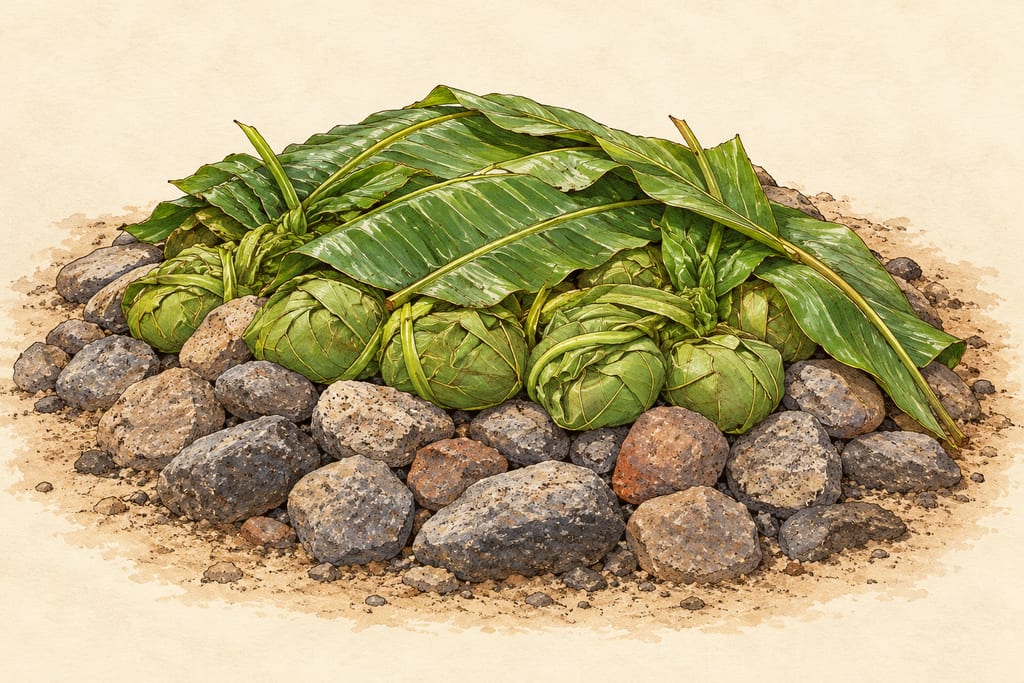
Above-ground stone oven
A fire-heated stone bed or mound holds food arranged on the stones and covered with leaves. The Samoan umu is one documented regional instance, not a universal blueprint.
 FermenteaWhere food goes to change
Built structures · above-ground-stone-ovens
The Samoan umu is an above-ground cooking build in which a fire heats volcanic stones, and foods cook on the surface beneath leaf coverings.
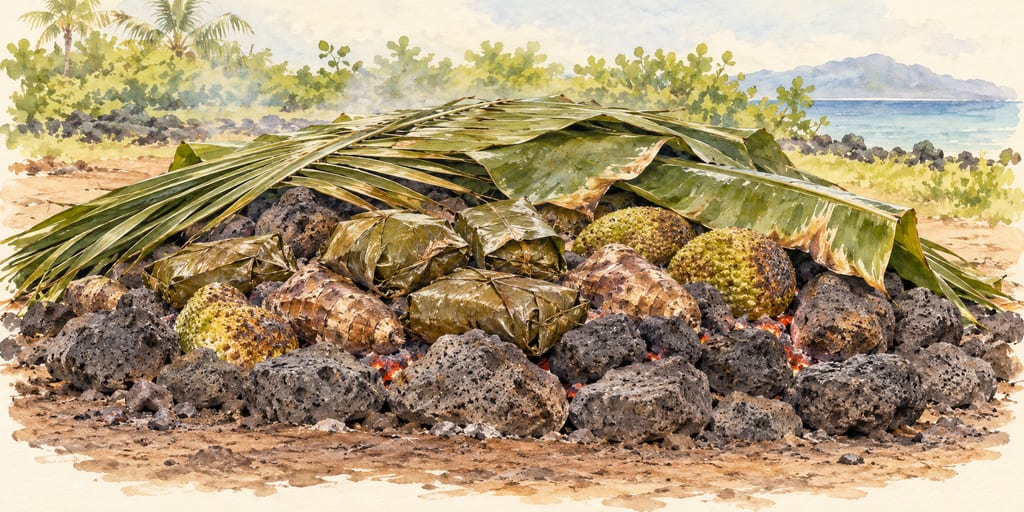
The Samoan household umu is commonly an above-ground oven built from hot volcanic stones. The cooking surface is assembled on the ground rather than necessarily dug into it. A fire heats the stones before food is arranged on top. The account here concerns Samoan practice and does not claim that every household uses one design or that Polynesian stone ovens share a single origin.
A photograph taken in Samoa in 2007 shows a pig on volcanic stones, with taro and breadfruit among the stones. Its caption also names lobster and palusami prepared for the same feast. This is a useful dated example of a meal in an umu, but the image does not define a universal mound shape or load.
Wood supplies the fire that heats the chosen stones. Once the stones are hot, foods are arranged on or among them. Banana leaves and coconut fronds can wrap individual foods; the tourism description also names half coconut shells as small containers. More banana leaves cover the upper surface and hold heat around the food. The result is an outdoor cooking mound rather than a manufactured appliance: its arrangement depends on stones, food and plant coverings at the site.
Foods cooked this way include fish and other seafood, pork, chicken, lamb, taro, bananas and other vegetables. Coconut cream is part of the food, not a structural material. One contemporary description gives about two hours as an indicative cooking period and says the oven is lifted and served while the food is hot. That is not a fixed build dimension or guaranteed timing for a different load.
Village use continues in present-day Samoa, including family meals and special occasions. This is evidence of current use, not a date for the oven's invention. The 2007 photograph also locates one example in Samoa, but it cannot establish how widely any single arrangement is used.
The Samoan umu and Tahiti's ahimā‘a share hot-stone cooking and plant coverings, yet their documented ground forms differ: the umu is commonly above ground, while the ahimā‘a is a dug pit. Keeping both entries linked as related methods preserves that distinction. Palusami is linked as a dish cooked in an umu; its taro leaves are food as well as a wrapper, not disposable packaging.
The tourism account documents an above-ground Samoan oven in contemporary use and describes its foods and coverings. A 2007 photograph captioned by its author documents pig, taro and breadfruit cooking on volcanic stones in Samoa. Neither source dates the origin of the practice.
A build is made where it stands: moving it means building it again.
The described build heats volcanic stones in a fire before they become the cooking surface.
Hazard sourceThe build traps heat under its covering; this account supplies no measured cooling or safe-opening procedure.
Hazard sourceThese sources are cultural and descriptive accounts, not construction or fire-safety specifications. They give no universal stone count, layout, dimensions, airflow arrangement, fuel load, structural load, temperature or stone-handling procedure.
The authority describes Samoa and village use generally; the photograph is a dated example from Samoa. This does not assert one fixed construction for every island or household.
A fire-heated stone bed or mound holds food arranged on the stones and covered with leaves. The Samoan umu is one documented regional instance, not a universal blueprint.
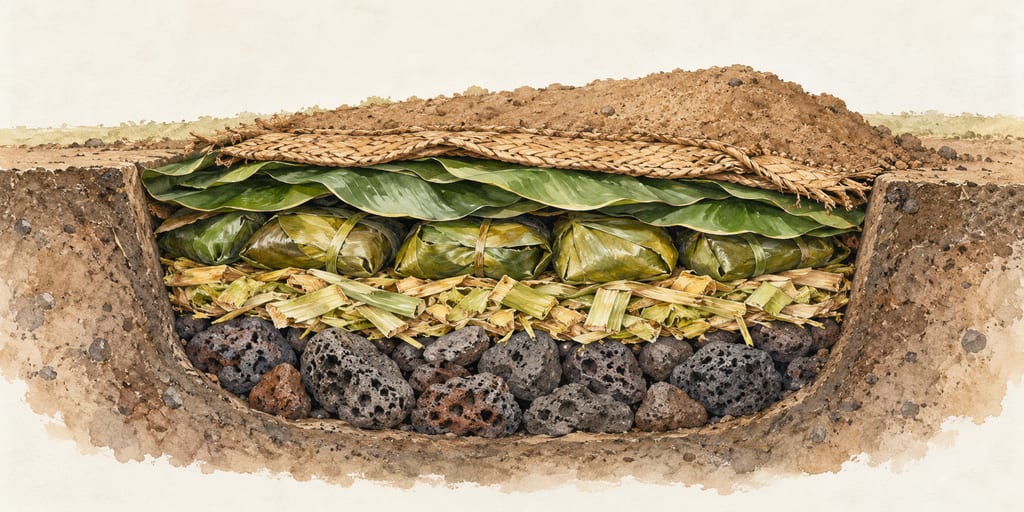
The Tahitian ahimā‘a is a ground oven built in a pit, where hot volcanic stones and layered leaves and earth cook food slowly.
No community contributions have been published for this entry yet.
Sign in to contribute. Published comments and photos are free to read.
Samoa Tourism AuthorityMethod · Materials · Geography · Present use
UmuThe tourism authority describes the household umu as above ground, built from hot volcanic stones.
It says stones are heated in a fire before foods are placed on top, wrapped in banana leaves or coconut fronds, or put into half coconut shells; banana leaves cover the oven.
It names fish and seafood, pork, chicken, lamb, taro, bananas and other vegetables as umu foods; about two hours is an indicative cooking period in the account.
The authority describes continued village use today; it does not establish an origin date.
Cited in: A Samoan surface oven; Building and using the umu; Local practice and regional distinctions
Wikimedia CommonsVisual reference · Materials · Historical attestation
File:Pig on the Samoan Umu.jpgNeil's caption describes pig cooking on volcanic or lava rocks, covered with banana leaves, with taro, breadfruit, lobster and palusami at the feast.
The photograph is dated 4 August 2007 and camera coordinates are recorded in Samoa.
The file is licensed CC BY 2.0; attribution and link are provided on the linked image.
Cited in: A Samoan surface oven; Local practice and regional distinctions